Home University of Edinburgh Library Essentials
April 4, 2026

New e-journal backfile purchases
We have purchased outright the archive content of the following e-journals. These are available in DiscoverEd. Click on the journal cover to access the title directly.
DeGruyter Platform – The Linguistic Review 
Palgrave Platform – British Politics

‘Scotland’s last martyr’ : remembering James Renwick
February was a suitable month to remember James Renwick (15 February 1662 – 17 February 1688). Renwick was a graduate of Edinburgh University who accepted a call to the ministry within the independent Presbyterian church ‘societies’. These communities were formed by the Covenanters, so named because they bound themselves in ‘covenants’ to maintain the Presbyterian doctrine as the sole form of religion in Scotland. They rejected the attempts of the Crown to control church government and patronage in Scotland.
Renwick’s short career included illegal field preaching, baptizing, and eluding capture by the authorities. His sermons and letter were published as tracts and pamphlets, some of which are preserved in New College Library’s Pamphlets Collection.
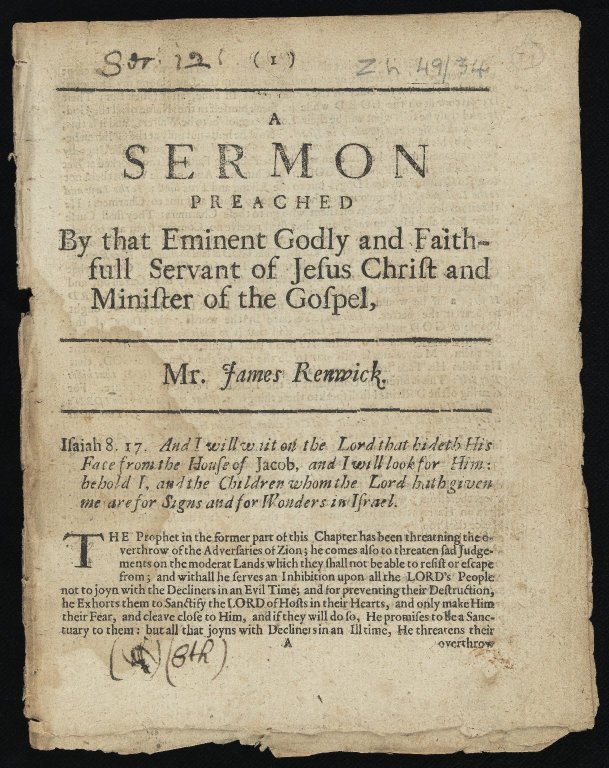
Renwick, James. A sermon. Glasgow? : s.n., 17? .Z.h.49/34
Renwick was arrested in the Cowgate, Edinburgh, on 1 February and hanged for treason in the Grassmarket on 17 February. New College Library holds this manuscript letter of testimony:
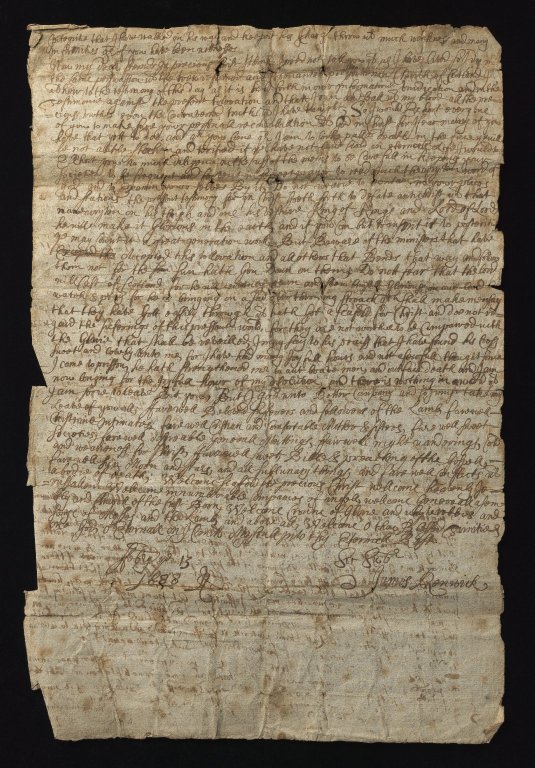
Renwick, James. Letter of testimony, Edinburgh, 13 February 1688. MS BOX 4.4.1
Written in prison days before his execution, he reasserts his Christian beliefs and bids a touching farewell :
“Farewell beloved sufferers and followers of the Lamb…farewell, night wanderings, cold and weariness for Christ…farewell, sun, moon, and stars, and all sublunary things…”
James Renwick’s Letter of testimony will be on display at the Centre for Research Collections, University of Edinburgh April-July 2016, as part of the ‘Given in Good Faith’ exhibition.
Christine Love-Rodgers, Academic Support Librarian – Divinity
Kirsty Stewart, New College Collections Curator
Information Exchange with Osaka University
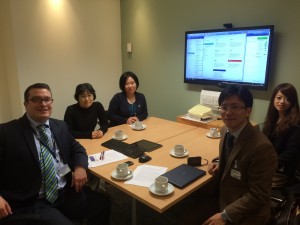
This morning the University of Edinburgh’s Scholarly Communications Team was delighted to receive a delegation of guests who have travelled all the way from Osaka University in Japan. Xin Yao and Tomoko Ohya are based in the University’s Support Office for Large-Scale Education and Research Projects. They were joined by Shotaro Hidaka who is Osaka University Library’s Serials & Electronic Resources Librarian, and Mami Yamamoto from the Finance Office.
The morning kicked off with an introduction from our Director of Library & University Collections, Jeremy Upton. After this, Head of Research & Learning Services Stuart Lewis talked through Edinburgh University’s activities in the Research Data Management arena, aided by a presentation in Japanese. Following this, we spent some time talking about Open Access to research publications and exchanging ideas about how to gain academic engagement with an institutional repository. It seems that many of the issues are the same in Japan as in the UK (expensive journal packages, lack of academic engagement with Open Access). As well as these main topics of discussion, we also spent time discussing funding streams for university libraries, roles & responsibilities of liaison librarians, library opening hours late-night service provision.
We certainly found this to be an interesting meeting with very stimulating discussion – and we hope to stay in touch about many of the items we discussed.

P.S. Many thanks our guests for the delicious Osaka University biscuits!!
Dominic Tate – Edinburgh University Library
Board Game Jam: Creating Openly-Licensed Board Games
At Innovative Learning Week this year we worked with students to develop board games using images from the CRC Flickr account as inspiration. Their challenge was to design a game which used at least three images from Open Educational Resource sites, one of which had to come from the CRC collection. The games also had to include at least three different game mechanics, be openly licensed and have a full set of rules.
Our groups created four fantastic and diverse games and we filmed them explaining their games. Read more below and view the full playlist at https://www.youtube.com/playlist?list=PLwJ2VKmefmxqqLjTK3kQrsASfefaVWz_K.
Apocalypse Later
Apocalypse Later is a card game in which players cooperate to overcome challenges ranging from volcano eruptions through to a zombie apocalypse, drawing and playing cards to gain advantages and advance in the game. One character is secretly a ‘mole’, whose sole purpose is to prevent the team from winning the game! The game features images from Anton Koberger’s German bible, the seal of Robert the Bruce and a decorated page from the Hours of the Blessed Virgin Mary from the CRC image collection.
Game rules: bit.ly/1TgeKbf
Cultured Ai (Arts for Ai)
In this art-themed board game, players take control of larvae hunting for works of art in various locations across the University. The larvae are highly cultured beings and need inspiration from art works in order to stay alive! Players draw cards representing different types of art (e.g. painting, sculpture) and have to decide whether to play them immediately for in-game bonuses / penalties or retain them for scoring at the end of the game. The player with the highest art value at the end is the winner. Cultured Ai (Arts for Ai) uses CRC plans of McEwan Hall, the Medical School and Glencoe Ballachulish for the game board.
Game Rules: Bit.ly/1mwFqGk
The Mouse Hunt
In The Mouse Hunt, players compete in two teams vying for domination of an 18th century Edinburgh tenement! On one side, a team of mice attempts to drive the human inhabitants mad by digging tunnels and making a lot of noise. On the other side, humans set traps and try to rid the house of the rodent infestation! The house in which the game is set was inspired by historical images of Edinburgh from the CRC collection.
Game Rules: Bit.ly/1ox6G9y
Mythical Continents
In Mythical Continents, players sail the seven seas fighting monsters and collecting relics hidden across the globe. Movement is governed by a wind dial (modelled on the Kalendar and Astronomical Tables from the CRC collection) and players complete to bring all treasures back to Nessie, drawing event and monster cards along the way!
Game Rules: bit.ly/20Zi3os
We had great fun designing board games and would be very keen to run the session again – please do get in touch if you’d be interested in being involved!
More information on finding, creating, and sharing your own Open Educational Resources can be found on the Open.Ed website.
Gavin Willshaw and Stephanie (Charlie) Farley
(Thanks also to Danielle Howarth for all the pictures and videos!)
Downtime Alert Wiley Online Library

Wiley Online Library will be unavailable on Saturday 27th February from 9am -2pm for essential maintenance. Wiley apologises for the inconvenience.
Service of James Roland Rider – in the Army Veterinary Corps (AVC)
ILLUSTRATING SOME OF THE UNIVERSITY MEDALS OF JAMES ROLAND RIDER
 James Roland Rider was the son of a veterinary surgeon. He was born in Beamish, near Durham, in N.E.England, on 13 November 1894. He was educated at St. Bees, Cumbria, and at Newcastle Royal Grammar School.
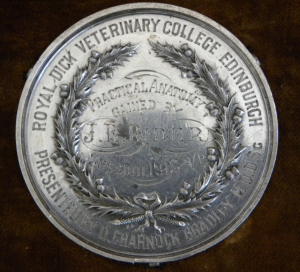
Reverse of silver medal, Session 1913-1914, Royal (Dick) Veterinary College, Edinburgh, Presented by O. Charnock Bradley M.D., D.Sc., Practical Anatomy, Gained by J.R.Rider
In 1912 he went to Edinburgh to study at the Royal (Dick) Veterinary College but in 1914 the outbreak of war interrupted his studies. Rider enlisted in the Scots Greys and he served at Gallipoli.
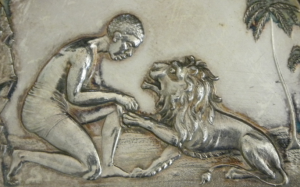
Detail from obverse, silver medal, Session 1913-1914, decorated with lion with raised paw being treated by kneeling figure, framed by palm trees and cliff

In 1916 he returned to the Dick Vet’, and the University medal-winning Rider graduated in 1917, becoming a Member of the Royal College of Veterinary Surgeons. He then re-enlisted, serving as a Captain in the Army Veterinary Corps (AVC).
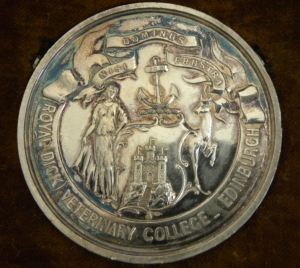
Obverse, silver medal, Obstetrics, Session 1917-18, Royal Dick Veterinary College, Edinburgh, decorated with armorial bearing of the City of Edinburgh and inscription NISI DOMINUS FRUSTRA
The AVC was responsible for the medical care of animals used by the army; predominantly horses, mules and pigeons. During the Great War, the Corps reorganised to provide a Mobile Veterinary Section as part of each Division that went overseas. A number of Base Veterinary Hospitals were established in the theatres of war. Most animals suffered from battle injuries, debility, exhaustion, mange and, for the first time, gas attacks.
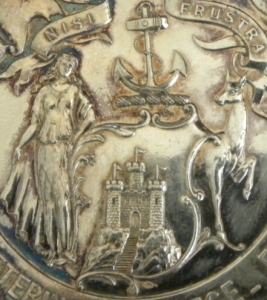
Detail from silver medal, Obstetrics, Session 1917-18
By 1918 almost half of the veterinary surgeons in Great Britain were serving in the AVC. As an Army veterinary surgeon, Rider served until the end of the War and was awarded a pair of medals – the British War medal, and the Victory medal.
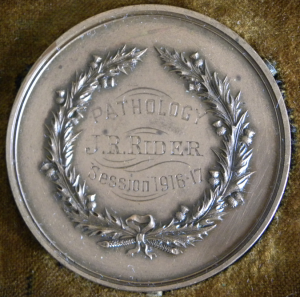
Reverse, bronze medal, decorated with thistle wreath surrounding the inscriptions – Pathology. J.R.Rider, Session 1916-17
On 27 November 1918 King George V conferred the Royal prefix to the Corps in recognition of the work of the AVC… or RAVC (Royal Army Veterinary Corps).
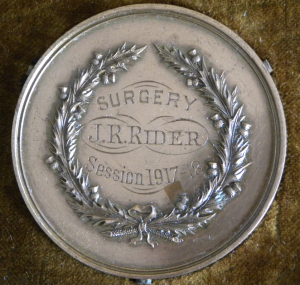
Reverse, bronze medal, decorated with thistle wreath surrounding the inscriptions – Surgery. J.R.Rider, Session 1917-18
From 1919 Rider was employed as a vet by Pease and Partners Ltd. owners of several mines in the coalfields of Durham and Teeside. In 1928 he declined the offer of a Lectureship at the Royal (Dick) Veterinary College, only to suffer a cut in working hours the following year due to the Depression which began in 1929. In 1930 however, Rider began his own private practice in Darlington.
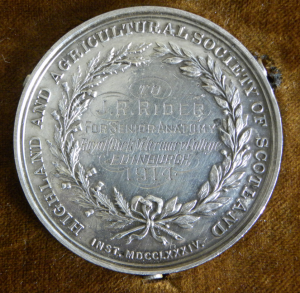
Reverse, silver medal, Highland and Agricultural Society of Scotland, To J.R.Rider, for Senior Anatomy, 1914, Royal (Dick) Veterinary College, Edinburgh, Inst. MDCCLXXXIV
In 1932 he published a paper on ‘Hypertrophy and diverticulae in the ileum in pit ponies’ for the Veterinary Record, British Veterinary Association.
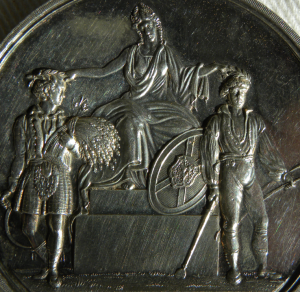
Detail, obverse, silver medal, Highland and Agricultural Society of Scotland, decorated with raised seated classical figure with Scottish armorial shield honouring figures representing agriculture and industry
James Roland Rider died of pulmonary tuberculosis in Urpeth, Durham, on 19 November 1942.

Dr. Graeme D. Eddie, Assistant Librarian Archives & Manuscripts, Centre for Research Collections

Some thoughts on the impact of Sci-Hub
Sci-Hub has been getting a lot of attention recently – for those of you not up to date there are some really good pieces written here:
What should we think about Sci-Hub?
Next moves in the Sci-Hub game
The last article raised some interesting points that prompted a reply from the Sci-Hub founder, who I think mistook critical thinking for criticism. If you would indulge me I’d like to spend 5 minutes thinking about the impact of Sci-Hub and what the longer term implications for scholarly communications are. I’m not particularly saying anything new, just crystallising a few thoughts that have been floating around.
What is the short term impact of Sci-Hub?
The impact is massive for anyone stuck outside of a subscription paywall. Immediate free access to articles that you would have had to pay ~$30 each. For these people it is a game changer. I don’t need to eulogise how important this is for enabling access.
For publishers, at a first glance it looks terrible. Their pirated content is being distributed for free. Shock! Horror! Quick unleash the legal dogs of war!
But take a closer look and the disruption enabled by Sci-Hub is not quite like the disruption that has occurred in other digital media (think Napster etc). This is because the customers who pay for content are mainly institutions and not individual customers, and they have very different behaviours. I would estimate that the long term financial impact of pirated material for academic journal publishers would be negligible at best, and at worst just a small dent in their 30%-40% profit margins.
Longer term effects.
If you step away from the warm rosy glow of immediate access, you’ll find that the change in scholarly communication is not as drastic as you first thought. On the whole, institutions will not drop all of their journal subscriptions because a website is offering free downloads of articles. Organisations, who in this case have the purse strings, do not think and behave like individuals.
Any reputable institution would not be able to tell their researchers that they have cancelled subs to the journals they read and that they have to find and use pirated content instead. Like them or not, we can trust publishers to make their content available 24/7 (well, most of the time) because we have service level agreements and other legally binding contracts. What is the longevity of Sci-Hub? I don’t know, but the Sci-Hub founder freely admits that the site runs on donations and it costs several thousand dollars per month to keep running. Unlike other scholarly communication nodes – for example arXiv* – there is no funding mechanism that organisations can use to pay Sci-Hub to keep running because it’s activities are illegal and that status is not going to change any time soon. As such, institutions cannot rely on Sci-Hub to provide access to it’s services 24/7 and will always stick with the publishers.
Sci-hub is a sticking plaster
It is worth repeating that the bottom line is that organisations will most definitely not stop paying subscriptions to journal publishers because of Sci-Hub. More knowledgeable people than me have pointed out that Sci-Hub is a symptom of the problem, or that it is palliative care which alleviates the immediate problem. Unfortunately, I don’t think Sci-Hub will be the main catalyst for wider change in scholarly communication that people want, or need, it to be. Subscriptions will still be paid, researchers will still publish in those pay-walled journals, we will still have restrictive licences, text-mining will still be difficult. Plus ça change. The problem is that authors and readers need better than this.
[*Other scholarly communication nodes have sustainable business models – for example arXiv raises ~$350,000 per year through membership fees generated by approximately 186 institutions.]
Violins, horns, diamonds and a crocodile: SCOConnects with MIMEd
Violins, horns, diamonds and a crocodile: SCO Connects with MIMEd
Reaching out and establishing ties to the community are important elements of the redevelopment of St Cecilia’s Hall. But how does a museum work with the community when the building is closed? By creating partnerships and taking our collections out into the community.
Recently MIMEd partnered with the Scottish Chamber Orchestra to provide quality performances and programming to audiences of all ages. SCO Connect, the creative learning team of the orchestra, worked with MIMEd Learning & Engagement Curator, Sarah Deters, to organise two Family Workshops which combined storytelling, live musical performance, and museum ‘show and tell’ for children aged 4-10 and their parents or care givers. The participants heard excerpts from The Crocodiamond, the story of Rita, a young girl who foils the theft of the largest diamond in the world. Providing the soundtrack for our storyteller were two musicians from the SCO playing violin, horn, and assorted percussion instruments.
Before and after the workshops participants had the opportunity to learn about, hear, and play items from the collections of MIMEd. Visitors young and old explored the sounds of serpents, horns, and even a Picco pipe (the smallest form of a duct flute).
The workshops were a great way to combine fun, learning, performance and MIMEd looks forward to future collaborations with the SCO and their creative learning team.


New MOOC! Research Data Management and Sharing
[Guest post from Dr. Helen Tibbo, University of North Carolina-Chapel Hill]
The School of Information and Library Science and the Odum Institute at the University of North Carolina-Chapel Hill and EDINA at the University of Edinburgh are pleased to announce the forthcoming Coursera MOOC (Massive Open Online Course), Research Data Management and Sharing.
 This is a collaboration of the UNC-CH CRADLE team (Curating Research Assets and Data Using Lifecycle Education) and MANTRA. CRADLE has been funded in part by the Institute of Museum and Library Services to develop training for both researchers and library professionals. MANTRA was designed as a prime resource for postgraduate training in research data management skills and is used by learners worldwide.
The MOOC uses the Coursera on-demand format to provide short, video-based lessons and assessments across a five-week period, but learners can proceed at their own pace. Although no formal credit is assigned for the MOOC, Statements of Accomplishment will be available to any learner who completes a course for a small fee.
The Research Data Management and Sharing MOOC will launch 1st March, 2016, and enrolment is open now. Subjects covered in the 5-week course follow the stages of any research project. They are:
- Understanding Research Data
- Data Management Planning
- Working with Data
- Sharing Data
- Archiving Data
Dr. Helen Tibbo from the School of Information and Library Science (SILS) at the University of North Carolina at Chapel Hill delivers four of the five sets of lessons, and Sarah Jones, Digital Curation Centre, delivers the University of Edinburgh-developed content in Week 3 (Working with Data). Quizzes and supplementary videos add to the learning experience, and assignments are peer reviewed by fellow learners, with questions and answers handled by peers and team teachers in the forum.
Staff from both organizations will monitor the learning forums and the peer-reviewed assignments to make sure learners are on the right track, and to watch for adjustments needed in course content.
The course is open to enrolment now, and will ‘go live’ on 1st March.
https://www.coursera.org/learn/research-data-management-and-sharing
Hashtag: #RDMSmooc
A preview of one of the supplementary videos is now available on Youtube:
www.youtube.com/watch?v=yhVqImna7cU
Please join us in this data adventure.
-Helen
Dr. Helen R. Tibbo, Alumni Distinguished Professor
President, 2010-2011 & Fellow, Society of American Archivists
School of Information and Library Science
201 Manning Hall, CB#3360
University of North Carolina at Chapel Hill
Chapel Hill, NC 27599-3360
Tel: 919-962-8063
Fax: 919-962-8071
tibbo@ils.unc.edu
Where there is tea, there is hope
Everyone uses different things to relax. For around two hundred years, a popular way to take a break has been to have a cup of tea. In fact, this website suggests that people in Britain drink about 165 million cups of tea a day!
Today we were contributing to that staggering number by handing out teabags to students. We had a variety of relaxing blends to choose from:

While hot drinks and books definitely don’t mix, we hope that our Takeaway Teabags reminded students to take a break and let them know that their library cares about them! Maybe they could enjoy the rare winter sunshine today by having a little tea party, like the McKendricks are doing in this image from our collections:

Tea Party with McKendricks, http://images.is.ed.ac.uk/luna/servlet/s/wl6b77 © The University of Edinburgh,
We will be popping up in the Main Library Foyer with another popular relaxation activity next week, so if you don’t like tea (or you just like bubble wrap!), keep an eye on our Facebook and Twitter!
Collections
 Hill and Adamson Collection: an insight into Edinburgh’s past
My name is Phoebe Kirkland, I am an MSc East Asian Studies student, and for...
Cataloguing the private papers of Archibald Hunter Campbell: A Journey Through Correspondence
My name is Pauline Vincent, I am a student in my last year of a...
Hill and Adamson Collection: an insight into Edinburgh’s past
My name is Phoebe Kirkland, I am an MSc East Asian Studies student, and for...
Cataloguing the private papers of Archibald Hunter Campbell: A Journey Through Correspondence
My name is Pauline Vincent, I am a student in my last year of a...

Projects
Cataloguing the private papers of Archibald Hunter Campbell: A Journey Through Correspondence
My name is Pauline Vincent, I am a student in my last year of a...
Archival Provenance Research Project: Lishan’s Experience
Presentation My name is Lishan Zou, I am a fourth year History and Politics student....