Home University of Edinburgh Library Essentials
December 16, 2025
Making the Invisible Visible – Repairs on Iron Gall Ink
Last Friday, I attended a one-day training workshop on iron gall ink repairs. The session was organised by the Collections Care Team at the National Library of Scotland and hosted by Eliza Jacobi and Claire Phan Tan Luu (Freelance Conservators from the Netherlands and experts in this field. Please see www.practice-in-conservation.com for further information).
Iron gall ink was the standard writing and drawing ink in Europe from the 5th century to the 19th century, and was still used in the 20th century. However, iron gall ink is unstable and can corrode over time, resulting in a weakening of the paper sheet and the formation of cracks and holes. This leads to a loss of legibility, material and physical integrity.
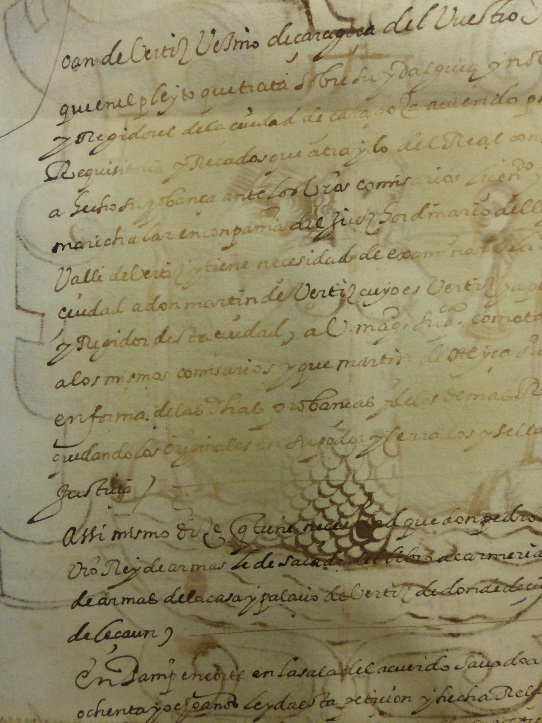
Document in the Laing collection showing early stages of iron gall ink corrosion.
Unsafe handling can exacerbate this problem. Bending and flexing a paper with iron gall ink can cause mechanical stress and result in cracking of the ink and tearing of the sheet. If this has happened, the area needs to be stabilised with a repair to ensure that further tearing doesn’t occur and additional material isn’t lost.
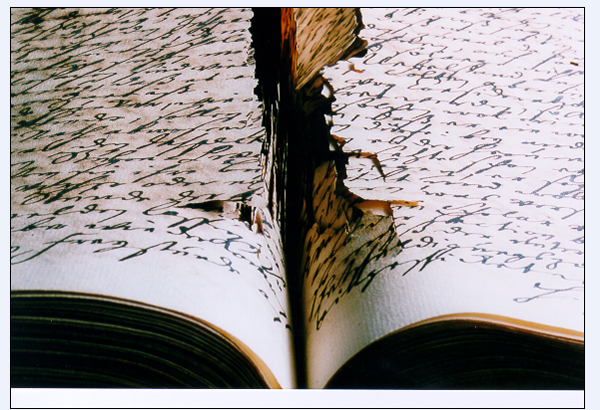
Courtesy of Wikimedia Commons. Books with corroded iron gall ink causing the paper sheet to break.
Paper conservators usually carry out tear repairs with water-based adhesives such as wheat starch paste and Japanese paper. However, this can be harmful for paper with iron gall ink inscriptions. Iron gall ink contains highly water-soluble iron (II) ions. These are invisible, but in contact with water they catalyse the chemical reactions that cause paper to decay. If these ions are not removed before treatment, any introduction of water can cause significant damage to the item. If a tear over an iron gall ink inscription is repaired using an aqueous adhesive, these invisible components will migrate out of the ink into the paper in the surrounding area, and speed up degradation in this location. Since this is not immediately visible, it can take approximately 25 years before the damage is noticeable.
Conservators have only recently become aware of this problem, and have had to develop a method of creating a very dry repair, and a way to test it before application. This is what we were shown during the workshop. First, we created remoistenable tissues for a repair paper using gelatine, rather than the traditional wheat starch paste. Gelatine is used because it has been found to have a positive effect on iron gall ink. It has been suggested that gelatine may inhibit iron gall ink corrosion, however, this has not been proved by empirical research.
To make the remoistenable tissue, we applied a 3% liquid gelatine solution to a sheet of polyester through a mesh. The mesh ensures that an even layer of gelatine is applied to the sheet. Japanese paper is then laid onto this sheet and left to dry. We created three sheets using different weights of Japanese paper, for use on different types of objects.
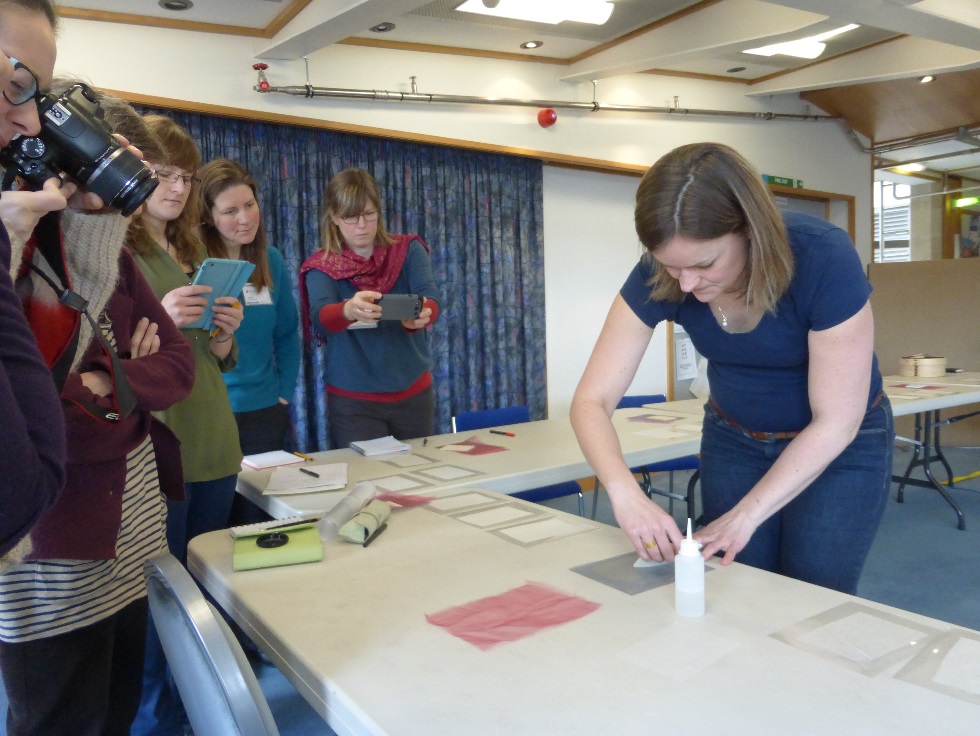
Eliza creating a remoistenable tissue.
When this was dry we had to remoisten the tissue so that it could be used to fix tears over iron gall ink. We were given a personalised mock-up item to practise this on. To remoisten the tissue, we used a sponge covered with filter paper to ensure that only a minimal amount of water is absorbed. You need just enough to make the gelatine tacky, but not so much that the water will spread away from the repair. Two sheets of filter paper are placed over a thin sponge and just enough water is added to saturate it. A small piece of remoistenable tissue is cut from the pre-prepared sheet, and placed, adhesive side down, on to the paper for a few seconds. This is then lifted using a pair of tweezers and applied to a test piece of paper that has been impregnated with bathophenanthroline and stamped with iron gall ink.
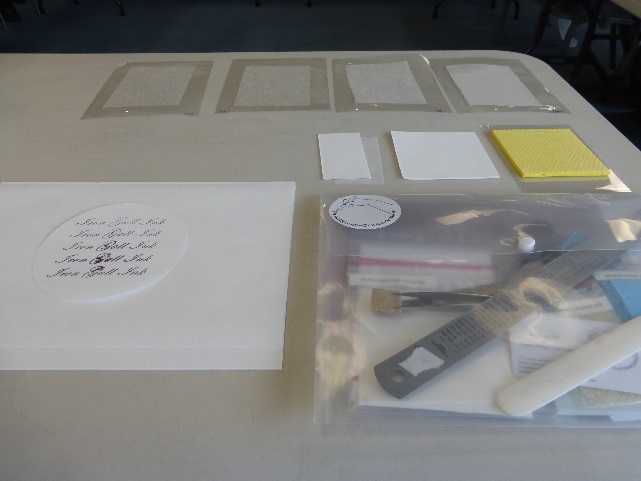
Workstation with four sheets of remoistenable tissue, sponge, filter paper and indicator paper.
Bathophenanthroline has no colour, but in the presence of iron (II) ions, it turns an intense magenta colour. As such, this sheet can be used as an indicator for the soluble iron (II) ions that can cause paper to degrade. If little or no magenta colour shows after application of the remoistenable tissue, this suggests that the repair paper has the correct moisture level and this method can be used on the real object. We used this indicator paper to try out a range of adhesives, to see what effect they had on the iron gall ink.
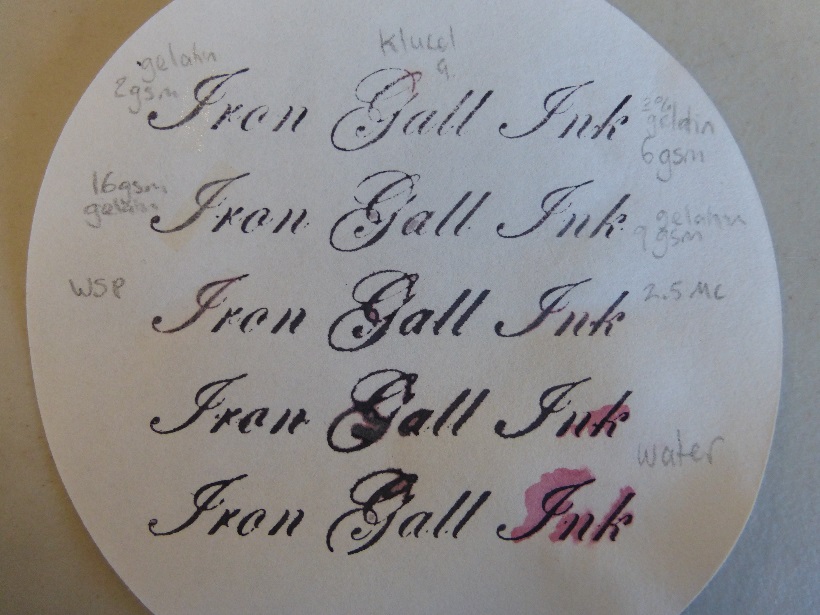
Bathophenanthroline Indicator Paper.
As you can see from the above image, the gelatine remoistenable tissue resulted in limited movement of iron (II) ions, whereas the wheat starch paste (WSP), methylcellulose (MC) and water applied directly to the paper has caused further movement. I thought that this was an excellent method of testing the repair technique, as it rendered the invisible movement of iron (II) ions visible. This means that a Conservator can be sure that the tear repair isn’t causing additional damage to the document.
Overall, the workshop was very informative and useful. A large number of documents at the CRC contain iron gall ink, so I’m sure I will put this new learning into practice very soon!
Check out this website for more information on iron gall ink: http://irongallink.org/igi_index.html
Emily Hick
Project Conservator
Women’s voices at New College Library
After my last blog post which focused on the women who gave their books to support the foundation of New College Library, I’ve been thinking about some of the collections we have which feature works written by women. Read More
Women and fiction
“Women and fiction remain, so far as I am concerned, unsolved problems.”
– Virginia Woolf, A Room of One’s Own
To celebrate International Women’s Day 2016, and to remind students that the Library has more than just textbooks, we compiled a list of some books written by women in the Main Library:
- Louisa May Alcott, Little Women, PS1017.L5 Alc.
- Margaret Atwood, The Handmaid’s Tale, PR9199.3.A8 Atw.
- Jane Austen, Pride and Prejudice, PR4034.P7 Aus.
- Charlotte Brontë, Jane Eyre, PR4167 Bro.
- Emily Brontë, Wuthering Heights, PR4172.W7 Bro.
- Agatha Christie, The Murder of Roger Ackroyd, PR6005.H66 Chr.
- Louise Erdrich, The Round House, PS3555.R42 Erd.
- Helen Fielding, Bridget Jones’s Diary, PR6056.I4588 Fie.
- Sue Monk Kidd, The Secret Life of Bees, PS3611.I44 Kid.
- Harper Lee, To Kill a Mockingbird, PS3562.E353 Lee.
- Audrey Niffenegger, The Time Traveler’s Wife, PS3564.I362 Nif.
- Sylvia Plath, The Bell Jar, PS3566.L27 Pla.
- Anne Rice, Interview with the Vampire, PS3568.I265 Ric.
- Mary Shelley, Frankenstein, PR5397.F7 She.
- Kathryn Stockett, The Help, PS3619.T636 Sto.
- Alice Walker, The Colour Purple, PS3573.A425 Wal.
- Virginia Woolf, A Room of One’s Own, PR6045.O72 Woo.
Today we were in the Foyer of the Main Library asking students to vote on their favourite one! It was a close race, but in the end the winner was Charlotte Brontë’s Jane Eyre! Other popular titles were Pride and Prejudice and Frankenstein!

Let us know on Facebook or Twitter (#happylibrary) if you have comments on the winners or suggestions of other titles! And why not borrow one of these books this week! Remember, it only takes six minutes of quiet reading to relax you.
We will leave you this week with another image from our collections, this time of Scottish writer Joanna Baillie, who was greatly admired by Sir Walter Scott for her poems and plays:
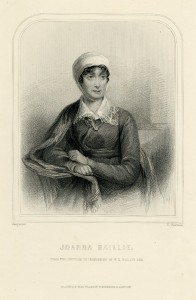
Steel engraved portrait of Joanna Baillie by H. Robinson after a painting by Masquerier. 1876-1877. Corson P.2021. Image can be accessed here.
Happy International Women’s Day!
ORCID is turning into the Yellow Pages
As pointed out to me a number of times the use of ORCID.org IDs is rapidly growing:
Oct 16, 2012: 0
Nov 21, 2014: 1,011,557
March 4, 2016: 2,014,645
(stats via Martin Fenner @mfenner)
Which I don’t need to point out is a good thing. But…..

After a tip off by @generalising (Andrew Gray) on Twitter – I don’t believe all this growth reflects actual bona fide researchers. Want some proof? Try searching for ‘laywers’ and you’ll see that there are a LOT of spam accounts:
https://orcid.org/orcid-search/quick-search/?searchQuery=lawyers

Each of the spam accounts looks to be a real business with URLs – something strange is definitely going on. It’s not just lawyers, but Taxi firms, Pizza restaurants, Plumbers. Try it for yourself. Dry cleaning? Sure ORCID has it covered: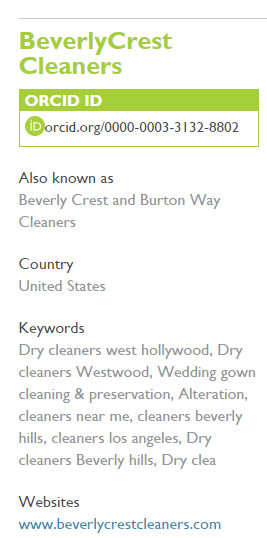 ORCID is turning into the Yellow Pages.
If I didn’t know any better then I’d say that ORCID is being used as a link farm for Search Engine Optimisation. Which is not really a good reflection on ORCID.org at all. I’ve pointed out a dozen spam accounts to support@orcid.org, but other than remove these specific accounts they don’t seem to be tackling the underlying problem. I’ve not looked at how prolific the problem is, but just a visual inspection shows that it is very widespread. So how many of those 2 million IDs are genuine? I really don’t know, and unless ORCID care to comment we’ll never find out.
If I was ORCID.org I’d be a bit more bothered about being used like this and made to look unprofessional, but to borrow a brilliant Polish phrase – ‘Not my Circus, Not my Monkeys’.
Trial access to Academic Video Online

We have trial access to Academic Video Online (via Alexander Street Press) until 30th April. Please complete a trial feedback form if you would like the library to subscribe to any of the subject collections.
Academic Video Online is a multidisciplinary collection of videos that touches on the curriculum needs of virtually every department. It delivers more than 48,000 video titles spanning essential subject areas including anthropology, business, counselling, history, music, film, and more. More than half of the titles can be found only at Alexander Street. With 400 new titles added per month, this collection is unmatched in its breadth. Academic Video Online allows students and researchers alike to analyse unique and valuable content from over 500 producers and distributors around the world.
In addition to the breadth and depth of content, Academic Video Online offers a wide range of platform tools for learning, research, and teaching, including:
- Learning segments. More than 14,000 learning segments make it easy for instructors to find and integrate specific video content into the classroom and help users get to the right content faster. Each segment is fully searchable and includes an abstract, making user selection even easier.
- Transcripts. Users view searchable, scrolling transcripts alongside more than 95% of titles.
- Clipping functionality. Users can easily create, annotate, and share video clips and playlists, and can embed them in third-party sites.
- Permanent URLs. All videos, clips, and playlists can be cited at permanent URLs, making integration with any learning management system easy.
- HD-quality player. A video player with a 16:9 aspect ratio that streams up to 2.5 mbps allows for optimized high-definition viewing.
- Comprehensive permissions. Our platform enables in-class, on-campus, and remote viewing.

Academic Video Online – streamed video, all disciplines – http://search.alexanderstreet.com/avon
Playlists – all disciplines – http://search.alexanderstreet.com/playlists – register to make your own
DISCIPLINE URLs
Art & Design – Art & Architecture, Fashion Studies – http://search.alexanderstreet.com/art-design
Diversity – Asian Studies, Black Studies, LGBT, Women’s Studies – http://search.alexanderstreet.com/diversity
Health Sciences – Counselling and Therapy, Health Policy, Medical Imaging, Nursing, Rehabilitation, Sports Science, Veterinary Science – http://search.alexanderstreet.com/health-sciences
History – World History, Women’s History, American History – http://search.alexanderstreet.com/history
Literature & Language – Drama, Film, Language, Literature – http://search.alexanderstreet.com/literature-language
Music & Performing Arts – Classical Music, Dance, Film, Jazz, American Song, Popular Music, Theatre, World Music – http://search.alexanderstreet.com/music-performing-arts
Personal Interest – Cooking, How-to, Travel – http://search.alexanderstreet.com/personal-interest
Psychology and Counselling – http://search.alexanderstreet.com/psychology-counseling
Science & Engineering – http://search.alexanderstreet.com/science-engineering
Social Sciences – Anthropology, Business & Economics, Criminal Justice, Education, Environment, Food, Human Rights, Media Studies, Politics, Psychology, Religion, Social Theory – http://search.alexanderstreet.com/social-sciences
Academic Video Online can also be accessed via DiscoverEd and the E-Resources Trial Webpage
New – PPLS Librarian blog!
The PPLS Librarian Blog
This is the inaugural post to the new PPLS Librarian blog, one of a range of blogs – both general and service specific – from Edinburgh University Library. It is the first of what I intend will be a fairly regular but not, I hope, overwhelming stream of communications about Library services. Read More
The women behind New College Library
If you visit New College Library today, International Women’s Day, women might seem hard to find amongst the portraits and busts of Thomas Chalmers and John Knox, and the shelves filled with works by or about male authors. Nevertheless, women have left their mark on New College Library from its earliest foundation. Read More
Publishing Data Workflows
[Guest post from Angus Whyte, Digital Curation Centre]
In the first week of March the 7th Plenary session of the Research Data Alliance got underway in Tokyo. Plenary sessions are the fulcrum of RDA activity, when its many Working Groups and Interest Groups try to get as much leverage as they can out of the previous 6 months of voluntary activity, which is usually coordinated through crackly conference calls.
The Digital Curation Centre (DCC) and others in Edinburgh contribute to a few of these groups, one being the Working Group (WG) on Publishing Data Workflows. Like all such groups it has a fixed time span and agreed deliverables. This WG completes its run at the Tokyo plenary, so there’s no better time to reflect on why DCC has been involved in it, how we’ve worked with others in Edinburgh and what outcomes it’s had.
DCC takes an active part in groups where we see a direct mutual benefit, for example by finding content for our guidance publications. In this case we have a How-to guide planned on ‘workflows for data preservation and publication’. The Publishing Data Workflows WG has taken some initial steps towards a reference model for data publishing, so it has been a great opportunity to track the emerging consensus on best practice, not to mention examples we can use.
One of those examples was close to hand, and DataShare’s workflow and checklist for deposit is identified in the report alongside workflows from other participating repositories and data centres. That report is now available on Zenodo. [1]
In our mini-case studies, the WG found no hard and fast boundaries between ‘data publishing’ and what any repository does when making data publicly accessible. It’s rather a question of how much additional linking and contextualisation is in place to increase data visibility, assure the data quality, and facilitate its reuse. Here’s the working definition we settled on in that report:
Research data publishing is the release of research data, associated metadata, accompanying documentation, and software code (in cases where the raw data have been processed or manipulated) for re-use and analysis in such a manner that they can be discovered on the Web and referred to in a unique and persistent way.
The ‘key components’ of data publishing are illustrated in this diagram produced by Claire C. Austin.
![Data publishing components. Source: Claire C. Austin et al [1]](https://libraryblogs.is.ed.ac.uk/datablog/wp-content/uploads/2016/03/Data_publishing_components_Claire_C_Austin.png)
Data publishing components. Source: Claire C. Austin et al [1]
The WG recently began some follow-up work to our report that looks ‘upstream’ to consider how the intent to publish data is changing research workflows. Links to third-party systems can also be relevant in these upstream workflows. It has long been an ambition of RDM to capture as much as possible of the metadata and context, as early and as easily as possible. That has been referred to variously as ‘sheer curation’ [2], and ‘publication at source [3]). So we gathered further examples, aiming to illustrate some of the ways that repositories are connecting with these upstream workflows.
Electronic lab notebooks (ELN) can offer one route towards fly-on-the-wall recording of the research process, so the collaboration between Research Space and University of Edinburgh is very relevant to the WG. As noted previously on these pages [4] ,[5], the RSpace ELN has been integrated with DataShare so researchers can deposit directly into it. So we appreciated the contribution Rory Macneil (Research Space) and Pauline Ward (UoE Data Library) made to describe that workflow, one of around half a dozen gathered at the end of the year.
The examples the WG collected each show how one or more of the recommendations in our report can be implemented. There are 5 of these short and to the point recommendations:
- Start small, building modular, open source and shareable components
- Implement core components of the reference model according to the needs of the stakeholder
- Follow standards that facilitate interoperability and permit extensions
- Facilitate data citation, e.g. through use of digital object PIDs, data/article linkages, researcher PIDs
- Document roles, workflows and services
The RSpace-DataShare integration example illustrates how institutions can follow these recommendations by collaborating with partners. RSpace is not open source, but the collaboration does use open standards that facilitate interoperability, namely METS and SWORD, to package up lab books and deposit them for open data sharing. DataShare facilitates data citation, and the workflows for depositing from RSpace are documented, based on DataShare’s existing checklist for depositors. The workflow integrating RSpace with DataShare is shown below:

RSpace-DataShare Workflows
For me one of the most interesting things about this example was learning about the delegation of trust to research groups that can result. If the DataShare curation team can identify an expert user who is planning a large number of data deposits over a period of time, and train them to apply DataShare’s curation standards themselves they would be given administrative rights over the relevant Collection in the database, and the curation step would be entrusted to them for the relevant Collection.
As more researchers take up the challenges of data sharing and reuse, institutional data repositories will need to make depositing as straightforward as they can. Delegating responsibilities and the tools to fulfil them has to be the way to go.
[1] Austin, C et al.. (2015). Key components of data publishing: Using current best practices to develop a reference model for data publishing. Available at: http://dx.doi.org/10.5281/zenodo.34542
[2] ‘Sheer Curation’ Wikipedia entry. Available at: https://en.wikipedia.org/wiki/Digital_curation#.22Sheer_curation.22
[3] Frey, J. et al (2015) Collection, Curation, Citation at Source: Publication@Source 10 Years On. International Journal of Digital Curation. 2015, Vol. 10, No. 2, pp. 1-11
http://doi:10.2218/ijdc.v10i2.377
[4] Macneil, R. (2014) Using an Electronic Lab Notebook to Deposit Data https://libraryblogs.is.ed.ac.uk/2014/04/15/using-an-electronic-lab-notebook-to-deposit-data/
[5] Macdonald, S. and Macneil, R. Service Integration to Enhance Research Data Management: RSpace Electronic Laboratory Notebook Case Study International Journal of Digital Curation 2015, Vol. 10, No. 1, pp. 163-172. http://doi:10.2218/ijdc.v10i1.354
Angus Whyte is a Senior Institutional Support Officer at the Digital Curation Centre.
Digitisation: Eduardo Paolozzi Mosaics
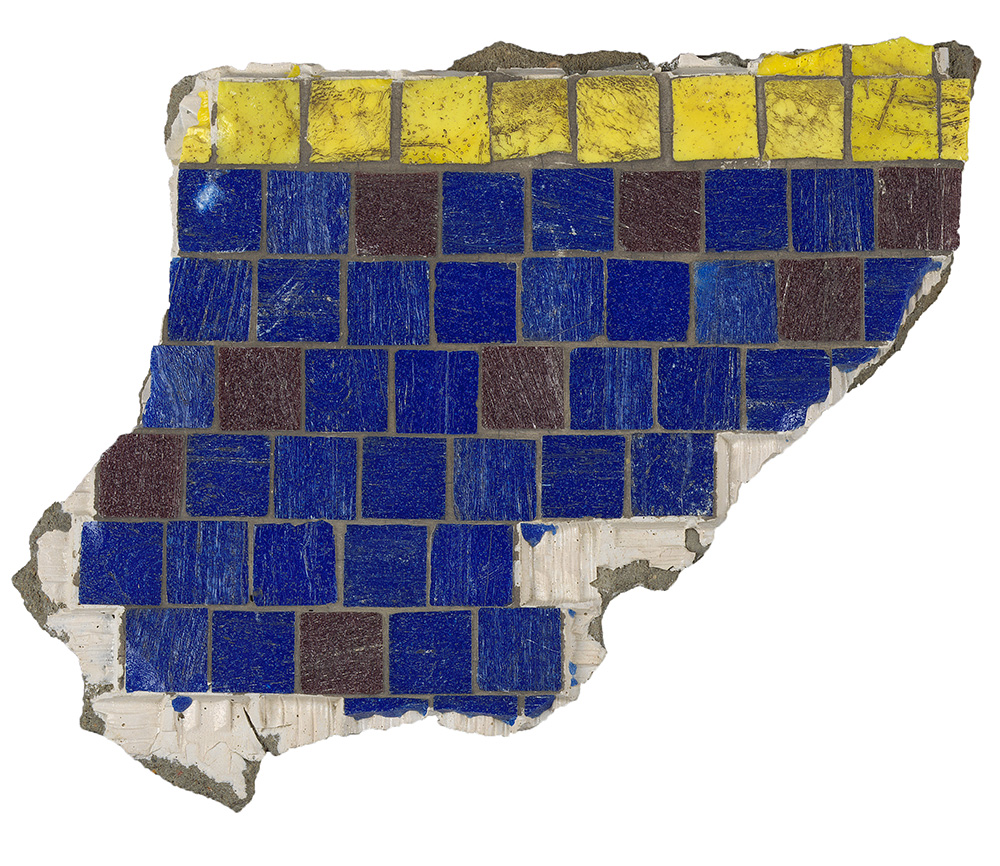
I have spent the past 6 weeks digitising mosaic fragments here in the DIU. Recently removed from Tottenham Court Road Tube Station, London, these mosaics were once part of a mural by the Scottish artist Eduardo Paolozzi that was first installed in 1984. The mosaics, now part of the University of Edinburgh Art Collection, make up about 5% of all the Tottenham Court Road murals by the artist, with the mosaics I am working on coming from the station archways more specifically. In an article for the Guardian Newspaper, London Underground’s design and heritage manager, Mike Ashworth, called this “one of the UK’s largest art conservation projects of the last decade” so I am very pleased to be involved.
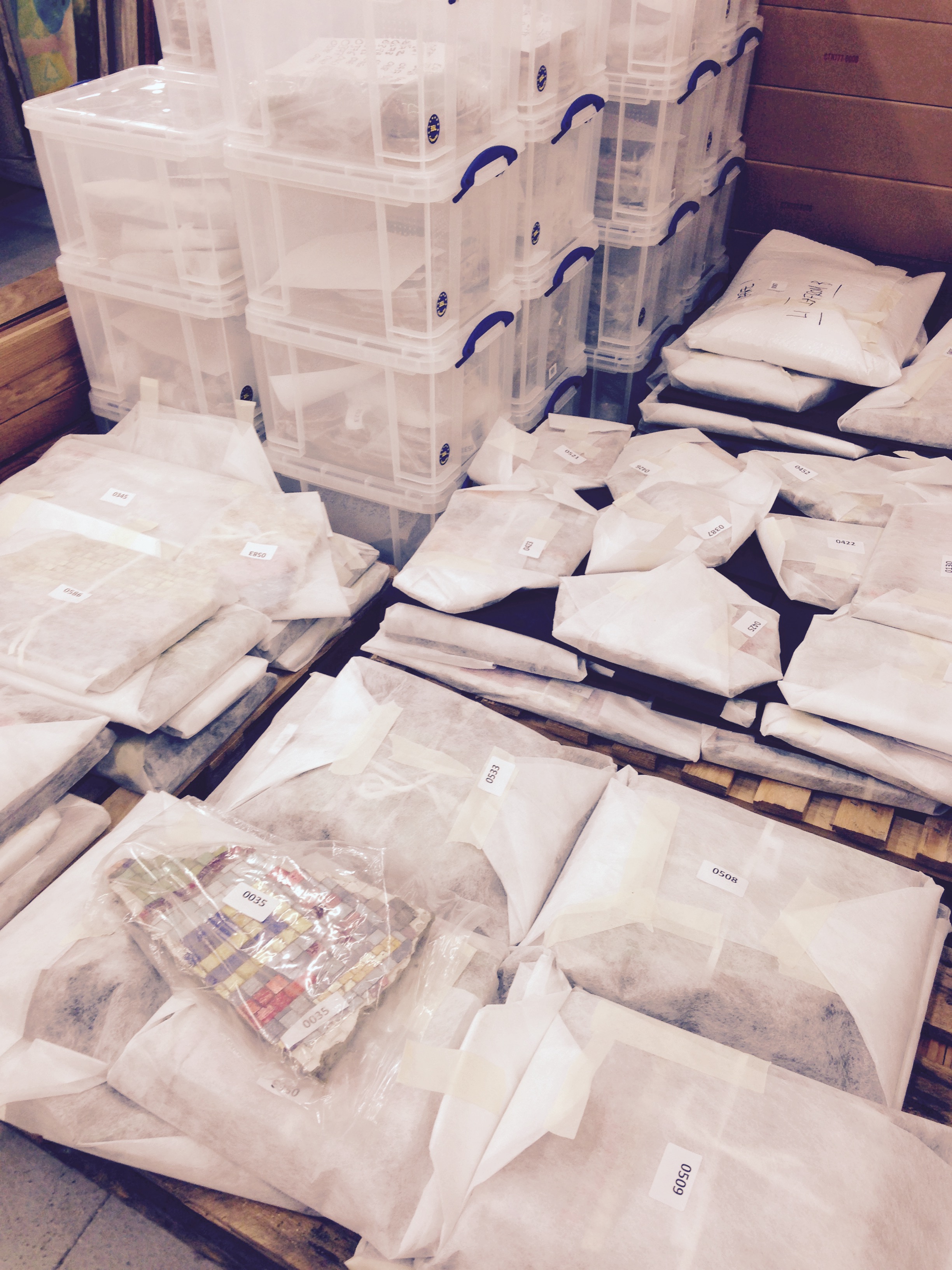
There are approximately 600 fragments of various shapes, sizes and colours spread over 42 boxes and 4 pallets. Unfortunately, the mural was not removed with conservation in mind so it is not exactly in great condition. It will be challenging to piece it all back together, first digitally and then physically. The long-term plan is to reconstruct the mural and install it within the university campus therefore giving it new life. So watch this space…!
I have been tasked with digitising each fragment. On completion, the aim is then to use the images in conjunction with image recognition software and an image of the original design, to digitally re-assemble the mural. This should provide a new digital image of the mural which will assist with the proposed physical reconstruction. The process will inform us whether areas of the mural are missing, and would need to be remade in some form.
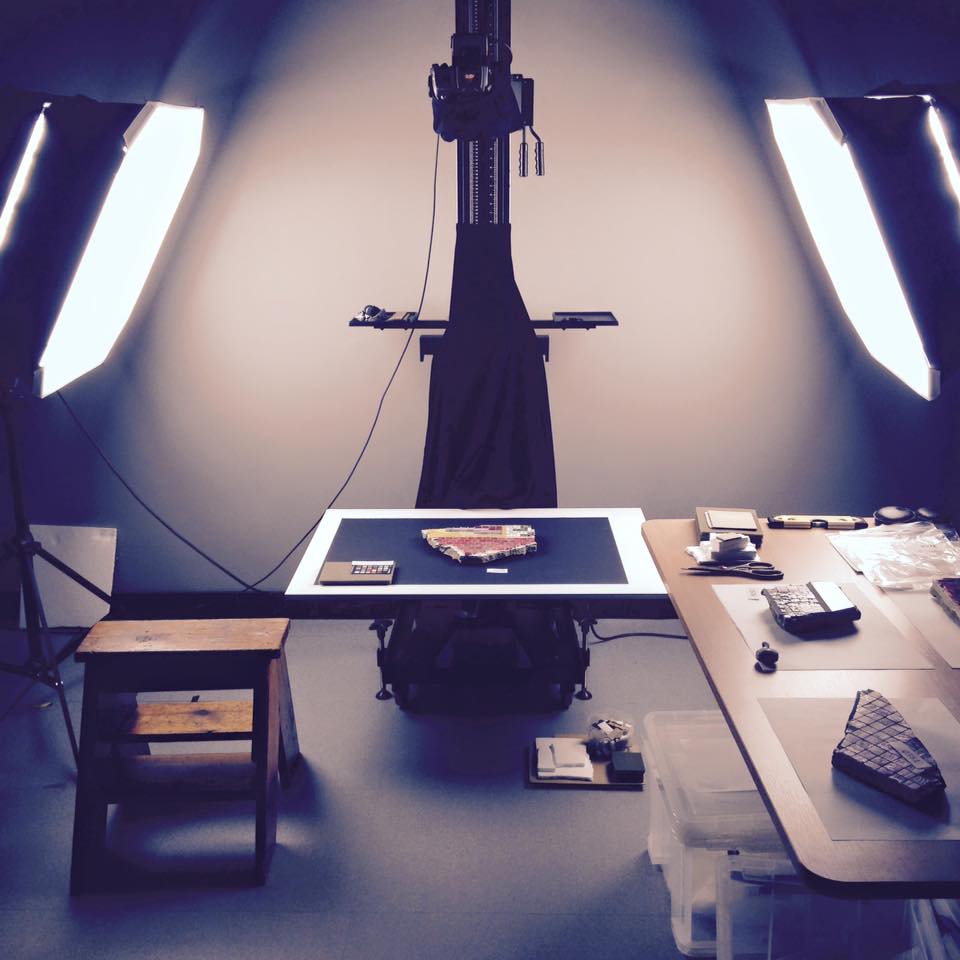
On a technical level, I have been using a high-spec digital Hasselblad-H4 camera and professional, Bowens studio lights in my digitisation process. To begin with, I capture several mosaic fragments in one shot and then go on to crop, and edit, each piece individually before saving as a separate, new file. The tricky part comes in ensuring that the scale of each fragment is represented correctly with every image produced. This is why placing a ruler within each raw image capture is crucial so to allow for the mosaics to be scaled to a 1:1 ratio by resizing them in Adobe Photoshop. If the size of the fragments were to be incorrect then this could cause problems later down the line when trying to complete this digital jigsaw (see image below!). Further, the faces/upside of the mosaics must be perpendicular to the focal plane of the camera and, collectively, the mosaics must be of equal distance to focal plane. The same principles apply for the positioning of the ruler itself. This confirms that perspectives are not distorted and that the relative size of the mosaics remains consistent throughout the project.
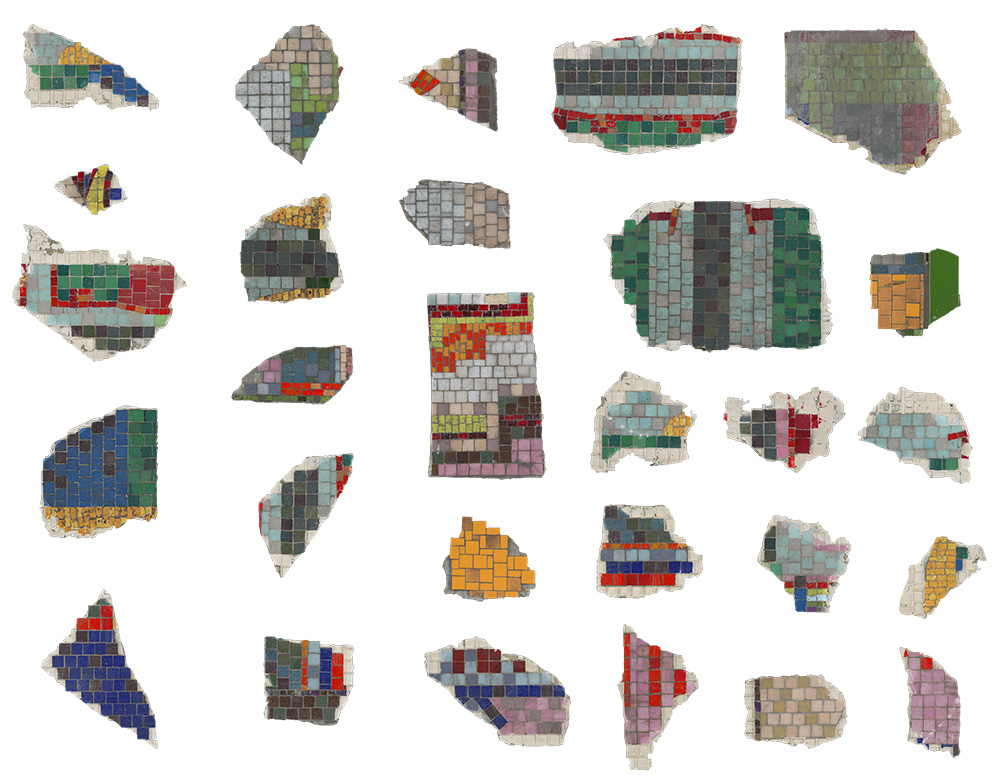
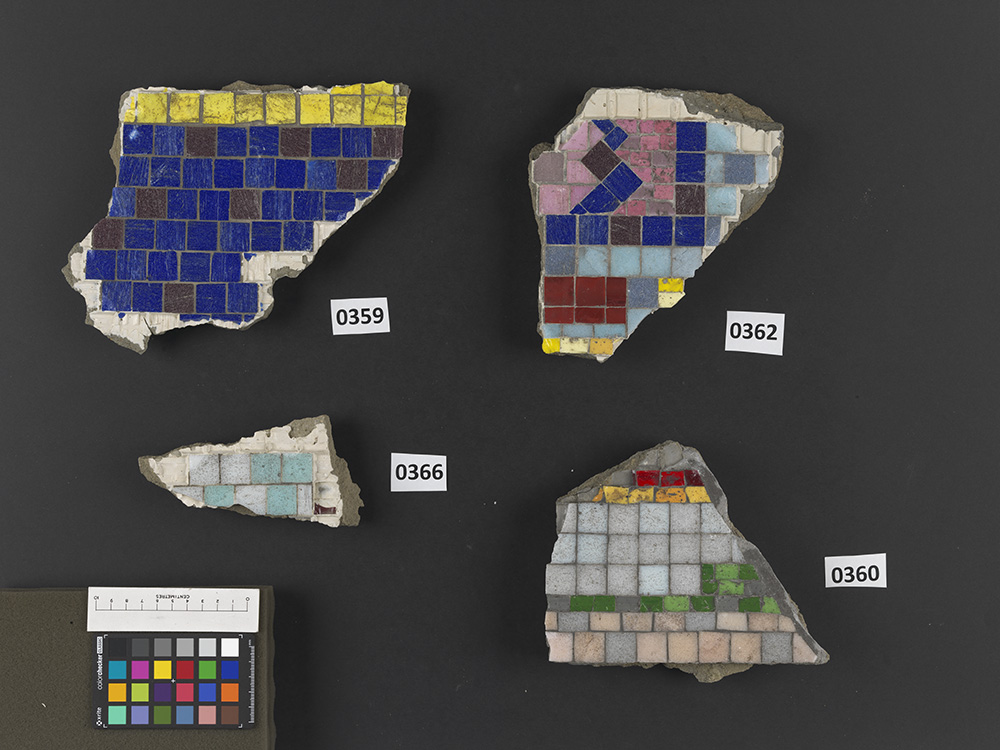
Currently, I am awaiting the arrival of the pallets as I have digitised all the fragments from the boxes. The majority of what is still to come are much larger mosaics fragments. I may be required to digitally stitch multiple images together in order to produce a single image. This is because some mosaics may be too large to photograph in their entirety on the copy stand. No doubt this will raise some new challenges to overcome!
John
Project Photographer (Paolozzi Project)
Trial access: Church Missionary Society Periodicals
The Library currently has trial access to the Church Missionary Society Periodicals from Adam Matthew Digital. This resource features publications from the Church Missionary Society, the Church of England Zenana Missionary Society and the latterly integrated South American Missionary Society between 1804 and 2009.
 You can access the resource during the trial period from the link below if you are working on-campus (or off-campus with VPN):
www.churchmissionarysociety.amdigital.co.uk
Trial ends 23rd March 2016*.
*Please note that our trial access has been extended. Read More
Collections
 Hill and Adamson Collection: an insight into Edinburgh’s past
My name is Phoebe Kirkland, I am an MSc East Asian Studies student, and for...
Cataloguing the private papers of Archibald Hunter Campbell: A Journey Through Correspondence
My name is Pauline Vincent, I am a student in my last year of a...
Hill and Adamson Collection: an insight into Edinburgh’s past
My name is Phoebe Kirkland, I am an MSc East Asian Studies student, and for...
Cataloguing the private papers of Archibald Hunter Campbell: A Journey Through Correspondence
My name is Pauline Vincent, I am a student in my last year of a...

Projects
Cataloguing the private papers of Archibald Hunter Campbell: A Journey Through Correspondence
My name is Pauline Vincent, I am a student in my last year of a...
Archival Provenance Research Project: Lishan’s Experience
Presentation My name is Lishan Zou, I am a fourth year History and Politics student....