Home University of Edinburgh Library Essentials
May 8, 2026
Current UK Open Access Issues
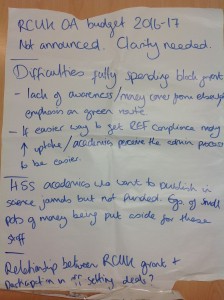
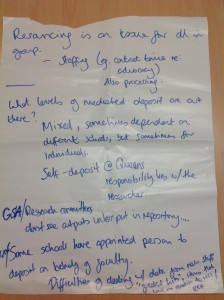
I’ve been looking at my notes from Monday’s workshop discussion looking at some of the current non-systems-specific issues facing OA practitioners in the UK at the moment. I’ve summarised the key points below and uploaded pictures of the notes from the day.
Key concerns discussed:
- RCUK Block grants have not yet been announced – this is of concerns to a wide range of institutions.
- Many institutions are expecting an increase in use of RCUK grants if gold OA is perceived to be an easier route to REF compliance.
- Repository/CRIS records without a Date of Acceptance is a major concern. Records imported from external sources such as Scopus will not have DoA information so this needs to be added manually.
- SHERPA REF aligns with current HEFCE policy (deposit within 3 months of the date of publication) whereas many institutions are telling authors to deposit on acceptance. This can cause confusion.
- More clarity is required regarding the use of exceptions for gold OA. Will these be counted in addition to the tolerance of other exceptions?
- Resourcing for supporting authors to deposit and to validate/sherps-check records is a concern. The REF policy means that records need to be checked on deposit (around the time of acceptance) and then again post-publication so the administrative burden is greater.
- How do we handle records from post-docs, late-stage-PhDs and ECRs whose REF-submission status is not yet determined?
- What do we do about recording evidence of date of acceptance? Current thinking seems to be “if you have it, keep it, if not – then don’t worry.”.




Dominic Tate – LOCH Project Manager
A Taste of Conservation
In this week’s blog we hear from Anna O’Regan, who recently attended a Conservation Taster Day at the CRC. Anna discusses why she wanted to take part, and what she learnt during the day…
My educational background is in Museum Studies and Cultural Heritage. While I enjoyed studying this masters degree, I found it to be a little too broad, and although I did choose to narrow the focus to cataloguing and gained voluntary experience in this area, I felt like this wasn’t the right path for me to follow. Then I stumbled upon conservation and figured out which direction I want to proceed in. When I learned about the Conservation Taster Day at Edinburgh University I was thrilled to be invited to take part and learn more about what branches of conservation there are, so I could get the information I needed and make a decision about what precisely I want to specialise in. Having completed the day I can say with certainty that paper conservation is for me and I couldn’t be more excited for what the future holds.
Open Access Technical Workshop

Yesterday saw the LOCH and End-to-End projects host a joint event at Glasgow’s Hilton Grosvenor Hotel to look at technical issues related to Open Access policcy compliance for the REF. The morning session consisted of a series of short ‘show-and-tell’ sessions whereby participants generously gave up their time to demonstrate how the repository and research information systems they use can support the new requirements, which came into play on Friday.
After lunch, delegates joined groups looking at technical issues in PURE and DSpace. Another group discussed some of the non-technical issues to do with REF policy and OA funding and spent time sharing experiences and best practice. The day was rounded off with presentations about CASRAI, SHERPA-REF and Jisc Publications Router.
The organisers are in the process of writing up a more thorough report, to be published on the LOCH and End-to-End blogs in the next few days.
Dominic Tate, LOCH Project Manager
Dynamic Research Support for Academic Libraries – Edinburgh Case Study
This week saw the publication of a new Facet Publishing title: Dynamic Research Support for Academic Libraries – a book which is aimed at enabling academic librarians to develop excellent services to support research.
As Manager of the LOCH Project, I contributed a chapter in the form of a case study, entitled Implementing Open Access across a Large University: A Case Study from the University of Edinburgh. A pre-print of this case study is now available from Edinburgh Research Archive at http://hdl.handle.net/1842/15766. Hopefully this may be of interest to practitioners looking at implementing more formal processes for ensuring Open Access to journal articles and conference proceedings – especially in light of the HEFCE Open Access Policy for REF, which comes into effect today (eek)!
In case this chapter whets your appetite for finding out more about some of the latest thinking in library research support, then you may be interested in the video below, in which the book’s editor Starr Hoffman explains the topics covered. You can also peek inside the book if you wish.
***with apologies for any shameless self-promotion***
Dominic Tate, Project Manager – LOCH
Edinburgh Edition of Thomas Reid
The Library has trial access, until 30th April 2016, to this new electronic resource from Past Masters. Check it out here! Read More
Trial access extended: Church Missionary Society Periodicals
Our current trial to Church Missionary Society Periodicals from Adam Matthews has been extended and access to this fascinating resource is now available until 28th April 2016.

You can access the resource during the trial period from the E-resources trials page. Please note that PDF download options are not available during the trial. Read More
II: 100th anniversary of ‘Zeppelin’ air attack on Edinburgh – Incendiary bombs and the Infirmary
Following on from Archibald Campbell’s account of the Zeppelin raid on Edinburgh and Leith one hundred years ago this weekend, minutes and images from Lothian Health Services Archive (LHSA) reveal its impact on the city’s hospital services.
As Archibald noted, the raid inflicted great damage on his school, George Watson’s College, just minutes away from the Royal Infirmary of Edinburgh on its Lauriston Place site. The impact upon Scotland’s largest voluntary hospital was less than that suffered by the school, but still notable. Luckily, LHSA holds a comprehensive account of the effects of the bomb damage on the Infirmary in minutes of the hospital’s House Committee. The Committee met a week after the blast, on 10th April 1916 (LHB1/1/54). According to the account, the George Watson’s bomb caused windows in three wards to be broken, along with damage to side rooms and an operating theatre – miraculously, however, no staff or patients were killed.
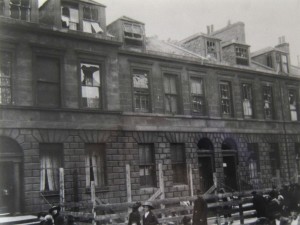
Bomb damage to buildings near the Infirmary, 2 – 3 April 1916 (P/PL1/E/208).
In addition, an incendiary bomb was dropped on the Infirmary itself, on the boiler house, although this caused relatively little damage.
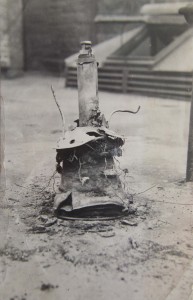
Incendiary bomb in situ at the Royal Infirmary , 1916 (P/PL1/E/021).
Like Archibald Campbell, Infirmary staff kept their own souvenir. Here at LHSA, we have this memento: a part of the actual incendiary bomb in a glass display case, which we store in our off-site store (because it is bulky rather than because it could go off!)
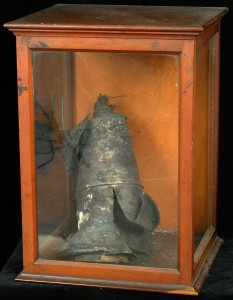
Incendiary bomb in glass display case (LHSA object collection, O26).
The Infirmary kept services going despite the raid, with the House Committee minutes praising medical, surgical and nursing staff, who carried out their duties ‘notwithstanding the immanence of personal danger … their individual efforts to reassure the patients did much to allay the alarm which naturally existed in the Hospital.’
The minutes record that 27 people were treated for bomb damage during the night, 12 of whom ‘were treated as in-patients, two of whom subsequently died and the remainder were treated in the out-patient department.’ The Infirmary’s General Register, which records admissions to the hospital, reflects the casualties from the night. Although the injuries to some are not explicitly stated as caused by the bomb, it is possible to have a good guess at the identity of these twelve patients and to trace the individuals who were to die from their wounds. The House Committee states that two of these patients did not survive their injuries. The General Register suggests that these unfortunates were a 45 year old carter from Grassmarket who died from perforation of the liver with a shell and an arterio-sclerotic 74 year old mason who succumbed to shock after an operation for an injury to the knee caused by the bombing.
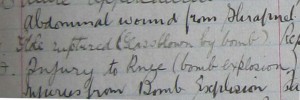
Section from the Royal Infirmary of Edinburgh General Register of Patients (LHB1/126/61) showing how bomb injuries were described.
One thing that those injured by the bomb had in common was their locality. Patients were centred around the old town, from the Grassmarket to St Leonards and the area of the present University of Edinburgh, making injuries such as ‘scratches to face and ear’ to people from these areas more likely than not to have been caused by effects of the raid. Others suffered injuries to the arms, legs, abdomen and head, or had eye injuries through flying glass. We can also match their addresses to bomb sites named on contemporary police and fire brigade reports.
For example, two of these patients were from 16 Marshall Street: a male tailor, who underwent surgery for a serious perforation wound to the eye; and a dressmaker, whose face had to be stitched. Both were discharged (the dressmaker on the same day and the tailor after almost four weeks). Nonetheless, they were the lucky ones in this four-storey building, housing shops, domestic dwellings, a dispensary and a school. A police report cites that six people were killed in total from the address. Three people standing in the building’s doorway and a man standing across the street were amongst the fatalities, according to the fire brigade account of the night.
However, although no staff were injured in the explosion, the House Committee minutes point to its possible psychological effects. The Lady Superintendent of Nurses, Miss Annie Warren Gill, was worried that, if another raid should occur, members of her staff could be ‘rendered unsuitable for duty through nervousness – some of them having suffered considerably that way on the recent occasion.’
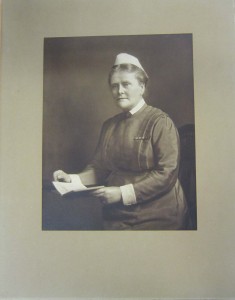
Annie Warren Gill, Lady Superintendent of Nurses, 1907 – 1925 (LHSA photography collection).
Committee members also showed concern at the lack of warning given for the attack to Infirmary officials, beyond the regular lowering of lights. In preparation for an increase in casualties following another attack, proposals were made for emergency staffing from existing medical and surgical teams.
The main part of the meeting was signed off with approbation for the enemy’s conduct, ‘the recklessness of which while dooming it to military failure endangered the lives of the inmates of an Institution whose doors have at all times been open to the suffering sick of all nations.’
Louise Williams, Archivist, LHSA
An earlier story about the attack can be read here: I: A School student walks among the wreckage
‘Given in Good Faith’ exhibition opening next week
 We’re very excited about our forthcoming exhibition, Given in Good Faith, which uses some of New College Library’s treasures to explore themes of church history, worship, science and scripture. From its earliest beginnings in 1843, New College Library was not only a working theological library but also a rare book and manuscript library, and many of the treasures on display were donated to the Library. Items on display will include a first edition of the works of Calvin, a Bible said to be owned by Andrew Melville and an illuminated Hebrew manuscript.
The exhibition recognises the contribution of New College alumni Dr Robert Funk, whose gifts over the last ten years have allowed us to secure, develop and discover these collections for new generations of students and scholars. It runs 5 April-29 July, at the Centre for Research Collections, University of Edinburgh Main Library, George Square, Edinburgh EH8 9LJ
An apple a day …
To keep the body in good health is a duty, for otherwise we shall not be able to trim the lamp of wisdom, and keep our mind strong and clear. Water surrounds the lotus flower, but does not wet its petals.
Buddha
This week we have been thinking about how students can stay healthy during high-stress study periods. Most people opt for comfort food when they are stressed, something we catered for last week by handing out chocolate. While a little chocolate is fine occasionally, it is not the best thing to eat while studying!

That’s why we have been handing out some healthier snacks this week. Healthy sugars, such as those found in fruit and vegetables, and protein provide more long-lasting energy and are much better for our brains.

We were handing out some dried fruit and nuts, which are great options for study snacks, but here are some other food ideas from the BBC for boosting brain power:
- Fish, such as salmon and tuna
- Pumpkin seeds
- Tomatoes
- Broccoli
- Peanut butter
- Blueberries and blackcurrants
Other types of fresh fruit, like those in this still life from our collections, are good options too:

Fruit (Still Life) by Penelope Beaton. © The University of Edinburgh. Find it here.
Take care of yourself this week! Remember, your library loves you!
I: 100th anniversary of ‘Zeppelin’ air attack on Edinburgh – A school student walks among the wreckage
A STORY FROM THE DIARY OF 15-YEAR OLD ARCHIBALD H CAMPBELL (1902-1918) WHO WOULD LATER BECOME REGIUS PROFESSOR OF PUBLIC LAW AND THE LAW OF NATURE AND THE NATIONS, EDINBURGH UNIVERSITY, 1945-1972
Over the next couple of days, and almost 100-years to the day since the first ever air assault on Leith and Edinburgh by Zeppelins of the Imperial German Naval Airship Service, our blog describes the event – on 2-3 April 1916 – as told by the diary of the young teenager Archibald Campbell, and also through interpretation of historical papers of the Royal Infirmary of Edinburgh curated by the Lothian Health Services Archive (LHSA).
Firstly… Archibald Campbell’s story…:
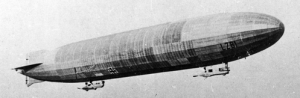
Airship – similar to Zeppelin L14 of the Imperial German Naval Airship Service which brought most of the damage to Edinburgh from the air in April 1916. In addition to Edinburgh, many other places on Great Britain suffered from Zeppelin raids including Kings Lynn, Gt. Yarmouth, Hull, Tyneside, Gravesend, the Midlands, London and the Home Counties. From January 1915 to end-May 1916 at least 550 British civilians had been killed (Creative Commons image).
Archibald Hunter Campbell was born 21 May 1902 in Edinburgh. He was educated at George Watson’s College in the city, at Edinburgh University, and then at University College, Oxford.

The cover of the school-boy diary kept by Archibald H. Campbell (Coll-221).
While still at school, aged 13 years, Campbell witnessed the aftermath of this first ever air attack on the city, and on Scotland as a whole, when the airships – the Zeppelins – dropped ordnance on 2-3 April 1916.

Campbell aged 13 in April 1916 had written extensive notes about the Zeppelin attack on a separate piece of paper inserted into his diary, noting that his description of the aftermath was ‘On paper’ (Coll-221).
The naval base at Rosyth in Fife and the Forth Bridge had been the focus of an attack composed of four Zeppelins but in the event only two craft reached the Scottish coast – L14 commanded by Kapitänleutnant der Reserve Alois Böcker, and L22 commanded by Kapitänleutnant Martin Dietrich. At 9.30pm on Sunday 2 April 1916 the military gave the order for the city to take air raid action, and road traffic ground to a halt, street lighting was lowered, and civilians were advised to take refuge.

Descriptive notes from the diary kept by Archibald H. Campbell and telling the story of the Zeppelin attack (Coll-221).
Leith Docks were attacked round about 11:30pm, and then the German airship crew plotted a course along the Water of Leith towards the city of Edinburgh. Just after midnight the young Campbell was awakened by the sound of bombs. He went down to the parlour where he waited until 1.10am on the morning of Monday 3 April and from the window he ‘saw blaze over Leith’. He then went to bed before rising again at 7.30am to get ready for school – George Watson’s. However he heard that a ‘bomb had fallen in front of school & smashed it up’. When he got to school he ‘mucked about’ in the bomb hole in the playground until he was ‘turned out’ of it.

Descriptive notes from the diary kept by Archibald H. Campbell and telling the story of the Zeppelin attack (Coll-221).
At noon when he got out of school he ‘went round to see bomb hole’ again. Every window in front of the school was ‘smashed’. The crater was ‘about 4′ 6” across right up against Ethel Davidson’s room which was absolutely smashed’ (the crater was just over a meter wide). He went on…:
Desks, window-frames, broken glass, stones, and piles of plaster, all smashed up, filled the room. Other front rooms about as bad.

Descriptive notes from the diary kept by Archibald H. Campbell and telling the story of the Zeppelin attack (Coll-221).
All windows smashed & street carpeted with broken glass. Bomb had landed through roof of a house.

Descriptive notes from the diary kept by Archibald H. Campbell and telling the story of the Zeppelin attack (Coll-221).

Descriptive notes from the diary kept by Archibald H. Campbell and telling the story of the Zeppelin attack (Coll-221).
It had missed the Castle by a few feet, hit the rock & brought down a small land slide.

Descriptive notes from the diary kept by Archibald H. Campbell and telling the story of the Zeppelin attack (Coll-221).

Descriptive notes from the diary kept by Archibald H. Campbell and telling the story of the Zeppelin attack (Coll-221).
Later on, when his mother had gone down to Leamington Terrace to see an uncle, Campbell ‘got a car’ (a tram) down to Leith Walk where he met his father and several teachers, and…:
Showed my bit of bomb & told them that Watson’s was still standing.

Descriptive notes from the diary kept by Archibald H. Campbell and telling the story of the Zeppelin attack (Coll-221).

Descriptive notes from the diary kept by Archibald H. Campbell and telling the story of the Zeppelin attack (Coll-221).
Saw all smashed windows & other effects of Castle bomb. Looked down into King’s Stables Road which was absolutely black with people.

Descriptive notes from the diary kept by Archibald H. Campbell and telling the story of the Zeppelin attack (Coll-221).
Owing to crumpling up of wire and that beastly developing box only one […] came out decently & even it was spotted.

Descriptive notes from the diary kept by Archibald H. Campbell and telling the story of the Zeppelin attack (Coll-221).
 Nearly all of the damage had been caused by devices dropped from Zeppelin L14. Zeppelin L22 ventured only briefly into the city and just caused minor damage after jettisoning most of its bombs in fields near Berwick-upon-Tweed. Later in the year, Alois Böcker was arrested by local policemen in Essex, England, in September 1916, when his Zeppelin (L33 on this occasion) was brought down by night fighters. Zeppelin L14 itself was destroyed by its crew on 23 June 1919 following the example of the naval scuttling in Scapa Flow.
At Bletchley Park he was a Foreign Office Civilian (Temporary Senior Assistant Officer) and worked at the Mansion, Hut 10, Block A and Block F(A), Air Section, including advanced research in the Italian sub-section. There he decrypted non-Enigma signals from German, Italian and Japanese Air Forces and produced intelligence reports. He also worked at Hut 5 and Block F, Military Section, probably Japanese, involved in decrypting and reporting on non-Enigma enemy army ciphers. This was also known as No 4 Intelligence School.
After the war he returned to Edinburgh and to the University’s Regius Chair of Public Law and the Law of Nature and the Nations which he held from 1945 to 1972. He was Dean of the Faculty of Law, 1958-64.
Professor Archibald Hunter Campbell died in Edinburgh 8 June 1989.
The diary with the separate page describing the damage across Edinburgh was ‘rediscovered’ in the A. H. Campbell material by one of our volunteers, Valentina Flex, Edinburgh University graduate, who had been creating a provisional listing of content.
A second blog post about the attack on Edinburgh 100-years ago – and from the curatorial staff of the LHSA – will go live in the next couple of days.
Dr. Graeme D. Eddie, Assistant Librarian Archives & Manuscripts, Centre for Research Collections
Notes…: In addition to the description of the events written by Archibald H. Campbell himself, freely accessible web-pages describing the events of 2-3 April 1916 (especially Scotland’s War ‘Midlothian’s War – Zeppelin raid over Edinburgh’) and a ‘Wikipedia’ list of Zeppelins, and also the website of the Bletchley Park Roll of Honour, were enlisted for the creation of this blog-post.
The image of the Zeppelin (here the P-class LZ45 ‘L13’) was obtained from Creative Commons.
The second story about the Zeppelin attack can be read here: II: Incendiary bombs and the Infirmary
Collections
 Hill and Adamson Collection: an insight into Edinburgh’s past
My name is Phoebe Kirkland, I am an MSc East Asian Studies student, and for...
Cataloguing the private papers of Archibald Hunter Campbell: A Journey Through Correspondence
My name is Pauline Vincent, I am a student in my last year of a...
Hill and Adamson Collection: an insight into Edinburgh’s past
My name is Phoebe Kirkland, I am an MSc East Asian Studies student, and for...
Cataloguing the private papers of Archibald Hunter Campbell: A Journey Through Correspondence
My name is Pauline Vincent, I am a student in my last year of a...
Projects
Cataloguing the private papers of Archibald Hunter Campbell: A Journey Through Correspondence
My name is Pauline Vincent, I am a student in my last year of a...
Archival Provenance Research Project: Lishan’s Experience
Presentation My name is Lishan Zou, I am a fourth year History and Politics student....