Home University of Edinburgh Library Essentials
March 30, 2026

Edinburgh Research Archive access stats: Q1 2016

Image: Bass valve trumpet. Nominal pitch: 8-ft C (CC-BY from the MIMEd collection)
Not one to blow our own trumpets too often, I’m pleased to report that during the first three months of this year we have achieved 334,913 page views and an incredible 207,945 downloads from the Edinburgh Research Archive (ERA).
ERA contains documents written by, or affiliated with, academic authors, or units, based at Edinburgh that have sufficient quality to be collected and preserved by the Library, but which are not controlled by commercial publishers. Holdings include full-text digital doctoral theses, masters dissertations, project reports, briefing papers and out-of-print materials.
Top 10 downloads from the Edinburgh Research Archive during Q1 2016
The most widely accessed items in ERA are an eclectic bunch of materials; mostly PhD theses, but also including an out-of-print civil defence manual from 1949, and a Psychological Screening Test produced by researchers at the University of Edinburgh.

It is pleasing to see that ERA is providing a platform for wide dissemination of materials that would otherwise not easily be available for consultation. We can’t second guess what people will find useful so by putting all our doctoral research online – in a structured format that is indexed by all major search engines – we can maximise the reach of these carefully written words in the hope that it will fall into the hands of someone who would be grateful to read them.
Newspaper archives on trial
The Library currently has trial access to two newspaper archives, The Telegraph Historical Archive (1855-2000) and British Newspapers Part V (1746-1950).
You can access both of these online archives via the E-resources trials page. Access is available both on and off-campus.
Both trials end on 10th June 2016.

The Telegraph Historical Archive (1855-2000) Read More
Looking for study space?
We’re already half way through the second week of exams and as always at this time of year the Main Library is often full to bursting. So what can you do if you’re struggling to find a space to study?

1) There is extra study space in the Main Library that you may not be aware of.
On the first floor the meeting rooms 1.07, 1.09 and 1.11 have been opened up for study space. These are available during full library opening hours and are available until 20th May 2016.
On the 6th floor the Centre for Research Collections (CRC) are also allowing students to use their research suite (12 seats) for study space. Access is only available during CRC opening hours (Mon-Weds 9am-7pm, Thurs-Fri 9am-5pm. No access at weekends.) Ask at the CRC enquiry desk on the 6th floor to get access. Again this study space is available until 20th May 2016. Read More
Breaking Boundaries #RDMRMA
On the 18th April 2016 over 50 professionals from across the UK came together to discuss the intersection of three disciplines: Research Data Management, Records Management / Information Governance, and Archives. Organised by Edinburgh University Library and the Digital Curation Centre, we met in the striking historic Playfair Library, part of the University’s Old College. Delegates were encouraged to record the event using the hashtag #RDMRMA.
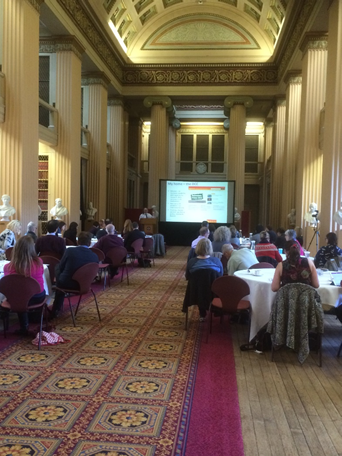
The day was kicked off by a welcome from the Library’s Head of Special Collections and the Centre for Research Collections. Following on from this, Kevin Ashley the DCC’s Director gave an overview of the issues we would likely cover along with some history of the domains working together. This was then followed by three presentations, each giving a brief overview of the specific domains:
- Records Management and Information Governance: Alan Bell (Head of Information Governance University of Dundee)
- Archives: Rachel Hosker (Archives Manager, University of Edinburgh)
- Research Data Management: Stuart Lewis (Deputy Director of Library and University Collections, The University of Edinburgh)
After a brief break, two more in-depth case studies were given:
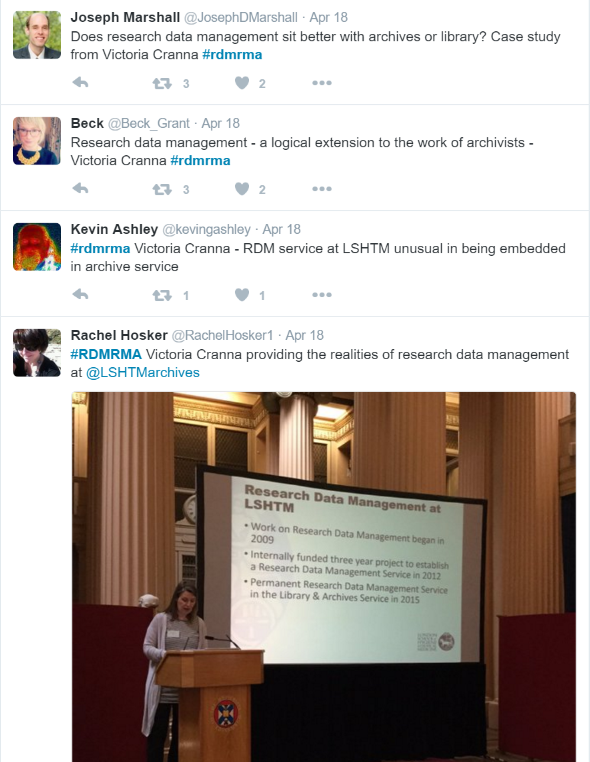
Victoria Cranna is Archivist and Records Manager from the London School of Hygiene & Tropical Medicine. LHSTM is perhaps unique in that their institutional Research Data Management programme is run from the Library’s Archives and Records Management Team. Victoria presented a few of her frustrations about the interplay between archivists and research data professionals: frustration at the lack of communication between the two groups; archivists’ view of research data; and research data managers’ lack of connection to archivists and their skills.
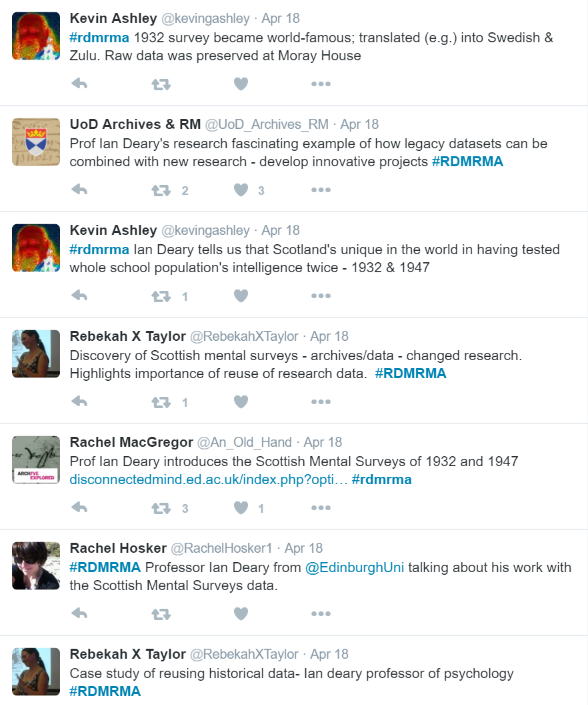
Ian Deary, Professor of Differential Psychology is Director of the Centre for Cognitive Ageing and Cognitive Epidemiology at the University of Edinburgh. Ian talked about the Lothian Birth Cohort Scottish Mental Studies from 1932 and 1947. These made use of data that was discovered from a storage cupboard in the Moray House School of Education and allowed subsequent reuse of the data over 60 years later. Ian described the sometime tortuous route that had to be followed to gain permission to use the data, how the data was coded and joined up with other data sources, and some of the outcomes that this has generated. One particular question was asked which prompted a strong response: Could you have undertaken this work if only a percentage of the data had been sampled and stored, rather than the whole dataset. The answer was a categorical “no”!
After lunch we were treated to four lightening talks that unpicked some of the issues a little further.
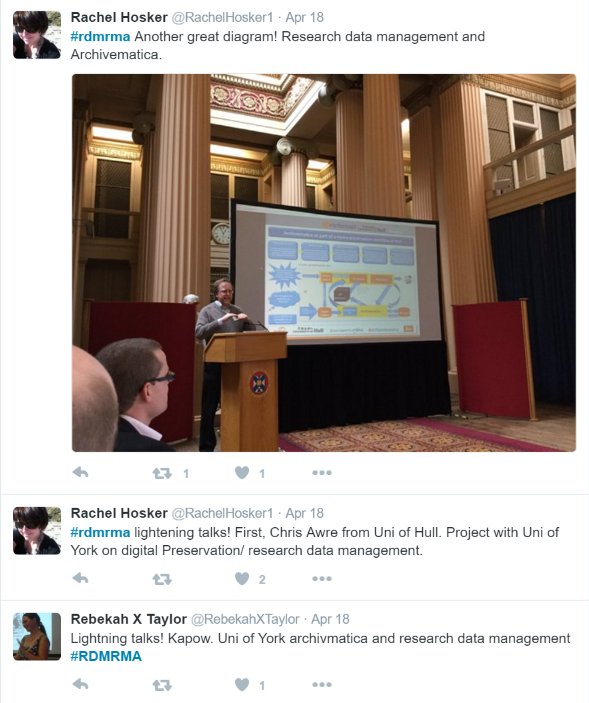
First up was Chris Awre, Head of Information Management at the University of Hull. Chris talked about some of the work that Hull and York universities have been undertaking with applying Archivematica and Digital Preservation approaches to research data. This ‘Filling the digital preservation gap’ is funded by Jisc as part of their Research Data Risk #DataSpring programme.
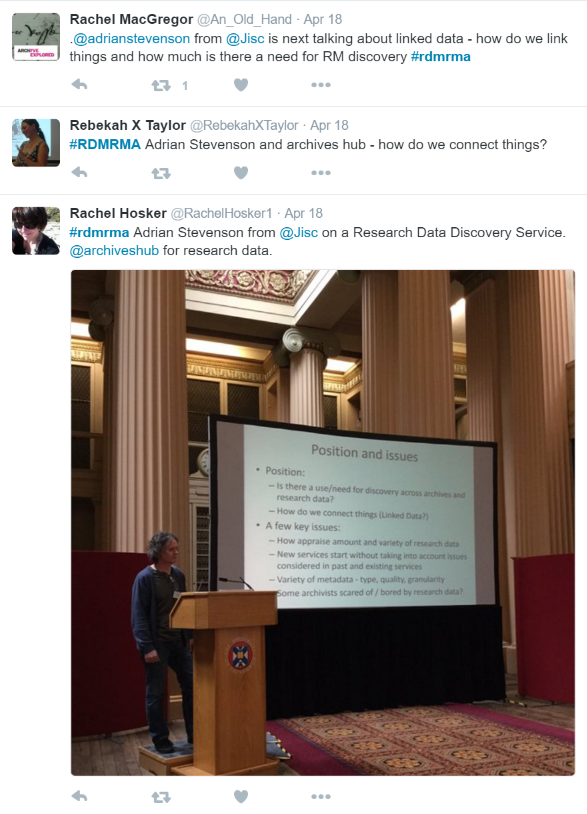
Next up Adrian Stevenson, Senior Technical Coordinator from Jisc talked about a number of issues, including linked data, discovery, and variety + quality of metadata. These partly came from Adrian’s involvement in two related discovery systems, ArchivesHub, and the UK Research Data Discovery Service. Ending his talk, Adrian asked a provoking question: are archivists scared of research data?
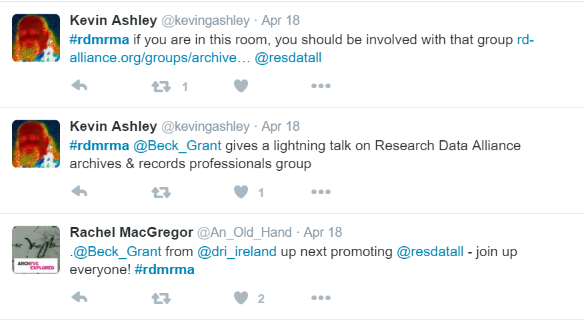
Following Adrian was Rebecca Grant, archivist at the Digital Repository of Ireland, and a PhD candidate at University College Dublin. Rebecca is one of the co-chairs of the Research Data Alliance’s Archives and Records Professionals for Research Data Interest Group, and explained about the importance of this group in advancing similar topics as the event was tackling.
Last up was Laura Molloy, studying at the Oxford Internet Institute and Ruskin School of Art on some of the challenges relating to digital skills in the creative arts, including issues such as mapping visual art work development flow onto standard research lifecycles.

After the lightning talks, the final session was introduced by Kevin Ashley. Participants were split into eight groups, each containing a mix of the different professions. The groups were then asked to undertake two tasks:
- PESTLE analysis of issues relating to the boundaries between research data, records management, and archives (Political / Economic / Social / Technological / Legal / Environmental)
- What can be done? Top three suggestions
Each group’s top three (in some cases more!) are listed below:
Group 1:
- Communication between the professions even if the language differences are frustrating.
- Identify skills and look to transfer them between the professions.
- Think more about how to help with appraisal, which must be sustainable.
Group 2:
- Top down approach pushed from funders.
- Leadership required to push different professions and skills to work together.
- Ensure data is transferred into the custody of the institution, and make sure researchers understand that they are not the ultimate data owners.
- Need shared language (map between professions).
- All professions to be advertised as being able to assist with RDM.
Group 3:
- Communication, and perhaps improve though cross team training or mentoring across professional areas.
- Integration of systems and using standards such as ORCID is important.
- Education to train staff, making use of other skills.
Group 4:
- Physical data needs to be thought about, as most effort is currently going on digital data.
- Data format identification for RDM needs to be improved.
- Also need to think about research software and associated documentation.
- It doesn’t matter who leads on RDM in an institution, as long as the professions work together.
Group 5:
- Commonality of purpose between professions.
- Try to define a common language between professions, and to share with the research community.
- Recognise who understands which aspect of the controlling requirements.
Group 6:
- Need for knowledge sharing with legal profession (ownership, IPR, patents).
- Care studies to show consequences of good research data management.
- Danger of compliance culture due to funding requirements. Policies must be reviewed.
Group 7:
- Look for areas of commonality where we can work together, for example collection policies.
- Think about critical success factors so that we know when we are succeeding.
- Look to align systems and their approaches rather than silo systems in each profession, and include other professions such as IT.
Group 8:
- Encourage the professions to collaborate more together.
- Teach information management to improve the creation of data.
- Establish work flows for ingest, appraisal and management of research data, understanding roles and responsibilities.
Some of the talks were recorded and can be viewed online from the this blog post. Other related outputs have also been created:
- A blog post about the event by Rachel MacGregor, Digital Archivist at Lancaster University Library
- A Storify created by Rachel Hosker
- A report by Laura Hynds on the Archives & Records Association website (Section for Specialist Repositories)
New to the Library for History, Classics & Archaeology
Thanks to recommendations from members of staff and requests via RAB from students the Library is continually adding new books to its collections both online and in print. Here are just a small number of the books that have been added to the Library’s collections in April 2016 for the School of History, Classics and Archaeology and these demonstrate the wide range of subjects being taught, studied and researched within School.
–> Find even more via DiscoverEd.
Corrupting luxury in ancient Greek literature by Robert J. Gorman and Vanessa B. Gorman (shelfmark: PA3009 Gor.)
A medieval book of beasts: the second-family bestiary. Commentary, art, text and translation by Willene B. Clark (shelfmark: Folio PA8275.B4 Cla.)

“The bestiary – a book of animals, both real and mythical – is one of the most interesting and appealing medieval artefacts. The “Second-family” bestiary is the most important and frequently produced version…This study addresses the work’s purpose and audience, challenging previous assumptions with direct evidence in the manuscripts themselves”
The spoils of freedom: psychoanalysis and feminism after the fall of socialism by Renata Salecl (e-book). Read More
New! Ancient commentators on Aristotle

The Library is in the process of obtaining the complete collection of these ancient Greek commentaries on Aristotle, which were originally gathered together and edited in the series Commentaria in Aristotelem Graeca (CAG). The 23 volumes in the series were first published by Reimer of Berlin between 1882 and 1909.
Open Access Technical Workshop – ‘Un-Report’
Hello All,
Here is the ‘un-report’ from our 4th April event looking at system functionality for Open Access. It mainly consists of informal notes and verbatim comments from the day.
OpenAccessTechnicalWorkshop Un-Report_20160404
We will be following this up at the final programme workshop around systems and metadata. The date and venue will be announced soon.
The presentations can be seen here:
Jisc – Sherpa REF and Publications Router
PURE – discussion was online on an instance of PURE – see the ‘un-report’ where there are lots of comments.
Posted on behalf of Valerie McCutcheon, University of Glasgow
Treasury of Linguistic Maps Online: trial access now available
We now have trial access – until 13th June 2016 – to Treasury of Linguistic Maps Online. 
Treasury of Linguistic Maps Online presents linguistic maps selected from various atlases and other publications that have been published over the years by De Gruyter Mouton and other De Gruyter imprints.
For the first time, this material is made available and searchable in one place and in a new, improved format.
All maps have been scanned in high-resolution for maximum quality and enriched with detailed metadata.
Many of these maps have not been digitally available before, and some are difficult to find even in printed form. The map interface allows zooming in on details, printing, and PDF export.
As always, your views on the resource will be most welcome!
Planning future sprints
We’re now in the third phase of the DataVault project, and as previously discussed, we are using fortnightly development sprints to undertake the remaining development tasks. Following our monthly project meeting yesterday, we now have draft sprints to take us up until the end of June, and the first full release of the software!
Keep an eye out for a future blog post: we’re scheduled to hold an event for potential early adopters of the DataVault system in their own institutions. 29th June, central London!
Between now and then we have planned a further four sprints (sprints 3, 4, 5, and 6). We plan these in details at the start of each sprint, but right now we have indicative backlogs for the next three. Not only will these involve further developments to the software, but also test installations at our institutions to allow more thorough testing of the software in-situ, especially once fully configured into local systems such as Shibboleth and PURE.

All of the Jisc #DataSpring projects have also been reviewed by both the SSI and the DPC in terms of sustainability and good practice from an open source perspective. We’re glad to report a relatively good result, but there are a few areas where we can improve – so we will also be addressing those in the coming weeks. These include better documentation, links about how to contribute to the project, and clearer contact details.
Fake invoice warning
Here is a quick blog post to warn you of targeted attempts to distribute malware by unknown and hostile persons. Over the last few weeks we have been sent numerous emails similar to the one below:
 At a first glance it looks relevant. It is addressed to me personally, it references my place of work, it has some invoicing details that could conceivably be genuine. However, alarm bells should be ringing as it is from a contact I have never heard of, the company is not relevant, the email address is not consistent with the contact name, and the email is hosted from an american cable TV/ISP company. This type of email has been dubbed a spear-phishing attack by threat researchers.
If you were to download and open the MS Word file it contains a macro which deploys a Malware payload which sniffs out data on your computer and sends it back to the command and control server. More info at:
The return of the Microsoft Word macro virus
A colleague was recently infected by malware distributed by opening a MS Word document. Whilst the infection was caught and dealt with quickly they were unfortunately a victim of online bank fraud a few weeks later which may, or may not be connected, but the timing is highly suspicious. Here is a reminder to:
- Only open expected email attachments that come from a trusted source.
- Don’t rely on all anti-malware software to detect viruses in email attachments as not all macro viruses are detected by antivirus software.
- Delete any suspect emails without opening them.
Collections
 Hill and Adamson Collection: an insight into Edinburgh’s past
My name is Phoebe Kirkland, I am an MSc East Asian Studies student, and for...
Cataloguing the private papers of Archibald Hunter Campbell: A Journey Through Correspondence
My name is Pauline Vincent, I am a student in my last year of a...
Hill and Adamson Collection: an insight into Edinburgh’s past
My name is Phoebe Kirkland, I am an MSc East Asian Studies student, and for...
Cataloguing the private papers of Archibald Hunter Campbell: A Journey Through Correspondence
My name is Pauline Vincent, I am a student in my last year of a...

Projects
Cataloguing the private papers of Archibald Hunter Campbell: A Journey Through Correspondence
My name is Pauline Vincent, I am a student in my last year of a...
Archival Provenance Research Project: Lishan’s Experience
Presentation My name is Lishan Zou, I am a fourth year History and Politics student....