Home University of Edinburgh Library Essentials
March 30, 2026
Al-Biruni live on LUNA

We are thrilled to announce that we now have online the entire manuscript of Abu Rayhan Al-Biruni, his ‘Chronology of Ancient Nations’. Al- Biruni was a famous astronomer and polymath and he completed this compendium in the year 1000. It records a vast number of calendars and chronological systems from a variety of different cultural and religious groups in the late antique and medieval periods in the Hellenic world, Central Asia and the Near East, even detailing festivals and liturgical practices.
Given in Good Faith : Science
The School of Divinity has recently been receiving praise for the MSc in Science and Religion programme. Visitors to the Given in Good Faith exhibition on the 6th floor of the Main Library in George Square can see how this excellence in the field of Science and Religion is also one of the key themes explored through the historic treasures of New College Library. From its foundation in 1843, the new Free Church of Scotland actively engaged in current learning and debate on scientific topics such as geology and astronomy, and Free Church ministry students at New College followed courses in natural science. This is one reason why New College Library’s Special Collections reflect this dialogue between religion and science.

Brookes, Richard. A new and accurate system of natural history … London: J. Newbery, 1763. Nat. 109
CSV Mind-Blow(ve)n!

Never waste a football-related pun. It’s been a good week for both PSV and CSV.
I was lucky enough to have a paper accepted to Csv,conf,2* in Berlin on the 3rd-4th of May, which was great to do, but it also got me through the door to see loads of great things going on in data and its surrounding technology. Yes, there was heavy mention made of CSV and Spreadsheets; in fact, at times it was akin to an AA meeting ,with people guiltily admitting their love of Excel. This left me feeling- quite worryingly- vindicated in a lot of the things I do.
As is always the case with any conference review blogpost, it’s not viable to list every link or ruminate on the message of every talk, so I’ll just home in on a few highlights. The talks (available in slide or video form) are appearing over at Lanyrd.com, and they’ll give a lot more depth to what was spoken about.
My own reason for being there- as far as my talk was concerned- was to look at better ways of processing workflow, enriching data, and improving engagement with our collections. Afterwards, I had some interesting conversations: I was alerted to the tool NeuralTalk2 by Maciej Gryka of rainforestqa.com, a company that specialises in cleaning data using mechanical turks and crowdsourced test-cases. Neural Talk, though, is a captioning tool, which will attempt to visually recognise what your image is “of”. I’m sure it fails as much as it succeeds, but, as I pointed out, we’ve not really used this kind of tech to enhance our metadata, so there’d be no harm in running some of our images through and seeing what it comes up with. Another chat, with a lady from UC Santa Cruz, made it clear that we are quite liberal with our approach to crowdsourced data. Where we have generally decided it’s fine to surface as long as it is properly marked as such, they are proceeding rather slowly, due to a particularly strict metadata librarian.
The keynotes were deliberately intended to cover a range of disciplines that might be new to most people at this highly eclectic conference. Resultantly, there were interesting talks on technology and activism (including visualisations of the Ebola crisis and police brutality); ethics in technology and workflows to give your consent without clicking on unreadable terms and conditions (do you know what SmartBins are taking from you as you pass?); dealing with messy spreadsheets (the Enron crisis showed this institution to manage them terribly), and open data with neuroscience (a lot of mouse brains in action).
Some other tools that we could be looking at:
Zegami – great for exploring large banks of images and spotting patterns across them. Can it work with IIIF, I wonder?
OpenRefine– a tool that we perhaps should have been using for some time to rationalise spreadsheet data, which could certainly save lots of time. Our former colleague, Richard Jones of cottagelabs, is a great advocate of these kinds of tools, as his talk made clear.
DataBaker– created in collaboration between the Office of National Statistics and ScraperWiki. This Python application can convert any ‘pretty’ spreadsheet into usable source data in CSV.
CSV Rinse and Repeat– built in Paris by Mathieu Jacomy of the Paris MediaLab, this is a JavaScript tool which intends to cut down the distance between data, coding and visualisation. Basically you take your data, spot patterns, recode to surface interesting things, and generate a visualisation out the end, in an iterative process.
Wikipedia Googlesheets– I am not sure if we would have a use for this specifically, but it was fascinating to see a plugin which serves up spreadsheet formulae coded in Google Apps JavaScript, which can then be used to interrogate any Wikipedia pages. Particularly of note is the ability to combine category pages and pageviews, to see if real-time events are influenced by Wikipedia and vice-versa. Developed by Thomas Steiner at Google.
Finally, here are three interesting observations, which certainly struck a chord with me:
- It is now deemed quite acceptable, as a symptom of rapid development, perhaps, that the CSV is used as the master dataset; perhaps the file-based database’s day is not over. I certainly found out about some interesting applications built in this way.
- I heard no-one but myself talk about Excel macros- at a spreadsheet conference, no less! It is far more fashionable these days to read your data as csv, and code against it using JavaScript, R, or Python. I clearly need to get out of the 1990s.
- EVERYONE suffers from problems with diacritics, glyphs, badly formatted data and what happens when you import a CSV into a spreadsheet tool that tries to be too clever. It is not just me.
All in all, an excellent couple of days, which have filled me with ideas for improvements for existing workflows. Hopefully the likes of the DIU will reap some benefits!
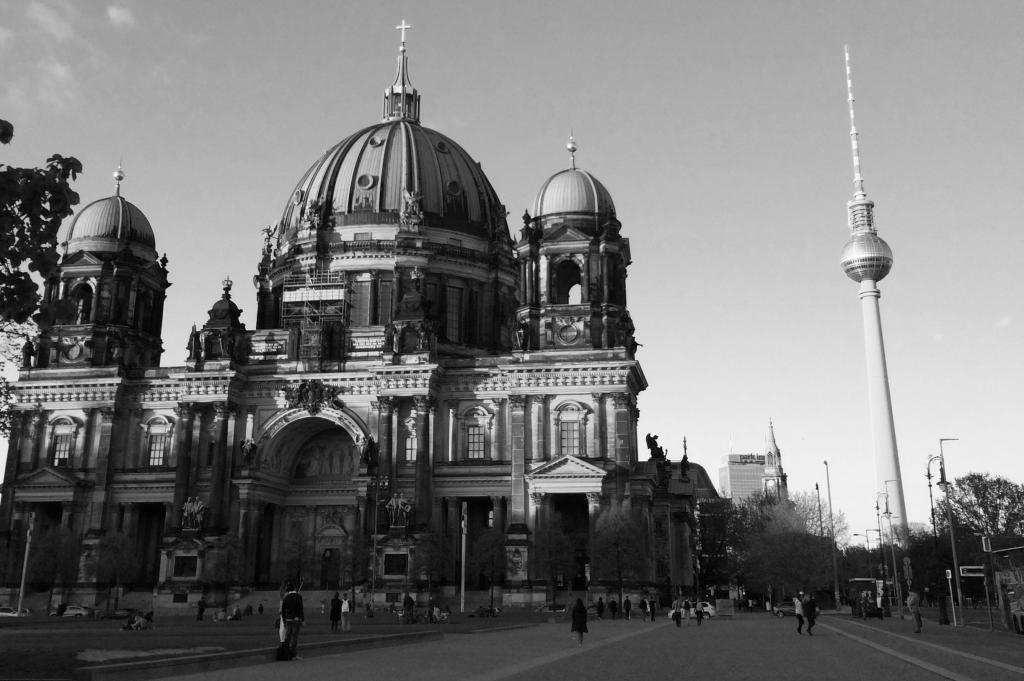
Insert standard caption regarding “old content meets new technology to surface it”!
Scott Renton, Digital Developer
*The commas are intentional, by the way!
Exploring the explorer – Traces of Ernest Shackleton in our collections – 10 May 2016 is the 100th anniversary of the safe arrival of the small boat ‘James Caird’ on South Georgia
ERNEST SHACKLETON (1874-1922) – LEADER OF THE IMPERIAL TRANS-ANTARCTIC EXPEDITION 1914-1917 WHICH HAD LEFT SOUTH GEORGIA IN DECEMBER 1914
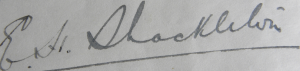
Signature of Ernest Shackleton on a letter to Charles Sarolea, 5 November 1912 (Sarolea Collection, Sar.Coll.33)
Shackleton’s Expedition and its fate has been much written about elsewhere, but in brief, and illustrated with some images from our William Speirs Bruce, Christian Salvesen & Co., and Charles Sarolea collections… read on…
…Some 17-months after his departure from South Georgia in October 1915, Ernest Shackleton suffered the loss of his Expedition ship Endurance which had been sunk by the pack ice of the Weddell Sea. The Expedition – 28 men – had been left adrift but surviving on the ice along with the small lifeboats and other equipment that could be rescued from the ship. By April 1916 however, the ice was beginning to break up and the Expedition took to these lifeboats and made for Elephant Island in the South Shetland Islands. They landed on the small island on 15 April 1916.
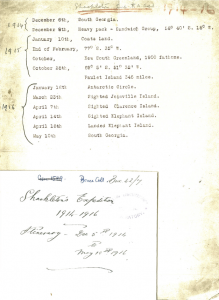
‘Itinerary’ of Shackleton’s Expedition, in the William Speirs Bruce archive (Gen. 1647 42/7)
Elephant Island was remote from anywhere that the original Imperial Trans-Antarctic Expedition had planned to go, and the likelihood of rescue from the bleak and inhospitable island was slight. Shackleton decided therefore that the most effective means of obtaining rescue would be to sail one of the lifeboats into the prevailing winds and make for the whaling stations of South Georgia some 1,500 kilometres away (800 nautical miles, or 620 miles).
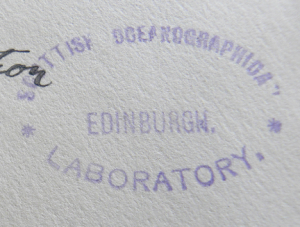
Stamp of the Scottish Oceanographical Laboratory on the envelope containing an ‘Itinerary’ of Shackleton’s Expedition, in the William Speirs Bruce archive (Gen. 1647 42/7)
Choosing five companions for the journey and selecting the strongest of the lifeboats – James Caird, named after a major sponsor of the Expedition – the boat was launched on 24 April 1916. With Shackleton were Frank Worsley (the captain of Endurance) as navigator, Tom Crean (an Irish seaman), John Vincent (a trawlerman), Timothy McCarthy (an Irish seaman), and Harry McNish (carpenter) who had refitted the James Caird for the journey, masting and rigging it out as a ketch. The other 22 men would have to remain on Elephant Island and wait for the outcome of this vital journey. They had fresh water, and plenty of seals and penguins to provide food and fuel for their survival there.
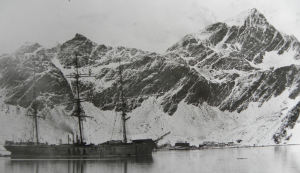
A contemporary picture of the whaling station at Grytviken, South Georgia, in 1913 (Salvesen Archive, 2nd tranche, Photographs Envelope 31)
On 10 May 1916, after over two weeks in the cold open ocean, Shackleton and his men landed their boat at Cave Cove, near the entrance to King Haakon Bay, South Georgia, albeit on the wrong side of the island from the manned stations at Prince Charles Harbour, Stomness, Leith harbour, Husvik, Grytviken, Godthul and Ocean Harbour. From Cave Cove James Caird was sailed a bit further and beached on shingle near the head of King Haakon Bay itself and then it was turned over to provide shelter and the makings of a ‘camp’.
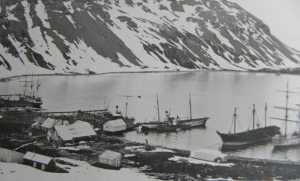
A contemporary picture of the whaling station at Grytviken, South Georgia, in 1914 (Salvesen Archive, 2nd tranche, Photographs Envelope 31)
After a period of rest Shackleton, Worsley and Crean set off on 18 May – without a map – on an overland trek across mountains and glaciers making for the whaling station at Stromness, leaving McCarthy, Vincent and McNish behind at the King Haakon Bay ‘camp’, the latter two far too unfit to walk. After 36-hours of trekking what would become the first confirmed land crossing of the South Georgia interior, the three reached Stromness.
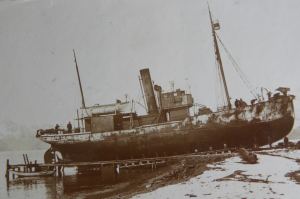
The vessel ‘Samson’ which rescued 3 men from King Haakon Bay after Shackleton’s trek to Stromness (Salvesen, 2nd tranche, B4 Box 2)
On 19 May, the whaling vessel Samson with Worsley aboard was despatched to King Haakon Bay to pick up McCarthy, Vincent and McNish.
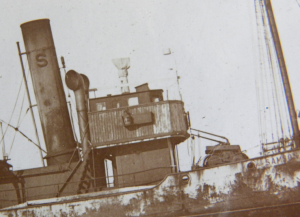
Detail of the vessel ‘Samson’ which rescued 3 men from King Haakon Bay after Shackleton’s trek to Stromness (Salvesen, 2nd tranche, B4 Box 2)
It would be another three months however before Shackleton was able to rescue the 22 men at Elephant Island. This was achieved with the assistance of the steam-tug Yelcho in the service of the Chilean Navy and under the command of Luis Pardo Villalón. All the men were saved and reached Punta Arenas, Chile, on 3 September 1916.
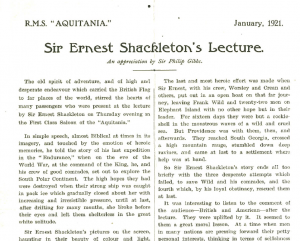
Shackleton was aboard the R.M.S ‘Aquitania’ in 1921 giving a talk on his Antarctic adventures (Sarolea Collection, Sar.Coll.135)
For Shackleton, army and diplomatic service followed – spending time in South America, northern Norway and in northern Russia – and he entered the lecture circuit too. Indeed in January 1921 he was aboard the R.M.S Aquitania giving a talk in the first class saloon. He was no stranger to this circuit of course and was already a public hero prior to the Imperial Trans-Antarctic Expedition, having headed the successful Nimrod Expedition, 1907-1909.
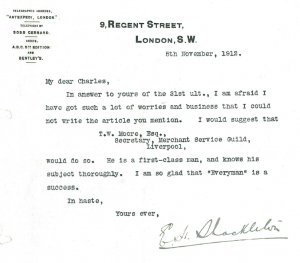
Reply from Shackleton to Charles Sarolea, November 1912 (Sarolea Collection, Sar.Coll.33)
After that earlier 1907-1909 Expedition, Shackleton had received many official honours and he was greeted with great enthusiasm around the country. In 1912, Charles Sarolea – then head of French at Edinburgh University and whose second wife was Shackleton’s sister-in-law – had written to the explorer asking him to ‘do a review, however short, of Amundsen’s book on the South Pole’. Reflecting his strenuous schedule of public appearances, lectures, social engagements, and business ventures, Shackleton had to reply that he had ‘such a lot of worries and business that I could not write the article you mention’. He was however able to congratulate Sarolea on the success of his magazine Everyman.
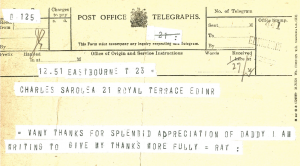
Telegram, noted Ray, from Raymond Swinford Shackleton to Charles Sarolea thanking him for an appreciation of his father (Sarolea Collection, Sar.Coll.135)
In the years following his return from the interupted Imperial Trans-Antarctic Expedition, Shackleton soon tired of the lecture circuit and in September 1921 he left again for the Southern Ocean – the Shackleton-Rowett Expedition – and he arrived in South Georgia in January 1922. On the journey south he is believed to have suffered a heart attack – in Rio de Janeiro – and only a few hours after his arrival in Grytviken he died. His wife asked that her husband be buried in South Georgia and he was laid to rest in Grytviken cemetery.
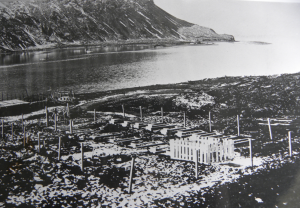
Shackleton’s grave at Grytviken prior to the raising of a granite stone there in 1928 (Salvesen Archive, 2nd tranche, Photographs Envelope 34)
Afterword:
A memorial bust to the Chilean officer ‘Piloto Pardo’ (Luis Pardo Villalón) was later erected on Elephant Island and, today, visiting ships on the Antarctic cruise circuit frequently stop close to it.
The James Caird was shipped to Liverpool arriving in December 1919. Today it is preserved at Dulwich College, London (Shackleton was an ‘Old Alleynian’ of Dulwich College).
Dr. Graeme D. Eddie, Centre for Research Collections, CRC, Edinburgh University Library
New to the Library for Social and Political Science
Thanks to recommendations from members of staff and requests via RAB from students the Library is continually adding new books to its collections both online and in print. Here are just a (very) small number of the books that have been added to the Library’s collections in April 2016 for the School of Social and Political Science and these demonstrate the wide range of subjects being taught, studied and researched within School.
–> Find these and more via DiscoverEd.
Capitalism: competition, conflict, crises by Anwar Shaikh (shelfmark: HB501 Sha. Also available as e-book).
Theories of international politics and zombies by Daniel W. Drezner (shelfmark: JZ1305 Dre. Also available as e-book).

“What would happen to international politics if the dead rose from the grave and started to eat the living? Daniel Drezner’s groundbreaking book answers the question that other international relations scholars have been too scared to ask. Addressing timely issues with analytical bite, Drezner looks at how well-known theories from international relations might be applied to a war with zombies.”
There is: the event and the finitude of appearing by Claude Romano ; translated by Michael B. Smith (shelfmark: B2433.R663 Rom.) Read More
Library Digital Development investigate IIIF
Quick caveat: this post is a partner to the one Claire Knowles has written about our signing up to the IIIF Consortium, so the explanation of the acronym will not be explained here!
The Library Digital Development team decided to investigate the standard due to its appearance at every Cultural Heritage-related conference we’d attended in 2015, and we thought it would be apposite to update everyone with our progress.
First things first: we have managed to make some progress on displaying IIIF formatting to show what it does. Essentially, the standard allows us to display a remotely-served image on a web page, with our choice of size, rotation, mirroring and cropped section without needing to write CSS, HTML, or use Photoshop to manipulate the image; everything is done through the URL. The Digilib IIIF Server was very simple to get up and running (for those that are interested, it is distributed as a Java webapp that runs under Apache Tomcat), so here it is in action, using the standard IIIF URI syntax of [http://[server domain]/[webapp location]/[specific image identifier]/[region]/[size]/[mirror][rotation]/[quality].[format]]!
The URL for the following (image 0070025c.jpg/jp2) would be:
[domain]/0070025/full/full/0/default.jpg

This URL is saying, “give me image 0070025 (in this case an Art Collection poster), at full resolution, uncropped, unmirrored and unrotated: the standard image”.
[domain]/0070025/300,50,350,200/200,200/!236/default.jpg
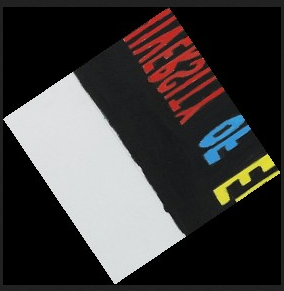
This URL says, “give me the same image, but this time show me co-ordinates 300px in from the left, 50 down from the top, to 350 in from the left, to 200 down from the top (of the original); return it at a resolution of 200px x 200px, rotate it at an angle of 236 degrees, and mirror it”.
The server software is only one part of the IIIF Image API: the viewer is very important too. There are a number of different viewers around which will serve up high-resolution zooming of IIIF images, and we tried integrating OpenSeaDragon with our Iconics collection to see how it could look when everything is up and running (this is not actually using IIIF interaction at this time, rather Microsoft DeepZoom surrogates, but it shows our intention). We cannot show you the test site, unfortunately, but our plan is that all our collections.ed.ac.uk sites, such as Art and Mimed, which have a link to the LUNA image platform, can have that replaced with an embedded high-res image like this. At that point, we will be able to hide the LUNA collection from the main site, thus saving us from having to maintain metadata in two places.

We have also met, as Claire says, the National Library’s technical department to see how they are doing with IIIF. They have implemented rather a lot using Klokan’s IIIFServer and we have investigated using this, with its integrated viewer on both Windows and Docker. We have only done this locally, so cannot show it here, but it is even easier to set up and configure than Digilib. Here’s a screenshot, to show we’re not lying.

Our plan to implement the IIIF Image API involves LUNA though. We already pay them for support and have a good working relationship with them. They are introducing IIIF in their next release so we intend to use that as a IIIF Server. It makes sense- we use LUNA for all our image management, it saves us having to build new systems, and because the software generates JP2K zoomable images, we don’t need to buy anything to do that (this process is not open, no matter how Open Source the main IIIF software may be!). We expect this to be available in the next month or so, and the above investigation has been really useful, as the experience with other servers will allow us to push back to LUNA to say “we think you need to implement this!”. Here’s a quick prospective screenshot of how to pick up a IIIF URL from the LUNA interface.

We still need to investigate more viewers (for practical use) and servers (for investigation), and we need to find out more about the Presentation API, annotations etc., but we feel we are making good progress nonetheless.
Scott Renton, Digital Developer
Wood you believe it? Identifying woods for conservation
In this week’s blog we hear from Musical Instrument Museums Edinburgh (MIMEd) Conservator, Jonathan Santa Maria Bouquet, who recently attended a training workshop on wood identification in Norway.

Jonathan examining wood samples
University of Edinburgh joins IIIF Consortium as a Founding Member
The University of Edinburgh has joined the International Image Interoperability Framework Consortium (IIIF) as Founding Members. On Tuesday 26th April, the formal agreement was signed between Gavin McLachlan, Chief Information Officer and Librarian to the University, and Michael Keller, University Librarian, Stanford University. Other founding members include: Stanford University, Cornell University, Wikipedia, Oxford University, British Library, and Wellcome Trust. Membership of IIIF was made possible through the Information Services Innovation Fund.
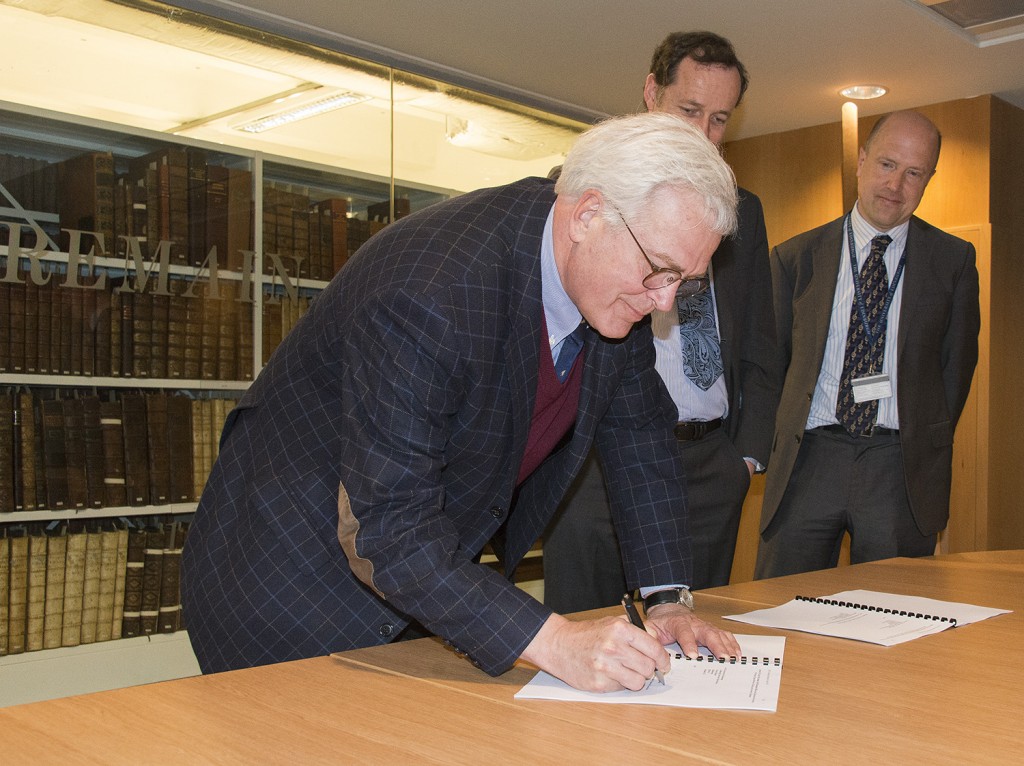
Mike Keller, the Stanford University Librarian signing the IIIF agreement with Gavin McLachlan and Jeremy Upton in the Treasures Viewing Room, 26th April 2016
IIIF is being widely adopted by University and National Libraries as a framework for the hosting, viewing, annotation and sharing of digitised images. Within the University’s Library and University Collections Division we are adopting IIIF for the delivery of our digitised rare and unique items.
IIIF standardises the delivery of images from different institutions, this allows all users of our collections to:
- Compare images from different institutions side by side
- Recreate collections/items that have been split up and are now housed in different institutions
- Create new collections consisting of items at different institutions
- Cite specific areas of images
- Embed images within blogs and websites
- Annotate images for teaching and research
We have already been engaging with the IIIF community through attending a technical workshop and community event. This has informed our investigations into IIIF servers and tools. We will also be attending the IIIF Conference in New York next week, where Claire Knowles will be discussing annotation, during a panel on future trends in IIIF.
“Adopting IIIF will enable the University’s rich and unique image collections to be utilised by our global audience for new and exciting areas of research and learning. In addition, other features of IIIF such as deep zooming will allow the collections to be enjoyed and explored in great depth. Joining the IIIF consortium as a Founding Member allows the University of Edinburgh to work with other world-leading institutions to support the growth and adoption of this standard.” Jeremy Upton, Library and University Collections Director
You can learn more about IIIF at http://iiif.io/
Claire Knowles and Stuart Lewis
New to the Library: The Chicago Manual of Style Online
I’m pleased to let you know that following requests from students and staff the Library has recently subscribed to The Chicago Manual of Style Online.

Access is available via DiscoverEd or go direct to Chicago Manual of Style Online. Access is available both on and off-campus with your EASE username and password.
The Chicago Manual of Style Online offers the full contents of the 16th and 15th editions providing recommendations on editorial style and publishing practices for the digital age. The site is easy to search and browse and also gives you access to the Chicago Style Q&A, tools such as sample correspondence and proofreaders’ marks and a Quick Guide to citations. Read More
Given in Good Faith : Worship
Currently open on the sixth floor of the Main Library at the University of Edinburgh, the Given in Good Faith exhibition explores themes of church history, worship, scripture and science through some of the treasures of New College Library.
We chose the second of these themes, worship, because New College Library’s historic collections preserve many examples of individual and collective forms of worship. And the New College community has come together for religious worship since its beginning, and continues to do so today.

Hore beatissime virginis Marie ad legitimum Sarisburiensis ecclesie ritum … Paris: Francis Regnault, 1534. MH 193
Sixteenth century devotional works such as the printed Book of Hours ‘The Salisbury Rite’ are valuable examples of aids for private worship. Read More
Collections
 Hill and Adamson Collection: an insight into Edinburgh’s past
My name is Phoebe Kirkland, I am an MSc East Asian Studies student, and for...
Cataloguing the private papers of Archibald Hunter Campbell: A Journey Through Correspondence
My name is Pauline Vincent, I am a student in my last year of a...
Hill and Adamson Collection: an insight into Edinburgh’s past
My name is Phoebe Kirkland, I am an MSc East Asian Studies student, and for...
Cataloguing the private papers of Archibald Hunter Campbell: A Journey Through Correspondence
My name is Pauline Vincent, I am a student in my last year of a...
Projects
Cataloguing the private papers of Archibald Hunter Campbell: A Journey Through Correspondence
My name is Pauline Vincent, I am a student in my last year of a...
Archival Provenance Research Project: Lishan’s Experience
Presentation My name is Lishan Zou, I am a fourth year History and Politics student....