Home University of Edinburgh Library Essentials
May 8, 2026
DataVault presentation and poll
The DataVault has been out and about recently: first to the International Digital Curation Conference (IDCC) in Amsterdam in February, and more recently to the first meeting of the new Jisc Research Data Network.
At both events we presented an overview of the DataVault project, followed by a live demonstration. We then used the ‘Poll Anywhere‘ audience participation system to facilitate feedback. In particular we asked the following questions to the audience:
- Did we present valid use cases for a Data Vault system?
- Do you see the need for a Data Vault iatyour institution?
- Do you think the Data Vault does enough ‘preservation’?
- Do you think the Data Vault is missing any obvious features?
Perhaps the most interesting piece of feedback was that at IDCC, which is an international conference, the feedback to question 2 (“Do you see the need for a Data Vault at your institution”), the response was 50% yes, and 50% no. However at the Jisc event which only contained a UK audience, the response was 100% yes.

The slides are available for download.
Cookery & recipes – an interesting insight into the Scottish country house diet
VOLUME CREATED BY LADY NINA BALFOUR AND VICTORIA ALEXANDRINE MONTAGU SCOTT (LATER LADY LOTHIAN)

Recently acquired by Edinburgh University Library is a fine bound manuscript volume of cookery and recipes compiled initially by Lady Nina Balfour of Balbirnie and then continued by Victoria Alexandrine Montagu Scott.
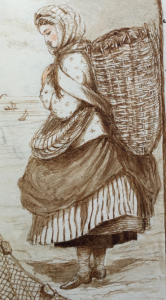
Fishwife illustrated in the cookery book
The volume was gifted by Balfour to Scott in about 1864-65, presumably in anticipation of her coming marriage, and was added to over some eighty years at Monteviot House (the Borders home of the Marquis of Lothian and the Kerr family).
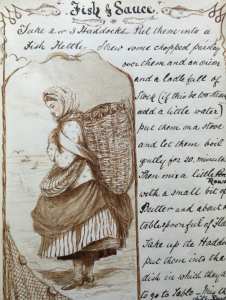
Recipe for ‘Fish sauce’
Victoria Alexandrine Montagu Scott was a daughter of the Duke and Duchess of Buccleuch & Queensberry, and she married Schomberg Henry Kerr, 9th Marquess of Lothian on 23 February 1865, becoming Lady Lothian. Lord Lothian was Scottish Secretary, 1887-1892.
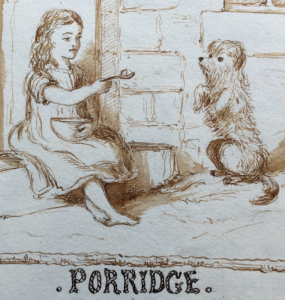
Illustration accompanying the recipe for ‘Porridge’
Spanning the Victorian and Edwardian eras and encompassing two World Wars, the recipes in the ms volume form an interesting chronicle of the Scottish country house diet.
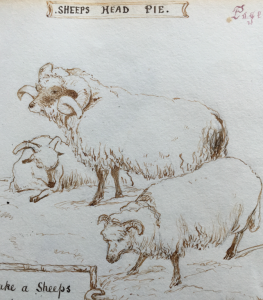
Illustration accompanying the recipe for ‘Sheeps head pie’
The opening pages created by Lady Nina Balfour are decorated with recipes and illustrations for Scottish staples, such as: Sheep’s Head Pie, Cockie Leekie, Porridge, Fish & Sauce plus Kedgeree and Boiled Cheese. Lady Victoria then takes over, with the book remaining in her family for the rest of her life and updated to 1945.
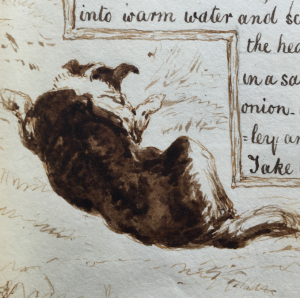
Sheep-dog illustrated with the recipe for ‘Sheeps head pie’
The Victoria Alexandrine recipes are varied: chicken curry, several hotch potches, flan Germanique, Spanish Salad, ginger beer, liniment and chocolate cake. These are often dated from Monteviot and with a note of sources… Monteviot House in the Borders is the residence of the Marquess of Lothian.
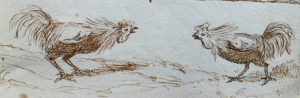
Illustration to ‘Cockie Leekie’ soup
Dr. Graeme D. Eddie, Assistant Librarian Archives & Manuscripts, Centre for Research Collections, Edinburgh University Library
Thus strangely are our souls constructed
We had a fantastic time participating in Festival of Museums at the weekend! From photography to pirates, there was something for everyone!
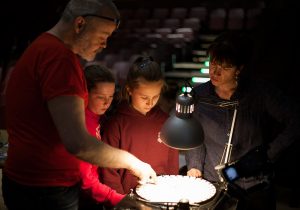
Ani-Adventure: Animation Workshop led by ECA’s Jared Taylor
The finale of the weekend was a talk by Gavin Francis, an Edinburgh University alumnus, who took us on a tour of the human body. He was also signing copies of his excellent book, Adventures in Human Being, based on his experiences as a doctor. Informative and moving, this book has been incredibly well-received.
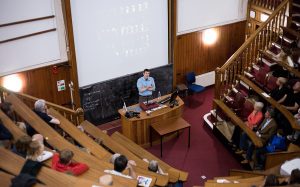
Adventures in Human Being with Gavin Francis in the Anatomy Lecture Theatre
Today, we have two signed copies of the book to give away! All you have to do is identify this quote, which Gavin Francis includes in Chapter One:
‘Thus strangely are our souls constructed, and by such slight ligaments are we bound to prosperity or ruin’
To win, comment below, or contact us on Facebook or Twitter (#happylibrary) with the name of the book and the author! Need a hint? The library holds several copies of this 1818 book!
Remember, the library has more to offer than textbooks!
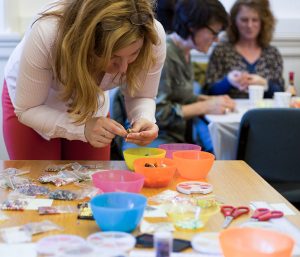
Hidden Gems: Mathematical jewellery workshop
George, in Focus: Hidden Text Revealed
In this week’s blog, Special Collections Conservator, Emily, discusses how she is using different imaging techniques to reveal concealed script.
I was recently challenged with a seemingly impossible task in the conservation studio; to reveal hidden texts in a book without using any invasive conservation treatment. The item in question is Recueil de Desseins Ridicules (1695), a bound volume with 111 illustrations by French artist George Focus. The illustrations have been pasted down overall on to the pages of the volume, however, there is writing on the verso of the drawings which is now, of course, obscured. Little is known about the artist, and this text is thought to be unique, so being able to read it could reveal a great deal about this enigmatic figure.

Illustration from Recueil de Desseins Ridicules (1695) by George Focus
New to the Library: IndiaStat
I’m pleased to let you know that following requests from students in SPS and a successful trial last year the Library has now subscribed to IndiaStat.

Access is available through the Databases A-Z list or the South Asian Studies databases list. Access is available both on and off-campus with your EASE username and password. Read More
New College Library welcomes the General Assembly 2016
New College Library welcomes attendees of the General Assembly of the Church of Scotland, which will take place between 21 and 27 May 2016.

Church of Scotland visitors to the Library are encouraged to apply for a free reference access card, for which photographic ID, proof of address and colour passport-size/style photograph is required. If you are applying for a reference card you may fill in the application form online before visiting the library, and you can check the online library catalogue, DiscoverEd, in advance of your visit. Borrowing access is also available, please ask Helpdesk staff for details. Alumni of the University of Edinburgh are entitled to additional library benefits, including free borrowing and access to JSTOR online journals.
Both reference access and alumni library cards entitle the holder to use not only New College Library but all of the University of Edinburgh libraries, including the Main Library at George Square. This year General Assembly visitors may be interested to visit the Given in Good Faith exhibition being held at the Main Library’s Centre for Research Collections. This highlights some of the treasures of New College Library, through themes of church history, worship, science and scripture which would have been familiar to the staff and students of New College in 1843.

Researchers wanting to trace previous discussions of this year’s debates can consult the Reports to the General Assembly or Blue Books, which are held in New College Library at sLX 50 B. This year’s Blue Book is available to download from the Church of Scotland website. For further information on Church of Scotland resources see Researching the Church of Scotland at New College Library.
New College itself will be very busy during this period, with all of the teaching rooms occupied by the Assembly. This includes the David Welsh Reading Room in New College Library which is being used for Assembly purposes. Library users are advised to carry their UoE staff/student card with them at all times as there may be a security presence at the entrance to New College.
Christine Love-Rodgers – Academic Support Librarian, Divinity
5 things to remember if using the Library this summer
This post was originally published in May 2016.
This Friday, 20th May, is the official last day of semester, so well done for making it this far!
Though many of you will have no intention of coming near the Library for the next few months (it’s ok, we’re not offended, much) there is still a large number of students who want to or need to continue with their studies over the summer.
So if you are one of the many who is planning on using Library facilities or services over the summer then read on. And for those of you who aren’t planning on this maybe you should read on anyway just in case (particularly if you have not returned borrowed books).
1) The Main Library and other site libraries* remain open during the summer vacation period.

Opening hours and Helpdesk staffed hours may be reduced in some libraries so keep an eye on the opening hours web site and follow the Library on social media for updates e.g. @EdUniLibraries, @EdUniMainLib, Facebook, etc. Read More
PhD thesis digitisation project begins!
Stock take completed, equipment purchased and staff in place: the digitisation of the Library’s PhD thesis collection has begun!
In January 2016 we secured funding to complete the digitisation of the Library’s PhD thesis collection. 10,000 PhDs are already accessible through ERA, our online institutional repository, and this project will digitise the remaining 15,000, thereby making unique Edinburgh research available to all.
Since January we have undertaken a full inventory of the collection (a big thank you to Paul, Aaron, Laura, Aoife, Ruby, Michael, Gillian, Joanne, Marco, Christina, Lorna, Ralph and Danielle), bought scanning equipment, PCs and furniture, and transformed one side of the Library Annexe work room into a fully functioning mass digitisation workshop.

Stock take underway at the Main Library and Library Annexe
Perhaps most importantly, this Monday we welcomed Paul Choi, Fiona Mowat, Giulia Giganti, Aoife O’Leary McNeice and Michael Logan to the Projects & Innovations team as Project Digitisation Assistants. This new team will spend the next two years digitising the collection by scanning theses and performing a number of pre and post scan processes.
The collection dates from the early 1600s to the present day and includes theses of varying sizes, styles and formats. Duplicate theses will have their spines removed using an IDEAL 4705 Guillotine and will then be fed through the 100-page-per minute Kodak i4250 document scanner. These copies will be recycled, freeing up around 500 linear metres of storage space in the Main Library building.
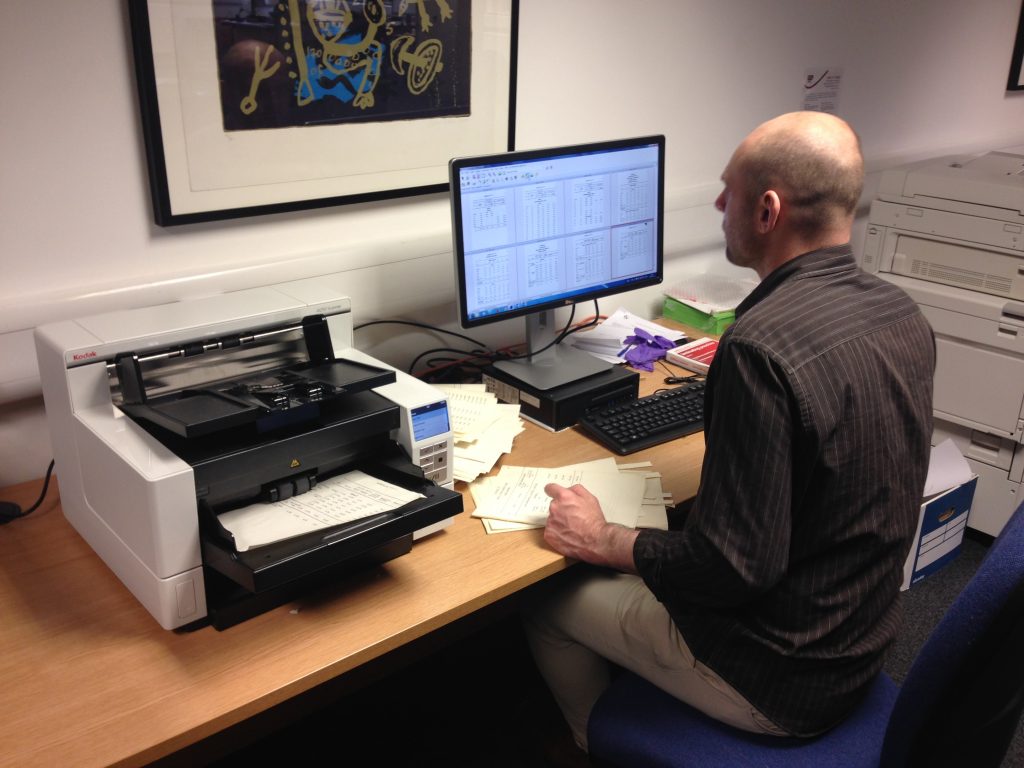
Kodak i4250 document scanner
Unique theses will be scanned manually using a Copibook Cobalt flatbed scanner and any items in poor condition will receive conservation treatment.

Copibook Cobalt book scanners
Following scanning, digital images will undergo several post-processing procedures, such as de-skewing, cropping and de-blurring,and will also be OCR-ed to enable keyword searching. Fully processed files will be uploaded to ERA as searchable multipage PDFs.
We’ll be setting up a project blog and aim to provide regular updates – in the meantime, please contact Gavin.Willshaw@ed.ac.uk if you have any further questions.
Lions and snakes and penguins (oh my!)
As you may have seen in our earlier blog post, this weekend (May 13th-15th) is Festival of Museums! This year’s theme is adventure and we have lots of exciting events planned, from photography to pirates! For more information, see the website here.
To tie in with Festival of Museums, we have been having fun in the Foyer today, making some wild animals out of origami and colouring in pirate ships. If you missed out, you can find some origami patterns here, and the colouring pages here.
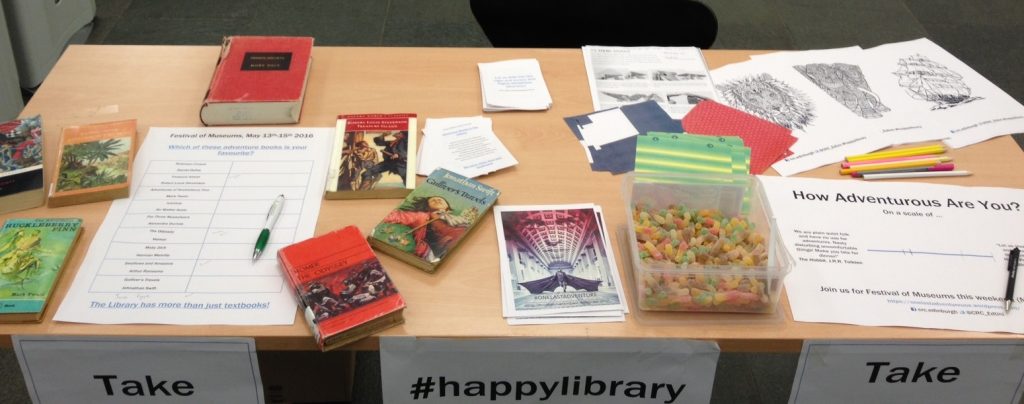
We have also been asking students to vote on their favourite adventure book! We have some great ones here in the Library:
Robinson Crusoe, Daniel Defoe, PR3403 Def.
Treasure Island, Robert Louis Stevenson, PR5486 Ste.
Adventures of Huckleberry Finn, Mark Twain, PS1305 Twa.
Ivanhoe, Sir Walter Scott, PR5318 Sco
The Three Musketeers, Alexandre Dumas, PQ2228 Dum.
The Odyssey, Homer, PA4025.A5 Hom.
Moby Dick, Herman Melville, PS2384.M6 Mel.
Gulliver’s Travels, Johnathan Swift, PR3724 Swi.
So far, The Odyssey is winning, with Treasure Island a close second. Disagree? Let us know what you think via Facebook or Twitter (#happylibrary)!
We will leave you this week with an engraving from one of the University’s holdings of another of these texts, but look out for us popping up again soon!

Steel engraving by R. Staines after a drawing by T. Allom of a scene from Sir Walter Scott’s Ivanhoe. 1837. Corson P.3655. © The University of Edinburgh. See it here.
PhD thesis digitisation project begins!
Stock take completed, equipment purchased and staff in place: the digitisation of the Library’s PhD thesis collection has begun!
In January 2016 we secured funding to complete the digitisation of the Library’s PhD thesis collection. 10,000 PhDs are already accessible through ERA, our online institutional repository, and this project will digitise the remaining 15,000, thereby making unique Edinburgh research available to all.
Since January we have undertaken a full inventory of the collection (a big thank you to Paul, Aaron, Laura, Aoife, Ruby, Michael, Gillian, Joanne, Marco, Christina, Lorna, Ralph and Danielle), bought scanning equipment, PCs and furniture, and transformed one side of the Library Annexe work room into a fully functioning mass digitisation workshop.
Stock take underway at the Main Library and Library Annexe
Perhaps most importantly, this Monday we welcomed Paul Choi, Fiona Mowat, Giulia Giganti, Aoife O’Leary McNeice and Michael Logan to the Projects & Innovations team as Project Digitisation Assistants. This new team will spend the next two years digitising the collection by scanning theses and performing a number of pre and post scan processes.
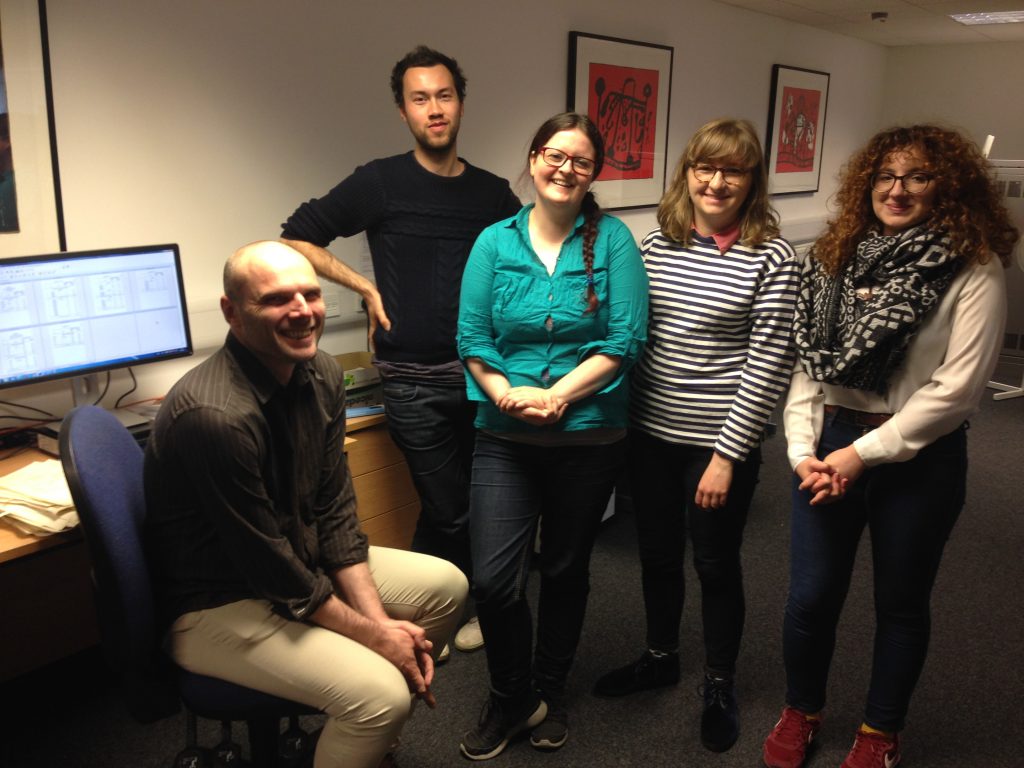
Project team: Michael, Paul, Fiona, Aoife and Giulia
The collection dates from the early 1600s to the present day and includes theses of varying sizes, styles and formats. Duplicate theses will have their spines removed using an IDEAL 4705 Guillotine and will then be fed through the 100-page-per minute Kodak i4250 document scanner. These copies will be recycled, freeing up around 500 linear metres of storage space in the Main Library building.
Kodak i4250 document scanner
Unique theses will be scanned manually using a Copibook Cobalt flatbed scanner and any items in poor condition will receive conservation treatment.
Copibook Cobalt book scanners
Following scanning, digital images will undergo several post-processing procedures, such as de-skewing, cropping and de-blurring,and will also be OCR-ed to enable keyword searching. Fully processed files will be uploaded to ERA as searchable multipage PDFs.
We’ll be setting up a project blog and aim to provide regular updates – in the meantime, please contact Gavin.Willshaw@ed.ac.uk if you have any further questions.
Collections
 Hill and Adamson Collection: an insight into Edinburgh’s past
My name is Phoebe Kirkland, I am an MSc East Asian Studies student, and for...
Cataloguing the private papers of Archibald Hunter Campbell: A Journey Through Correspondence
My name is Pauline Vincent, I am a student in my last year of a...
Hill and Adamson Collection: an insight into Edinburgh’s past
My name is Phoebe Kirkland, I am an MSc East Asian Studies student, and for...
Cataloguing the private papers of Archibald Hunter Campbell: A Journey Through Correspondence
My name is Pauline Vincent, I am a student in my last year of a...
Projects
Cataloguing the private papers of Archibald Hunter Campbell: A Journey Through Correspondence
My name is Pauline Vincent, I am a student in my last year of a...
Archival Provenance Research Project: Lishan’s Experience
Presentation My name is Lishan Zou, I am a fourth year History and Politics student....