Home University of Edinburgh Library Essentials
March 30, 2026

DATA-X Workshop 2
We are holding our second DATA-X workshop on Wednesday 15 June at the
James Clerk Maxwell Building, Room 3217 and are inviting PhD students
and technologists to come along and participate in what we hope will
be lively discussion and activities.
We aim to engender Art and Science collaborations by offering
micro-funds towards each ‘installation’ as well as the opportunity to
publish in the exhibition catalogue and present at the Pioneering
Research Data Symposium later in the year.
We have over 20 registered participants with a range of research
interests including:
Crystal structure, Raman spectroscopy, Structural biology,
Measurement-Based Power Systems Control, Astrophysics, Polymer-sensors,
Biological data mining, Computational Mechanics,
Internationalization of Higher Education, Bioinformatics, Evolution,
Genomics, Visual sociology, Advertising, National identity, Environment,
Agriculture, Nutrient Management, Soil, Pollen, Farmers, Social Network
Analysis, Food security, Systems biology, Cell level
modelling, Cell physiology, Mobile User Experience, Enviromental
Sustainability, Political science, Human rights, Data materialisation,
Digital fabrication, Practice based research, Synthetic
biology!
To register for the workshop (and get a free lunch) see:
http://data-x.blogs.edina.ac.uk/
To find out more about DATA-X see:
http://data-x.blogs.edina.ac.uk/about/
or watch the short You Tube
trailer: https://youtu.be/NMPPZZc-sZ4
Please get in contact should you require further information.
All best,
Stuart Macdonald
DATA-X Project Manager / Associate Data Librarian
EDINA
Soft Furnishing Upholstery Works
A number of soft seating areas within the library will undergo upholstery work during the summer – these include stools within the study pods on the ground floor, 1st floor and café area as well as other soft seating areas in the mezzanine level and break out areas on some floors.
The colour samples below represent the new colour scheme within the group study pods.


Study Pods – Audio Visual Upgrade
Over the summer, we will also be upgrading the audio-visual kit in the Student Study Pods on the ground and first floor of the Main Library. The refresh will increase the size of the screens as well as moving from analogue to digital, improving the screen image quality.
The Pods will also have Bring Your Own Device (BYOD) connectivity allowing users to wirelessly connect their laptops and smart devices to the screens to show content. The work will be completed before the start of Welcome week.
PC Upgrades – Main Library
We have started on a programme to upgrade all PCs on floors 3 & 4 to new HP EliteOne 800 G2 Models. This work will continue over the summer. The PCs on the 3rd floor have already been replaced and we will now be concentrating on replacing PCs on the 4th floor.
We will also be upgrading a number of DiscoverEd search points on levels 2 to 6 and within the library café.
Media Hopper
If you have not already done so, do check out our new media asset management solution – Media Hopper – a new service that puts video at the heart of teaching, learning, research and public engagement. Read More
Celebrating Shakespeare
 With the 400th anniversary this year of the death of one of our greatest and most influential playwrights, William Shakespeare, I found myself cropping images of some of his first printed quartos for the creation of an e-reader as part of the Shakespeare image collection. Now existing as high quality e-readers are the plays Love’s Labours Lost (1st Quarto Edition) and Romeo and Juliet (2nd Quarto Edition), both of which are used as part of the collaborative project concerning Shakespeare’s printed quartos, The Shakespeare Quarto Archive (http://www.quartos.org/index.html). These works themselves have very unique histories and are important in Shakespearean studies for many reasons. Their place in the Special Collections in the University of Edinburgh Library is invaluable.
A Passage to India – Part 1
In this week’s blog, Special Collections Conservator Emily, describes the first stage of conserving a collection of Indian portraits…
I was recently asked to complete a condition report and treatment proposal for a collection of 32 portraits from India, known as a Tasawir, dating from the late eighteenth or early nineteenth century. The images have been pasted onto gold-sprinkled paper, and 7 have examples of calligraphy on the back. They are due to be used in a teaching seminar at the University in the new academic year and are scheduled for exhibition in 2017, but need to be conserved and rehoused before they can be safely handled and displayed. Prior to any conservation work carried out on treasures in the collection such as this, a full condition report is required to document any signs deterioration. This allows the conservator to study the object in detail to understand the materials used, the types of damage found and what may have caused it, ensuring that the treatment proposal put forward is carefully considered and suitable for the item. The brilliance of the pigments used, and the detailed nature of the paintings make these items visually stunning and I was delighted to be given the opportunity to examine them closely.
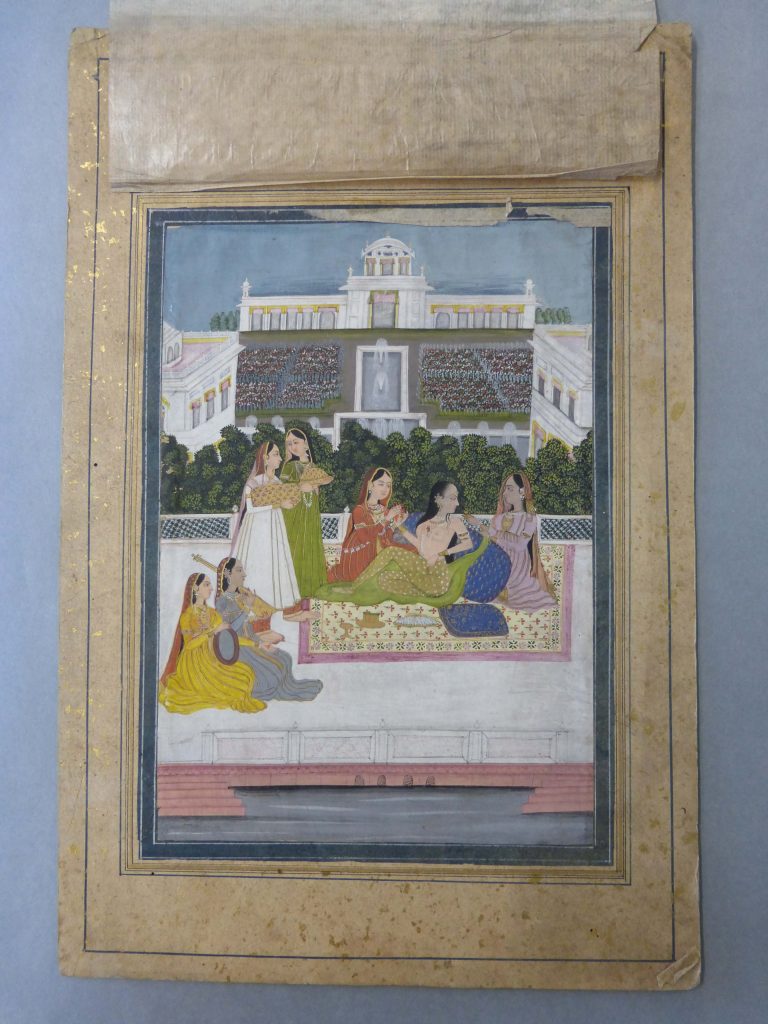
One of the paintings in the Tasawir
The Battle of Jutland – 100 years on
This week sees the hundredth anniversary of the Battle of Jutland, the largest and most important naval engagement of the First World War, and also a particularly Scottish event, as the majority of the British ships involved set out from Scottish ports – from Rosyth on the Forth, up to Scapa Flow in Orkney.
As the Navy, the politicians and VIPs, heavy security and the media descend on Orkney this week, it seemed an appropriate moment to see what we could find in our collections of the contemporary reporting and commentary on the battle.
The outcome of the battle of Jutland was complex: the losses of British ships and lives were far higher than the Germans’; but, it was a tactical advantage in that Britain retained control of the seas, maintained the blockade of German shipping and ultimately it contributed to winning the war. However, immediately after the battle the longer-term consequences were not obvious and the consequences of the confused action were very much open to interpretation.
Jutland, was, for the Admiralty, a media disaster: the German High Seas Fleet, having retreated to port, issued prompt communiques declaring it their victory. The Admiralty was unable to report so rapidly; the British fleet was still at sea, and they had no information. When they did issue their own communique it was so badly worded as to make the British media interpret it as a defeat.
This was embarrassing. The situation inspired the Admiralty to start a systematic propaganda campaign, as well as a review of how they handled these matters.
Their propagandist of choice was Rudyard Kipling – famous, influential, very much in support of the war, but long sympathetic to the lot of the ordinary soldier or sailor. He was already writing general newspaper articles for the Admiralty – three were ready for publication when Jutland happened, appearing in The Times in late June 1916. Kipling’s visits to the Fleet in connection with these had made contacts among the officers, and he had heard first-hand accounts of the battle as soon as a week after it happened. In August he was provided with all the official reports, and in October four articles were published in The Daily Telegraph.
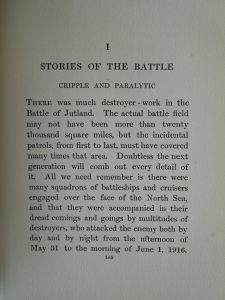
These begin by outlining a positive interpretation of the battle, stressing the confusion of the action and the difficulty for those involved of being sure what was happening. The rest of the articles, consistently upbeat in tone, consist of anecdotes showing the bravery, resourcefulness and ingenuity of the men involved, in overcoming battle damage, hitting their enemy targets, and getting their ships home. They owe as much to Kipling’s contacts among the ships’ crews as to the official reports, and are as colourful in the telling as his fictional stories. Indeed, they are openly somewhat fictionalised to avoid disclosing military intelligence.
From a modern perspective the thing which seems odd about these is the timing. In our modern instant-news culture a series of lengthy articles would be unlikely to be published four and a half months after the event, and certainly not as a means to win round public opinion in that way. What is even more alien to modern media culture, is that these, along with Kipling’s other articles for the Admiralty, were republished in book form before the end of 1916.
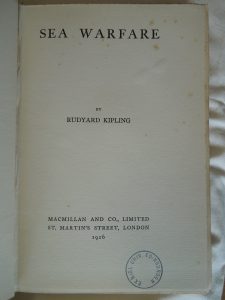
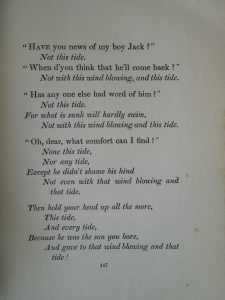
However, the book version interspersed the articles with verse, and acquired a greater nuance of interpretation than that conveyed by the original articles alone. The Jutland section of the book opens with ‘My Boy Jack’, a reflection on the dead. This undoubtedly carries some of Kipling’s feelings about the loss of his own son at the battle of Loos the previous year, framed in naval terms.
Our copy of Sea Warfare, can be consulted in the Centre for Research Reading Room, shelfmark: S.B. 82391 Kip.
Oxford Bibliographies – additional modules purchased

Following a successful trial at the end of last year, Oxford Bibliographies modules have been purchased in the following subject areas:
- American Literature
- Anthropology
- Biblical Studies
- British and Irish Literature
- Criminology
- Education
- Hindu Studies
- International Law
- International Relations
- Jewish Studies
- Linguistics
- Psychology
- Social Work
- Sociology
Developed cooperatively with scholars worldwide, Oxford Bibliographies offers exclusive, authoritative research guides. Combining the best features of an annotated bibliography and a high-level encyclopedia, this cutting-edge resource guides researchers to the best available scholarship across a wide variety of subjects.
Each subject area has an Editor in Chief, Editorial Board, and team of peer reviewers overseeing the development and updating of articles ensuring balanced perspective with scholarly accuracy and a robust updating program to keep researchers informed of advances in their field. See http://oxfordbibliographiesonline.com/obo/page/subject-list for the list of articles included in each subject module.
Access Oxford Bibliographies via DiscoverEd or the Databases A-Z list.
Stuck with your dissertation literature search? Try this.
 Are you stuck with the literature search for your dissertation? Not finding as much on your topic as you hoped? Here are five suggestions to help you move forward. Read More
Collections
 Hill and Adamson Collection: an insight into Edinburgh’s past
My name is Phoebe Kirkland, I am an MSc East Asian Studies student, and for...
Cataloguing the private papers of Archibald Hunter Campbell: A Journey Through Correspondence
My name is Pauline Vincent, I am a student in my last year of a...
Hill and Adamson Collection: an insight into Edinburgh’s past
My name is Phoebe Kirkland, I am an MSc East Asian Studies student, and for...
Cataloguing the private papers of Archibald Hunter Campbell: A Journey Through Correspondence
My name is Pauline Vincent, I am a student in my last year of a...

Projects
Cataloguing the private papers of Archibald Hunter Campbell: A Journey Through Correspondence
My name is Pauline Vincent, I am a student in my last year of a...
Archival Provenance Research Project: Lishan’s Experience
Presentation My name is Lishan Zou, I am a fourth year History and Politics student....