Home University of Edinburgh Library Essentials
May 5, 2026
Cambridge University Press e-Journals and e-Books Downtime

Cambridge Journals Online, Cambridge Books Online, Cambridge Histories Online, Cambridge Companions Online, Shakespeare Survey Online and University Publishing Online will be unavailable Sunday 26th June from 9am to 1pm.
Cambridge University Press apologise for the inconvenience of this downtime and have advised that it is due to essential maintenance work ahead of the migration of content held on the above platforms to their new integrated platform branded Cambridge Core and scheduled for release mid 2016. See http://librarians.cambridgecore.org/watch-the-cambridge-core-video/ for an introduction to Cambridge Core.
Twenty’s Plenty: DataShare v2.1 Upload Upgrade
We have upgraded DataShare (to v2.1) to enable HTML5 resumable upload. This means depositors can now use the user-friendly web deposit interface to upload numerous files at once via drag’n’drop. And to upload files up to 15 GB in size, regardless of network ‘blips’.
In fact we have reason to believe it may be possible to upload a 20 GB file this way: in testing, I gave it 2 hours till the progress bar said 100%, and even though the browser then produced an error message instead of the green tick I was hoping for, I found when I retrieved the submission from the Submissions page that I was able to resume, and the file had been added.
*** So our new advice to depositors is: our current Item size limit and file size limit is 20 GB. Files larger than 15 GB may not upload through your browser. If you have files over 15 GB or data totalling over 20 GB which you’d like to share online, please contact the Data Library team to discuss your options. ***
See screenshots below. Once the files have been selected and the upload commenced, the ‘Status’ column shows the percentage uploaded. A 10 GB file may take in the region of 1 hour to upload in this way. 15 GB files have been uploaded with Chrome, Firefox and Internet Explorer using this interface.
Until now, any file over 1 GB had caused browsers difficulties, meaning many prospective depositors were not able to use the web deposit interface, and instead had to email the curation team, arrange to transfer us their files via DropBox, USB or through the Windows network, and then the curator had to transfer these same files to our server, collate the metadata into an XML file, log into the Linux system and run a batch import script. Often with many hiccups concerning permissions, virus checkers and memory along the way. All very time-consuming.
Soon we will begin working on a download upgrade, to integrate a means for users to download much bigger files from DataShare outside of the limitations of HTTP (perhaps using FTP). The aim is to allow some of the datasets we have in the university which are in the region of 100 GB to be shared online in a way that makes it reasonably quick and easy for users to download them. We have depositors queueing up to use this feature. Watch this space.
Further technical detail about both the HTML5 upload feature and plans for an optimised large download release are available on the slides for the presentation I made at Open Repositories 2016 in Dublin this week: http://www.slideshare.net/paulineward/growing-open-data-making-the-sharing-of-xxlsized-research-data-files-online-a-reality-using-edinburgh-datashare .
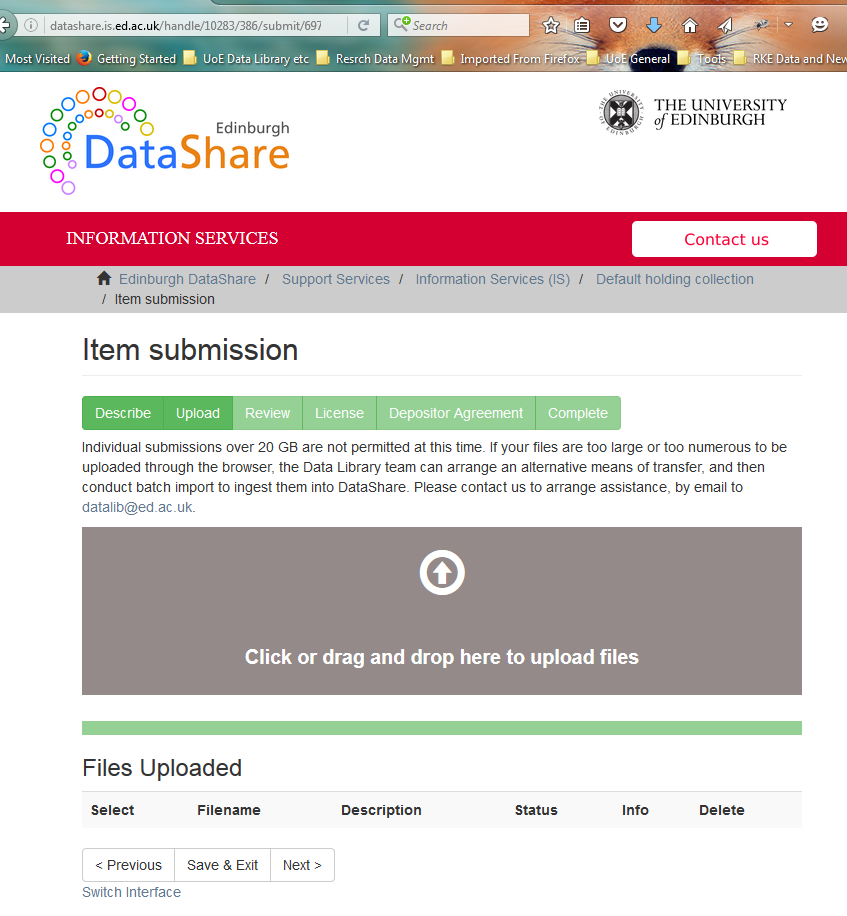
A simple interface invites the depositor to select files to upload.
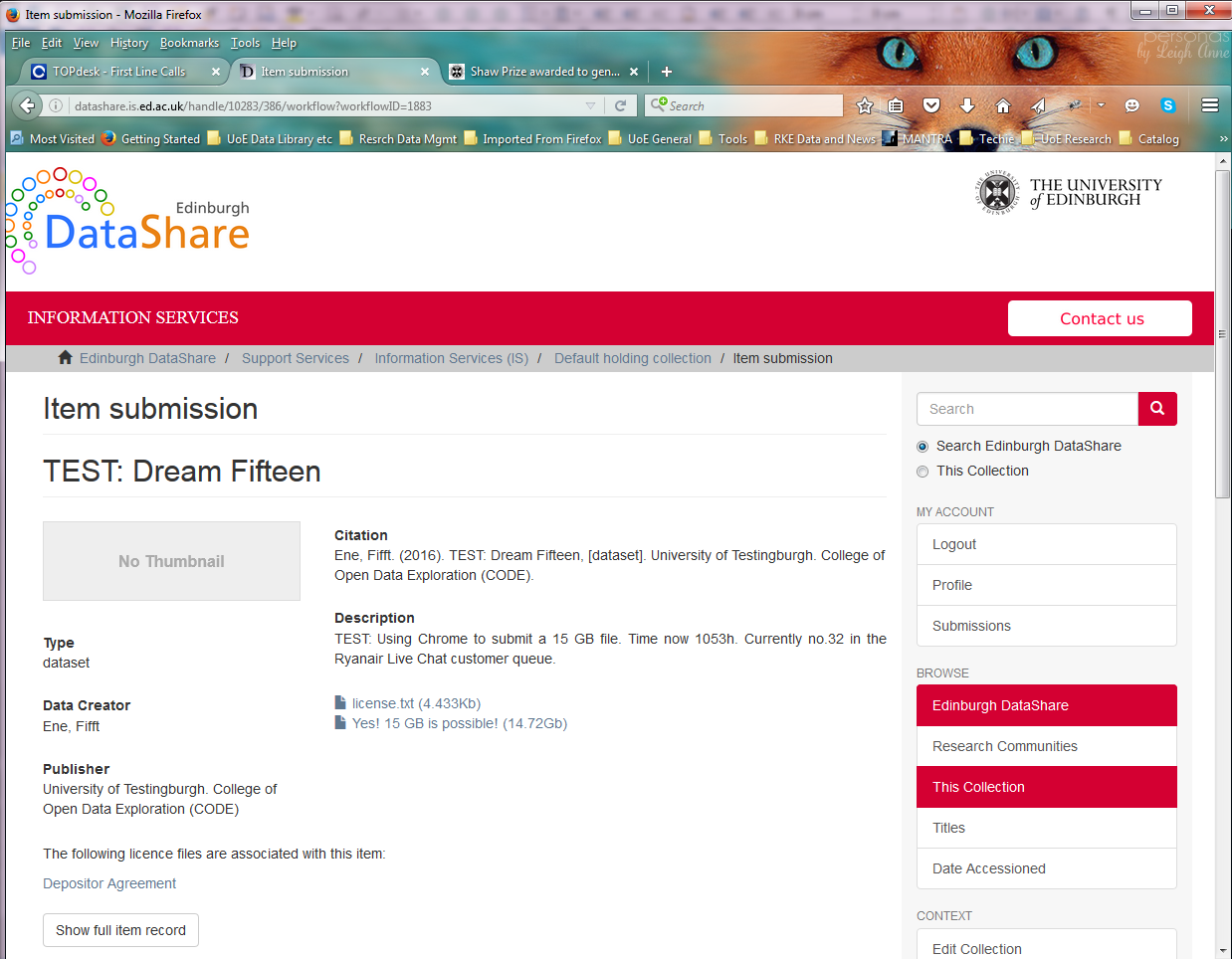
A 15 GB file uploaded via Firefox on Windows and included in a submitted Item.
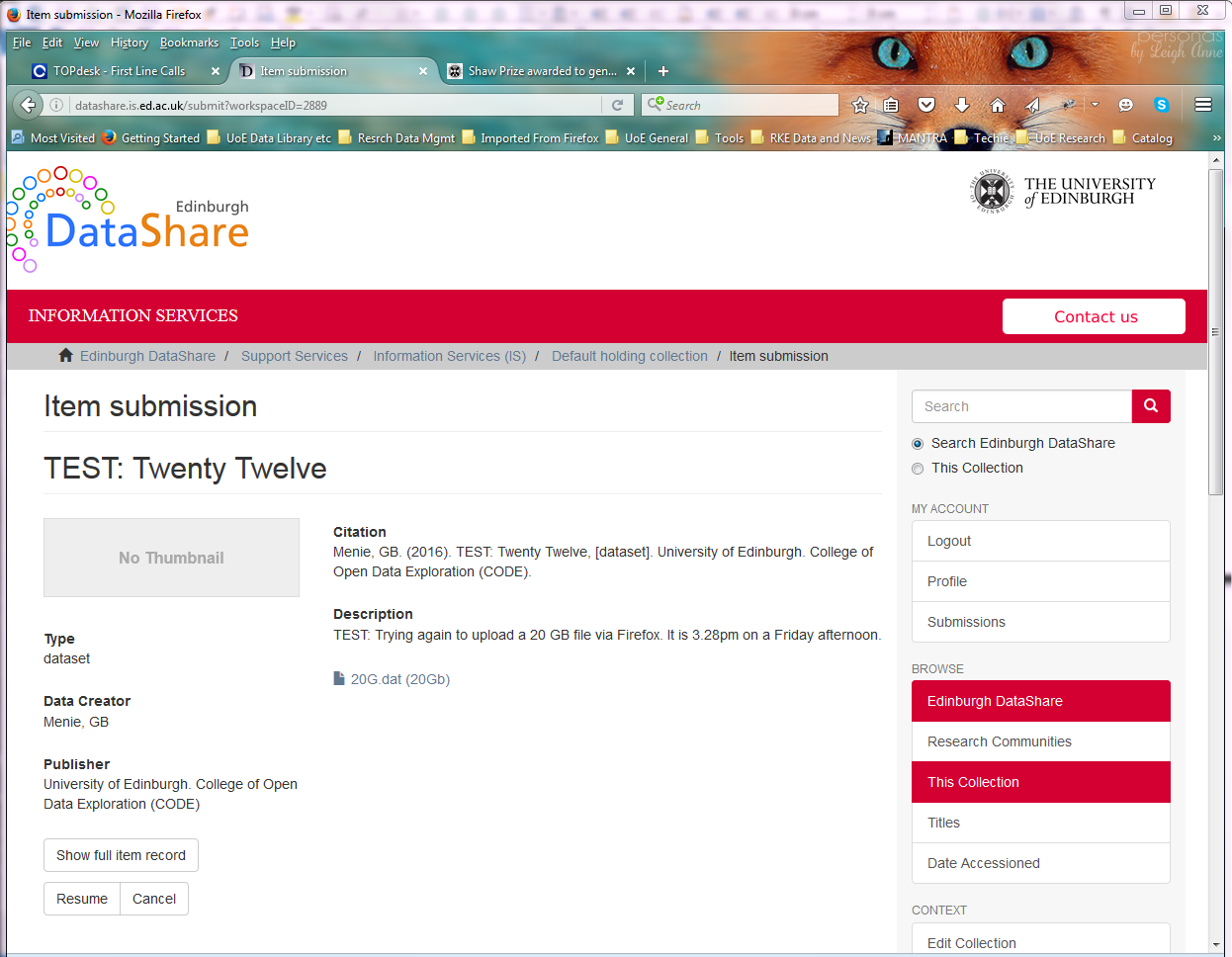
A 20 GB file uploaded and included in an incomplete submission.
Pauline Ward, Data Library Assistant, University of Edinburgh
New resource: Historical Statistics of the United States
I’m pleased to let you know that following a successful trial earlier this year the Library has recently purchased Historical Statistics of the United States: Millennial Edition Online.

Historical Statistics of the United States (HSUS) is a compendium of statistics about the United States and is the standard source for the quantitative facts of American history. Read More
Oxford Handbooks Online – new content purchased

We have purchased the following e-book collections to add to our existing Oxford Handbooks Online holdings:
- Archaeology – 2015, 2016 Collection
- Business and Management – 2015, 2016 Collection
- Classical Studies – 2015, 2016 Collection
- Criminology – 2015, 2016 Collection
- Economics and Finance – Foundation, 2012, 2013, 2014, 2015, 2016 Collection
- History – 2015, 2016 Collection
- Law – 2012, 2013, 2014, 2015, 2016 Collection
- Linguistics – 2015, 2016 Collection
- Literature – 2015, 2016 Collection
- Music – Foundation, 2012, 2013, 2014, 2015, 2016 Collection
- Philosophy – 2013, 2014, 2015, 2016 Collection
- Politics – 2015, 2016 Collection
- Psychology – Foundation, 2012, 2013, 2014, 2015, 2016 Collection
- Religion – 2013, 2014, 2015, 2016 Collection
These new purchases now bring us fully up to date with all Oxford Handbooks Online content until the end of 2016. Title lists for the entire collection or subject specific title lists are available at http://www.oxfordhandbooks.com/page/title-lists
Access
Basic records for each e-book have been added to DiscoverEd, these will be overwritten with fuller records. Additional titles will be added throughout 2016 as further titles are published.
An entry for Oxford Handbooks Online is also listed on the E-book AZ list and the Databases AZ list.
James Miranda Steuart Barry and the Crimean War
We recently became aware of a single letter from James Miranda Barry, written just before departure for Sebastopol shortly after its capture by the ‘allies’ in 1855. We acquired it in 1977.
Margaret Bulkley was born in Ireland: a bright, precocious child, she moved to London, with her mother in 1805 and there had access to General Francisco de Miranda’s library with ‘treatises such as might be considered to form a tolerably complete Medical Library for a private gentleman’. As her father had been declared bankrupt, she had no hope of a good marriage so it was decided she should go to university but this was not an option for a woman.
Taking the name of James Barry (after an uncle), Barry went to study medicine, at Edinburgh University, one of the most demanding and rigorous courses in Britain. Barry graduated with a MD thesis dedicated to patrons, General Francisco de Miranda and David Steuart Erskine, 11th Earl of Buchan (1742-1829). Then, even more extraordinary, after further training, Barry joined the army and travelled throughout the British Empire. There is no definitive version of Barry’s adopted name.
Read more about Barry on Our History
We knew about Barry’s matriculation and graduation records and MD thesis. This letter, while recorded in our sheaf index to manuscripts, had not yet made its way into our online catalogue and was stumbled upon while looking for something else. It makes interesting reading.



(Update: More recent scholarship has raised other perspectives in terms of Barry’s sex and gender. The above has therefore been edited to remove references to gendered pronouns, other than for Barry’s childhood)
Paper Conservators: News and Ideas Exchange 2016
This week’s blog post comes from Conservation Volunteers Mathilde Renauld and Paula Burbicka, who recently attended a paper conservators new and ideas exchange event at the CRC….
Scotland’s Paper Conservators gathered on May 4th 2016 for informal 5-minute presentations and socialising, hosted by the Centre for Research Collections (CRC), University of Edinburgh.
Organiser Helen Creasy (The Scottish Conservation Studio) began by enumerating the outcomes of last year’s news and ideas exchange; this year’s well attended event will also assuredly be impactful. Talks were enthusiastically received, prompting many questions and fruitful discussions.
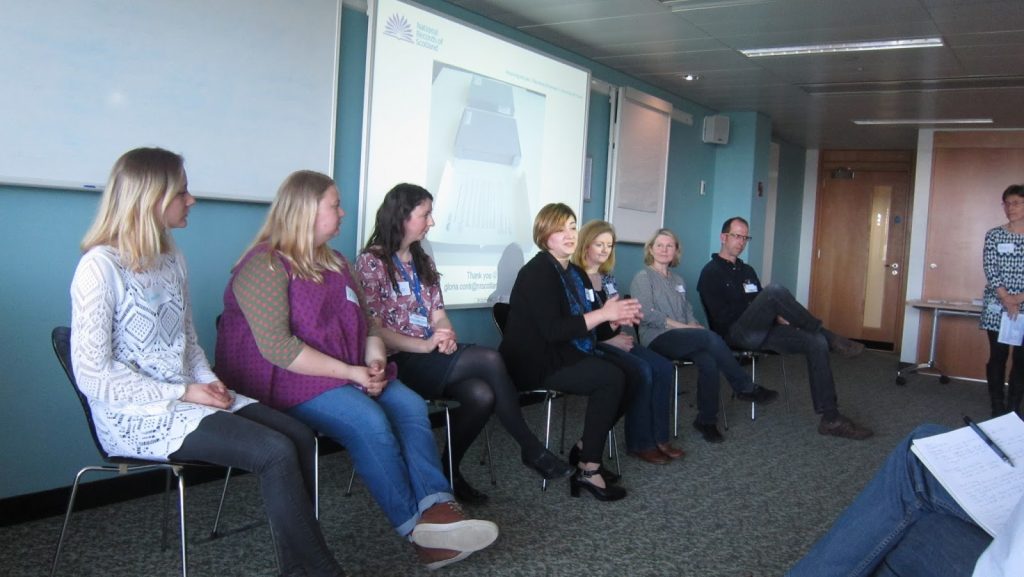
Paper conservators at the news and ideas exchange
There are always flowers
There are always flowers for those who want to see them.
Henri Matisse
This week is British Flowers Week! This is a week-long celebration of British flowers and the UK cut flowers industry, and it has been making us think about all the flowers we have in our collections here. We have decided to feature some of our favourites below!
One of our most special items is this eighteenth-century harpsichord – the most famous harpsichord in the world! More copies have been made of this harpsichord than any other in the world, and it was used as the model for the first harpsichord built in the revival period. Look at the beautiful flower detailing on it:

Find more information here.
To turn to our manuscript collections, the flowers in the margins of MS 195, our fifteenth-century copy of Virgil’s Georgics camouflage a variety of interesting creatures:

© The University of Edinburgh. Find more information here.
We also have many modern fiction books that feature flowers. Why not borrow Umberto Eco’s The Name of the Rose (PQ4865.C6 Eco.) to read this summer? Alternatively, we have The Black Tulip, by Alexandre Dumas (PQ2229 Dum.)! What is your favourite flower-related book?
Remember, the library has more than textbooks! Flowers are everywhere if you look for them!
Managing publisher’s open access memberships with Trello

As more and more publishers have started to offer open access institutional memberships we have started to struggle with the effective management of the various schemes. We are currently signed up to 12 active deals and are scoping half a dozen more. All of the memberships are at different stages of maturity leading to a fairly complex situation if you are trying to stay on top of things.
Currently this work is all carried out by one member of the Scholarly Communications Team; however, we are trying to move towards a more transparent decision making and management process which is available to the whole team and other associated staff members.
After reading an interesting post about the use of Trello within Libraries we decided to try out this project management tool for managing our open access membership schemes. I won’t go into detail about about Trello, as this is covered by the blog post linked above, but I will talk about how we are using the tool for this specific purpose.

Each project you wish to manage with Trello gets assigned it’s own board which you can keep private to an individual or share with a team. In the screenshot above you can see that I have 3 private boards and am sharing 2 boards with the Scholarly Communications Team. Looking in more detail at the OA Prepay membership board (screenshot below) you can see that we have created 4 vertical columns, known as lists, each populated with a number of cards. You can assign tasks to cards, but in this case we have chosen to allocate them to publishers membership deals. If you want to you can even assign cards to be monitored by specific people within the team, but we have not yet opted to do this.

The lists are a way to keep the cards organised – for example each list could represent a workflow step. If you like the ‘Getting Things Done‘ methodology you could have To Do, Doing and Done lists.
When looking at publishers’ open access membership deals there are a number of tasks that need to be carried out which can be arranged into 4 general groups:
- Evaluating the initial offering
- Sign-up procedures
- Day-to-day administration and usage monitoring
- Renewal/ deactivation decision making
We decided to use 4 lists to represent the workflow of moving from evaluating new publisher deals, through completing the sign up procedures and monitoring usage, finishing with renewal/deactivation processes:
Scoping -> Current Memberships <-> Action required ->Dropped memberships
Each new potential open access membership deal would be given a new card (see below for an example). The card is firstly populated with a brief description of the membership. We then add a Label (to enable filtering by publisher), a Checklist of to-do items, and a Due Date when a decision is needed. It is possible to add attachments to the card, for example the offer documents or contracts, but we have decided not to do this. Instead we show the file path where the documents are saved on shared network drives accessible only to the team. We don’t trust giving a third party our business documents in case of a data breach.

Once the checklist items have been worked through, if successful and the membership was activated, the card would move over right to the Current Membership list. If unsuccessful we would place at the bottom of the Scoping list with a sticker indicating this (a big red thumbs down).

Once on the Current memberships list (2) the cards are ordered by dates, with the membership deals that are ending first placed at the top. Any member of the Scholarly Communications Team can then see which deals are active, when the membership runs out, find out details of the deal including costs, sales rep contact details and links to other documentation. This is preferable to having all the membership knowledge retained by one member of the team.

Towards the end of the membership period the cards are moved over to the Action Required list (3) to indicate that a renewal or deactivation decision is needed to be made. If renewed the card is placed back into the Current Memberships list with details updated and the Due Date reset (4). If the renewal is rejected then the card is passed right to the Dropped Membership list (5), with the decision details recorded so they can be revisited at a later date if the renewal is questioned.
In summary, the workflow we present here might not work for every institution however we have found Trello to be a very useful tool to manage the process of managing open access membership schemes within a team setting. It’s main benefits are that it is highly visual and thus easy to use with minimal training, very adaptable to fit different circumstances and the basic version is free.
Less than one week to go!
With less than a week to go before our first ever Knowledge Exchange Week begins, we are getting excited about meeting all of our participants.
Our programme for the week has now been finalised and you can find it online here.
During the week, you will be able to follow everything that is going on by checking the blog for daily updates and following #EdLibKEW
Current Library Exhibitions
A reminder that there are a couple of exhibitions taking place in the Main Library that you may wish to check out! Read More
Collections
 Hill and Adamson Collection: an insight into Edinburgh’s past
My name is Phoebe Kirkland, I am an MSc East Asian Studies student, and for...
Cataloguing the private papers of Archibald Hunter Campbell: A Journey Through Correspondence
My name is Pauline Vincent, I am a student in my last year of a...
Hill and Adamson Collection: an insight into Edinburgh’s past
My name is Phoebe Kirkland, I am an MSc East Asian Studies student, and for...
Cataloguing the private papers of Archibald Hunter Campbell: A Journey Through Correspondence
My name is Pauline Vincent, I am a student in my last year of a...

Projects
Cataloguing the private papers of Archibald Hunter Campbell: A Journey Through Correspondence
My name is Pauline Vincent, I am a student in my last year of a...
Archival Provenance Research Project: Lishan’s Experience
Presentation My name is Lishan Zou, I am a fourth year History and Politics student....