Home University of Edinburgh Library Essentials
March 28, 2026
Collections Management talk and Library Annexe tour – Hannah Mateer
On Monday 20 June I gave a talk focusing on the relationship between Collections Management projects and the development of the University Estate.
I spoke about the Law Library refurbishment at the University as an example of a current collections project which results from an Estates development. In this project we’re moving the Law Library to a temporary location for 18 months while the permanent Law School undergoes a complete refurbishment and then in December 2017 / January 2018 we’ll move the Library back to its refurbished home. As part of this move the Collections Lifecycle Management team and Law Library colleagues are managing the move of the collections and undertaking collection assessment, relegation and weeding projects.
In addition to the continual transformation of the University Estate, the ongoing management of our collections is also undertaken within the wider context of developments such as our e-preference model for new acquisitions, the increase in online distance learning, the growth of our heritage collections and our commitment to collaborative collection management with other institutions.
On Wednesday 22 June I then gave a tour of the Library Annexe, the Library’s offsite storage facility.
In addition to showing how we house some of our different collections — monographs, journals, archives, art works … harpsichords! — I spoke about the retrieval and scanning services we offer to allow access to our collections in the store.

During the tour the group discussed some of the challenges we all face in managing print collections. Some common themes were the increasing need for collaborative solutions to issues of space and retention / disposal and the need for purpose-build storage facilities to provide appropriate conditions for our valuable or unique heritage collections.
Vetstream Vetlexicon

Following a successful trial, the Library now subscribes to Vetstream Vetlexicon
Vetstream Vetlexicon Canis, Felis, Lapis and Equis (dogs, cats, rabbits and horses) services are subscription based online encyclopaedias of point-of-care clinical veterinary information. The content is provided by 900 of the world’s leading veterinary clinicians and includes more than 19,000 peer-reviewed articles on diseases and their pathogens, diagnostic tests, medical and surgical treatments as well as breeds and owner factsheets and images, videos and heart sounds. The content is categorised into 30 body systems and disciplines and cross-linked to each other. This allows the veterinarian to move between all the relevant information relating to a particular case, enabling them to diagnose, treat and effectively communicate all the relevant information to the owner.
Features include
- Updated weekly
- Search function that searches across all four services (dog, cat, rabbit and horse) to enable a comparative approach
- Diagnostic images, sound and video
- Owner factsheets to support your communication with owners
- Detailed formulary so you can prescribe with confidence
- Direct links to PubMed and VetMed Resource
- Free Monthly newsletters
- RSS & Twitter feeds of updated content
Vetstream Vetlexicon can be accessed via DiscoverEd and the Veterinary Medicine Databases A-Z list.
Meet the Project Digitisation team!
We’re now almost two month’s into the PhD thesis digitisation project. Find out a bit more about the project digitisation team below!
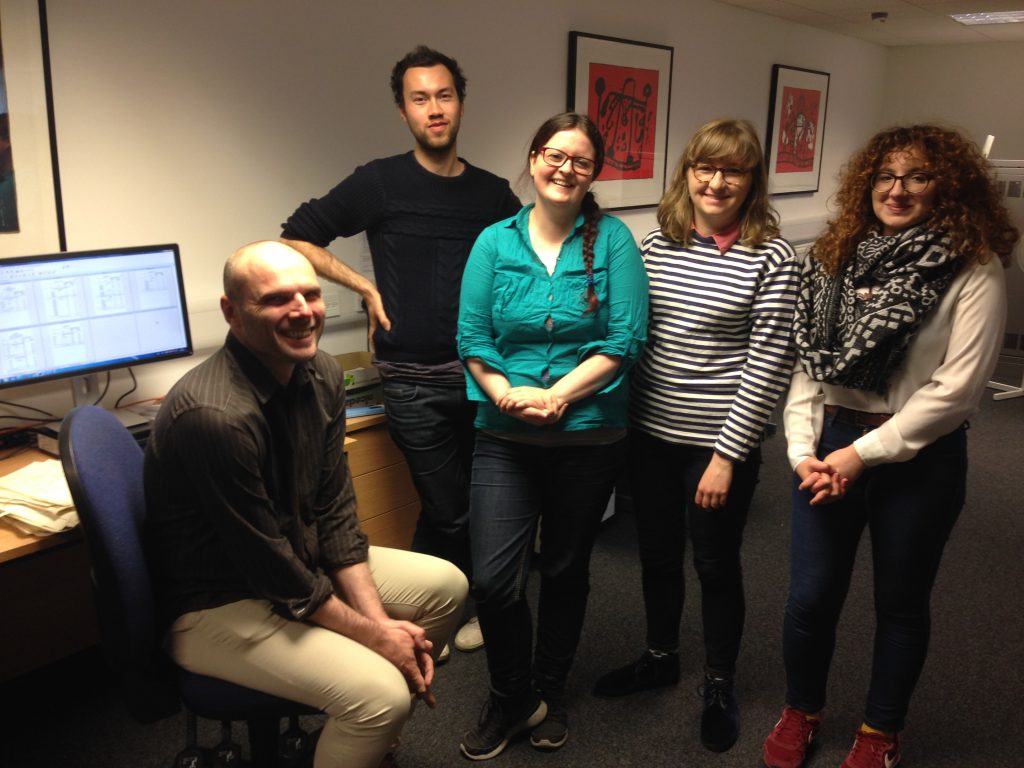
The Project Digitisation team: Michael, Paul, Fiona, Aoife , Giulia
Fiona
I am Fiona Mowat and I have worked at Edinburgh University since 2009 in various different capacities, including as a Shelving Assistant and as a Rare Books Cataloguing intern. Having recently completed my PhD in Roman Art and Archaeology, I am keen to expand my knowledge in the fields of Library and Museum Collections and in particular Digitisation – this connects to my archaeological fieldwork experience and speciality in finds processing and imaging.
I love to catalogue and really enjoy enabling library users to discover material that they had no idea existed. It is great, in this role, to preserve other people’s PhD theses in an electronic form so that their research is discoverable and will continue to make a scholarly impact many years or decades on!
Aoife
I studied English and History in University College Cork and later pursued a Master’s degree in Eighteenth-Century Literature and Society at the University of Edinburgh, from which I graduated last year. Throughout my studies I benefited hugely from digital collections, be it an eighteenth-century travel guide or a student magazine from the early twentieth century. During my studies I worked in different roles in different libraries, handling material as diverse as ephemera from the recent independence referendum to musical instrument mouthpieces.
The theses we are working with are equally diverse, ranging from polar exploration to potato tubers (a surprisingly popular topic), I am excited to be part of the team digitising this diverse and fascinating collection.
Giulia
I have always (academically and professionally) worked closely with heritage and library collections. Before starting this post at here at the University, I worked at the National Galleries of Scotland as a digitisation assistant, seconded at the National Library of Scotland and volunteered for a variety of cultural organisations.
Digitisation gives you the unique opportunity to work with both the physical and digital items; it exposes you to the breadth, uniqueness and heterogeneity of the collection. I am looking forward to understanding what collections and artefacts, such as PhD theses, can tell us about, not only academic subjects, but also practices of the university, topic-trends and gender.
So far we have digitised all sorts of work, from thesis on the chemical qualities of potatoes to ones on the evolution of foot-binding in China. A particular favourite of mine is Raymond Mills’s ‘The Effect of Urbanisation on Health in Sierra Leone’ from 1962, as it contains maps and rare photographs of Sierra Leone’s landscape.
Paul
My name is Paul and this is my first post for the University of Edinburgh. Being a graduate from the University of Glasgow, my MSc was in Information Management and Preservation, which makes a snappy abbreviation of IMP. IMP is actually an Archives and Records Managements qualification, HATTI at the School of Humanities had the foresight a few years ago to include digital preservation into the course. This naturally involves many aspects of digitisation. Particularly relevant to this project was the 2D digitisation module.
Considering the move towards digitisation replacing traditional cataloguing work, or absorbing it, what is interesting is how Edinburgh University will utilise these digitisation workflows developed in this project for future work.
Michael
I’ve arrived at the Digitisation Project having spent six years within the University Library, working in various teams and on different projects in the Main Library and other sites. The project is different as rather than working with what’s already there, we’re seeing new technologies arrive and the job start to build around them.
KEW – gardens
KEW 2016’s action-packed schedule continued yesterday with an off-campus trip to the Library and Archives at the Royal Botanic Garden. Not wanting to miss the opportunity to find out more about the collections – which include the intriguing category, ‘Living Collections’ – I went along for the ride.
We were introduced to the Library by Head of Library Services, Lorna Mitchell, who explained some of the 400 year history of the Garden and described the variety of collections that the Library and Archives house. The Library has recently reached 10% in their programme to digitise collections, while continuing to provide over 70,000 monographs and hundreds of thousands of journals to users. Lorna showed us some of the Library’s rare and unique collections, including a letter from Charles Darwin and beautifully detailed plant drawings by Lilian Snelling, who drew at the Botanics for five years in the early 20th century.

A quick tour around the Glasshouses, by the Living Collections Curator, was a real highlight, and covered topics about the conditions needed to house the vast array of plants, from all corners of the globe, in the collections.

We were also shown around the Herbarium by Dr David Harris. The Herbarium began as a Victorian exercise in categorisation and collecting, which continued with the increasing professionalisation of the sciences. Here, we looked at flowers preserved through drying and pressing in the late nineteenth century, which we learned (to much surprise!) are sent out on loan to other institutions and are encouraged to be annotated. With permission, and after careful consideration, some scientists are even allowed to use a piece of the specimen for experimental purposes: following rehydration in boiling water, a plant will take back its original form (but not colour). However, this contrasts with present day collections policy, which dictates that plant samples are preserved through a similar manner of drying and pressing, but also photographed and GPS-tracked. To our relief, additional samples are also collected purely for the purpose of scientific experiments: no more trimming off pieces of the collections!

There’s some fascinating work underway at the Botanics, and it was brilliant to see collections from a very different perspective, and facing unique challenges: how do you categorise a plant that isn’t recognisable? How do you keep track of plants as they evolve – can we simply distinguish between ‘living’ and ‘dead’ plant collections? And how can we best preserve these collections for future use – be this practical or theoretical? We had a great afternoon pondering the significance of these, and many more questions besides – many thanks to the Botanics for taking the time to talk to us about their work.
Publisher downtime alerts
Several publishers are taking advantage of vacation time to carry out maintenance work and platform updates. The following affect our e-resources this weekend:
- Annual Reviews. On Friday June 24 – Saturday June 25 between 11:00pm and 3:00am (BST), Annual Reviews have planned routine maintenance to their website. Website content may be unavailable during this time.
- BioOne. On Friday June 24 – Saturday June 25 between 11:00pm and 3:00am (BST), BioOne have planned routine maintenance to their website. BioOne content and service will be unavailable during this time.
- Cambridge Journals Online (CJO), Cambridge Books Online (CBO), Cambridge Histories Online (CHO) Cambridge Companions Online (CCO), Shakespeare Survey Online (SSO) and University Publishing Online (UPO), will be unavailable on Sunday 26th June 2016 for 4 hours between 09:00 AM BST and 13:00 BST due to essential maintenance.
- Taylor & Francis. On Friday June 24 – Saturday June 25 between 11:00pm and 3:00am (BST), Taylor & Francis have planned routine maintenance to their websites Taylor&Francis Online (Journals) and Taylor & Francis eBooks. Taylor&Francis Online will be unavailable during this time.
Digital Preservation: the search for the silver bullet
 It is fair to say that the preservation of digital material, as an issue, it not new to anyone and that was certainly true of those present at our Knowledge Exchange Week event. We all, whether as individuals or as part of a wider group, produce digital content in ever growing volumes. Whilst the majority of that content is arguably ephemeral and irrelevant, some will be of sufficient value to warrant preservation and the effort required to carry that out. However, digital preservation is a discipline that is continually evolving. The global digital landscape, driven by commercial gain, is constantly changing. New tools, new devices and new platforms give rise to new preservation challenges, as does trying to engage with old, out of date technology to salvage content from the clutches of media decay and bit rot. The digital archivist appears to be always working on the back foot.
Whilst the last 30 years has produced a significant shift in efforts to address the issues at hand the distinct lack of drive or acknowledgement from manufacturers or software developers that they have an important role to play or, dare I say it, obligation to help support the security, integrity and accessibility of our digital cultural heritage has meant that the elusive silver bullet remains, for now, just that…elusive.
But its not all doom and gloom. The digital preservation community is striving forward using mutual support and collaboration to achieve its collective goal of long term custodianship of our past, present and future. As a strong and determined community of digital archivists we must pull together the resources and knowledge at our disposal, be it financial, empirical, technical or strategic so that archivists and researchers of the future can benefit and build upon our efforts. At present there is a growing suite of open source systems, microservice tools, platforms as well as international and de facto standards to support the development of frameworks to manage the preservation function. It’s a slightly modular approach but if modular is our only option, in the absence of a ‘silver bullet’, then it’s better than doing nothing at all!
Rationing and a healthy and nourishing diet during the Great War
REFLECTED IN PARTS OF A RECIPE BOOK CREATED BY NINA BALFOUR AND VICTORIA ALEXANDRINE MONTAGU SCOTT (LATER LADY LOTHIAN)

Recently acquired by Edinburgh University Library is a fine bound manuscript volume of cookery and recipes compiled initially by Lady Nina Balfour of Balbirnie and then continued by Victoria Alexandrine Montagu Scott. The volume was gifted by Balfour to Scott in about 1864-65, presumably in anticipation of her coming marriage, and was added to over some eighty years at Monteviot House (the Borders home of the Marquis of Lothian and the Kerr family).

Noted in the ms volume is the date when rationing started during the Great War
Victoria Alexandrine Montagu Scott was a daughter of the Duke and Duchess of Buccleuch & Queensberry, and she married Schomberg Henry Kerr, 9th Marquess of Lothian on 23 February 1865, becoming Lady Lothian. Lord Lothian was Scottish Secretary, 1887-1892.
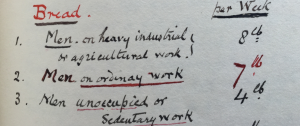
Note in the volume of the bread ration for men during the Great War
Spanning the Victorian and Edwardian eras and encompassing two World Wars, the recipes in the ms volume form an interesting chronicle of the Scottish country house diet.The entries for the Great War of 1914 -18 open with notes of rations introduced at different dates, then there are imaginative but parsimonious and largely vegetarian dishes: peelings stock, potato scones, potato bread, vegetable hot pot, savoury parsnips and ‘thrift cake’.
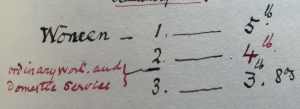
Bread ration for women
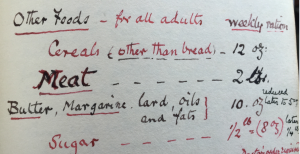
Note of rationing of other foods
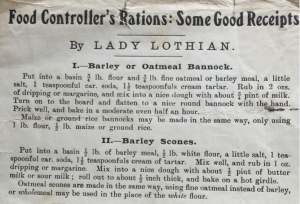
‘Some Good Receipts’ from Lady Lothian
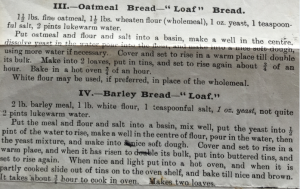
A few of lady Lothian’s recipes, from the printed insert in the volume

Note in the volume about fresh cream and its use

Note of War dates in the ms volume
Behind the Scenes at the NLS
We have had a busy day today kicking off with a trip to the University Collections Facility at South Gyle where Hannah Mateer gave a tour of the facility and Gavin Willshaw chatted about current library digitisation work. A very exciting trip back to town on a tram followed and a lovely lunch at the Outsider was topped off with a trip to the National Library of Scotland.

A big thanks to our hosts at NLS who provided us with a very interesting tour, including a behind the scenes look at some of the collections and storage areas.
The Knowledge of Dance
Following a busy first two days in the library the Knowledge Exchangers let off some steam on Tuesday night at the The Ceilidh Club at Summerhall. There was some very impressive dancing from the group, particularly from the first timers amongst us.

One of the group danced so much one of her shoes fell apart!

Norman also surprised us with the first, and probably last kilt appearance of the week.

Visit to the Centre for Research Collections
On Day 2 of KEW, we welcomed the participants to the Centre for Research Collections (CRC). The CRC is the main point of access for the University’s heritage and cultural collections. The afternoon was designed to give an overview of the work we do, and explore some of the specialisms that go in to providing access to both physical visitors and remote enquirers.
We started the visit with a chat about how we provide access to the collections and what this involves for the CRC User Services team, including the workflows and processes we use. The diagram below illustrates the workflow from point of request for rare books, manuscripts and archives:

The group then had an opportunity to see some recent acquisitions as Joe Marshall, Head of Special Collections and the CRC, talked them through the decision-making process when considering what purchases to make. A particularly intriguing item is this Batik divination manuscript on bark from Sumatra:
 Now we just need to find someone who can read it!
We had a quick break mid-afternoon to watch a 1968 documentary film about the Main Library. The film was directed by Eric C. A. Lucey and provided students with useful information about how to navigate the building just after it opened. We used this as a starting point for a discussion about how the building has developed over the decades. You can watch the video on the University’s Media Hopper website. It’s amazing how much online discovery has improved students’ access to library resources but interesting to see how some things don’t change!
The rest of the afternoon was spent at conservation and the Digital Imaging Unit, looking at how we balance the preservation of the collections with user access, and the exciting experiments with new technology that the DIU photographers have been doing.
Fran Baseby
CRC Services Manager
Collections
 Hill and Adamson Collection: an insight into Edinburgh’s past
My name is Phoebe Kirkland, I am an MSc East Asian Studies student, and for...
Cataloguing the private papers of Archibald Hunter Campbell: A Journey Through Correspondence
My name is Pauline Vincent, I am a student in my last year of a...
Hill and Adamson Collection: an insight into Edinburgh’s past
My name is Phoebe Kirkland, I am an MSc East Asian Studies student, and for...
Cataloguing the private papers of Archibald Hunter Campbell: A Journey Through Correspondence
My name is Pauline Vincent, I am a student in my last year of a...
Projects
Cataloguing the private papers of Archibald Hunter Campbell: A Journey Through Correspondence
My name is Pauline Vincent, I am a student in my last year of a...
Archival Provenance Research Project: Lishan’s Experience
Presentation My name is Lishan Zou, I am a fourth year History and Politics student....