Home University of Edinburgh Library Essentials
April 5, 2026

RESP Outreach Intern – January
Written by: James Rice, RESP Outreach Intern
Going into the new year, January was a particularly important period of my internship that saw me shaping what I hoped to achieve through my work with the RESP. By the end of the month, I hoped to pitch my ideas to the team at St Cecilia’s Hall to determine what was feasible within the time frame of my internship.

Concert Room, St Cecilia’s Hall
However, this was not as straight forward as it initially seemed. When it comes to outreach and bringing attention to a project such as this, there are so many avenues that could be taken. For example, I first contacted the Scottish Society for Northern Studies to determine if they would be willing to publish an article that I would write on the RESP. Then, I emailed the Student Newspaper for the University of Edinburgh, with the intention of bringing awareness among students to the archive.
Unfortunately, I found little success in either of these two options. Nevertheless, I decided that I would continue with listing contacts and colleagues I work with at the CRC to determine what opportunities may be available for me going forward.
As I still hoped to engage students at the University with the project, I began looking into student societies relating to poetry and drama after seeing an outreach event at the National Archives. While volunteering in London, with a local university the archive put together a performance based off of archival material with students. With this, I considered contacting poet and writer in residence, Michael Pedersen, to see if he would be interested in writing something for the project. Yet, when pitching this idea, we decided that this would be difficult to achieve in the short time that I had to organise an event for this.
In another case, I met with Laura, the Engagement Officer for the Heritage Collections at the University. Through Laura, we discussed engagement opportunities through the creation of an ‘Activity Pack’ aimed at local primary and secondary schools. While we decided later that interacting with schools was not a route we hoped to look into, my team agreed that creating a few worksheet resources and a dedicated ‘Kids Page’ on the RESP website would be a great idea for the project.
At the pitch, myself and my team felt that alongside these sheets, producing promotional material and a video tutorial for the online archive itself was best for what we hoped to achieve. Promotional items like themed postcards and pencils were a simple way to get people curious about the RESP, while a video tutorial improved accessibility among users unfamiliar to our website or online archives in general.
Overall, while at times I felt discouraged as I found myself scrapping ideas or running into dead ends when thinking about how to engage in outreach, January was an important personnel step for me; allowing me to realise that some ideas falling through is just a natural part of the process. Without that, I wouldn’t have decided upon how to promote the RESP going forward.
Recreating Connections: Exploring Charles Lyell’s Offprint Collection
An offprint is a separate printing of a work that originally appeared as part of a larger publication, such as an academic journal, magazine, or edited book. Offprints are used by authors to promote their work and ensure a wider dissemination and longer life than might have been achieved through the original publication alone. They are valued by collectors as akin to the first separate edition of a work and, as they are often given away, and may bear an inscription from the author. Historically, the exchange of offprints has been a method of correspondence between scholars; by studying Lyell’s offprints, we will be able to extend our understanding of his network, for example, contrasting the correspondence files, or by following up references in his notebooks, but, to do that, first we need a list! Please welcome Harriet Mack and Claire Bottoms, who are now charged with that task….
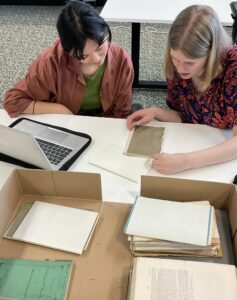
Hi, we are Harriet and Claire, and we have been working for about a month on Charles Lyell’s collection of offprints held by Heritage Collections. These offprints are a series of publications collected and kept by Charles Lyell (1797-1875) assisting with his understanding of scientific principles. Their numerous locations and authors help expose the extensive network of researchers publishing – from Paris, Geneva, Berlin, Sicily to North America – as well as being a record of Lyell’s wide-reaching interests – from geology, history, science, anatomy and civil engineering – to name a few! Using Lyell’s own work and his archive collection, and by listing these offprints, we are recreating Lyell’s network and reference library, providing researchers with a route to Lyell’s own reading and research.
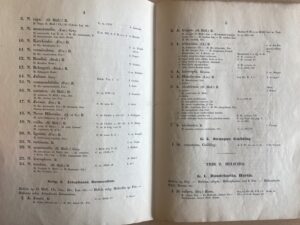
Catalogue of Land Shells in the Royal Collection of the late King of Denmark. Fam. Cochleadea. Trib.1. Vitrinida, by Henrik Hendriksen Beck.
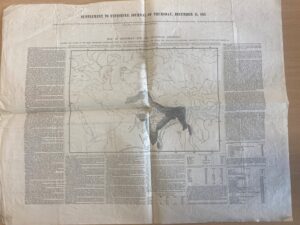
Map of Hindostan and the Countries Adjoining, showing the tracks of the most remarkable earthquakes since 1819, the principal volcanoes and hot wells, the localities of hailstorms, direction of the wind in the rainy season, etc. by George Buist
From the get-go we were focusing on the specific primary metadata that could be taken from each offprint. These include the title, author, paginations, language, date, publisher, and any handwritten notes. Titles are often long and specific to geological terminology with many in German, Italian, French, and English with some outliers of Latin and Swedish – we’ve been spending a lot of time on Google translate! What is interesting is that the dates follow a huge range across Lyell’s lifetime, with some early works from 1811 and later works dated in the months before his death in 1875. We are pulling out publishers and journal titles as they provide crucial information concerning the works of learned societies, publications of similar dates, similar interests at the time, and an understanding of the priorities in each year. So far, we have recorded over 200 offprints covering a wide range of topics.
Of great interest are the handwritten notes that accompany the printed works – which reveal hidden details. These appear often on the cover of the offprints and contain dedications by the authors, as well as notes made by Lyell and his team – wife Mary Lyell (1808–1873) and secretary Arabella Buckley (1840 – 1929). Working through the collection, we have uncovered these additional layers to Lyell’s administrative organisation; these added names and dates ensure that the offprint can be identified by the cover as well as the title page.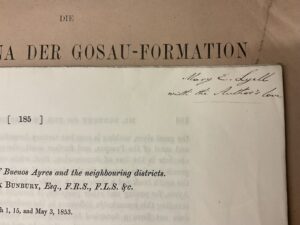
One of our favourite dedications so far is on the cover of Notes on the Vegetation of Buenos Ayres and the neighbouring districts by Sir Charles James Fox Bunbury (1809-1886) dated 1854. The dedication stands out as it is to Mary Lyell rather than Charles: ‘to Mary E. Lyell with the Author’s love’. Charles Bunbury married Mary’s sister, Frances (1814–1894). Lyell’s wider archival collection holds correspondence that details their family and working relationship – it’s gratifying to see this extend to the sharing of offprints.
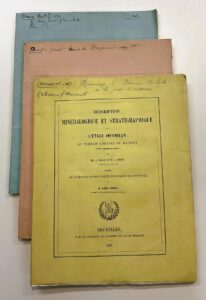
Surprisingly colourful, Lyell’s offprints come in a range of pastel shades
Lyell’s offprints have been fascinating to look through. We have gained a colourful wealth of knowledge on specific regions and geological phenomena, as well as an understanding of broader nineteenth century scientific knowledge. At the same time, it is easy to get lost; a common rabbit hole has been the pink journal Revue des Sciences. For this title, Lyell kept specific monthly editions in full. By doing this, he has enabled us to see what else was printed in each edition, widening our understanding of what he and his contemporaries (his network of ‘able investigators’) were reading in connection with one another.

We are really looking forward to continuing looking, and finding more!
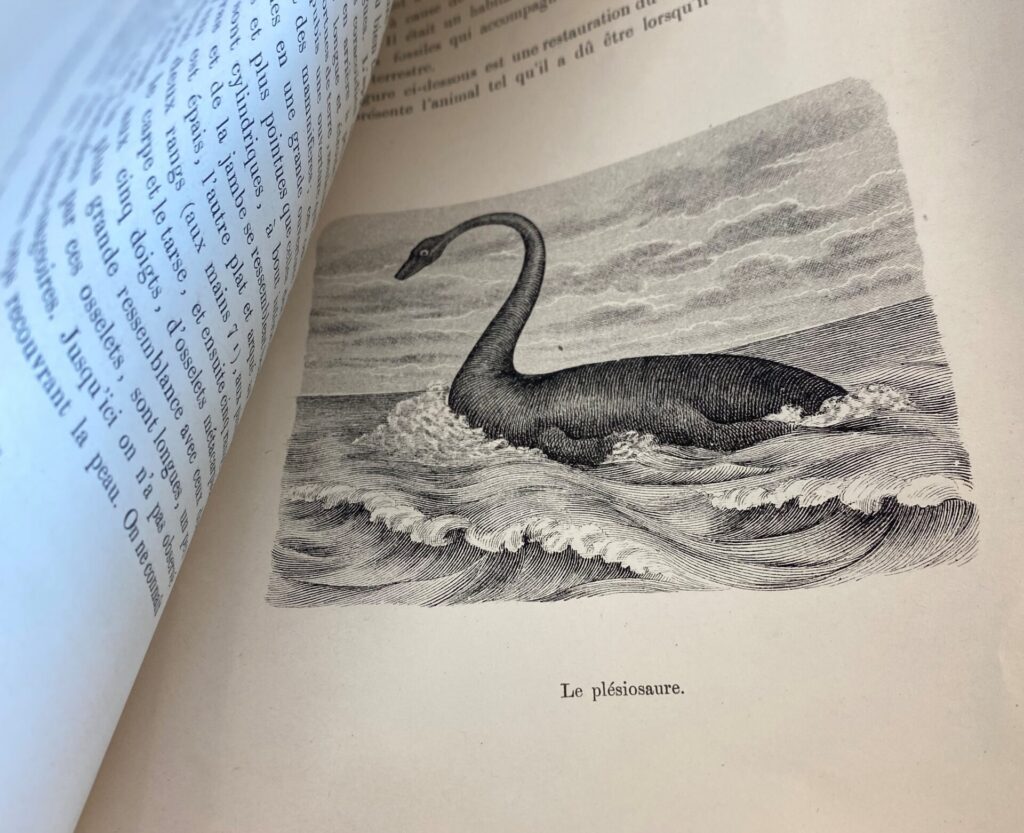
Le Plesiosaurus Dolichodeirus conyb. Du Musee Teyler, By T.C. Winkler
RESP Outreach Intern – Late November & December
Written by: James Rice, RESP Outreach Intern
Hi there, I’m James, a part-time MSc student in Islamic and Middle Eastern studies at the University of Edinburgh, and the Outreach Intern for the Regional Ethnology of Scotland Project. I have had an amazing time working with the team, while building experience and a sense of responsibility working in the Heritage Sector. As such, I thought it would be a great idea to keep note of my thoughts, goals, and some of the challenges I have experienced along the way and share them with you through this blog. I intend to look back upon this blog to recall my experiences and reflect on the work that I have accomplished, while sharing my journey with others who may also be looking to begin a career in the sector.
For this reason, I thought I would begin by summarising my experiences month by month from the start of my internship up until now and the end of my contract.
After having gone through the interview process for two positions for the RESP, I was successful in being selected as the new RESP Archive Project Outreach Intern in November. As I work once a week while balancing my studies, you can imagine that my first two weeks were largely induction based, involving setting up my new work email, login details, work laptop and so on. Aside from this and the important (but often mundane) online training modules, this involved meeting the RESP team and becoming familiar with the Centre for Research Collections at the University.
The team is made up of Archivist Lesley Bryson and Assistant Archivist Caroline Milligan, who previously interviewed me for my role. I also caught up with fellow intern Rebekah Day. I first met Rebekah through the CRC’s Summer Heritage School organised by Student Engagement Officer, Serena Fredrick; who later advertised these positions for the RESP. As I found out on my first day, Rebekah had coincidentally applied for these roles, and was selected for the position of RESP Archive Project Curatorial Intern.
After these first two weeks and being informed of my responsibilities and what I could expect in my role, I tasked myself with gathering materials from the RESP archive for the project’s ‘Advent Calendar’ X (Twitter) feed; which involved writing and scheduling posts for the month of December, presenting users with an archival entry relevant to a Christmas themed hashtag. For this, I was provided with the login details to manage the RESP’s twitter feed hence forth. This was a great way for me to familiarise myself with the online archive itself and navigating the material available.
Soon after this period, I decided to start scheduling weekly posts under the hashtag ‘ThrowbackThursday’ that presented an interesting archival entry from our collection. During this, I thought I would try posting these ‘X’s at different times in the day to test engagement with the public:
The following week in the middle of December, Lesley, Caroline, and myself travelled to see a showing of the film ‘A film about life and work in the Musselburgh Mills’ in Tranent put together by The European Ethnological Research Centre (EERC). The film told the story of the mills through the words of those who worked and lived in the town and beyond. This was a great opportunity to see in person the significance of oral history and the impact of these stories upon local communities:
This first month gave me a lot to consider when it came to my responsibilities going forward and what was expected from me. While I have previously volunteered for the National Archives in London and the Heritage Collection for the CRC, this internship already gave me a new insight into the inner workings of the Heritage Sector!
Curating and illustrating the ‘Animal Encounters’ online exhibition
Written by: Rebekah Day, RESP Curatorial Intern
From December 2023 to May 2024, I have had the pleasure of working on curating an online exhibition for the Regional Ethnology of Scotland Project (RESP).

View the exhibition: www.exhibitions.ed.ac.uk/exhibitions/animal-encounters
After successfully interviewing for the Regional Ethnology of Scotland (RESP) curatorial internship, I was given information from the Project team on a whole range of topics and themes that could be used as a basis for the exhibition but was assured that I had the choice to pitch my own idea. After some back and forth discussions about what kind of content and topics I was likely to find in the RESP interviews, I started to listen to some of the recordings available on the website and found myself drawn to the stories people shared that included interactions with animals.
I pitched the idea of my theme being ‘Animal Encounters’ giving the following rationale:
It can be said that the RESP archive, and ethnology more widely, is concerned with studying and recording the everyday stories of people – but ostensibly they also capture the nuances of the universally shared, yet deeply individual, human experience.
A surprising theme that reoccurs throughout the interviews is the significance of animals, which appear in a huge variety of the memories and stories individuals have shared with the RESP archive.
The rural locations where many interviews have been carried out naturally mean that individuals have shared connections to agricultural activity such as farming, so it is no surprise that stories of animals framed by this industry occur – what is interesting though, is just how many spheres of influence animals crop up in throughout a person’s life.
Some of these stories recount the chores involved raising farm animals, the joy of playing with a beloved family pet, the intensive labour involved in abattoir work, the impact of poaching and cattle theft on communities, or lamenting the loss of fields used for grazing now given over to modern housing estates.
By selecting the specific subject of ‘animals’, this exhibition will provide a window into the RESP archives – encouraging audiences to delve more deeply into the RESP website and other CRC collections for their own research.
This exhibition will also provide a timely and entertaining resource for students and those interested in local history, encouraging discussion about the changing relationship between Scotland’s people and the natural environment.
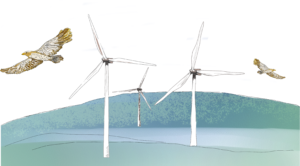
Given the go ahead, I was then trained in how to use the exhibitions website so I could see what kind of content could be displayed and what layout was possible. I was also guided on what external organisations and volunteers associated with RESP I could approach to ask for visual content such as photographs and videos.
Caroline Milligan also provided me with an extensive list of interviews
that she knew mentioned animals – you can see the whole list here. When first listening to these, I wanted to stop and write down the time stamp for every little anecdote I thought was interesting, but this would have taken forever!

Instead I listened to a couple of them the whole-way through the first time around with my digital drawing tablet set up. I soon found that just doodling away while listening to the interviews clarified that the topics and themes I was clearly drawn to involved animals and nature.
Going back to make notes of relevant stories from some of these interviews and thinking about the kind of illustrations I was producing, and the other visual content RESP had access to, I was able to suggest three ‘categories’ that the content could be placed in, to provide a framework for the exhibition.
The three categories ‘for us,’ ‘with us’, ‘around us,’ are not intended as concrete descriptions, but as loose themes that can frame or challenge your interpretation of the kind of interactions between people and animals that can be found in the exhibition.
I found reference images on the internet to ensure I was getting things like the colours, details and proportions somewhat right for these illustrations. Some interviews discussed populations of pheasants, kites and lapwings which I guessed were birds, but only thanks to a Google search could I confidently replicate what they looked like!
This exercise in itself was eye opening – searching out further details from the fleeting comments made within an interview gave me such a greater appreciation for the topics people were discussing.
For example, discovering that lapwings, also known as ‘peewits’, had adorable pointy head-feathers and nested on the ground, helped me imagine how these creatures would have stood out to a person gazing across the landscape.
I could imagine the parent birds watching over their cute fluffy chicks, but also worrying as farm machinery and road traffic milled by dangerously close to their nests.
I was really inspired by how a previous intern for the Friends Exhibition used their own illustrations throughout the exhibition; her scrapbook-style collages neatly frame the pages and provide a visual connection between collection items that might have otherwise felt disparate. The illustrations in the Friends Exhibition enhance the viewers experience while navigating the website, but do not draw any focus away from the key material on display. This was a method I hoped to replicate by including my own drawings in the Animal Encounters exhibition.
To give the idea that my illustrations were visual components of a larger, multi-media, exhibition, I placed the individual illustrations in a variety of mismatching frames. This created a kind of jigsaw or collage to use on the homepage and in marketing material.
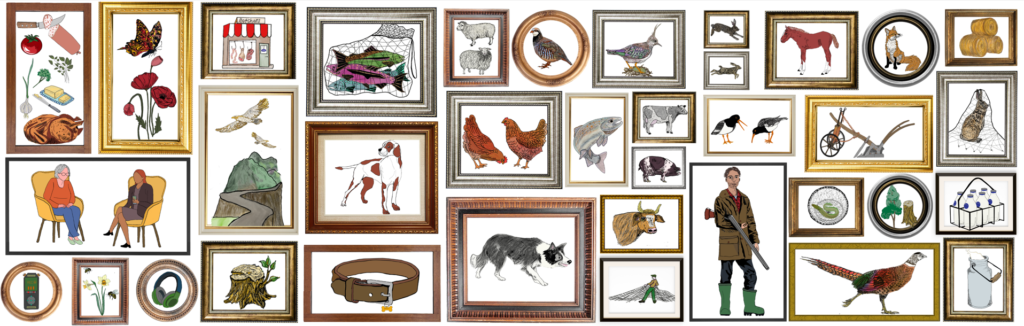
For each sub-page, I then took a smaller group of framed illustrations that felt relevant to the interviews and used these as header images.

Where I included audio clips from the interviews I tried to accompany these with images of the individual speaking or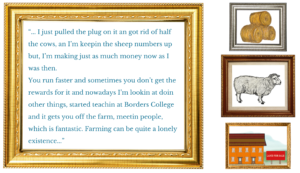 photographs from the location the interviewee came from. Where I could not find a relevant image, I instead took a quote from the interview transcription and placed it in a frame alongside some relevant illustrations.
I felt this helped keep the content engaging and created continuity between different sections.
In the Friends Exhibition, the intern included a short recording of the Curator speaking about an item in the collection which inspired me to include a piece of my own connection to the themes explored in the Animal Encounters exhibition through a short interview with the RESP Project Archivist Lesley Bryson.
I had been eager to include mention of a connection we had discovered over the months since I started this internship. Through chatting about family history we realised that the area of Morningside where Lesley lives today is right by the location of the historic dairy my husband’s great-great-grandparents had lived and worked in the early 1900s.
I was recently sent some of these family photos and showed Lesley, who enjoyed seeing how different the street had looked in the past. She also told me that recent building works at her house had uncovered cow bones, possibly evidence of the historic dairy.
This interaction is the last story included in the exhibition as I feel that it surmises for me just how pervasive the connections between humans and animals remain across the decades.
View the exhibition: www.exhibitions.ed.ac.uk/exhibitions/animal-encounters
AM Explorer – your primary source hub (trial access)
I’m happy to let you know that the Library currently has extended trial access to AM Explorer, your gateway to millions of pages of primary source content. AM’s collections provide access to digitised historical materials – manuscripts, government records, rare books, maps and more – across a wide range of disciplines, from History to English Literature, Gender Studies, Sociology, Economics, Area Studies, Political Sciences and more.
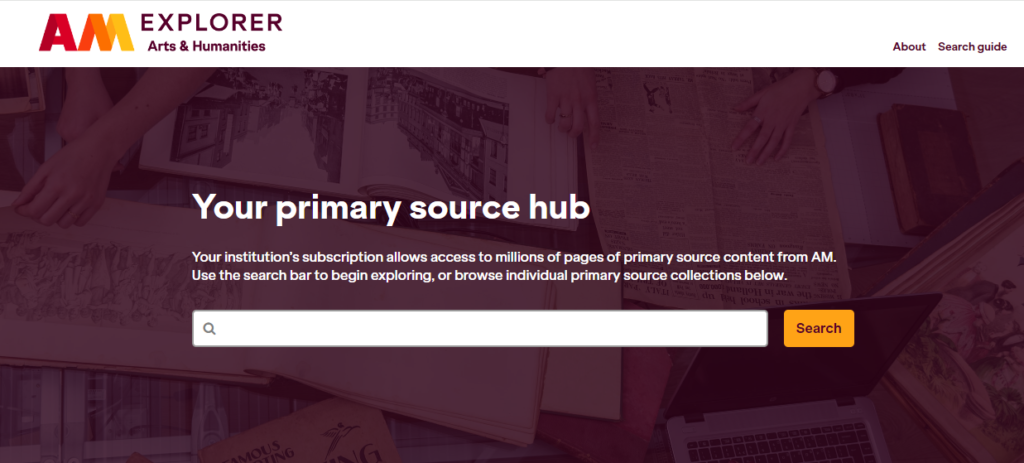
You can access AM Explorer via the E-resources trials page.
Trial access ends 8 July 2024.
While the Library already has permanent access to 21 collections from AM (listed at end) this trial access to AM Explorer gives us access to a further 66 collections covering world history from the 15th century up to modern times.
AM Explorer allows you to search through all 87 collections at one time. You can use their search to explore through a single keyword search; take a deep dive into your areas of interest; and discover new archival materials to serve your research, learning and teaching. Read More
Skills4EOSC fellowship
This is a guest blog post from Clara Parente Boavida, about her fellowship with the Research Data Service as part of a European Open Science Cloud (EOSC) project.
My name is Clara Parente Boavida and I work in the Research Support Office at Iscte-Instituto Universitario de Lisboa (Portugal). I applied for the first call of the Skills4EOSC Fellowship Programme and between 11th March to 5th April I worked with an amazing team at Research Data Service at the University of Edinburgh.
The Skills4EOSC Fellowship Programme aims to address the need to promote and sustain professional roles dedicated to open research by supporting short-term secondments.
Among the three different types of fellowships, I have chosen a Research Data Support internship. This placement allowed me to actively participate in the day-to-day activities related to research data support, providing an immersive experience and a comprehensive understanding of research data management practices within the host institution.
I would like to congratulate the Skills4EOSC project for this initiative and thank everyone who has helped to make this opportunity possible. I’m grateful for the support of my institution (Vice-Rector Jorge Costa and Carina Cunha), I’m grateful to Robin Rice for the extraordinary welcome and I’m grateful to all the people I’ve had the opportunity to talk to and interact with during this month.
“the essential is invisible to the eyes”
Antoine de Saint-Exupéry’s novel “The Little Prince”
Each week’s agenda was carefully prepared with my expectations and interests in mind. The University of Edinburgh has a busy life in terms of Research Data Management. Not only in collaboration with various services within the University, but also with the external community. This holistic view has made me reflect about the different services that Research Data Management intersects with. Success comes from healthy and effective relationships with different stakeholders.
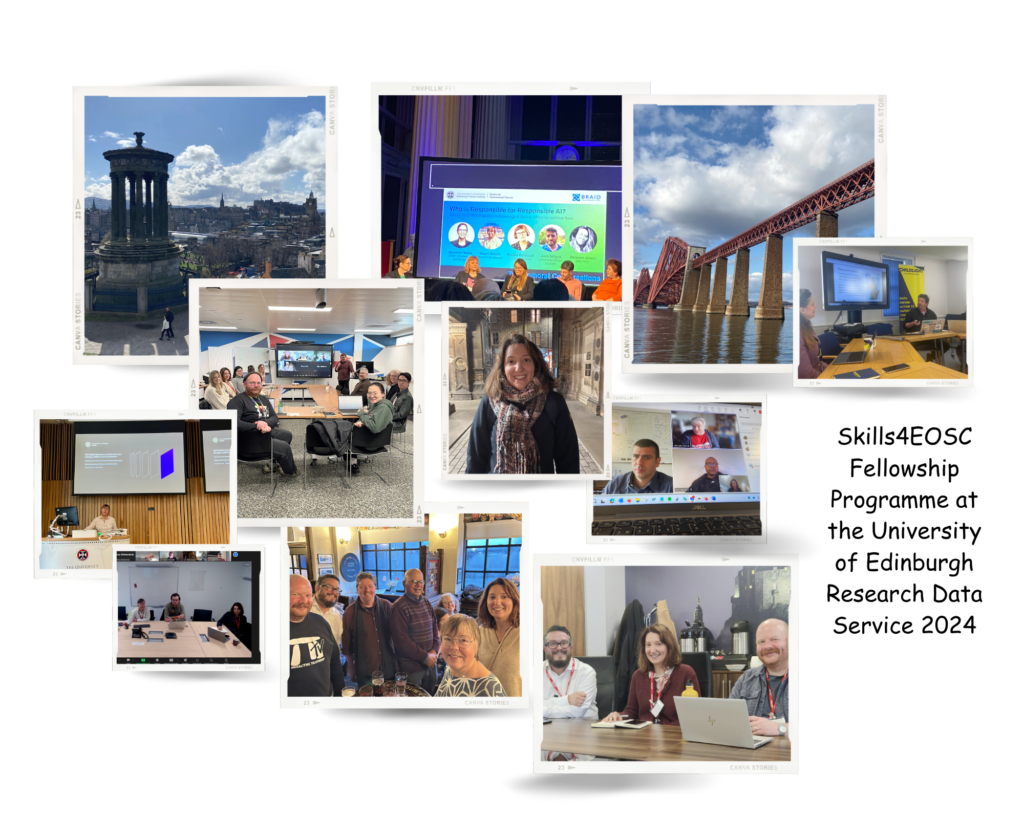
I was involved in the day-to-day activities of different members of the team, and each experience added something new. I had the opportunity to attend face-to-face events, one-to-one meetings, kick-off meetings, as well as online meetings and events. I also took part in internal team meetings and service meetings. Informal activities were carefully planned to allow the Research Data Service team to interact with each other and to allow other teams to be involved.
I had one-to-one meetings with each member of the Research Data Support team about: DataShare, DataVaut, training programme, DMP, DMPonline, Research Data Management Policy and Metrics. I had one-to-one meetings with members of other teams: Open Research, Scholarly Communications, Research Information Systems, Digital Research Services, and Edinburgh Research Office.
I attended a number of events in person: Digital Research Lunchtime Seminar: How to interpret and analyse your data efficiently; Open Research Scotland Meeting; Open Science Framework Workshop Modules 1, 2, 3 & 4; Ethics & Data Management at the Childlight GDF Residency; Technomoral Conversations: Who is Responsible for Responsible AI?; Library Tour for Staff, and Digital Research Lunchtime Seminar: Manage, publish, share and preserve.
I also participated in online events: Updating the DataCite Metadata Scheme webinar; UK Research Network (UKRN) webinar on Indicators for Open Research; UKRN Indicators Pilot 2 online meeting; UKRN Pilot 1 kick-off meeting; Writing a Data management plan, for the Health in Social Science School; and Working with Personal and Sensitive Data. I also had the opportunity to organise an online meeting with Mike Wallis (Research Services, IT Infrastructure) and the IT Services of Iscte to answer questions about DataStore.
In terms of personal contributions, I wrote suggestions for updates to MANTRA Unit 1, part of an open access Research Data Management Training course. I had the opportunity to demonstrate the interoperability process between CRIS systems and OpenAIRE, and also how to link EC funded projects to publications and datasets.
Finally, I designed a Research Data Management Roadmap for the Iscte. This roadmap intends to guide the work to be developed over the next three years towards the implementation of a RDM Service for the Iscte-Instituto Universitário de Lisboa. It incorporates lessons learned during the Skills4EOSC Fellowship Programme at the University of Edinburgh. It is also aligned with the Human Resources Excellence in Research Award (HRS4R) principles for researchers, which is a mechanism through which the European Commission seeks to ensure that concrete steps are put in place by institutions to enhance working conditions for researchers across Europe, as set out in the European Charter and Code.
One Health Research wrap up
Hello again!
This is my final week on the One Health project, in which I’ve undertaken research and academic engagement – it’s been a fascinating and exciting project to contribute to, with a fantastic team. I thought I’d provide a quick recap of what’s been done and what the future might hold in terms of engagement with the collections, as well as what I’ve learned from this experience.
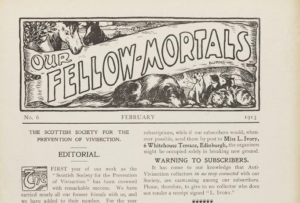
Image of Our Fellow Mortals Magazine, volume number 6, February 1913, SSPV
What’s been done in the research space?
- mapping of research topics across the collections – there is so much to continue to explore!
- writing research articles – bacterial infections and how animal welfare was implicated in related public health issues across all three collections (submitted to the British Journal for the History of Science), and women and the politics of care, exploring the OneKind and Royal Zoological Society of Scotland archives (about to be submitted to the Journal of Women in Culture and Society!)
- writing up of possible follow on grant for the Wellcome Trust
- lots of engagement with academics internally and externally (see previous blog post!)
The future?
As I’ve said before, these collections provide a wealth of material for researchers, across different disciplines, and I hope those reading this blog post consider engaging with them! If you would like to view items you can book a time in the reading room:
Visiting in Person | The University of Edinburgh
You can peruse the Dick Vet and OneKind archives here:
The RZSS archive will be catalogued over the next year, an exciting follow on project. The future will no doubt include the realisation of multiple projects based on the archival materials, potentially around changing conceptions of cruelty since the early 1900s, exploration of conceptions of wellbeing benefits of interactions with animals and nature in the early to mid-1900s in Scotland, profiling various prominent women who appear in the archival materials to ensure their place in historical research/record, and much more!
What have I learned?
Archival research is a vastly rewarding journey of discovery. At first I felt quite overwhelmed by the amount of items in each archive and wondered how I would be able to digest it all – in the end I couldn’t look at everything in detail, instead becoming selective, in order to complete the two short research projects. But there is much I would still love to see within the collections! I also realised that finding out more about the lives of individuals named in annual reports and magazines (for example) takes much longer than you might anticipate, since some of the women in particular were relatively obscure (although they shouldn’t be!) – hunting for hours turned up almost nothing!
Finally, I learned so much about the actual process of doing archival research, huge thanks to the project archivist and lead, Fiona Menzies, and Amanda Dodd in conservation. I also found out that Fiona makes great cakes, for instance this vegan one of Our Fellow Mortals magazine (genius!), devoured in the kitchen today as we wind down the project:
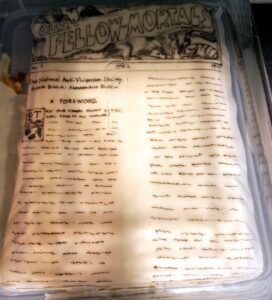
Cake of Our Fellow Mortals magazine!
To introduce you to the methods used to handle various items, please watch this video:
The University of Edinburgh – Guide to Handling Collections Material (youtube.com)
Do contact CRC for more information and access: Centre for Research Collections | The University of Edinburgh
While I am leaving the One Health project, I’m still very happy to engage with anyone to share insights regarding what’s in the collections, so don’t hesitate to get in touch!
Elizabeth
One Health Academic Engagement
My role in the Wellcome Trust One Health archival project has involved identifying research topics that can be found in archival records, undertaking research AND academic engagement.
We have developed some very fruitful connections internally with Health in Social Science through my work with Alette Willis as well as Dick Vet academics and members of the Environmental Humanities Network.
Some animal studies groups externally have shown keen interest in the One Health archival collections as well, such as Sheffield Animal Studies Research Centre (ShARC) at the University of Sheffield and the British Animal Studies Network (BASN) at Strathclyde University.

There are a few other animal studies networks in the UK that relate to the One Health project:
- University of Manchester, Centre for the History of Science, Technology and Medicine (CHSTM)
- University of Kent, Animal Humanities Network
- University of Exeter, Anthrozoology group
Thanks to those centres and networks we’ve engaged with so far!
The new Library Wellbeing Collection
 Looking for ways to look after yourself during your studies and exams? The Library’s new Wellbeing Collection provides resources on all aspects of wellbeing, including but not limited to anxiety, exercise, general wellbeing, happiness, relationships, sleeping well and University life.
The collection of books and e-books is available to borrow for all students and staff. In this blog post we highlight just a few of the e-books available in the collection.
You can explore all the books in the Wellbeing Collection in DiscoverEd or browse a list of books by subject area in the resource list.
To launch our new collection we have a display of Wellbeing Collection books in the Main Library (30 George Square) which is in place until the end of May 2024. In the two weeks since the display was put in place 66 items have already been borrowed!
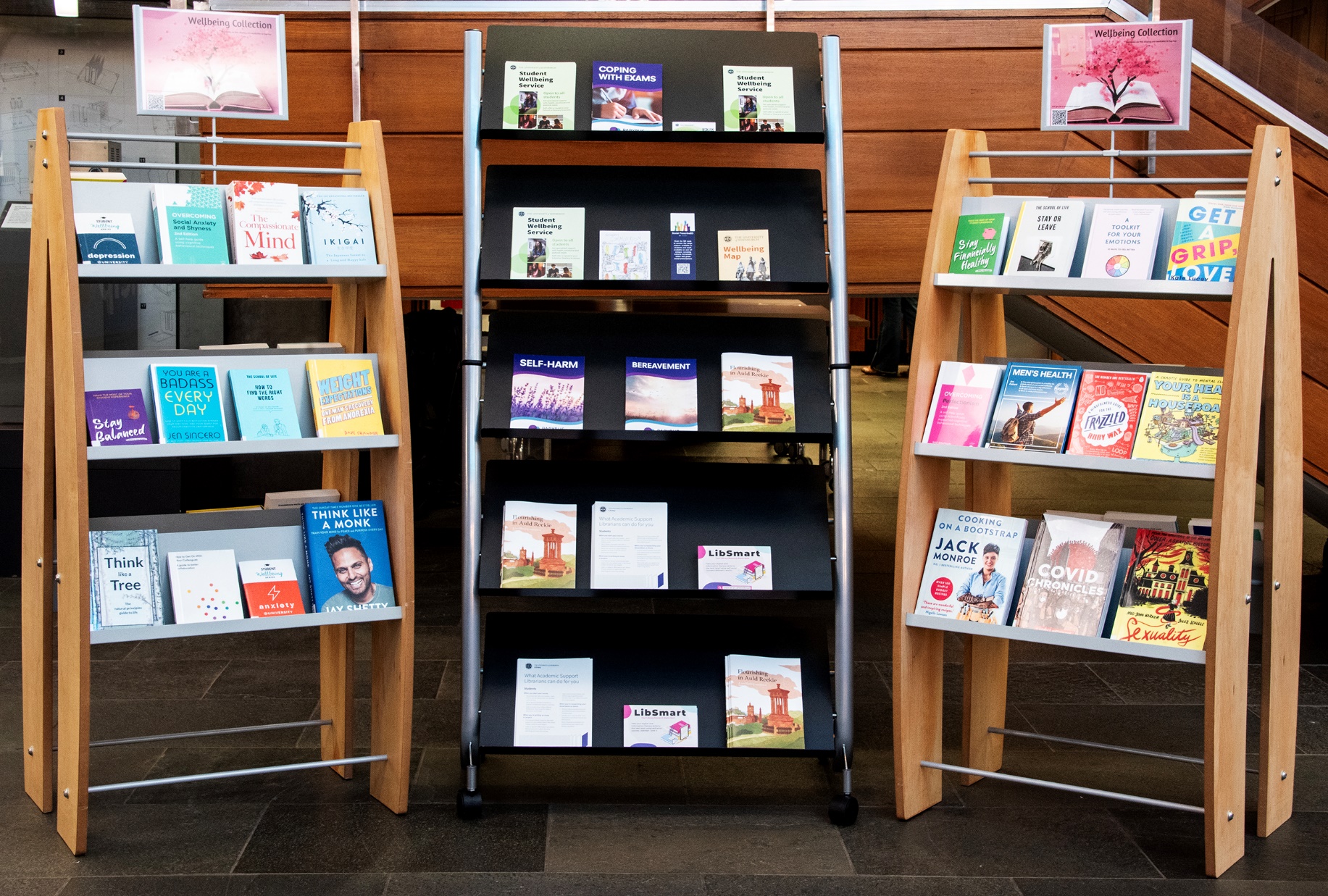
Wellbeing Collection books on display in the Main Library
What does the Wellbeing Collection cover?
Here we highlight some example e-books from the collection on a few different themes that you might wish to explore:
University life
 It’s normal to feel nervous before an exam or overwhelmed with your workload sometimes, but it’s important not to let anxiety or stress have a negative impact on your performance.
- You’ve Got This : A Student’s Guide to Well-being at University and Beyond
- Stay Happy While You Study: Make the most of your student experience
Building good habits
 If you have a tendency to procrastinate instead of revising, or want to develop healthy habits in your life, the collection has books to help.
- Procrastination : How to Do It Well
- How to be a productivity ninja : worry less, achieve more, love what you do
Sleep and rest
 It’s important to look after yourself at stressful times, and that includes getting plenty of sleep and rest.
- Insomnia: A Guide to, and Consolation for, the Restless Early Hours
- Nothing Much Happens: Calming stories to soothe your mind and help you sleep
Getting more exercise
Keeping active can boost your mood as well as your physical health.
- Mind & Body : Mental Exercises for Physical Wellbeing; Physical Exercises for Mental Wellbeing
- A Philosophy of Walking
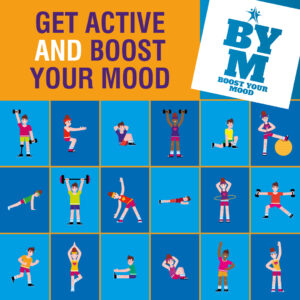 Why not pair your reading with a spot of rock climbing or yoga – Sport & Exercise have a whole range of activity running in April and May, from bootcamps to Yoga, from Learn to lift workshops to weekend courses at Firbush, and free gym entry for students and staff next week.
Exploring nature
 Exposure to nature has been shown to have a positive impact on physical health and cognitive function. Spring has sprung in Edinburgh, so now’s the perfect time to get out into nature.
- The Natural Health Service: How Nature Can Mend Your Mind
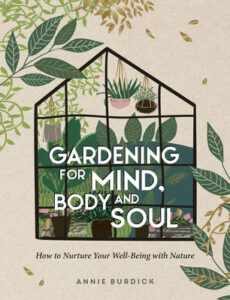
- Gardening for mind, body and soul : how to nurture your well-being with nature
You can read more about using the Library for wellbeing and leisure on our subject guide.
The Wellbeing Collection is managed by a team including Library staff, University Student Wellbeing Advisers and the EUSA Student Opportunities Representative (Wellbeing).
If you are an Edinburgh student and you need to talk to someone there’s lots of help and guidance available from the Student Health and Wellbeing Services, and staff can access support through the Staff Health and Wellbeing Hub.
Digital Curation Interviews project with DCC
In this guest blog post, Clara Lines Diaz reports on last year’s Digital Curation Interviews with University of Edinburgh researchers, conducted by the Digital Curation Centre (DCC) on behalf of Digital Research Services.
The project was initiated by staff in the Research Data Service to gain an overview of the research data and software management practices and challenges across the University through in-depth interviews with researchers. The DCC was selected as best placed to conduct the interviews, given its expertise on the subject matter and location at University of Edinburgh. The information was collected through semi-structured interviews during Spring 2023.

Image by WOCinTech Chat, Flickr
The motivation to collect this information was to help ensure that researchers are supported in their specific needs and to contribute to shaping the research data management (RDM) services. The choice of in-depth interviews as a method was also expected to help build deeper relationships between service providers and users.
For the semi-structured interviews we had some topic blocks as below, and some prepared questions within each of those blocks. This was used more as a check list for us and we gave the interviewees space to focus on or bring up anything they considered relevant.
Topic blocks:
- A: Introduction: Research line, projects, collaborations
- B: Data provenance, types and reuse
- C: Data/Software management practices
- D: Influences on data/software management practices
- E: Data management challenges and sources of assistance
This type of interview works well for exploratory studies like this because it allows common and maybe unexpected patterns to emerge, but also has some caveats around comparability, as not all interviews cover exactly the same topics in the same level of detail. This means that in the results we were able to indicate, for example, how many people mentioned using a particular service, but we could not infer that the others don’t use it, just because they did not mention it.
To select the participants, we contacted research support staff in the three colleges and asked them to suggest participants or send the invitation around. It felt like there was a high interest to discuss these topics and make the challenges they encounter heard, especially among researchers in the College of Science and Engineering (CSE). The interviewees were all involved in data intensive research, with a mix of senior and early career researchers. The interviews were planned to last around 45 minutes but there was some variation in the duration.
From the 14 interviews, four were with staff from the College of Medicine and Veterinary Medicine (CMVM), eight with staff from CSE and two with staff from the College of Arts, Humanities and Social Sciences (CAHSS). The oversampling of CSE interviews was intended as the service team was particularly interested to hear about their practices, which are less well known to them.
Once we had all the interview notes, we extracted the comments and classified them by themes. This was the basis for the final project report, which included a selection of the themes and possible points for action for the Research Data Service and the Research Computing Service in five key areas:
- Data sharing and reuse was common practice, but there were challenges and areas where further support would be beneficial.
- Code sharing and collaborative development was widespread and growing, but support and services were perceived as being less mature than that provided for data.
- External collaboration with university-hosted services could be challenging.
- Awareness of FAIR and open science was variable.
- There was an appetite for more training, both for students and staff.
Sharing and reuse had a special focus in the interviews and the first two points are connected to that. Most interviewees had a lot to say about challenges related to sharing and reusing data, especially those working with sensitive data. Some extra advice to help people with those challenges would help. Most interviewees also discussed storing and, in some cases, sharing their code. GitHub is in general preferred for that. Sharing code is in general considered very time consuming.
A briefing was given to the Digital Research Services in August, 2023 and the Research Data Support team was given the transcripts and full results to inform service development.
Clara Lines Diaz
Research Data Specialist
Digital Curation Centre
Collections
 Hill and Adamson Collection: an insight into Edinburgh’s past
My name is Phoebe Kirkland, I am an MSc East Asian Studies student, and for...
Cataloguing the private papers of Archibald Hunter Campbell: A Journey Through Correspondence
My name is Pauline Vincent, I am a student in my last year of a...
Hill and Adamson Collection: an insight into Edinburgh’s past
My name is Phoebe Kirkland, I am an MSc East Asian Studies student, and for...
Cataloguing the private papers of Archibald Hunter Campbell: A Journey Through Correspondence
My name is Pauline Vincent, I am a student in my last year of a...

Projects
Cataloguing the private papers of Archibald Hunter Campbell: A Journey Through Correspondence
My name is Pauline Vincent, I am a student in my last year of a...
Archival Provenance Research Project: Lishan’s Experience
Presentation My name is Lishan Zou, I am a fourth year History and Politics student....