Home University of Edinburgh Library Essentials
June 11, 2026
Reading your reading list and recognising references
Got your reading list but not sure what you’re being asked to read (is it a book, is it an article, is it a bird, is it a plane…)? Or are you just not sure how you’re meant to search for and find these items in the Library (in print or online)?

Being unsure about this is very common for new students so you’re not alone but if you can learn how to read your reading list and recognise references now it will make you more confident using the Library and will save you a lot of time and effort in your studies. And these skills will be of use to you at all stages of your University life and beyond.
What’s in a reading list?
Reading lists are just lists of essential, recommended or further readings for your course. They can include a wide range of material including books, book chapters, journal articles, documentaries, films, newspaper articles, websites, blogs, etc., but I am going to concentrate on the 3 most common:
- Book
- Book chapter
- Journal article
RILM Abstracts of Music Literature with Full Text now available

We have upgraded our RILM Abstracts of music literature subscription to include full text.
RILM abstracts of music literature with full text (RAFT) expands and enhances the unrivalled global bibliography of writings on music with the addition of a million pages of full-text content from more than 200 key periodicals, many of which are not available anywhere else online. In addition to metadata, abstracts, and indexing curated and written by RILM’s team of subject experts, RAFT offers search and browse for each full-text issue, cover to cover.
A spreadsheet of the current title list can be found here. New titles are expected each month rising to 240 by the end of the year.
Further info
Access this full text database via DiscoverEd, our Music AZ list or our main AZ list.
Find peace in the Library
Finding peace in the library might mean finding a bit of quiet study space to you. If that’s the case, have a look at our guide to quiet and silent study space.

However, September 21 is the U.N. International Day of Peace, which seemed like a good day to highlight the resources available in Edinburgh University Library for peace and conflict resolution. Read More
Scopus maintenance alert 21st Sept

On September 21st from 4pm – 6pm Scopus will undergo maintenance. During this period, the Scopus database will be available in read-only mode, which means that users will be able to perform most of the usual operations, but won’t be allowed to perform operations writing into the database such as:
– Saving/editing a search query
– Saving/editing an alert
– Creating or modifying a list
– Changing a user configuration
Feedback questions from library welcome sessions
 It was great to meet so many SPS postgraduate students in our Welcome Week workshops on Library Resources. We’ve now put the slides from these sessions up on our subject guide web pages. We asked you to write any questions you still had about the library on your feedback sheets so we could get back to you. Here’s some of the things you asked :
1. “Are there any free software resources in the library? For example SPSS?”
Yes, the University provides access to SPSS – see http://www.ed.ac.uk/information-services/computing/desktop-personal/software/main-software-deals/spss for more information. A range of other software resources are also available on University desktop machines, such as NVivo.
2. “You mentioned VPN – how and when do we use it for the library?”
VPN, or Virtual Private Network, is necessary for off campus access to a small number of library databases. In particular some newspaper databases, such as Factiva and Nexis UK, require VPN access for off-campus access. You can find information about the VPN service at <http://www.ed.ac.uk/is/vpn
3.“Is there any reference management system I can download to my computer for free?”
You can download Endnote Online for free. See http://www.ed.ac.uk/information-services/help-consultancy/is-skills/catalogue/text-catalogue/endnote-web-intro. You may also be interested in Mendeley and Zotero.
4. “I would like to find out more about referencing systems such as Mendeley. Does the University support the desktop version?”
The desktop version of Mendeley is installed on lab PCs throughout the University, although the University doesn’t provide as full a support service for this package as it does for Endnote. If you’d like to find out more about using different bibliographic managers, you may find this comparison table useful.
5. “Is there a floor plan of the Main Library?”
Yes, there are plans for each floor – see the bottom of the page at http://edin.ac/2beNlFw
Christine Love-Rodgers & Caroline Stirling, Academic Support Librarians – Social & Political Science
CABI E-Books now available
 We have purchased 325 e-books from CABI publishing. Titles have been picked from the following subject areas; Agriculture subject collection, Animal Production and Husbandry collection, Human Health and Nutrition collection and the Veterinary Medicine collection. A spreadsheet of the new titles can be found here.
These books are hosted on CABI’s own website and as well as reading online, the books can be downloaded for offline reading for 30 days. A userguide covering DRM restrictions, how to download to different devices etc is available here.
Further info
These books will appear in DiscoverEd soon until then, the CABI platform links can be found on the E-Book AZ list.
Oxford Scholarship Online – new e-books
A further 197 e-books across a variety of subject disciplines have been added to Oxford Scholarship Online and these are now available in DiscoverEd.
A list of the new additions can be found in the spreadsheet here.

The women behind the words: thanking the typists of the twentieth century
Digitising this thesis collection is an act of time travel. We began in May at the early twentieth century and are currently working through the seventies. We have enjoyed images of a man in a beautiful three-piece suit coaxing a snake into a glass tube from the twenties, and are currently being treated to some majestic large collars, trousers and hair from the seventies. Not only do the fashions change, but the technology changes as well, from hand written, to meticulously typed on typewriters, and finally to modern computers, which we have yet to encounter. In this way the PhD thesis collection is a litmus test for the technological development of the society from which it emerged.
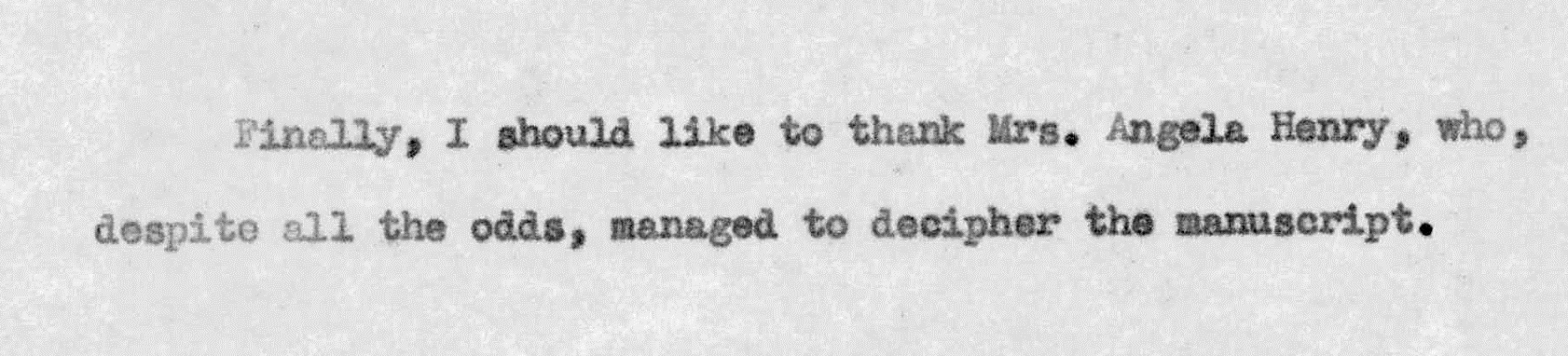
The collection is also an indication of social development. It cannot be denied that the authors of these theses are not representative of society en masse, but a highly educated, largely male minority. But these are not the only people bound within these volumes, and one could argue not the only creators of these theses as physical objects. I am fascinated by the names of countless women who worked tirelessly to create this collection. These are of course the professional typists who pieced together chapters, created tables and graphs and read handwriting that seems to have been often rather illegible. I encounter these women in the acknowledgments section of the theses. I find this particularly amusing because presumably in order to be thanked in the thesis they needed to type their own acknowledgement.
I have been taking note of these women for about three weeks now and so far about 40% of the volumes I have encountered contain acknowledgments to typists. I don’t know if these means the work was typed by its author or if the typist’s name just hasn’t been included. I have recorded sixty different women. Only two women, Helen Scott and Anthea Cormack, have been named twice. Cormack typed two theses addressing fibrinolysis, whereas Scott typed one PhD in chemistry and another MD about the liver. Therefore I’m not sure whether typists specialised in certain topics or not. I have encountered one example of a man typing a thesis for a women, Maureen Child completed her thesis entitled ‘An ethological study of social interaction among nursery school children’ in 1978. She thanks Nick Child, perhaps a relative, for typing her thesis.
These names will not be on the catalogue, they did not receive a new title for their work, and presumably within a decade or so their skills were no longer required. I have managed to find very little information about typists working in Edinburgh in the 60’s, 70’s and 80’s but clearly there were several. I would like to type an acknowledgement to them so they don’t have to do it themselves for once.




Sustainable Organization Library – more content added
We have updated our holdings to Sustainable Organization Library. New e-journal and e-book content has been added to DiscoverEd.
New e-journal
The Journal of Sustainable Mobility (ISSN 2053-2350) is a new peer-reviewed journal that provides an interdisciplinary forum for the exchange of innovative and empirically sound research on sustainable transportation. The Journal of Sustainable Mobility is published in association with Cranfield University, Nottingham Business School and The Chinese Academy of Sciences (CAS).
The Journal of Sustainable Mobility publishes on topics including, but not limited to, the following:
- Low-carbon vehicle technologies

- Renewable/clean/green technologies
- Biofuels and other sources of renewable energy
- Transportation management systems
- Vehicle emission controls
- Sustainable transport policies and governance
- Corporate sustainability
- Historical review of the automotive and oil industries and transport management systems
- Comparative studies of national and regional approaches to technology development and environmental control
- Case studies of innovations in technology, business models, and policy initiatives in relation to sustainable mobility
New e-books
Dō Sustainability E-books – 50 new titles. DōShorts are a collection of concise, high-quality books for professionals. They address one sustainability challenge at a time and can be read in 90 minutes. The collection includes practical “how to” guides as well as framework pieces and business briefings that give an expert overview of cutting-edge developments in a wide range of fields.
See the full list at http://www.ingentaconnect.com.ezproxy.is.ed.ac.uk/content/dos

More info
The full list of Sustainable Organization Library content can be browsed at http://www.ezproxy.is.ed.ac.uk/login?url=http://www.ingentaconnect.com/content/collection/gse_susorg2013. Individual records have been added to DiscoverEd. Sustainable Organization Library can also be accessed from the Business Databases AZ list.
Digital video resources for Divinity
I’ve been following up from student feedback questions following library induction sessions last week, and one really interesting one has been about library access to digital video recordings.
The Library has recently purchased access to the large and comprehensive online streaming video resource Academic Video Online from Alexander Street Press. Containing over 50,000 recordings overall, it currently lists 324 videos on ‘Religion & Thought’ – and that’s just the start.

Academic Video Online allows you to create and share playlists and create clips, permalinks are also available to embed or link to from other sites. Transcripts are available for many videos and these can be searched. Read More
Collections
 Hill and Adamson Collection: an insight into Edinburgh’s past
My name is Phoebe Kirkland, I am an MSc East Asian Studies student, and for...
Cataloguing the private papers of Archibald Hunter Campbell: A Journey Through Correspondence
My name is Pauline Vincent, I am a student in my last year of a...
Hill and Adamson Collection: an insight into Edinburgh’s past
My name is Phoebe Kirkland, I am an MSc East Asian Studies student, and for...
Cataloguing the private papers of Archibald Hunter Campbell: A Journey Through Correspondence
My name is Pauline Vincent, I am a student in my last year of a...
Projects
Cataloguing the private papers of Archibald Hunter Campbell: A Journey Through Correspondence
My name is Pauline Vincent, I am a student in my last year of a...
Archival Provenance Research Project: Lishan’s Experience
Presentation My name is Lishan Zou, I am a fourth year History and Politics student....