Home University of Edinburgh Library Essentials
April 5, 2026
Archival Provenance Project: Emily’s finds
My name is Emily, and I’m the second of the two archive interns that are currently working on the Dc and Dk collections. I’m a part-time Masters student in the History, Classics and Archaeology department, and I’m just finishing up the first year of the Late Antique, Byzantine, and Islamic Studies course, which is an interdisciplinary degree. As you might imagine, that covers quite an eclectic range of subjects, and I have a variety of different research interests coming from a History and Literature background. During my degree, I spend quite a lot of time in the History and Divinity schools, so this internship was especially appealing as it’s allowing me to put my (limited) Latin skills into practice!
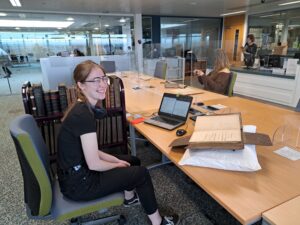
Emily working on the Dc sequence in the CRC Reading Room.
I did my undergraduate degree at the University of Edinburgh, so I’d previously used the Centre for Research Collections to look at some books related to Machiavelli and the Lothian Health Archives, but I hadn’t conducted any individual research there myself. I did have a session there in recent weeks independent from my internship as part of a seminar on Islamic esotericism, so I got to look at some of the CRC Arabic and Persian collections, which proved to be absolutely fascinating. They actually have an edition of the Quran that would fit into the palm of my hand – it’s best not to think too hard about the logistics of creating something like that – years of work and immense eye strain, no doubt. I’ve also spent a little time in various archives around Edinburgh, including the Royal College of Physicians on Queen Street, so I was fairly familiar with reading rooms beforehand.
We’re now four months into the project, and we’ve just last week completed the Dc collection, which proved to be a fascinating look into the history of Edinburgh and of the University itself. Coming from a Literature background, I’ve been especially enamoured with some of the more famous names to be featured in the Dc collection, including Percy Bysshe Shelley, Robert Burns, and William Wordsworth. Many of the volumes we looked at include sheafs of letters, files, and correspondence, some of which were from some of the more famous names of the day. I’m sure Maddie can attest to me spending ages poring over various letters and such that I’ve stumbled across.
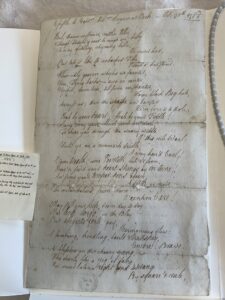
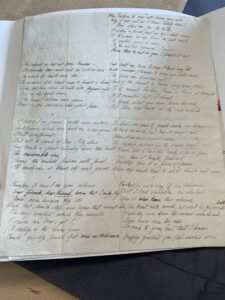
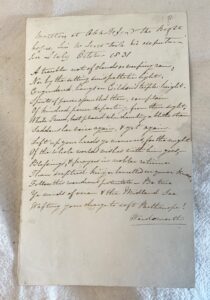
Some interesting letters and poems by Burns, Shelley and Wordsworth respectively.
Thus far into the internship, Maddie and I have come across some fascinating books, including books on alchemy, science, and the history of the University, and my interest was piqued by the sheer amount of books in the collection that were written in Icelandic. However many you’re thinking, I can guarantee that there were more, including a saga on Nordic kingship. Exactly how the University accumulated so many Icelandic books is a mystery that I’m still working on, but it’s a fascinating discovery. I also stumbled across a version of Julian of Norwich’s ‘Revelations of Divine Love’ dating to approximately the seventeenth century, a woman whose life I find particularly interesting – an East Anglian anchorite and English mystic dating to the fifteenth century. Tucked away in the collection there was also a letter regarding the marriage of Mary, Queen of Scots to the French dauphin, which was, in all likelihood, contemporary. And as someone who has a particular interest in the history of medicine, I also found some interesting paraphernalia relating to the invention of anaesthesia, including a photo of the first child to be born whilst their mother was anaesthetised during the birth.
I always like stumbling across photos tucked in the volumes, especially in collections of letters, as I feel like it gives a sense of the person who wrote them. In one collection of letters, there was a photo of an old soldier and aristocrat, alongside other personal effects donated by his family (including an invitation to the Duke of Wellington’s funeral and Queen Victoria’s coronation!). Another volume was written by a student here in the early twentieth century, and included photographs of his regiment – all of whom were fellow students at the University as well. As such, it really gives a sense of who created these volumes and what was important to them – in this case, he wanted to commemorate his friends and brothers.
Photos and illustrations have been particularly prominent within this collection, whether it’s scribbled doodles in old textbooks (not so different from more modern student notes) to scientific diagrams illustrating different theorems. I’ve found a variety of different illustrations within the Dc collections, ranging from quick scribbles to beautifully detailed fly-leaf illustrations – so detailed, in fact, that it took me a while to figure out that it wasn’t printed.
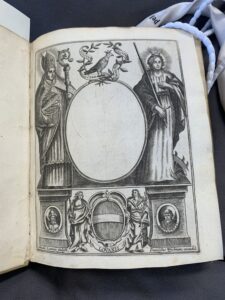
Hand-drawn or printed? Hand-drawn, it turns out.
With the prevalence of scientific notes in the collection, many of the volumes also featured detailed illustrations which were used to explain various biological, chemical, and physical concepts. Many of these works were by the more famous scientific names associated with the University – and at the very least, names that a visitor to the King’s Campus would be familiar with, such as Joseph Black and Colin Maclaurin. A particular favourite of mine was a volume on metaphysics that had moveable parts to help explain different concepts.
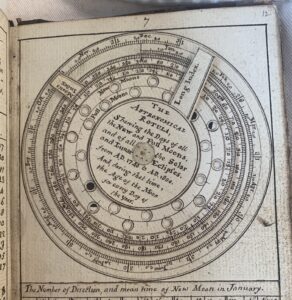
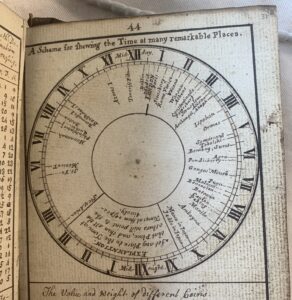
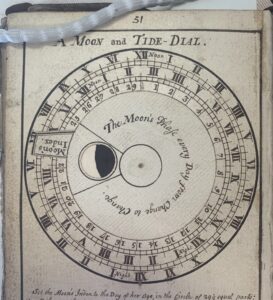
Three different scientific diagrams, all with moveable parts.
One thing that these particular collections have in abundance is minute books from various clubs and societies associated with the University. Although seemingly slightly tedious, Dk.1.4 proved an especially interesting find, as someone had taken the time to illustrate the minutes. One such event that was recorded was an impromptu sledding session down Carlton Hill, where one of the party ended up in the University infirmary shortly afterwards.
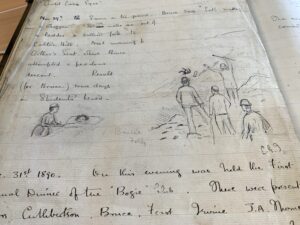
Sledding down Carlton Hill. An age-old saga.
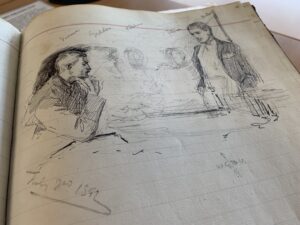
Minute book illustrations.
And as a final note, there was an especially interesting aspect to these sorts of illustrations in the collection – the use of colour! Some of the volumes in particular felt like they’d been coloured in only yesterday – despite being at least three hundred years old. How they managed to keep it looking so pigmented is beyond me – and in any case, I’m sure it would be of interest to the art students.
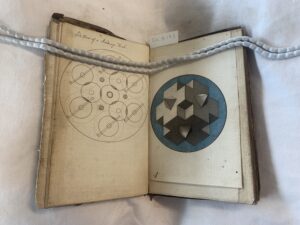
This volume dates to 1771, if you can believe it!
We’ve got a little over a month of the project left, and I’m excited to see what we’ll discover in the Dk collection. One thing’s for sure – it’ll be incredibly interesting!
Edinburgh Open Research Conference 2024
Join us on May 29th for the 2024 edition of the Open Research Conference. This year we are addressing the big challenge: culture change. It is not simply enough to facilitate open access and FAIR Data. We need to embed all aspects of Open Research into our everyday practices.

Join us to consider the broad themes of culture change, along with the role of next generation metrics, education, training and skills development in this process. We will also look to other contexts in which positive shifts in culture are actively taking place: EDI, healthy working lives, and research integrity. We ask what we can learn from these contexts, and how can we collaborate to make a more equitable and open research environment?
In addition to talks on the themes of research integrity, next generation metrics, and open research education & skills, there will be rapid-fire lightning talks, a poster session, and drinks reception along with plenty of opportunities to expand your network.
Registration for in-person attendance closes on May 19th and for online it’s May 24th, full details of the conference have been published.
If you would like to keep up with Open Research news, please sign up for the newsletter, and you can also follow Edinburgh Open Research on EventBrite to find out about our future events.
We look forward to welcoming you to the conference!
Kerry Miller,
Research Data Support Officer & Open Research Coordinator
RESP Outreach Intern – 1st May, Launch Event
Written by: James Rice, RESP Outreach Intern
With the arrival of May, my internship was close to an end, but, not before the in-person launch event for Rebekah’s online exhibition; representing the culmination of both her and most of my work so far!
Coming in on the 1st May, there were many last second arrangements for the event that afternoon. First, liaising with the team, I organised where each of my colleagues would stand to welcome and direct our guests to the CRC on the 6th floor about 20 minutes before the event itself at 4pm; each taking either an A3 or A4 stand displaying the signage for the event. In doing so, I prepared a guest checklist for the building’s security just in case any of our guests were missed by a colleague and found themselves being ID’d by staff.
After which, I ensured that the monitor in the Research Suite where the event would be hosted was functioning as intended, while the Ipads we hoped to provide guests where fully charged with the exhibition’s website accessible. While I did check on these factors the day prior, I thought it would be best practice just to confirm once again ahead of the event in case of any issues.
While the monitor worked fine, and I was able to stream my laptops screen and audio to the display, I found on the day that the provided Ipads did not work as intended. While everything else with these devices were functional without any issue, I had yet to test Rebekah’s exhibition on them until it finally launched that day. Upon testing this, I found that the Ipads (which had not been updated in several years) struggled to display the on-line exhibition as intended; instead presenting metadata and incorrect formats across several of the webpages on the site. Despite this, the RESP team came together and decided to allow guests to use our laptops to access the page instead.
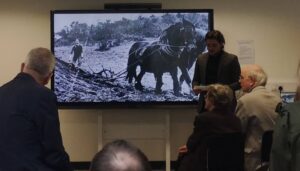
Photo taken of myself reading out at the live launch event for Rebekah Day’s ‘Animal Encounters in the RESP’.
With this crisis averted, my last responsibility on the day was to ensure that our catering order was still set to be delivered between 3pm and 3:30pm ahead of the event. For whatever reason, the order confirmation was no longer displayed on the teams account history. But I was able to run downstairs and check with the catering team and confirmed that we were all set to go as the time came.
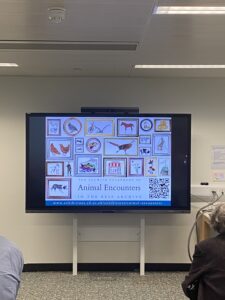
Photo of our exhibit display.
After this, the event ran without a hitch. We were grateful for the speech by our guest, David Paterson, who spoke of his brother Logan who was interviewed as part of the Dumfries & Galloway RESP in 2013. Likewise, we were treated to a wonderful performance by Dr Jo Miller, who is a singer, fiddler, ethnomusicologist, and community musician based in Stirling. Overall, despite the issues that arose this was once again a brilliant experience. The problems that did arise were evident that in reality, there is no perfect setup to an event. Hiccups occur and you can’t predict the unforeseen. But, the key here was not to panic, be open with those around you, and focus on finding a solution ahead of time to minimise problems.
New to the Library: Osmosis
 We are happy to let you know that the Library has a subscription to Osmosis, a health education platform of 1,800 animated videos and 22,000 integrated practice questions, covering subjects including basic science, physiology, medicine and more.
You can access Osmosis from our list of Databases, where you will find information about registering and the access links.
Osmosis is also included in the list of Databases for Medicine, along with other useful tools and databases for your learning and research.
The subscription is a result of the extensive feedback we received to our trial of Osmosis – thank you for letting us know what you think of this resource! The Library regularly arranges trials to new resources. Publishers are usually willing to provide trial access to allow us to use and evaluate a resource before making a decision about purchase. You can see current e-resource trials on the Library website.
Report from the annual LILAC information literacy conference
Between 25-27 March a host of librarians from across the globe descended on Leeds Beckett University for the annual LILAC information literacy conference. Information literacy is a key concept in the work of the Academic Support Librarians, covering all the skills that we teach, from referencing through to critical thinking. Here are our key takeaways from three days of keynotes, workshops, and poster presentations.
AI, AI, and more AI
As you might imagine AI featured heavily across the conference. The keynote on the first day was framed as a Q&A between the audience and four information professionals on the topic “Artificial Intelligence and Information Literacy: Seismic Shift or Passing Fad?”. The discussion brought up some interesting ideas, including:
- AI as a chance for us to take information literacy teaching to a new level, as the bias within AI generated content and training data is the same biases present in the literary canon and the majority of academic and scientific content. It’s the same challenges but at a greater amount/speed and possibly people are more aware of it.
- We need to be aware of the “hype cycle” of AI adoption, acknowledge that we are all learning together about AI, and be more comfortable living in a messy world and working with others to find a way forward – we need to be able to adapt and apply the skills we learn to new things and we can apply the principles of information literacy to this new technology.
- AI can only be a great leveller if everyone is digitally literate. Should libraries subscribe to AI models to increase access for all students?
- It’s important to consider the context in which AI is being used and the existing digital skills of the students and staff using it. It may be necessary to establish a foundation of digital literacy skills first and then layer additional skills building up to using AI. Also, there may be significant disciplinary differences in ways of using AI, so support and guidance may need to be tailored.
- In response to a question about the potential of AI to disrupt traditional research practices, the power of AI to make sense of unstructured research data, e.g., transcribing audio data, translation and providing metadata summaries, was mentioned, along with the need to open up support structures in universities to enable AI specialists to train researchers. A good question to ask yourself: Are you using AI to help you work better or using it to cut corners? This is a key question (although not the only one) when considering whether use of AI is cheating or not.
Additional sessions on the first day also focussed on AI and information literacy and libraries. We heard from Emily Dott and Terry Charlton from the Library and the Learning and Teaching Development Service at Newcastle University who presented their work in developing the University’s approach to AI literacy. They spoke about the institutional AI journey over 2022 to 2024, including: growing awareness about the potential impact of AI on education; the launch of guidance resources; developing and running workshops; editing their existing information literacy framework to align with AI literacy; launching new resources; and planning future developments. They highlighted Newcastle’s principle-led approach to AI and work on developing collaborative models for working with academic staff and students and defining AI literacy alongside IL literacy. Guidance and learning materials for students and academic colleagues were also showcased, including the AI and Your Learning website and AI for Learning Canvas course.
Erin Nephin from Leeds Beckett University gave an overview of the Library Academic Team’s work over the last year in playing a key role in developing the University’s guidance and principles on AI. Erin outlined how the team have updated their academic integrity module and referencing guidance and developed sessions for professional services and academic staff. The collaborative nature of this work with colleagues in Academic Quality Enhancement, Academic Integrity Leads, the Centre for Teaching and Learning, Library and Student Services, and the Students’ Union Advice Services was emphasised.
Erin highlighted the University’s pragmatic view of AI technologies as here to stay and needing a user education that focusses on ethical and responsible use. The focus of information literacy (IL) teaching at Leeds Beckett is very much on how AI tools work, particularly in information IL contexts such as misinformation, privacy/IP, and ethics, rather than how to use them. The success of teaching and guidance has been largely measured through post-session feedback. Key impacts of the work so far have been in incorporating IL more overtly into all teaching sessions and materials, improving staff understanding of IL and AI, information sharing, and building collaborations. Erin also recommended several sources of support, including the JISC National Centre for AI, ALDinHE AI Forum and Community of Practice, ILFA AI Special Interest Group, and AI4LAM community. On the Tuesday we had a keynote from the inspiring Maha Bali. She focused on critical AI literacy and what this might look like. For her, critical AI literacy will also be contextual, differing depending on the student, the discipline, the location etc. That said, her basic model argues that everyone should:
- Understand how it works
- Asses appropriate use
- Craft effective prompts
- Recognize inequalities and biases
- Examine ethical issues
She provided lots of links and resources to investigate further but we will definitely be incorporating some of her ideas into the teaching we do around use of generative AI in HE. A commitment to Open Educational Resources and sharing of material was also prevalent throughout the conference (and the librarian community more generally). For example, instructional designers from Ohio State University shared details of their online course around AI and information literacy, particularly how they used scaffolded assignments, and we will be considering how we can deliver something similar.
Topics other than AI still exist
Despite the prevalence of AI, there were plenty of sessions on other topics. Examples include a discussion of information literacy links with employability and how this can help encourage engagement, consideration of how we could deliver more staff-focused training on information literacy and using an informed learning design model for teaching. There were also some interesting talks about new-to-me research methods, such as photovoice and narrative inquiry, which can be used to understand individual’s experiences in a more experiential way.
A really interesting talk from the final day related to encouraging help-seeking behaviour at the same time as supporting students through transition periods at university. Beth Black of Ohio State University talked about the creation of an innovative online course aimed at new undergraduate students. The course uses scenarios based on the real experiences of other students to help students understand the support available, to encourage them to access it, and also to help them see that they are not alone in the issues they face. When they analysed retention rates, they saw that students who had completed this course were more like to stay on at university, showing the value of this approach for students and the university.
If you would like to see the slides from this and previous year’s conference, they are available on the LILAC Slideshare account.
Anna Richards & Robert O’Brien, Academic Support Librarians
Keith Munro, new Research Data Support Assistant
Hello, my name is Keith Munro and on March 4th 2024 I began my new role as a Research Data Support Assistant. Immediately prior to joining the Research Data Service (RDS), I studied for a PhD in Computer and Information Science at the University of Strathclyde. My thesis studied the information behaviour of hikers on the West Highland Way, see below for a photo of me during data gathering, with a particular focus on embodied information that walkers encountered, the classification of information behaviour in situ and well-being benefits resulting from the activity. I was lucky to present at the Information Seeking In Context conference in Berlin in 2022 and I am still working on getting a number of the findings from my thesis published in the months ahead. I passed my viva on Feb 2nd, so the timing of starting this job has been excellent.
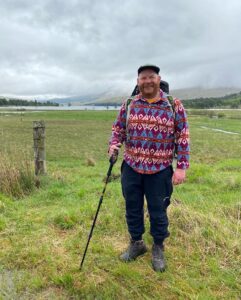
Before my PhD, I studied for a MSc in Information and Library Studies, also from the University of Strathclyde, so there was always a plan to work in the library and information sector, but as my Masters degree was finishing during the outbreak of the Covid-19 pandemic in Spring/Summer 2020, I decided to take an interesting diversion, the scenic route, if you will, with the PhD! My Masters thesis was on the information behaviour of DJ’s, motivated by my own, lucky to do it but not exactly high-profile, experience as a DJ. From this, I was very fortunate to win the International Association of Music Librarians (UK & Ireland branch) E.T. Bryant Memorial Prize, awarded for a significant contribution to the literature in the field of music information. Subsequently, findings from this have been published in the Journal of Documentation and Brio.
Since starting my new role I have been greatly impressed by the team I have joined, who all bring a wealth of experience from across the academic spectrum and have also been very warm in welcoming me and in sharing knowledge. I hope I can bring my study and research experience to complement what the RDS team is doing and I am excited to be learning more about research data management. The size of the University of Edinburgh can be daunting and learning all the acronyms will take some time I suspect, but the range of research I have already encountered in reviewing submissions to DataShare has been fascinating, including Martian rock impacts and horse knees, something I’m sure will continue to be the case!
Is that Vegan…? Conscious conservation changes during the One Health Project and beyond.
By Amanda Dodd, Projects Conservator, Heritage Collections
In this week’s blog, Amanda Dodd reviews the work she did on the One Health Project with a particular focus on this use of more sustainable materials when conserving collections.
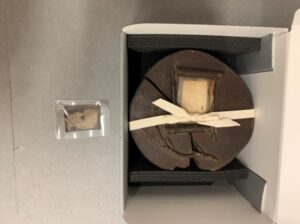
Above: Rehoused R(D)SVS photograph and ornate frame of O.C. Bradley.
In October 2023 I took over as Project conservator for The One Health initiative. A little bit of background: The project, generously funded by the Wellcome Trust, was a monumental effort to catalogue, preserve, and provide access to three distinct archival collections pertaining to the evolution of animal health and welfare in Scotland from the 1840s onwards. These collections include the Royal (Dick) School of Veterinary Studies (R(D)SVS), OneKind Animal Charity, and the Royal Zoological Society of Scotland (RZSS).
RESP Outreach Intern – April
Written by: James Rice, RESP Outreach Intern
April was the last month before the launch of the online exhibition curated by Rebekah Day. As such, my main priority was ensuring that everything related to the event was set and ready.
However, as a student balancing my role with my studies and volunteering, this month was filled with deadlines that I had to prioritise. As such, I learnt very quickly what to prioritise during this time.
For starters, I ensured that the final text for both Eventbrite and our invites were completed and sent out to our guests made up of staff, volunteers, and interviewees alike. Additionally, I ensured that signage and the designs of our postcards were likewise completed after Rebekah shared her new updated design for the RESP website. Finally, liaising with the team, we updated our food order to include a variety of drinks and sent it off.
In the following weeks, I completed another draft video tutorial that I shared with the team, wrote up summaries in preparation for these blogs and briefed our planned speakers for the event.
Finally, in the leadup to the 1st of May, I began scheduling relevant posts from the RESP archive for our X (Twitter) account, before sending out a follow up email for attendance. On the 1st itself when the online exhibition launched, a specific post was shared celebrating the event and encouraging the public to view Rebekah’s work.
Evidently, this month primarily focused on the final elements of the launch event. I was overall pleased with the progress made here, and as the event seemed ever closer, I was increasingly excited to see how our work would pay off.
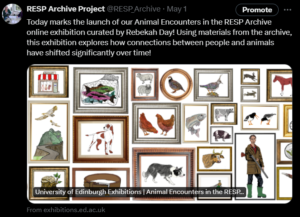
Launch Event Tweet (X) promoting the ‘Animal Encounters in the RESP Archive’, 1st May 2024.
RESP Outreach Intern – March
Written by: James Rice, RESP Outreach Intern
Going into March, now with my responsibilities made more clear, my internship primarily focused upon organising the event itself and invites. Before this, I had no idea how much planning has to go into event management and outreach, even for a relatively small space such as the research suite at the CRC.
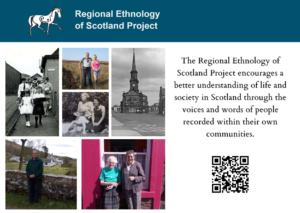
Front of ‘Postcard 2’, designed by James Rice.
While liaising with the team, we confirmed speakers for the event, their schedule, and a guest list made up of colleagues, volunteers, and interviewers for the RESP. We also decided that I would be the best fit as the Master of Ceremonies to lead the event, guide guests, and ensure that the event ran as scheduled. On top of all of this I continued to produce draft iterations of my proposed postcards for outreach using
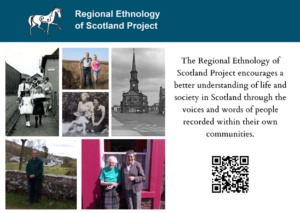
Front of ‘Postcard 2’, designed by James Rice.
‘Canva’.
As someone with little experience working in design, this online tool was incredibly helpful, allowing me to make significant changes often within literally seconds. This was especially useful as I was able to share my designs with the team, allowing them to make their own adjustments or suggestions with their own copies of my work.
As the month progressed, several designs for my Oral History document, as well as a signage sheet for the launch event were circulated. Alongside this, Rebekah shared with us an updated logo for the RESP that we could apply to our designs going forward. As such, further iterations for two postcard designs were produced, as well as another two video tutorials. Through feedback, I was able to edit my designs to be consistent with font, while we agreed that making my tutorial videos shorter would be ideal.
Updated RESP Logo Design, by Rebekah Day.
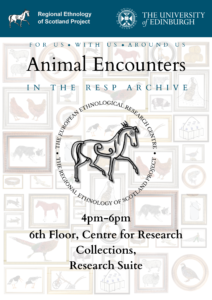
Signage for the Animal Encounters in the RESP Archive on-line exhibition.
While I would continue playing with designs and video editing, I was still concerned with the practical elements of running a launch event in the CRC space. This involved discussions with engagement officer, Bianca, on using equipment such as laptops and Ipads on the day. Additionally, I confirmed that the Research Suite would be booked and cleaned on the day itself, while a catering order was made that met a variety of dietary needs. With this, and the confirmation of the room capacity for the event sorted, I was left with finalising the text for Eventbrite and the invites ready to be sent the following month.
For me, March represented a big step toward meeting my goals for my internship by making a large amount of progress on the ideas that I pitched at the end of January. I had begun to feel far more confident with my responsibilities, and knew exactly how and what to deliver for the RESP.
RESP Outreach Intern – February
Written by: James Rice, RESP Outreach Intern
With my pitch given and what I hoped to achieve with my internship outlined, I could begin planning how to carry out my responsibilities.
In the first week of February, I dedicated a lot of my time to exploring our online archive for a few reasons. First and foremost, having decided to produce a number of activity sheets, I wanted to determine what themes I would focus upon, as well as what entries I could potentially use for their recordings. Eventually, after meeting with the team, we decided that themes relating to ‘Sport and Games’, toys, transport, the changing environment, and food to name a few, were ideal for worksheets aimed at kids. We also thought that an Oral History worksheet that described the significance of oral histories and the ability to record spoken stories was perfect here, as it would bring more attention to the reason why the RESP archive is so special. By the end of the month, I had begun to draft some of these sheets for this purpose.
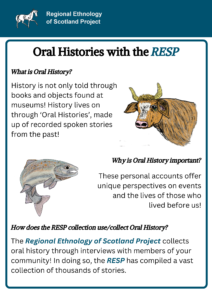
‘Oral Histories with the RESP’ worksheet, page 1, created by James Rice
Second to this, in regard to producing promotional materials such as postcards, having a variety of images from the entries within the project itself on-hand was important. While we did consider using images from Scottish archives with permission for some of our postcards, we concluded that it would be more appropriate to use our own images to invite the public to see what our archive could offer them. In this light, I decided with my colleague, Rebekah, that I would use ‘Canva’ as a free editing software to produce these materials.
Third and finally, having also decided to eventually produce a video tutorial for the website, being hands on with the archive was the best way to familiarise myself in preparation for the video itself. Fortunately, the process of editing and finalising this video wasn’t too much of a challenge, as I already had some experience with recording software and using ‘Adobe Premiere Pro’ for short videos I made with friends. Yet, as we hoped that this video would be relatively short, I admittedly struggled to be as informative as possible while keeping this limited. Nevertheless, I was prepared to start recording raw footage and audio for several drafts to be discussed with the team.
Alongside these responsibilities, I had also begun planning the launch event on the 1st of May for our online exhibition led by curator Rebekah Day. This involved organising and booking the physical space for the event in the CRC, as well as liaising with Daryl Green, Head of Heritage Collections at the University, to organise an opening speech on the day. I also started putting together an ‘Eventbrite’ page for the launch itself, giving guests a platform to accept their invites and a relatively easy way for myself to keep track of those attending.
While this period involved a lot of planning ahead for my role, there was still a lot for me to do over the next coming months ahead of the launch. Nevertheless, I was particularly proud of what I had been able to accomplish thus far, and felt far more confident in my role in light of the previous month, when I was still finding my footing for what I wanted to achieve.
Collections
 Hill and Adamson Collection: an insight into Edinburgh’s past
My name is Phoebe Kirkland, I am an MSc East Asian Studies student, and for...
Cataloguing the private papers of Archibald Hunter Campbell: A Journey Through Correspondence
My name is Pauline Vincent, I am a student in my last year of a...
Hill and Adamson Collection: an insight into Edinburgh’s past
My name is Phoebe Kirkland, I am an MSc East Asian Studies student, and for...
Cataloguing the private papers of Archibald Hunter Campbell: A Journey Through Correspondence
My name is Pauline Vincent, I am a student in my last year of a...
Projects
Cataloguing the private papers of Archibald Hunter Campbell: A Journey Through Correspondence
My name is Pauline Vincent, I am a student in my last year of a...
Archival Provenance Research Project: Lishan’s Experience
Presentation My name is Lishan Zou, I am a fourth year History and Politics student....