Home University of Edinburgh Library Essentials
April 10, 2026
ProQuest Congressional on trial
*The Library currently has access to ProQuest Congressional through the ProQuest Access 350 subscription until 31st July 2024. Access via the Databases A-Z list.*
The Library currently has trial access to the full range of digital collections for ProQuest Congressional. In addition to our existing Congressional Record access this provides access to the ‘Congressional Research Digital Collection’, or CRDC a collection of research materials – CRS Reports and Committee Prints – created for Congress. It also gives access to the ‘Congressional Hearings Digital Collection’, a collection of published and unpublished hearings held by Congress.
You can access the database via the E-resources trials page.
Access is available both on and off-campus.
Trial access ends on 1st April 2017.
Listen very carefully!
I’m happy to let you know that thanks to an agreement with JISC the Library has been given extended trial access to the primary source database BBC Listener Research Department, 1937-c.1950 from British Online Archives.
You can access the database via the E-resources trials page (listed as British Online Archive – BBC Listener Research Department, 1937-c.1950).
For off-campus access you will need to use the VPN.
Trial access ends 31st December 2017.

Founded in 1936 the BBC’s pioneering Listener Research Department (LRD) examined wireless listening in Britain nationwide and at a regional level. This database reproduces the entire available collection of weekly Audience Summaries, together with the weekly then daily Listening Barometers. Also included are the Audience Reaction Reports on specific programmes and Special Reports on particular themes or issues for the period, as well as some key policy documents produced by the LRD during these years, tracing the early development of what has come to be known as market research within the BBC. Read More
Trial access: Socialism on Film
And finally…Adam Matthew have given the Library trial access to their just released resource Socialism on Film. This impressive collection of documentaries, newsreels and features reveals the world as seen by Soviet, Chinese, Vietnamese, East European, British and Latin American film makers. Documenting the communist world from the Russian Revolution until the 1980s and covering all aspects of socialist life.
You can access the database via the E-resources trials page. Access is available both on and off-campus.
Trial access ends 5th April 2017.

Trial access: Race Relations in America
The Library has been given access to another exciting new primary source database from Adam Matthew, Race Relations in America. So for a limited time only you can use this resource to explore three pivotal decades in the struggle for civil rights in America through the eyes and work of sociologists, activists, psychologists, teachers, ministers, students and housewives.
You can access the database via the E-resources trials page. Access is available both on and off-campus.
Trial access ends 5th April 2017.
**Trial access has now been extended until 23rd May 2017**

Annual Review of Cancer Biology – now available

Annual Review of Cancer Biology has now been added to DiscoverEd. This e-journal is a new start for 2017 and will review a range of subjects in cancer research that represent important and emerging areas in the field. The Annual Review of Cancer Biology will be divided into three broad themes: Cancer Cell Biology, Tumorigenesis and Cancer Progression, and Translational Cancer Science.
Further info
We subscribe to the Annual Reviews Sciences Collection – this provide access to 44 titles. A list can be viewed here.
Trial access: East India Company
I’m very pleased to let you know that the Library has been given trial access to the brand new primary source database East India Company from Adam Matthew. This unique digital resource allows students and researchers to access a vast and remarkable collection of primary source documents from the India Office Records held by the British Library, the single most important archive for the study of the East India Company.
You can access the database via the E-resources trials page. Access is available both on and off-campus.
Trial access ends 5th April 2017.

From 16th-century origins as a trading venture to the East Indies, through to its rise as the world’s most powerful company and de facto ruler of India, to its demise amid allegations of greed and corruption, the East India Company was an extraordinary force in global history for three centuries. Read More
Window to a Sixth-Century Scriptorium
A post from guest curator Elijah Hixson, PhD student, School of Divinity
This month’s student led display at New College Library features the facsimile Codex Purpureus Petropolitanus, which is on display at the entrance to New College Library. This Codex is one of the three manuscripts to be discussed in the next Biblical Studies seminar “Window to a Sixth-Century Scriptorium: Three Luxury Gospel Manuscripts and the Scribes Who Made Them” on Friday 10 March.
Codex Purpureus Petropolitanus (N 022) [facsimile] Four Gospels; Sixth century (Possibly Syria?).
[Facsimile] Athens: Miletos, 2002
New College Library (Special Collections):
Ho Porphyrous Kōdix tōn euangeliōn Patmou kai Petroupoleōs; Folio Z.142
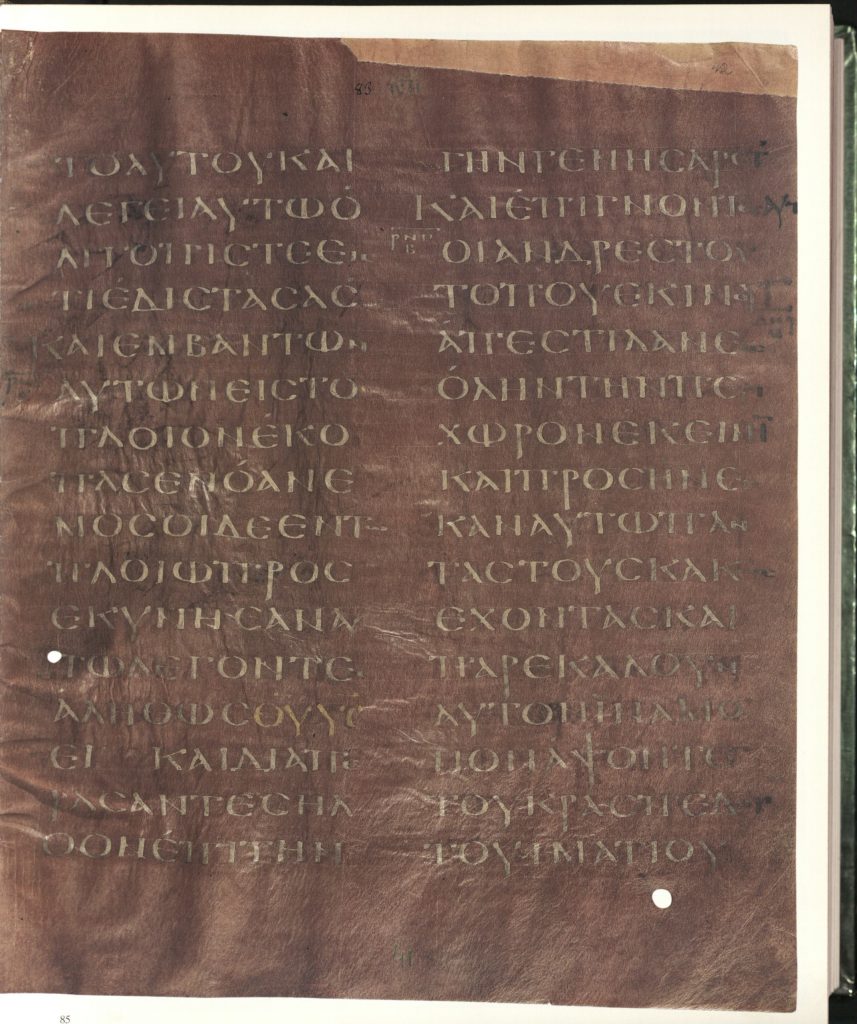
 These four letters are abbreviations for the words “God” and “Son” in the text: αληθως θ(εο)υ υ(ιο)ς ει (“Truly, you are the Son of God”).
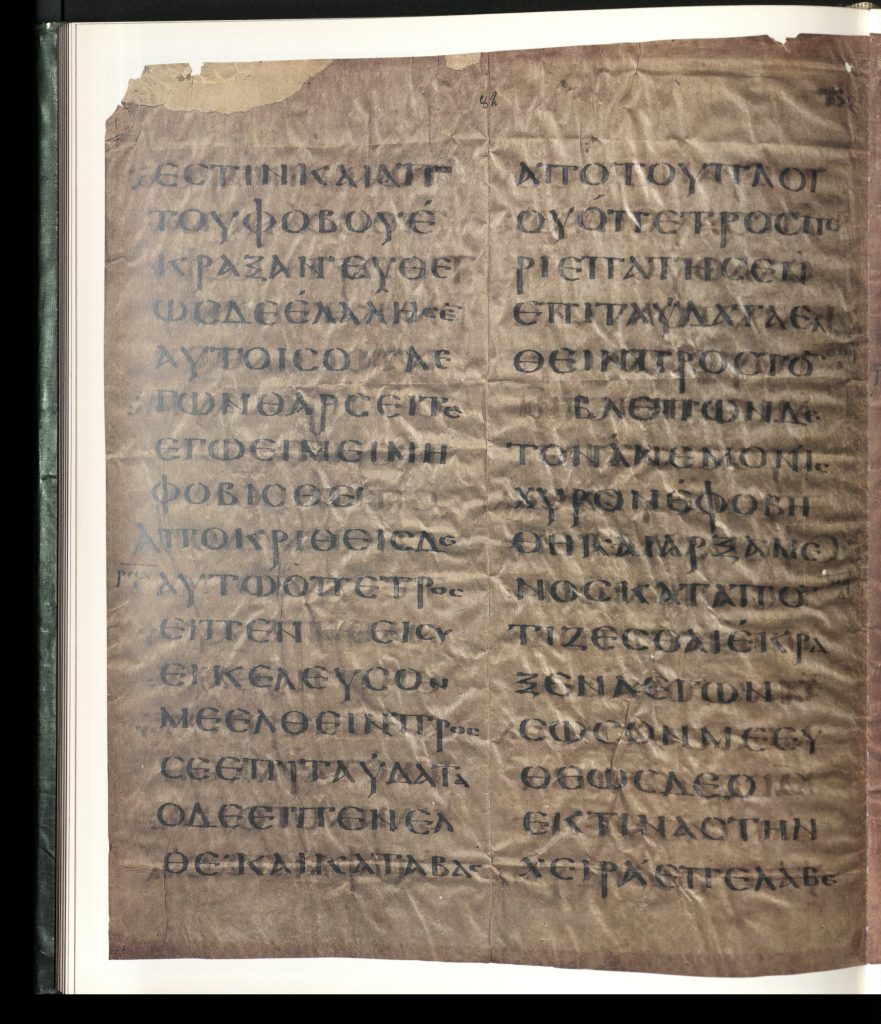
The facsimile is open to Matthew 14:26–36. This opening is an excellent example of how much the conditions in which a book is kept can affect its appearance. These two folios remained together for around 1,300 years. They were numbered consecutively, relatively recently in their history (see the numbers 82 and 83 written in the centre of the top margins). At some point after they were numbered (probably around the year 1896, but not before 1820), the folio on the left was separated from the rest of the codex.
Codex Purpureus – left folio
When the folio resurfaced in Athens in the 1950s, its purple dye had faded, its silver ink had tarnished, and the folio had crease marks because it had been folded up. The folio on the right remained protected within the majority of the codex, and only the silver letters around the edges of the page were exposed to air and tarnished. which was sold to Russia in 1896, and it remains in St. Petersburg to this day.
Codex Purpureus Petropolitanus is cited as N in most modern critical editions of the Greek New Testament. Its text is an early form of the Byzantine textform found in the majority of Greek New Testament manuscripts. Most scholars think it was made in Syria (possibly Antioch).
Elijah Hixson, PhD candidate, School of Divinity
IIIF Technical Workshop and Showcase March 2017
Improving Access to Image Collections
On 16th and 17th March the University of Edinburgh and National Library of Scotland will be hosting two International Image Interoperability Framework events.
IIIF Showcase
The IIIF Showcase brings together developers and early adopters to explain the background and value of IIIF, its growing community, and the potential of the Framework and the innovative ways in which it can be used to present digital image collections. There will be presentations from Edinburgh University Library, National Library of Scotland, National Library of Wales, Durham University, University College Dublin, The Bodleian Library, Digirati, Cogapp and others.
Logistics
- Registration: Registration is free but capacity is limited.
- Date: Friday, March 17, 2017
- Location: National Library of Scotland (NLS) Boardroom on George IV Bridge (see map)
- Audience: Individuals and institutional representatives interested in learning more about IIIF
- Code of Conduct: The IIIF Code of Conduct applies to all IIIF events and related activities.
- Social Media: Tweets about the event should use #iiif and @iiif_io.
IIIF Technical Workshop
The IIIF Technical Workshop unconference, hosted by the University of Edinburgh at Argyle House, will bring together colleagues who have implemented IIIF services, are developing the Framework and associated tools, and working on community initiatives. The workshop will provide opportunities to discuss implementations, issues, initiatives and developments and the forthcoming Annual IIIF conference in June.
Logistics
- Registration: Registration is free but capacity is limited.
- Date: Thursday, March 16, 2017
- Location: University of Edinburgh Argyle House (see map)
- Audience: Developers already working with IIIF or considering an implementation
- Code of Conduct: The IIIF Code of Conduct applies to all IIIF events and related activities.
- Social Media: Tweets about the event should use #iiif and @iiif_io.
Trial access: China: Trade, Politics and Culture
The Library has been given trial access to the primary source database China: Trade, Politics & Culture from Adam Matthew. So for a limited time only you have access to this fantastic digital collection of English-language primary sources relating to China and the West from 1793 to 1980.
You can access the database via the E-resources trials page. Access is available both on and off-campus.
Trial access ends 5th April 2017.

I: Edinburgh University Battery Officers’ Training Corps – OTC
LIFE IN THE ARMY, AT STOBS CAMP AND ELSEWHERE… AND SOME FACES OF THE FALLEN…

Edinburgh University Battery Officers’ Training Corps was one of Scotland’s oldest military volunteer Units. By 1860 undergraduates of the University had formed No.4 Company of the Queen’s Edinburgh Rifles and in 1872 they also supplied recruits to the 1st Edinburgh City Royal Garrison Artillery Volunteers. A Medical Volunteer Company was also formed in 1890. In 1908, they combined to form one of the original eight University Officers Training Corps (OTC) contingents.
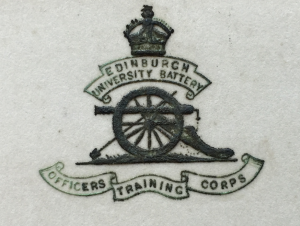
Badge of Edinburgh University Battery, Officers’ Training Corps, on an invitation card inserted in ‘Minute Book. Artillery Unit. Officers ‘ Training Corps’, Dec. 1914 – Nov. 1920. EUA. Acc.99/017
Also in 1908, and as part of the Haldane Army Reforms, the OTC was formally established as a distinct unit in the British Army. It had the remit of supplying officers for the Special Reserve and the Territorial force. Against this background of Army reform, the Royal (Dick) Veterinary College OTC was also formed… in September 1912.
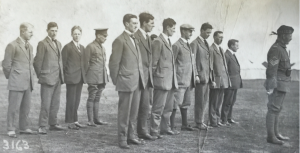
Officer recruits at a School of Instruction, Barry Camp, August 1914. Album in EUA. Acc.99/017.
On the outbreak of war in 1914, the OTCs would become officer-producing units, but as the war progressed high attrition rates meant that the demand for officers soon outstripped supply. Local Edinburgh recruits would pass through Stobs Camp, near Hawick, in the Scottish Borders, and attend the Officers’ School of Instruction at Barry Camp, near Carnoustie, in Angus.
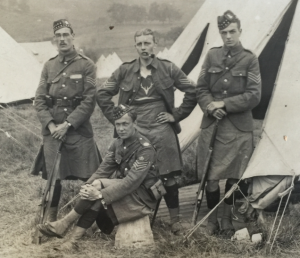
A group of Sergeants at Stobs Camp, 1914. Album in EUA. Acc.99/017.
By the end of 1914, thousands of recruits were arriving at Stobs Camp to begin their transition from civilian to military life with up to 5,000 men being accommodated. Indeed, there were so many visitors to the Camp that an Exclusion Order was implemented to prevent civilians entering unless issued with a pass.
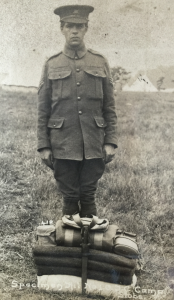
Specimen ‘kit’ displayed by a Sergeant at Stobs Camp, 1914. Album in EUA. Acc.99/017.
It had been intended that the Camp be used mainly as a summer training ground, and so the troops were only provided with tents. By 1917 however, the Camp contained at least 80 huts, a hospital with 150 beds, its own light railway, stores, workshops, Post Office, and a YMCA outside the perimeter. From October 1914, Stobs also served as a prisoner-of-war camp.
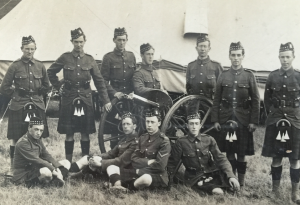
Photograph showing the Gun Team at Stobs, 1914, with Chilton, Balleny, Yorston, Robertson, Wedderburn, Calver, Laidlaw, Hill, Milne, Fraser and Waddy. Album in EUA. Acc.99/017.
The Gun Team of Edinburgh University Battery OTC was photographed in group at Stobs Camp in 1914. The Roll of Honour 1914-1919 of the University of Edinburgh notes that Medical student Frank Chilton, 1912-1914 (standing back left), from Christchurch, New Zealand, served in the OTC Infantry unit from October 1913 to August 1914. He became a Cadet in the 13th Argyll and Sutherland Highlanders, before becoming a 2nd Lieutenant in August 1914 and then Lieutenant in January 1915. He was then attached to the 2nd Hampshires, 29th Division, and was killed in action at Gallipoli on 4 June 1915 aged 23. He is honoured at the Helles Memorial (panel 183/184) which stands on the tip of the Gallipoli Peninsula in Turkey.
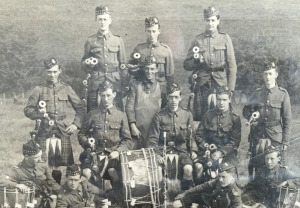
Photograph showing the Band at Stobs, 1914, with W.M.Hutchison, Mackay, W.M.McPhail, J.A.Robertson, N.McRury, C.G.N.Edwards, T.F.Murdoch, R. Hill, Duff, W.A.Sinclair, Younie, R.Coull, and J.D.Russell. Album in EUA. Acc.99/017.
Because of the lack of initials and the common surnames on the group photograph other Fallen from the Gun Team are difficult to identify. However, the general records of service of some war survivors from the group – with less common surnames – can be summarised. William Balleny (standing next to Chilton) for example, was an Arts student, 1913-1914, and like Chilton served in the OTC Infantry unit, though from October 1913 to September 1914. He became first a Cadet, then 2nd Lieutenant, then in September 1916 a Lieutenant with the 2nd Gordon Highlanders.
Robert MacDonald Yorston, a Science student from Montrose, 1912-1914, 1918, (and standing next to Balleny), served in the OTC Infantry unit from October 1912 to September 1914. He served as a Cadet with the 4th North Staffordshire Regiment, and then became a 2nd Lieutenant in August 1914, a Lieutenant and then a Captain in 1917. He served in France and was wounded at the Somme in July 1916. He was posted to Dublin from 1918 to 1919.
Edmond William Waddy (seated front right) had been a student at Merchiston Castle before becoming an Arts student, 1912-1915. He was a member of the OTC from 1908 and became involved with the University Battery OTC, Infantry unit, from October 1913 to October 1914. He was a Cadet with the Scottish Rifles, becoming a 2nd Lieutenant in October 1914, then a Lieutenant in November 1915, before assignment to the 56th Training Reserve Battalion in December 1916. He served in France in 1916 and 1917 an became an Acting Captain in July 1917. He was wounded during his war service.
At least two OTC men from the Band (photographed at Stobs) were killed in action. William Murray Hutchison from Sefton Park, Liverpool, had attended the Liverpool Institute, and been an OTC Cadet Colour-Sergeant there before studying at Edinburgh University. He had been part of the University Battery OTC, Infantry unit, October 1912 to August 1914. He was a Cadet then 2nd Lieutenant (August 1914) then Lieutenant (1915) then Captain (1916) with the Liverpool Regiment. He served in France in 1915 and was awarded the Military Cross as well as being Mentioned in Dispatches in May and September 1915. He died on 27 April 1916 after wounds received in France, aged 22. He lies in plot A.11 at Bruay Communal Cemetery Extension in the large village of Bruay, Pas-de-Calais, France.
Prior to studies at Edinburgh University and participation in the University Battery OTC, Infantry unit, from November 1909 to October 1914, Norman McRury (in front of Hutchison) had been a student at George Watson’s College. He was a Cadet Pipe-Major, then 2nd Lieutenant (October 1914) then Lieutenant (February 1915) with the 11th Royal Highlanders (Black Watch). He was attached to the King’s Own Scottish Borderers (KOSB) and was in Gallipoli in May 1915. Like Frank Chilton, McRury was killed in action at Gallipoli on 4 June 1915, aged 24. He too is honoured at the Helles Memorial (panel 144) which stands on the tip of the Gallipoli Peninsula in Turkey.
A second blog on the Edinburgh University Battery Officers’ Training Corps – OTC will appear before November 2018. The website of the Commonwealth War Graves Commission was also used in building this picture of University alumni associated with the OTC.
Edinburgh University Battery Officers’ Training Corps is now part of the City of Edinburgh Universities OTC.
Dr. Graeme D. Eddie, Assistant Librarian Archives & Manuscripts, Centre for Research Collections (CRC)
Collections
 Hill and Adamson Collection: an insight into Edinburgh’s past
My name is Phoebe Kirkland, I am an MSc East Asian Studies student, and for...
Cataloguing the private papers of Archibald Hunter Campbell: A Journey Through Correspondence
My name is Pauline Vincent, I am a student in my last year of a...
Hill and Adamson Collection: an insight into Edinburgh’s past
My name is Phoebe Kirkland, I am an MSc East Asian Studies student, and for...
Cataloguing the private papers of Archibald Hunter Campbell: A Journey Through Correspondence
My name is Pauline Vincent, I am a student in my last year of a...
Projects
Cataloguing the private papers of Archibald Hunter Campbell: A Journey Through Correspondence
My name is Pauline Vincent, I am a student in my last year of a...
Archival Provenance Research Project: Lishan’s Experience
Presentation My name is Lishan Zou, I am a fourth year History and Politics student....