Home University of Edinburgh Library Essentials
May 3, 2026
Do we have access to the British Newspaper Archive?
A question I get asked quite a lot is if we have access at the Library to the British Newspaper Archive. And it is the sort of question that I would usually be able to give a yes or no answer to but in the case of the British Newspaper Archive it isn’t quite as simple.
In fact the answer I would normally give is either “Yes, BUT…” or “No, BUT…”and I’ll try to explain why.
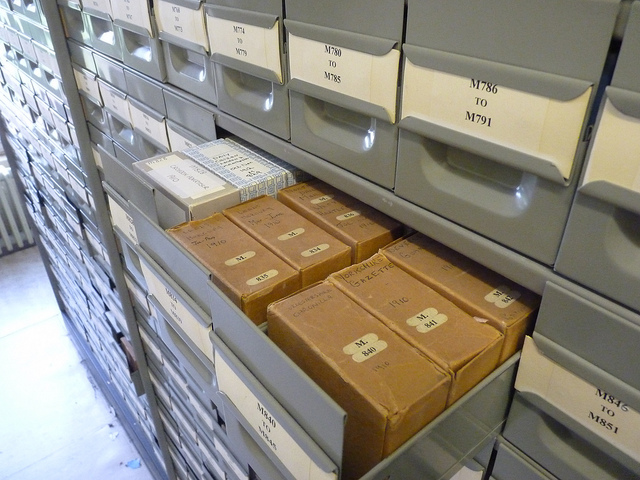
“Drawers” (https://flic.kr/p/gaUXpW) by Luke McKernan (https://flic.kr/ps/vNbEP) is licensed under CC BY 2.0 (https://creativecommons.org/licenses/by-sa/2.0/).
EDINA’s ShareGeo Open content into DataShare
Many fascinating datasets can be found in our new ShareGeo Open Collection: http://datashare.is.ed.ac.uk/handle/10283/2345 .
This data represents the entire contents of EDINA’s geospatial repository, ShareGeo Open, successfully imported into DataShare. We took this step to preserve the ShareGeo Open data, after the decision was taken to end the service. Not only have we maintained the accessibility of the data but we also successfully redirected all the handle persistent identifiers so that any existing links to the data, including those included in academic journal articles, have been preserved, such as the one in this paper: http://dx.doi.org/10.1007/s10393-016-1131-y .
Similarly, should the day ever arrive when DataShare was to be closed, we would endeavour to find a suitable repository to which we could migrate our data to ensure its preservation, as per item 13 of our Preservation policy.
We were able to copy the content of almost all metadata fields from ShareGeo to DataShare. The fact both repositories use the Dublin Core metadata standard, and both were running on DSpace, made the task a little easier. The University of Edinburgh supports the Dublin Core Metadata Initiative. DataShare’s metadata schema can be found at https://www.wiki.ed.ac.uk/display/datashare/Current+metadata+schema setting out what our metadata fields are and which values are permitted in them.
Our EDINA sysadmin (and developer) George was very helpful with all our questions and discussions that took place while the team settled on the most appropriate correspondence between the two schemas. The existing documentation was a great help too. George then produced a Python script to harvest the data, using OAI-PMH to get a list of ShareGeo items, then METS for the metadata and bitstreams. He then used SWORD to deposit them all in DataShare.
The team took the opportunity to use DSpace’s batch metadata editing utility and web interface to clean up some of the metadata: adding dates to the temporal coverage field and adding placenames and country abbreviations to the spatial coverage field, to enhance the discoverability of the data.
For example “GB Postcode Areas” can be found using the original handle persistent identifier: http://hdl.handle.net/10672/51 as well as the new DOI which DataShare has given it – DOI: 10.7488/ds/1755. Each of the 255 items migrated to our ShareGeo Open Collection contains a file called metadata.xml which contains all the metadata exactly as it was when exported from ShareGeo itself. I have manually added placenames in the spatial coverage field (which was used differently in ShareGeo, with a bounding box i.e. “northlimit=60.7837;eastlimit=2.7043;southlimit=49.8176;westlimit=-7.4856;”). Many of these datasets cover Great Britain, so they don’t include Northern Ireland but do include Scotland, England and Wales. In this case I’ve added the words “Scotland”, “England” and “Wales” in Spatial Coverage (‘dc.coverage.spatial’), even though these are already implicit in the “Great Britain” value in the same field, because I believe doing so:
- enhanced the accessibility of the data (by making the geographical extent clearer for users unfamiliar with Great Britain) and…
- enhanced the discoverability of the data (users searching Google for “Wales” now have a chance of seeing this dataset among the hits).
James Crone who compiled this “GB Postcode Areas” data is part of EDINA’s highly renowned geospatial services team.
Part of James’ work for EDINA involves producing census geography data for the UK DataService. He has recently added updated boundary data for use with the latest anonymised census microdata (that’s from the 2011 census): see the Boundary Data Selector at https://census.ukdataservice.ac.uk/get-data/boundary-data .
Pauline Ward is a Research Data Service Assistant for the University of Edinburgh, based at EDINA.

Detail from GB Postcode Areas data, viewed using QGIS.
NEW! Rhizomata: a journal for ancient philosophy & science
We now have full access from volume 1 to this De Gruyter title, first published in 2013. Read More
Several Theses in One Binding
In this week’s blog post, Projects Conservator Nicole, gives us an update on the work she is carrying out for the Thesis Digitisation Project…
I am currently working on a collection of theses ranging in date from 1838 – 1850. They consist of theses of all different sizes that have been bound in large book cloth bindings. Some bindings contain up to 9 individual theses, which has made the spine more than 10cm in width. With such large bindings and different sized pages, surface dirt has accumulated in between the individual theses, and the bottom of the spines have become distorted and narrowed.

Theses before conservation treatment
‘BLAST’ – a journal that will ‘try and brave the waves of blood, for the serious mission it has on the other side of World-War’
‘…THIS PUCE-COLOURED COCKLESHELL […] HAS TO SPRING UP AGAIN WITH NEW QUESTIONS AND BEAUTIES WHEN EUROPE HAS DISPOSED OF ITS DIFFICULTIES…’
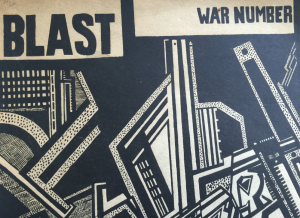
Detail from the ‘puce-coloured’ front cover of ‘Blast’, issue 2, July 1915, in the A.H. Campbell Collection.
These were the words of Wyndham Lewis (1882-1957), editor of Blast, in his editorial piece published in the July 1915 issue (only the second issue) of the journal. About that issue, he said that it ‘finds itself surrounded by a multitude of other Blasts of all sizes and descriptions’.
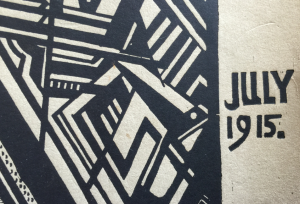
Detail from the front cover of ‘Blast’, showing month of publication of issue 2… being July 1915… in the A.H. Campbell Collection.
Blast was the literary magazine of the Vorticist movement in Britain and it only survived two issues. The first issue came out only weeks before the beginning of the War, and the second came out a year later in 1915. It featured a woodcut by Lewis on the cover.
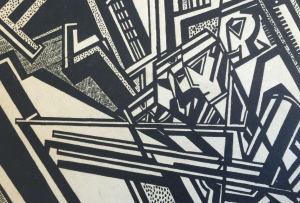
Detail from the front cover of ‘Blast’, issue 2, a woodcut by Wyndham Lewis, in the A.H. Campbell Collection.
The vorticists were an avant-garde group formed in London in 1914 – with Wyndham Lewis as its founder – aiming towards an art that expressed the dynamism of the modern world. Vorticism was launched with the journal Blast which, within its content included manifestos ‘blasting’ the effeteness of British art and culture and proclaiming the vorticist aesthetic.
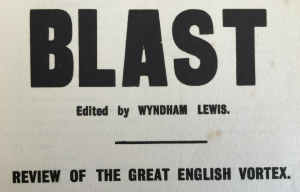
Detail from the title page of ‘Blast’ issue 2, July 1915, in the A.H.Campbell Collection.
Vorticist painting combined Cubist fragmentation of reality with an imagery derived from the machine and the urban environment. In its embrace of dynamism, the machine age and all things modern, it is more closely related to Futurism.
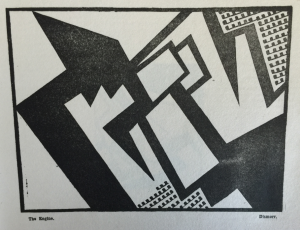
‘The Engine’ by one of the signatories to the Vorticist manifesto Jessica Dismorr (1885-1939). Her illustrations show a sharing of the involvement with the dynamism of the machine-age city. In ‘Blast’, issue 2, July 1915, in the A. H. Campbell Collection.
Blast, issue 2, included designs by painter and illustrator Jessica Dismorr (1885-1939), artist and architect Frederick Etchells (1886-1973), artist and sculptor Henri Gaudier-Brzeska (1891-1915), painter Jacob Kramer (1892-1962), and by figure and landscape painter, etcher and lithographer, Christopher Richard Wynne Nevinson (1889-1946).
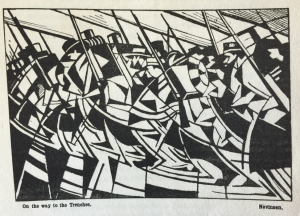
‘On the way to the trenches’ by Nevinson, in ‘Blast’ issue 2, July 1915, in the A. H. Campbell Collection.
It also contained graphic contributions from the figure and portrait painter William Roberts (1895-1980), Helen Saunders [or Sanders] (1885-1963), Dorothy Shakespear (1886-1973) artist and wife of Ezra Pound, artist Edward Alexander Wadsworth (1889-1949), and also Wyndham Lewis.
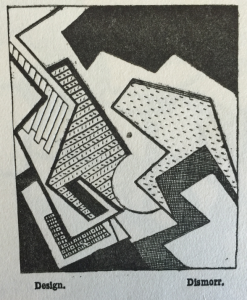
‘The Design’ by Jessica Dismorr (1885-1939), in ‘Blast’, issue 2, July 1915, in the A. H. Campbell Collection.
Other contributions were made by Ezra Pound (1885-1972), Ford Madox Hueffer [Ford Madox Ford] (1873-1939), and T. S. Eliot (1888-1965).
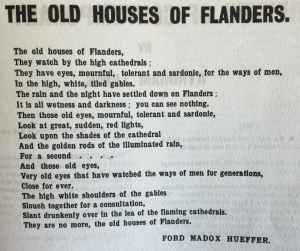
The poem, ‘The old houses of Flanders’ by Ford Madox Hueffer (Ford Madox Ford) in ‘Blast’, issue 2, July 1915, p.37, in the A. H. Campbell Collection.
It had been the unfolding human drama, the unimagined industrial scale of death borne out of the machine-age, and the absolute disaster of the War – known to that generation as the Great War – that came to drain the Vorticists of their creative zeal. The real war experience of Ford Madox Ford influenced his poem ‘The old houses of Flanders’.
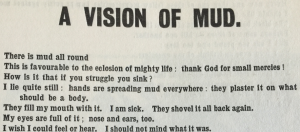
The poem, ‘A vision of mud’ by Helen Saunders in ‘Blast’, issue 2, July 1915, pp.73-74, in the A. H. Campbell Collection.
Ford writes of the mournful eyes of the houses watching the ways of men, and of the rain and night settled down on Flanders; how the eyes look at great, sudden red lights and the golden rods of the illuminated rain; how the old eyes that have watched the ways of men for generations close for ever, and how the gables slant drunkenly over.
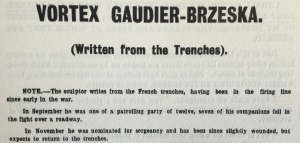
‘Vortex Gaudier-Brzeska (Written from the trenches’, in ‘Blast, issue 2, July 1915, pp.33-34, in the A. H. Campbell Collection.
Unlike Ford, Helen Saunders had no first-hand knowledge of the trenches and the shell blasted Flanders but in her poem ‘A vision of mud’ she took the image of the mud of the trenches to describe a wider sense of foreboding and anxiety. She imagined what would happen to a body underground and about what it would feel like to drown in mud with eyes, nose, mouth and ears filled with it. She imagined the distortion of awareness, and how the body would swell and grow as it filled with mud. She described a muddy soup of bodies.
‘…There is mud all round […]
They fill my mouth with it. I am sick. They shovel it back again.
My eyes are full of it […]
It is pouring into me so that my body swells and grows heavier every minute […]
I have just discovered with what I think is disgust, that there are hundreds of other bodies bobbing about against me.
They also tap me underneath…’
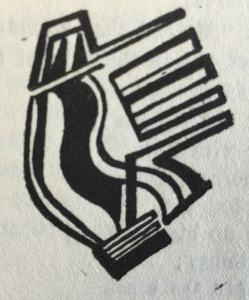
Artwork in ‘Blast’, issue 2, July 1915, p.49, in A. H. Campbell Collection.
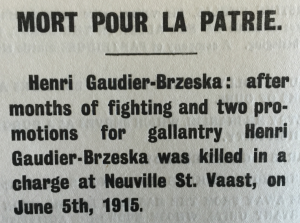
The trenches were also described by Frenchman Henri Gaudier-Brzeska. He wrote:
Human masses teem and move, are destroyed and crop up again.
Horses are worn out in three weeks, die by the roadside.
Dogs wander, are destroyed, and others come along.
It had been Lewis’s hope that with the end of the War – when Europe had ‘disposed of its difficulties’ – Blast and the Vorticist movement would ‘spring up again with new questions’ in order to tackle the ‘serious mission’ that it would have ‘on the other side of World-War’.
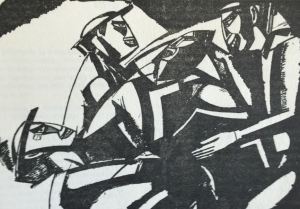
‘Design for programme cover – Kermesse’, by Wyndham Lewis, in ‘Blast’ issue 2, July 1915, p.75, in the A. H. Campbell Collection.
The War brought Vorticism to an end for the reasons already described in paragraphs above, but in 1920 Lewis did make a brief attempt to revive it with ‘Group X’, a short lived group of British artists formed to provide a continuing focus for avant-garde art in Britain.
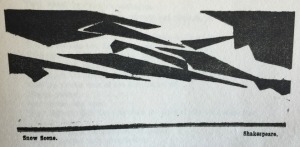
‘Snow-scene’ by Dorothy Shakespear, in ‘Blast’ issue 2, July 1915, p.35, in A. H. Campbell Collection.
The real stories, real imagery, and real maimed victims of War – the horrors of War – had brought about a rejection of the avant-garde in favour of traditional art, and there was a ‘return to order’ and the more traditional approaches to art creation.
‘War-engine’ by Wadsworth, in ‘Blast’, issue 2, July 1915, in A. H. Campbell Collection.
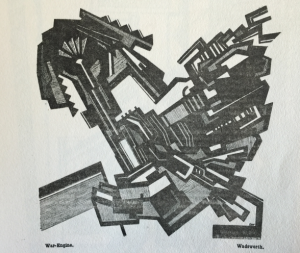
Nevertheless, the typography of the Vorticists possibly places them as important forerunners of the revolution in graphic design that occurred in the 1920s and 1930s.
A copy of Blast, Issue 2, July 1915, was re-discovered in the Papers of Archibald H. Campbell, a collection which had been undergoing preliminary listing.
Dr. Graeme D. Eddie, Assistant Librarian Archives & Manuscripts, Centre for Research Collections, Edinburgh University Library
Used in the construction of this blog-post, in addition to the issue of Blast (2) 1915, were: (1) ‘ Beyond the trenches’, Dr. Kate McLoughlin, in Research & teaching, Review 2013, pp.30-31, from Birkbeck web-pages [accessed 27 July 2016]; and, (2) ‘Vorticism’ and other pages on the website of the tate.org.uk [accessed 27 July 2016].
Conservation and Preservation at St Cecilia’s Hall
by
Emily Hick, Katharine Richardson, Jonathan Santa Maria Bouquet, Nicole Devereux and Helen Baguley
This has been a busy month for the musical instruments collection, as more than 400 objects are being installed in the new display cases at St Cecilia’s Hall. Jonathan has been working with Sarah Deters and the Plowden & Smith team to make the museum look fantastic. We are looking forward to next month when it will be the turn of the keyboard instruments to get unwrapped, adjusted, and rearranged.
Helen has been assisting Jonathan at St. Cecilia’s this month in creating a Marvelseal™ package to treat a piano which has an infestation of webbing clothes moth. She has also completed conservation work of the Hortus Sempervirens collection, which has been surfaced cleaned and housed in custom made boxes. Her attention has now turned to the map and atlas collection within the rare books collection.
-
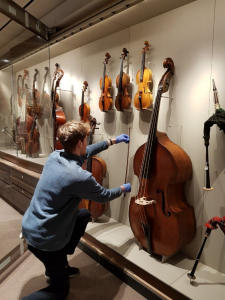
- Installation of musical instruments at St Cecilia’s Hall
-
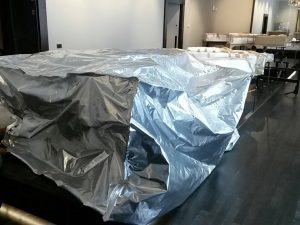
- Piano in Marvelseal™ package
Nicole has continued working on the Latin theses with broken sewing and split spines. She has also been working on theses that have been digitised prior to conservation. Conservation work on these volumes include rehousing and consolidation. Before Nicole took up the post as Projects Conservator, biological samples had been found within the collection, including broken microscope slides and cross sections of lungs which had been laminated and bound into a volume. Nicole researched the risks of handling and storing them. Professor Colin Smith from the Pathology Department kindly came to assess both of the volumes. He came to the conclusion that the lung specimens posed no risk to health, and could be kept. However, he advised that the slides should be disposed of as they do not have any medical value, and pose a hazard to health.
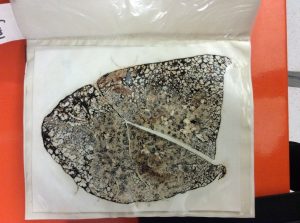
Cross section of lung, laminated and bound into a volume
This month, Katharine recruited an Edinburgh University student through the Employ.ed scheme for a 10-week summer internship funded by the innovation fund. The intern will focus on developing an e-learning resource on integrated pest management (IPM) and collections care. This will be created using the data collected from the IPM inspections over the last year, and research on the subject that Katharine has undertaken. We hope to hold a launch event to conclude the placement, for staff to have the opportunity to trial the e-learning resource.
At the end of March, we welcomed a new intern to the Conservation team. Claudia Callau Buxaderas is the third in a series of interns who will be working on the Thomson-Walker collection of medical prints. The internship will last eight weeks, and will mainly involve removing old adhesives and secondary supports from the prints and rehousing them in acid-free folders and boxes.
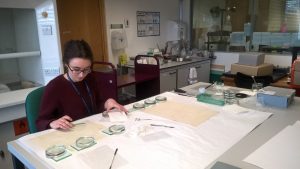
New Thomson-Walker Intern, Claudia
Confessions of a work placement student
A guest post from MSc Book History and Material Culture student Holly Sanderson
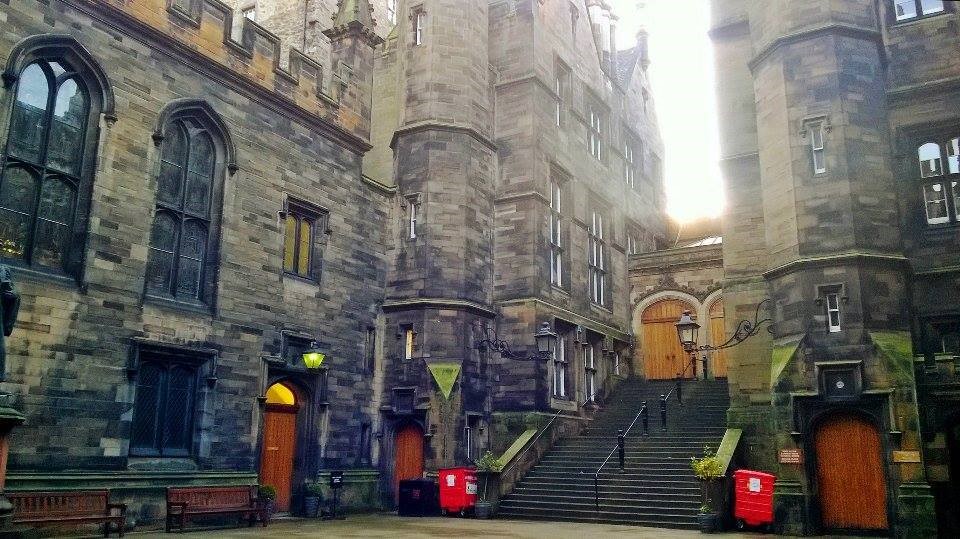
Entrance to the Library from New College Courtyard
As part of the Master’s degree in Book History and Material Culture at the University of Edinburgh, each student is required to undertake a ten-week work placement at a cultural heritage institution. I have long focused my academic interest upon aspects of divinity, especially liturgical and devotional texts, and as such, it was a pleasure to learn that my placement would be at New College Library. Now, with just one workday left until the placement’s end, I am taking the opportunity to reflect upon my time here – the treasures found, tasks undertaken, and skills learnt.
The projects I’ve been working on fall into roughly three areas: collections assessment, collections care, and exhibitions. I’ve handled several different collections, including the Chinese collection donated to New College Library in 1921 by the Rev. James W. Inglis, the Portraits collection from the New College archives, and the Norman Walker Porteous Papers. I’ve also been working with a sequence of very dusty unaccessioned material and a sequence of uncatalogued pre-1800 books. I was on the lookout for any items with copy-specific features and/or interesting provenance that could heighten potential research value. Collections care is another important factor in library management, and when handling each item I would assess its condition, making a note of particularly bad damage and tying any fragile items with cotton conservation tape. One particularly interesting item I came across was a photo album collected by Bishop Whipple from Minnesota. After spending most of the day sifting through albums of British ministers and notable men, it was a surprise to encounter portraits of nineteenth-century North American Indians!
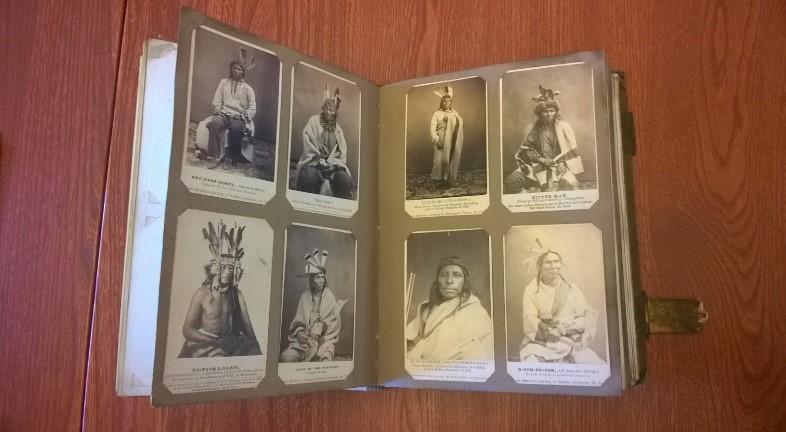
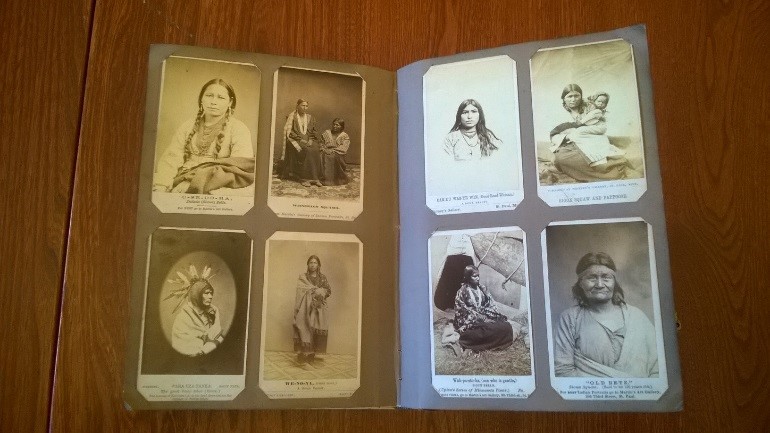
Images from Bishop Whipple’s Photo Album
Anyone who has visited the library will be able to understand why my romantic sentiments were only encouraged by the stunning neo-gothic building that is New College. However, as the placement progressed, I came to realise the problem with my original perspective: not only was it impractical, it was selfish. My bibliophilic daydream made room for me only, hoarding rare books like a dragon with its gold, when the true importance of cultural heritage lies in it being openly accessible to all. Enabling public access to special collections can generate significant environmental, economic and social benefits: it boosts the economy, aids social inclusion and cohesion, advances understanding and education, and can even contribute to wider agendas such as health outcomes, the environment, and urban planning.
The importance of cultural heritage to humanity is perhaps recognised most clearly through its destruction. Consider ISIL’s treatment of Palmyra and Mosul, or the Taliban’s destruction of the Buddhas of Bamiyan in Afghanistan in 2001 – both attempts to destroy a community’s sense of shared history and identity. However, heritage is mostly lost not by wilful destruction but by simple neglect, demonstrating the constant need for good collections care and management. Any loss of heritage highlights not only its importance but also its irreplaceability. This, I have come to realise, is one of the clearest arguments for the importance of collections care and management as a profession: preserving our history to pass on to future generations.

Image courtesy of http://lotr.wikia.com
I would like to thank Christine Love-Rodgers, and all of the staff at New College Library, for allowing me to see behind the scenes and get to grips with the everyday tasks that ensure these collections can be accessed, enjoyed, and preserved. Gone are my fantasies of green leather-topped desks, lamplight, and spending every day surrounded by mountains of fifteenth-century manuscripts, but I have found the reality that has replaced these daydreams to be just as exciting.
Holly Sanderson
April 2017
New journals available for History, Classics and Archaeology
The Library has recently started subscriptions to 3 new journals following requests from the School of History, Classics and Archaeology. So welcome to the Library…
 Journal of Greek Archaeology
This is a new English-language journal specialising in synthetic articles and in long reviews and the journal is produced by staff at the University. The journal covers Greek archaeology both in the Aegean and throughout the wider Greek-inhabited world, from earliest Prehistory to the Modern Era.
The Library has subscribed to the print edition which can be found on the 4th floor of Main Library but the online version is also available. This is a brand new journal so only one volume is available just now. Read More
Pop-up IT Support Desk pilot scheme
A new Pop-up IT Support Desk, situated on the ground floor concourse of the Main Library, will run from 12pm to 6pm (Monday – Friday) with late opening until 7.30pm on Wednesdays between 27/03/17 and 19/05/17. This will replace the regular Mobile Device Clinics during this period.
Library open during New College Quad closure 8-22 April 2017
Due to building works, access to New College Library via the New College Quad will be closed between Sat 8th to Sat 22nd April. However alternative access to New College Library will be provided via the door to left of the archway on Mound Place.

New College Library – temporary side entrance
Due to concerns about fire exits, Stack II will be closed to public access for this period. A collection service will be operated for library users. Please make enquiries at the Helpdesk. We apologise for any inconvenience caused.
Access to the School of Divinity is available via the Ramsay Lane entrance – see map.
Christine Love-Rodgers, Academic Support Librarian – Divinity
Collections
 Hill and Adamson Collection: an insight into Edinburgh’s past
My name is Phoebe Kirkland, I am an MSc East Asian Studies student, and for...
Cataloguing the private papers of Archibald Hunter Campbell: A Journey Through Correspondence
My name is Pauline Vincent, I am a student in my last year of a...
Hill and Adamson Collection: an insight into Edinburgh’s past
My name is Phoebe Kirkland, I am an MSc East Asian Studies student, and for...
Cataloguing the private papers of Archibald Hunter Campbell: A Journey Through Correspondence
My name is Pauline Vincent, I am a student in my last year of a...
Projects
Cataloguing the private papers of Archibald Hunter Campbell: A Journey Through Correspondence
My name is Pauline Vincent, I am a student in my last year of a...
Archival Provenance Research Project: Lishan’s Experience
Presentation My name is Lishan Zou, I am a fourth year History and Politics student....