Home University of Edinburgh Library Essentials
March 24, 2026
E-Resources Access Alert – EZProxy issues RESOLVED
This issue has been resolved
There are currently off campus access problems to e-resources via EZProxy links which are being investigated by our IT team.
Eg http://www.ezproxy.is.ed.ac.uk/login?url=http://www.oxfordscholarship.com may not work but if you drop the “http://www.ezproxy.is.ed.ac.uk/login?url=” portion to http://www.oxfordscholarship.com the link will work as long as you are on the VPN or able to log in to the e-resource using Institutional Login/Shibboleth (if offered by the publisher).
Please see http://edin.ac/1bjVuCC for details of how to access E-Resources during this time, especially if off campus.
Further updates may also appear on the IS Alerts page http://reports.is.ed.ac.uk/alerts/index.cfm?fuseaction=view_alert&alert_id=7222.
We apologise for any inconvenience during this time.
Under the Skin: Studies in Parchment
This week’s blog comes from Special Collections Conservator, Emily, who recently took part in a training event in London on the conservation of parchment. This is the first in a two-part blog. It focuses on the introductory section of the workshop, consisting of a series of lectures to develop understanding of the material. The second post will look at practical techniques for the conservation of parchment…
From 19 to 22 October, I attended a four-day training event on the conservation of parchment at the National Archives in Kew. Parchment can be a problematic material to work with as it highly sensitive to moisture. Since many of the treatments we use in paper conservation utilise water, we have to employ methods that use the smallest amount possible to avoid irreparable damage. We have a large amount of parchment in our collections at the CRC, including approximately 3000 parchment charters in the Laing collection, so I was keen to find out more about this material and learn the very latest techniques for its conservation and preservation.
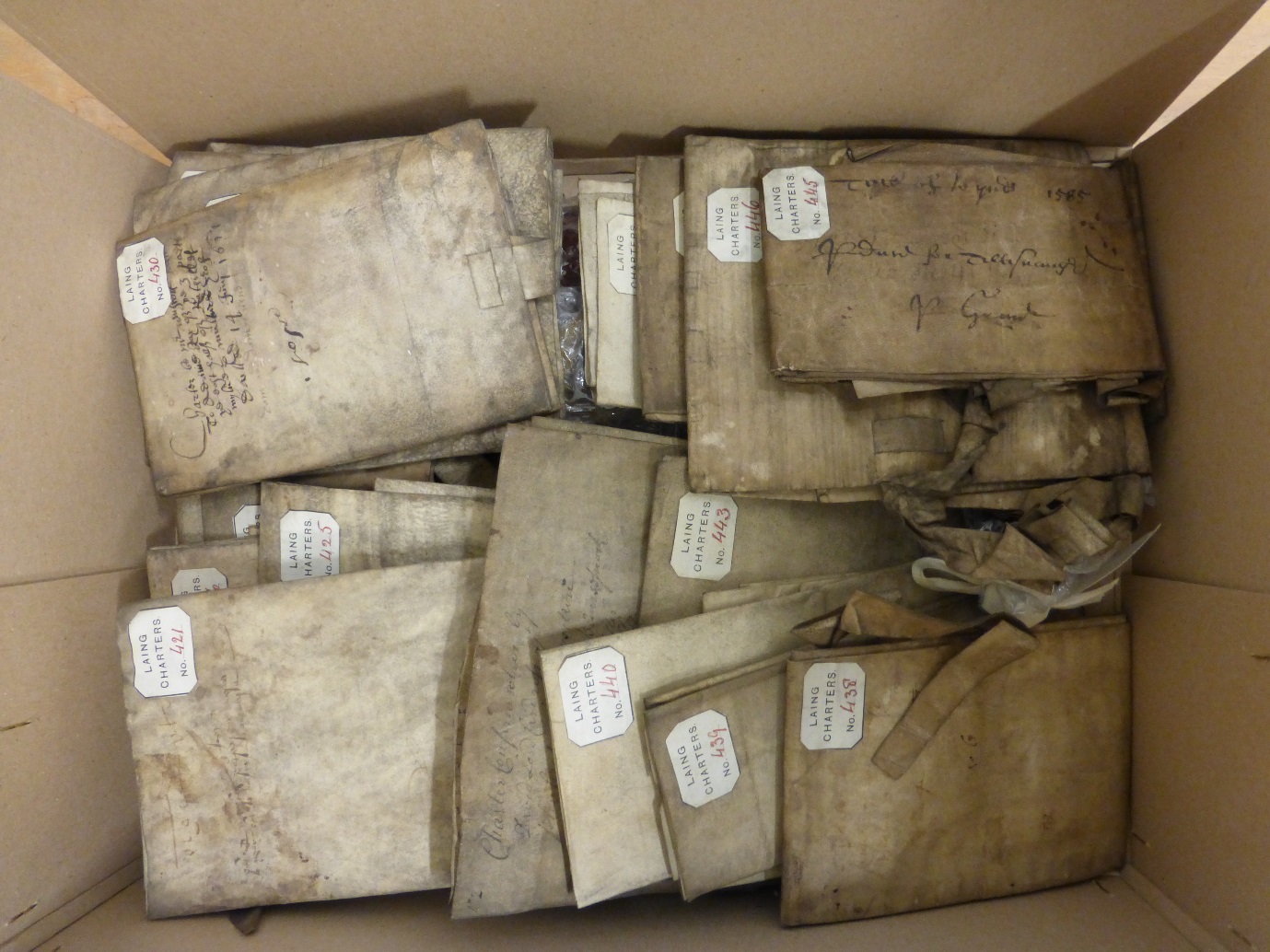
Parchment charters in the Laing collection
The event consisted of two days of lectures, followed by a two-day practical session. The lectures were open to a large number of people, whereas the practical workshop was limited to a maximum of 15 attendees.
The talks during the first two days focused on the making and analysis of parchment. The first talk was by Theresa Lupi, freelance Book and Paper Conservator in Malta, who discussed aspects of codicology and how it can be helpful to conservators. By studying different elements of the manuscript, we can learn how the parchment was made, what tools and techniques were used to prepare it and how this might affect its longevity and the treatments we can use. Following this, Theresa also gave lecture on fragments of manuscripts. Parchment documents were often recycled and reused in the past, and fragments can be found in the bindings of later books or used a wrappers for other items. These fragments can give clues to the how manuscripts were historically used.
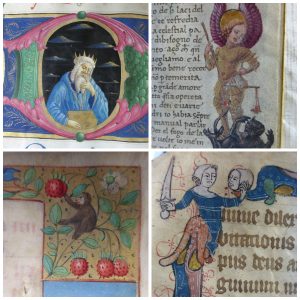
Drawings in manuscripts in the CRC collections
Next, Dr Fiona Brock, Lecturer in Applied Analytical Techniques at the Cranfield Forensic Institute presented a paper on the radiocarbon dating of parchment. Fiona first described the method of radiocarbon dating and discussed the advantages and disadvantages of using this method to estimated when the parchment was made.
After this, Professor Matthew Collins from the University of York presented his research which focuses on the identification of skins in our archive, and how this can tell us about the history of livestock management and craft. Matthew uses small eraser slithers which are gently rubbed against the parchment to remove a minute amount of material from the parchment. These tiny samples are analysed and the type of animal used to make the document can be identified. This service is offered for free and you can obtain a sample kit by emailing matthew@palaeome.org.
The day ended with a presentation by Jiří Vnouček, Conservator of Parchment and Paper at the Royal Library of Copenhagen. Jiří discussed the methods of parchment making and how it has changed over the centuries. Studying the production techniques can give conservators clues which help date and give provenance to the manuscript.
The next day began with another talk from Jiří, which followed on from his presentation the previous afternoon. He first focused on the methods of parchment making in the UK, and showed the below video of the methodologies used in Britain in 1939. He also discussed parchment making in Iceland and how the preparation can affect the final result.
The following talk by Angelica Bartoletti, Researcher in Conservation Science at the Tate, examined parchment on a nano-scale. Angelica states that not all damage to parchment is visible and by scrutinising the material on a micro-scale, we can detect damage before we can see it with the naked eye, and develop conservation techniques to reduce the effects of that damage.
The penultimate talk of the day was by Dr. David Mills, Microtomography Facilities Manager at Queen Mary University of London. The main focus of this talk was on the Apocalypto Project, a collaborative effort between conservators, scientists and computer vision experts to investigate how x-rays can be used to reveal obscured writing or text on parchment. David and his team used a CT scanner to take a 3D x-ray of a tightly rolled piece of parchment. Using a computer programme, they were able to digitally unravel the scroll and decipher the handwriting, without causing any detectable damage to the document. This technique has also been successfully used to view previously inaccessible archives, including glass plate negatives which have been stuck together, and a roll of film that was severely degraded by vinegar syndrome, which can be viewed in the video below. Amazingly, this service is offered for free! Email David (D.mills@quml.ac.uk) for more information.
The final talk of the day was by Edward Cheese, Conservator of Manuscripts and Printed Books at the Fitzwilliam Museum Cambridge. He gave a talk on the repair and binding of parchment manuscripts. Edward evaluated the balance between the risks of conservation treatment, against the benefits to collection items when they have been conserved. For example, Edward argued that although treatments such as humidification may have negative effects on the substrate, this is preferable to leaving the document unusable, or leaving the item in a state which encourages repeated stress on certain areas when handled. For example, a parchment charter that is difficult to open should be humidified and flattened, rather than repeatedly opened and closed which will eventually cause a split, even though the humidity may cause damage on a micro level.
Overall, I found the first two days of the event informative and inspiring, and it provided a great base for the practical session that followed. Read the second part of this blog to find out more about historic conservation of parchment, and up-to-date methods conservators use today – coming soon!
E-Resource Trials ending on Monday
There are a few days left to try out the following potential new e-resources and send in your feedback.
Eighteenth Century Drama
Eighteenth Century Drama features the John Larpent Collection from the Huntington Library – a unique archive of almost every play submitted for licence between 1737 and 1824. The resource also features correspondence between key theatrical figures, biographical information, portraits, advertisement and historical information. The companion texts The London Stage 1660-1800 and A Biographical Dictionary of Actors, Actresses, Musicians, Dancers, Managers & Other Stage Personnel in London, 1660-1800 feature as both scans in their original printed format and as a searchable database.
Foreign Office Files for Japan 1919-1952
Providing significant insight into this fascinating period of Japanese history, these Foreign Office files provide full-text searchable access to formerly restricted top level discussions and correspondence from the British Embassy and consulate in Japan. Files consist of wide-ranging material, including memoranda, reports, minute sheets and correspondence, along with detailed assessments of key events, speeches and topics of special interest.
Literary Manuscripts Leeds
This project offers scholars the opportunity to examine complete facsimile images of manuscripts of 17th and 18th century verse held in the celebrated Brotherton Collection at the University of Leeds. Poets represented include Mary Campbell, John Dryden, George Herbert, Mary Leapor, Andrew Marvell, Alexander Pope, Hester Pulter and Jonathan Swift. There are also countless songs, riddles and popular tags which tell us even more about contemporary society.
Literary Print Culture
Explore this unique archive relating to the history of printing, publishing and bookselling dating from 1554 to the 20th century. The Stationers’ Company was a key agent in the process by which the book trade was regulated and monitored and thus it is widely regarded as one of the most important sources for studying the history of the book, publishing history, the history of copyright and the workings of an early London Livery Company.
Romanticism: Life, Literature and Landscape
The Wordsworth Trust is recognized as the leading archival collection of Wordsworth manuscripts anywhere in the world. The collection offers an insight into the working methods of the poet and the wider social, political and natural environment that shaped much of his work. In addition, this collection makes available the writings of Dorothy Wordsworth through her much celebrated Grasmere Journals, Alfoxden diary and travel journals. Verse manuscripts and correspondence from leading literary lights of the Romantic period such as Samuel Taylor Coleridge and Robert Southey are also available as well as a strong collection of Thomas de Quincey manuscripts.
Shakespeare in Performance
Shakespeare in Performance features rare and unique prompt books from the world-famous Folger Shakespeare Library in Washington DC. The prompt books tell the stories of key performances as they were put on in theatres throughout Great Britain, the United States and further afield, between the seventeenth and twentieth centuries. In a mixture of handwritten manuscripts and printed typescripts, often interspersed with personal notes, sketches, and cues for lighting and music, this resource takes users behind the scenes to shine a light on how the Bard’s timeless works have been interpreted by theatre companies, actors and directors across the centuries. *Please note that PDF download options are not available during trials.
Socialism on Film
Sourced from the British Film Institute (BFI), this collection of documentary, newsreel and feature films reveals the world as seen by Soviet, Chinese, Vietnamese, East European, and Latin American filmmakers. Ranging from the early 20th century to the 1980s, material encapsulates the themes of war, revolution, news, current affairs, culture and society. The project makes available the superb ETV-Plato Films collection put together by the British communist Stanley Forman in the years after the Second World War – produced almost exclusively in the communist world and then versioned into English for distribution in the West. *Please note that PDF download options are not available during trials.
Further info.
Access these and other trials from our Trials Webpage.
Student Research Rooms: fantastic resource for History, Classics and Archaeology
Today’s blog post is a guest post from Aimee Fletcher, SRR Co-ordinator, about the superb book collections available to staff and students from HCA in the Student Research Rooms (SRR).
At the School of History, Classics and Archaeology (HCA) we are fortunate to have our Student Research Rooms (SRR). This is a space which is not only a study space, it is also home to the School’s personal book collections. All of these collections are vast and have come from significant academic figures, personal collections which were donated to the school, and have continued to flourish thanks to the tradition of donating books.

Upper floor of Student Research Rooms, Doorway 4, Teviot Place. © Aimee Fletcher
Within some of these collections are books with have been passed down by important figures of HCA’s history at Edinburgh. Individuals such as Jim McMillan, a European historian and previous head of the School; the Sellar and Goodhart collection, which is named after two of Edinburgh’s most influential classics professors and Jim Compton whose American history collection of 2,000 books boasts some of the only known copies of certain publications of its kind in Scotland. The collections we have are unique and are looked after and made available to borrow by twenty volunteers who are found at the volunteer desk on 2M (10am-6pm, Monday-Friday).
You can find out more about the collections and the books within these from Student Research Rooms (SRR). Read More
Trial access: Oxford Research Encyclopedia of Politics online
Thanks to a request from a member of staff the Library currently has trial access to the online Oxford Research Encyclopedia of Politics. This resource offers long-form overview articles written, peer-reviewed, and edited by leading scholars on a large and varied range of topics and subjects related to politics.

You can access the database via the E-resources trials page.
Access is available both on and off-campus.
Trial access ends 12th December 2017.
Updated regularly you can easily search the resource, browse by subfield or search within a subfield. It also gives you options to refine and sort your search results.
Access Oxford Research Encyclopedia of Politics via e-resources trials.
Access is available until 12th December 2017.
Feedback welcome.
Access is only available to current students and staff at University of Edinburgh.
Caroline Stirling – Academic Support Librarian for Social and Political Science
Trial access: World Politics Review
I’m pleased to let you know that the Library currently has extended trial access to World Politics Review from EBSCO, which provides up to date and extensive coverage of foreign policy, international politics and foreign affairs.

You can access the database via the E-resources trials page.
Access is available both on and off-campus.
Trial access ends 31st December 2017.
World Politics Review is a daily online publication for foreign policy issues. Articles for the Review are written by several hundred contributors from around the world, experts in a variety of disciplines. Full text is included in PDF and/or HTML and the Review contains thousands of articles in its archive. Read More
New E-books available

We have added 120 more e-books from Wiley across most subject areas. See the title list here.
Our current subscription to Wiley e-books means that we automatically gain access to most of the e-books they publish each month and these are added to DiscoverEd on a monthly basis.
E-Resource trials ending soon
Less than 1 week left to try out some potential new e-resources.
Elgar Advanced Introductions to Law
Introductions to major fields in Law. Designed to be accessible yet rigorous, they offer concise and lucid surveys of the issues associated with discrete subject areas. The aims of the series are two-fold; to pinpoint essential principles of a particular field, and to offer insights that stimulate critical thinking. By distilling the vast amount of information available on the subject area into a concise and meaningful form, the volumes serve as accessible introductions for undergraduate and graduate students coming to the subject for the first time. Importantly, they also develop well-informed, nuanced critiques of the field that will challenge and extend the understanding of advanced students, scholars and policy-makers. PDF downloads are unavailable during the trial.
Trials ends: 15/11/17
HAPI
The Hispanic American Periodicals Index (HAPI) provides bibliographic citations to over 380 scholarly journals and links to the full text contents of over 675 journals published around the world on Latin America and the Caribbean since 1970. Subject coverage includes everything from political, economic, and social issues to the arts and humanities.
Trial ends: 15/11/17
Women’s Magazine Archive I and II
Women’s Magazine Archive comprises archival runs of leading women’s consumer magazines of the twentieth century. The magazines are all scanned from cover to cover in high-resolution color, ensuring that the original print artifacts are faithfully reproduced and that valuable non-article items, such as advertisements, are included. Titles include Chatelaine, Cosmopolitan, Good Housekeeping, Ladies’ Home Journal and Seventeen.
Trial ends 16/11/17
Further info.
Access these and other trials from our Trials Webpage.
Bombs, Bins and Burglary: The Miraculous Survival of the Margaret Morris Collection

The Fergusson Gallery, Perth.
A fortnight ago I paid my first visit to the Fergusson Gallery, Perth, to begin assessing and listing the Margaret Morris Collection which is housed there. This is the first step towards what will eventually be full cataloguing, rehousing and conserving of the archival collection, and I enjoyed my introduction to the remarkable life of movement and dance pioneer Margaret Morris (1891-1980) and, what’s more, the astonishing story of her archive.
The collection encompasses an array of materials relating to Morris’ life and career as well as the organisation she established, Margaret Morris Movement (which expanded to become the International Association of Margaret Morris Movement). Things get a bit complicated – not to mention dramatic – once we start looking at the variety of people who have added to this collection over the years, and ensured its survival against the odds.

Margaret Morris, anatomical drawing of a hand. Courtesy of Culture Perth and Kinross.

Alhambra Theatre programme, 1928. Courtesy of Culture Perth and Kinross.

Margaret Morris reciting aged five, c.1904. Courtesy of Culture Perth and Kinross.
The earliest parts of the collection were amassed by Victoria Bright Morris, Margaret’s mother. She collected photographs, posters and promotional material relating to her daughter’s performing career (which began aged three, when Margaret would recite poetry and stories in both English and French). Margaret herself kept a lot of material relating to her life and work: programmes, brochures and posters from her famous summer schools, demonstrations and performances; lecture notes and anatomical drawings from her training as a physiotherapist, and voluminous correspondence with her mother, her husband the artist J.D. Fergusson and friends and associates, including numerous literary, musical and theatrical names. The archive also includes items originally created by or belonging to Margaret’s students and colleagues. One of them, Margaret’s personal secretary, dresser and costume maker, Isabel Jeayes, who stored the archive in her London home during the Second World War (when Margaret and Fergusson relocated to Glasgow). Here the first of many disasters struck the collection when it was damaged during the Blitz.
What survived the bombing was moved up to Glasgow, partly to Margaret’s home and partly to the premises of her Margaret Morris School. When J.D. Fergusson died in 1961, Margaret decided to close the School and sell the building. One of her former students, the dancer Jim Hastie, received an urgent call to tell him that the archive was being rapidly disposed of in three skips outside the building. Jim travelled by bus overnight from London and spent two days rescuing as much material as he could before the refuse collectors arrived, storing the surviving material at Margaret’s home.

Margaret Morris Method Canada newsletter, winter 1986. Courtesy of Culture Perth and Kinross.
More upheaval followed during the 1970s when Margaret relocated back to the south of England. Hastie took the archive in to his own home in Glasgow before moving it to the Head Office of Margaret Morris Movement (also in Glasgow) following Margaret’s death in 1980. Catastrophe struck when burglars entered the building and set it on fire. The surviving items were moved to another part of the building only to be damaged again (mainly by water this time) when the adjoining hotel was also set on fire. At this point, Hastie took the archive back into his home before donating it to Perth and Kinross Council (now Culture Perth and Kinross) in 2010. Jim, who became Life President and Artistic Director of the International Association of Margaret Morris Movement, added many items to the collection relating to his own career as well as the operation of the organisation.
The archive is now housed in a building dedicated to the work of J.D. Fergusson and Margaret Morris, and forms part of a wider set of collections of artwork, costumes, sculpture and furniture (as well as Fergusson’s own archive). My first tasks are to begin to untangle the complicated provenance of Morris’ archive and identify those items requiring urgent conservation treatment. Thanks to Wellcome Trust funding, Margaret Morris’ archive will be made fully accessible for many decades to come, but it is thanks to all those who have gone before that it is here today at all.
Clare Button
Project Archivist
With grateful acknowledgement to Jim Hastie’s own reminiscences, ‘The Story of the Margaret Morris Archive.’
Martin Luther in his own words #Reformation500
Today the School of Divinity will mark 500 years since Martin Luther nailed the Ninety Five Theses to the door of Wittemberg Church with a public lecture from Durham University’s Professor Alec Ryrie, a leading scholar of Reformation History, who will speak on ‘Protestants and their Bibles from the Reformation to the Present’.
In New College Library, a display in the Library Hall showcases some of Luther’s early publications. Martin Luther’s prolific publishing output in Latin and German preserves the arguments that shook Catholic Europe. Much more can be seen at the Incendiary Texts exhibition to be held at the Centre for Research Collections, Main Library, 10 November 2017-8 March 2018.  Read More
Collections
 Hill and Adamson Collection: an insight into Edinburgh’s past
My name is Phoebe Kirkland, I am an MSc East Asian Studies student, and for...
Cataloguing the private papers of Archibald Hunter Campbell: A Journey Through Correspondence
My name is Pauline Vincent, I am a student in my last year of a...
Hill and Adamson Collection: an insight into Edinburgh’s past
My name is Phoebe Kirkland, I am an MSc East Asian Studies student, and for...
Cataloguing the private papers of Archibald Hunter Campbell: A Journey Through Correspondence
My name is Pauline Vincent, I am a student in my last year of a...
Projects
Cataloguing the private papers of Archibald Hunter Campbell: A Journey Through Correspondence
My name is Pauline Vincent, I am a student in my last year of a...
Archival Provenance Research Project: Lishan’s Experience
Presentation My name is Lishan Zou, I am a fourth year History and Politics student....