Home University of Edinburgh Library Essentials
March 23, 2026
Queens and female coders

Recommended library museum piece to view on International Women’s Day
Today is International Women’s Day. And this year, which just happens to be 100 years since women have had the right to vote, the theme of the day/year is Press for Progress. To motivate you to think, act and be gender inclusive – we’re sharing a book and museum piece, which are linked to powerful and influential women throughout history.
Dr Sarah Deters is the Learning and Engagement Curator at The University of Edinburgh’s St Cecilia’s Hall – the Concert Room & Music Museum on Niddry Street. She shares a couple items that have inspired her below.
1940s female coders
“I am not sure if I have a favourite book written by a woman, but I really enjoyed the book Code Girls by Liza Mundy, said Dr Deters.
“This non-fiction book follows the journey of a number of American women who were recruited by the US Navy and Army to become cryptanalysts during the Second World War. It was a fascinating book and I really enjoyed learning about this very important, but otherwise forgotten, group of women and the critical work they did during this time.“
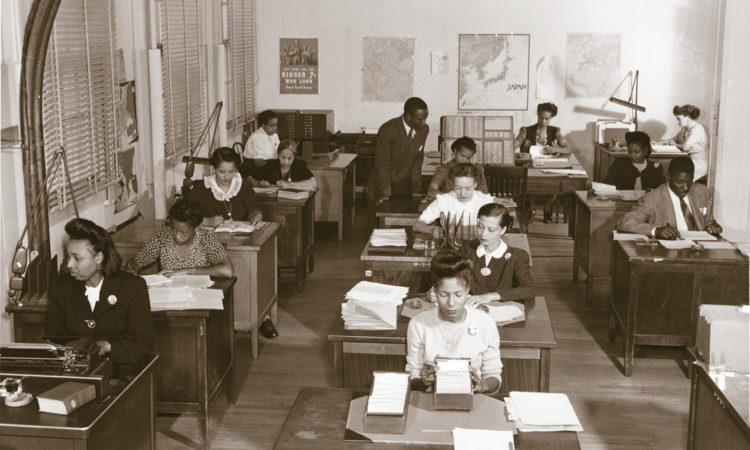
At Arlington Hall, a secret African American unit – mostly female, and unknown to many white workers – tackled commercial codes, keeping tabs on which companies were doing business with Hitler or Mitsubishi. Copyright US National Security Agency.
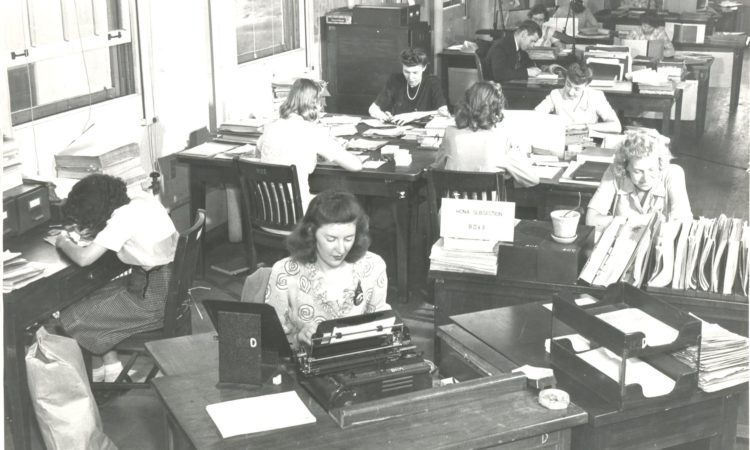
At Arlington Hall, Ann Caracristi (far right), an English major from Russell Sage College, matched wits against Japanese code makers, solving message addresses and enabling military intelligence to develop “order of battle” showing the location of Japanese troops. The messages would then be passed along to Dot Braden and other women whose efforts led to the sinking of Japanese ships. Copyright: US National Security Agency.
Harpsichord fit for a 17th century queen
“On display at St Cecilia’s Hall is a harpsichord, which is not only decorated with paintings of women revelling in what appear to be a bacchanal-like gathering, but is thought to have been owned by a famous and powerful woman,” shared Dr Deters. “The harpsichord was made by Andreas Ruckers in Antwerp in 1608.”
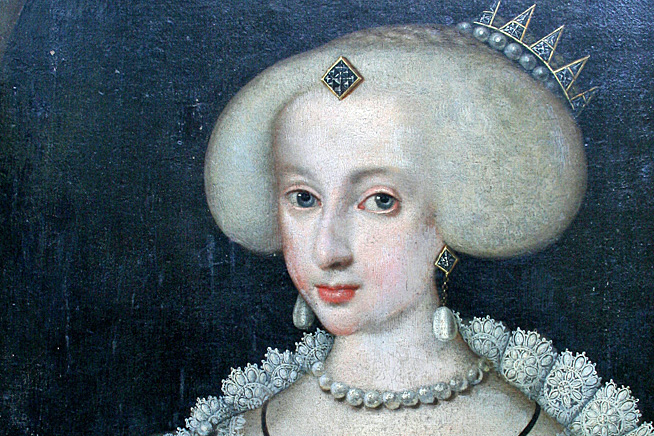
Portrait of Christine of Sweden (1626-1689) by royal court painter Jacob Henry Elbfas dated 1640 or 1642. Copyright: Wikimedia Commons.
“Sometime in the mid-17th century the lid was painted, most likely by the Flemish artist Pieter Codde, who lived from 1619 – 1666. His painting shows a mythical scene complete with a faun and figures representing love, dance and music. My favourite character in the painting is a woman in a vibrant red dress who is playing a lute. Aside from the lovely decoration on this instrument, I really enjoy its provenance. The harpsichord is believed to have been owned by Christina of Sweden, who baulked against the gender norms of her day, was highly educated and was known for her patronage of the arts.”
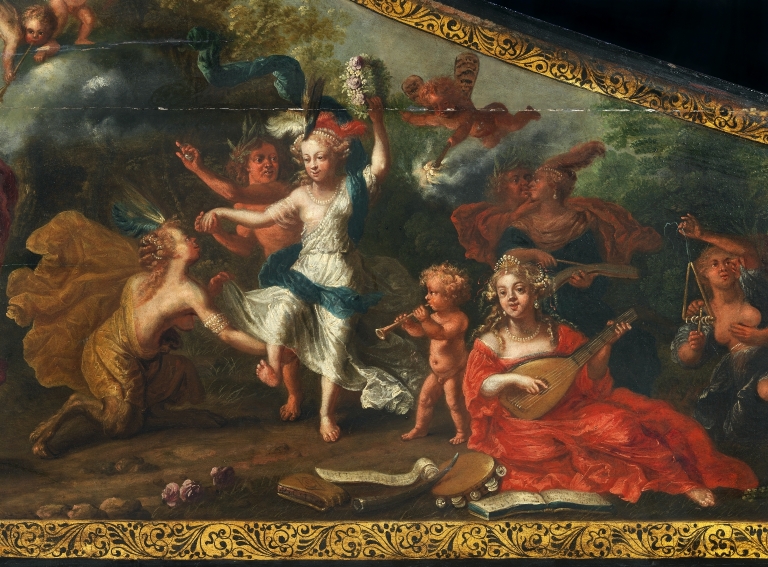
Double-manual harpsichord by Andreas Ruckers. Copyright: The University of Edinburgh
Check it out
St Cecilia’s Hall is home to the University of Edinburgh’s collection of historic musical instruments.
Opening hours: Tues-Sat, 10 am- 5 pm
Location: 50 Niddry Street, Edinburgh EH1 1LG
 The University of Edinburgh’s Main Library is celebrating its 50th anniversary at George Square – where connections come alive. The library is currently creating an archive of current and former students and staff memories. Submit your memories via our website, Facebook or Twitter pages #UoElib50. Photos and videos are welcome!
Database trial – NK News

NK News is an independent, specialist database focused on North Korea. It aims to be a one-stop-shop on North Korea, bringing together news, opinion & analysis, research tools, data, and subject specialists in one convenient place. In addition to providing primary and secondary data on North Korea that is unavailable anywhere else, it offers research tools specifically tailored for users within government and academia. KCNA Watch provides up-to-date North Korea state media.
The Library has arranged a trial of NK News, including NK Pro and KCNA Watch, from 1 to 31 March 2018. Access these resources on the University network.
E-resources for Korean Studies
With the partial financial support from the Korea Foundation, we have now subscribed to 6 Korean databases of e‐books, e‐journals, bibliographies and newspaper archives covering a wide range of subject areas. The initiative was in response to the emerging Korean Studies programmes in the department of Asian Studies. These databases are all listed in the Databases by Subject for East Asian Studies.
Explore black history through Archives Unbound
In this week’s blog post I wanted to highlight a number of primary source databases that you have access to at the University that allow you to discover more about black history.
I’m concentrating on collections available to you through Archives Unbound, which presents topically-focused digital collections of historical documents. There are currently 265 collections in Archives Unbound covering a broad range of topics from the Middle Ages forward-from Witchcraft to World War II to 20th century political history.
You can access Archives Unbound via the Databases A-Z list or Primary Sources database list.

As Archives Unbound covers such a vast range of subjects and collections, searching through the whole database will provide material perhaps from some surprising areas (so it’s very worthwhile doing this), however, I’m going to focus on some of the individual collections. You can access the individual collections by clicking on “Browse Collections”, where you can either browse through an alphabetical list or choose to browse by “Categories” instead.
So here is just a small selection of collections that will allow you to take your research into black history further.
Fannie Lou Hamer: Papers of a Civil Rights Activist, Political Activist, and Woman
Fannie Lou Hamer (née Townsend) was born in Mississippi in 1917. The youngest of 20 children she would go on to become an American voting rights activist and a leader in the Civil Rights Movement. Hamer was instrumental in organising Mississippi Freedom Summer for the Student Nonviolent Coordinating Committee (SNCC). She was actively involved in starting the Delta Ministry, and she was one of the founders of the Mississippi Freedom Democratic Party later to become the Vice-Chair. Read More
5 recommended library resources for LGBT+ History Month
February has seen the celebration of LGBT+ History Month in the UK and you may have enjoyed one of the many fantastic events put on by the University’s Staff Pride Network or the University’s Students’ Association. LGBT+ History Month may be near the end but I wanted to highlight just some of the library resources available to staff and students of the University that will allow you to study and research LGBT+ history further.
1. Books, journals, articles, etc.
The Main Library is co-hosting a ‘micro-exhibition’ with student groups Project Myopia and LiberatEd with a pop-up book display on the ground floor this week. A LGBT+ History Month Resource List has also been put together to highlight the wide range of LGBT+ books available at the University Library. This is just a selection of titles available at the Library and you can use DiscoverEd to find more.

You can also use DiscoverEd to search for and find a large range of journal articles and journals on LGBT+ related research. Or you can go further in your research by using some of the bibliographic databases the Library has access to that will allow you to search for journal articles, abstracts, book reviews, book chapters, reports and proceedings, etc.
2. What to watch?
You can use some of the Library’s moving image and video streaming databases to search for and view films, documentaries, news programmes, interviews, plays, TV programmes, etc. Read More
On trial: Secret Files from World Wars to Cold Wars
Following a successful trial towards the end of last academic year I’m pleased to let you know that we’ve been allowed trial access again to Secret Files from World Wars to Cold War: Intelligence, Strategy and Diplomacy from The National Archives and Taylor & Francis. This provides you with access to 144,000 pages of British government secret intelligence and foreign policy files source from the National Archives U.K. Content which is only available elsewhere by visiting the National Archives in London.

You can access this online archive via the E-resources trials page.
Access is available both on and off-campus.
Trial access ends 26th March 2018.
This major primary source database contains nine file series which span four major 20th century conflicts – the Spanish Civil War, the Second World War, the early years of the Cold War and the Korean War. Files are sourced from the Permanent Undersecretary’s Department (PUSD) – the PUSD was the point of liaison between the Foreign Office and the British intelligence establishment – Joint Intelligence Sub-Committee, War Cabinet, Cabinet Office and Ministry of Defence. Read More
On trial: Black Newspaper Collection
*The Library now has access to all titles in the Black Newspaper Collection until 31st July 2024 as part of ProQuest Access 350.*
Thanks to a request from a HCA student the Library has trial access to the Black Newspaper Collection from ProQuest Historical Newspapers. This superb resource contains the archives of 9 individual newspaper titles that provide cultural perspective and insight to the events that shaped the United States in the 20th Century.

You can access Black Newspaper Collection via the e-resources trials page.
Access is available both on and off-campus.
Trial access ends 28th March 2018.
Black Newspapers offers primary source material key to the study of American history and African-American culture, history, politics, and the arts. The 9 titles included in this resource are: Read More
On trial: primary source databases from Adam Matthew
*The Library has now purchased access to Literary Print Culture: The Stationers’ Company Archive. See New to the Library: Literary Print Culture.*
We currently have trial access to Literary Print Culture: The Stationers’ Company Archive and London Low Life, two fascinating primary source databases from Adam Matthew.
So if you’re interested in the history of the book or of publishing, working and social lives in Victorian London, history of copyright, police and criminality in the 19th century, the workings of an early London Livery Company, commerce in London and more, then there may be something here for you.
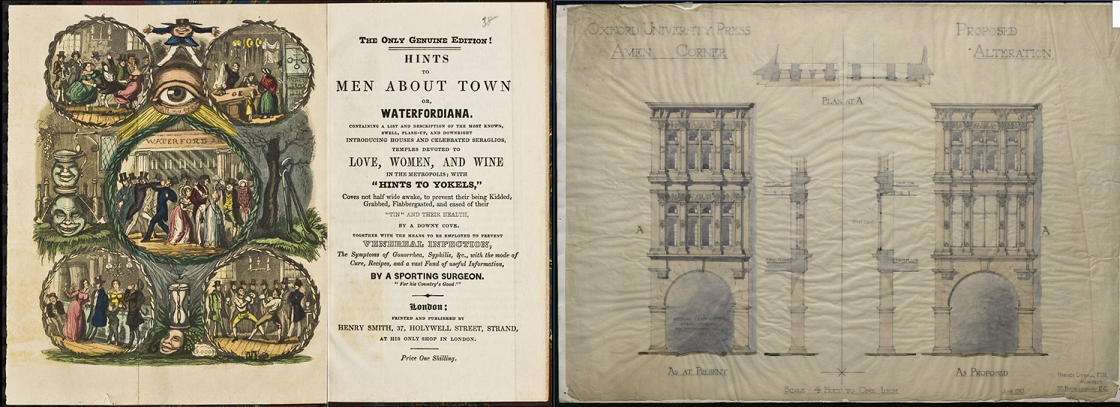
Left: Hints to men about town, or, Waterfordiana: containing a list and description of the most known,swell, flash-up, and downright introducing houses and celebrated seraglios … with the means employed to prevent venereal infection … / by a sporting surgeon (1830s) from London Low Life. Right: Architectural plan for Oxford University Press, Amen Corner (1913) from Literary Print Culture.
Both databases can be accessed via the E-resources trials page.
Access is available on and off-campus.
Trial access for both databases ends 12th March 2018. Read More
Dealing with Data, 2017
One hundred researchers from across the University came together to present work in progress and discuss many tricky issues they face in ‘dealing with data’ at a Research Data Service sponsored event on 22nd November in Playfair Library.
A theme that emerged from this year’s event was around approaches to balancing the drive to make data open with the increasingly restrictive ethical and legal requirements for non-disclosure of personal data from research subjects.
The University’s CIO and Librarian, Gavin McLachlan, set the scene for the day’s topics in his welcome address, referencing data driven innovation through the Edinburgh Region City Deal, the aims of the European Open Science Cloud, FAIR data (Findable, Accessible, Interoperable, Reusable), and the GDPR – the new General Data Protection Regulation coming into force in May, 2018.
Videos of speakers and links to presentations may be viewed from the event page at http://edin.ac/2CypID0. Look out for the event same time next year!
Robin Rice & Kerry Miller (DWD 2017 Organiser)
Research Data Service
Influence of Scotland in the World: Trade, Work and Travel
This is the second post looking at the influence of Scotland on the world. This time we are focusing on trade between Scotland and other countries, as well as Scots traveling and working abroad.
Trade
Scotland, at the time of the Statistical Accounts, was very much a sea-faring nation, with many ports situated not just around the country’s coastline, but also inland on its river banks. These included: Campbelton, Kirkcaldy, Port Glasgow, Grangemouth, Alloa, Inveresk, Leith, Prestonpans and Banff, with many of these no longer operating. It was primarily through these porst that goods were imported and exported in Scotland.
Many of the parish reports contain excellent records of its ports, containing information on the type and number of ships stationed there, what was imported and exported and other activities based there, for example the carrying of passengers on steamboats. Very detailed tables are given for Port Glasgow, County of Renfrew (NSA, Vol. VII, 1845, p. 67), Inveresk, County of Edinburgh (NSA, Vol. I, 1845, p. 293) and Stromness, County of Orkney (OSA, Vol. XVI, 1795, p. 447).
At Campbelton, in the County of Argyle:
“There are thirty-three registered sloops and schooners belonging to this place, employed in the coasting trade, besides a number of fishing-boats. There is also a ship of 515 tons register, the property of Messrs Nathaniel MacNair and Company, employed in carrying timber from Canada. In 1840, five ships, and in 1842, two ships from foreign parts landed cargoes at Campbelton. In 1842, there were 646 vessels with cargoes inwards, and 365 with cargoes outwards, and, besides these, two steam-boats belonging to the port ply regularly between Glasgow and Campbelton with goods and passengers. The principal imports are barley, yeast, coals, timber, iron, and general merchandise, and the exports are whisky, malt, draff, black cattle, sheep, and horses, potatoes, turnips, beans, butter cheese, and fish. The quantity of barley and bear imported in 1842 was 41,735 quarters, 5 bushels.” (NSA, Vol. VII, 1845, p. 464)
At Kirkcaldy, in the County of Fife:
“Two vessels are engaged in whale-fishing; the rest in trading to North and South America, the Mediterranean, France, the Baltic, and occasionally beyond the Cape of Good Hope. The foreign ships which usually trade to this port are Norwegian, Danish, Hanseatic, Hanoverian, Prussian. On an average of years there have been 92 vessels from foreign parts. The principal articles of import are flax and timber; of export, coals and linen yarns.” (NSA, Vol. IX, 1845, p. 756)

The Ship ‘Castor’ and Other Vessels in a Choppy Sea. Thomas Luny, 1802. Thomas Luny [Public domain], via Wikimedia Commons.
- timber and other wood goods; coals, bricks, cordage, woolens, and cottons from Grangemouth. (NSA, Vol. VIII, 1845, p. 28)
- linen, including its bleaching and dying, which found markets in Canada, the United States, South America, the West Indies, and Australia. (NSA, Vol. IX, 1845, p. 755),
- grains, malted and used in distilleries. (NSA, Vol. II, 1845, p. 137)
- salt (OSA, Vol. XVIII, 1796, p. 25 and OSA, Vol. XVII, 1796, p. 72)
- barrels of ale to England, the continent, North and South America, the East and West Indies, and Australia. (NSA, Vol. VIII, 1845, p. 51)
- fish, for example boiled and kitted salmon from Thurso. (OSA, Vol. XX, 1798, p. 523)
- wool, freestone, oats, wheat, and barley. (NSA, Vol. IV, 1845, p. 19)
- the Ayrshire cow to Prussia and Australia. (NSA, Vol. V, 1845, p. 538)
- and even golf balls from St Andrews!
“The manufacture of golf balls has long been carried on here, to a considerable extent. Above 10,000 are made annually. A good workman can make from 50 to 60 a-week. Nearly one-half of the product is required for the use of the cultivators of the amusement in St Andrews. A market for the remainder is found in other places. Some have been sent as far as Calcutta and Madras.” (NSA, Vol. IX, 1845, p. 476)
Imports included:
- timber, deals, lath wood, and tar from America and the Baltic. (NSA, Vol. IV, 1845, p. 529)
- tobacco, sugar, rum, cotton, mahogany, logwood and staves, together with some timber, iron and hemp from the Baltic. (OSA, Vol. V, 1793, p. 554)
- fir-spars and deals from Norway. (OSA, Vol. XX, 1798, p. 513)
- coal, slate, iron, tallow, timber, hemp, and wine. (NSA, Vol. IV, 1845, p. 19)
- tea. (NSA, Vol. VI, 1845, p. 170 and NSA, Vol. VIII, 1845, p. 52)
- bark, timber, and bones to be ground down for manure. (NSA, Vol. IX, 1845, p. 244
Changes in Trade
Even during the time of the Statistical Accounts, great changes were taking place in trade, both within Scotland itself and in other countries. For example, in the parish of Borrowstowness, County of Linlithgow, it was reported that:
“Between 1750 and 1780, Bo’ness was one of the most thriving towns on the east coast, and ranked as the third port in Scotland. But since the opening of the Forth and Clyde Canal, and especially since the erection of Grangemouth into a separate port, the commerce of this place has decreased, and at present it is in a very languishing condition.” (NSA, Vol. II, 1845, p. 138)
In the parish report for Perth, County of Perth:
“During a great part of the eighteenth century, trade was carried on to a considerable extent between the port of Perth and the principal ports, not only of Britain, but of Russia, Germany, France, Holland, Sweden, Norway, Denmark, Spain, and Italy. This foreign intercourse, however, has, particularly of late years, been very much diminished. Various causes have operated in producing the decline, such as a total change in the description of the manufactures of the place; a successfully pushed competition on the part of other ports which are free from the inconvenience of river navigation; the establishment of extensive general agencies, through which our merchants now obtain the products of other countries. But the most powerful of all causes has been the natural obstructions to navigation which have arisen in our river itself.” (NSA, Vol. X, 1845, p. 101)
The American War of Independence also had an effect on trade, especially that between Glasgow and North America. (OSA, Vol. V, 1793, p. 499)
Scottish Strengths Abroad
In our last post, we referred to the hardships endured by whole families, who then decided to emigrate for the chance of a better life. The lack of opportunities was also keenly felt by young Scots. In the parish of Kilbride, County of Bute, as in many other places in Scotland, there were “increased habits of industry in the rising generation, who, instead of following the old practice of loitering half idle at home, go to trades or service in the low county, or engage as sailors in merchant ships.” (NSA, Vol. V, 1845, p. 26).
In the parish of Ronaldshay and Burray, County of Orkney, it was noted that:
“The passion of the young men for a sea faring life nothing can exceed, except their aversion to a military one. Four or five young men have this winter voluntarily entered on board his Majesty’s navy. Every year several young men go to Greenland or Iceland fishing, to Hudson’s Bay, or on board some merchant ship: All of them prove to be excellent sailors. And it is believed, that they are more industrious abroad than at home. In no country are the people more tenacious of their old customs than here.” (OSA, Vol. XV, 1795, p. 311)
Along with it’s great seafaring capabilities, Scotland has always had a very strong fishing tradition. An excellent account of fisheries and the trading of fish can be found in the report for Thurso, County of Caithness. (OSA, Vol. XX, 1798, p. 522) and the report for Boindie, County of Banff. (NSA, Vol. XIII, 1845, p. 236) It is, therefore, no surprise that some decided to work with the Iceland or Greenland fishermen, “with whom they only continue for 3 or 4 months”, but, according to the report of Kirkwall, County of Orkney “when they return, the money which they have earned, instead of furnishing the means of industry, is almost always spent in idleness, and often in dissipation.” (OSA, Vol. VII, 1793, p. 551)
Despite the seafaring nature of the Scots, not all wanted a life on the open seas. In the parish of Drumblade, County of Aberdeen, the decrease in inhabitants was attributed to “young men, such as masons, shoemakers, wrights, slaters, etc. going abroad to improve themselves in their respective crafts; and to the enlisting of some in the army, particularly in the artillery”. (OSA, Vol. IV, 1792, p. 53)
Fencibles
There are several mentions of the Highland Fencible Corps in the Statistical Accounts. Fencibles were British regiments raised to fight in numerous wars abroad during the late eighteenth and early nineteenth centuries. In the parish of Stromness, County of Orkney, 200 Fencibles were raised (OSA, Vol. XVI, 1795, p. 444), while in the parish of Golspie, County of Sutherland, a regiment was raised and sent into service in the space of just 4 weeks! (OSA, Vol. XXI, 1799, p. 231) Even Rev. Dugal Campbell, the writer of the report for the parish of Kilfinichen and Kilviceuen, County of Argle, enlisted in a Highland Fencible Corp (“the late West Fencible regiment, raised by the Duke of Argyll”). (OSA, Vol. XIV, 1795, p. 210)
In the report for Rosskeen, County of Ross and Cromarty, there is a wonderful story about Mr George Macintosh and his role in not just raising a Fencible regiment in Glasgow, but also commanding (with respect) a regiment based abroad – the Canadian Fencibles!
“When war recommenced in 1803, it was mainly through his exertions that the Glasgow Highland Volunteer Regiment was raised and organized; and when, about this time, the regiment of Canadian Fencibles, then stationed in Glasgow, evinced symptoms of mutiny Mr Macintosh, at the desire of General Wemyss, then commanding the district, hastened to their quarters, and addressed the soldiers in their native tongue; – the effect was electrical.”
With such authority, the troubled host he swayed,
The Hudson’s Bay Company
As mentioned above, a large number of young Scottish men, especially those from Orkney, went to work for the Hudson’s Bay Company, which, since 1670, had an exclusive charter to trade at Hudson Bay. Back in 1795, the Company had three ships which carried over “provisions, guns, powder, shot, hatchets, cloths, etc. to be exchanged with the Indians for beaver, and other furs. These vessels usually arrive at the harbour of Stromness about the first of June, where they stop for two or three weeks to take aboard men for their settlements. They engage usually from 60 to 100 men, natives of this country, to go to these settlements, every year… The Company’s ships usually return to the harbour of Stromness about November, to land those men who choose to return home.” (OSA, Vol. XVI, 1795, p. 442)

An image from page 7 of “Hudson’s Bay, or, Every-day life in the wilds of North America, during six years’ residence in the territories of the honourable Hudson’s bay company”. By Robert M. Ballantyne. (1848). [Public domain], via Wikimedia Commons.
“It was long the practice of many of the young men to go to Hudson’s Bay as labourers and mechanics, as carpenters, blacksmiths and brick-layers. Few have gone in later times, though the wages have been raised. A labourer receives L. 16 a-year annually, for the first three years, with maintenance, while employed at the factories. A mechanic. L. 25 a-year. The engagement is now for five years, and at the end of three years everyone is advanced according to his merit. The great object was to save as much as might render his future days at home, easy and comfortable.” (NSA, Vol. XV, 1845, p. 25)
In the report Section on the county of Orkney from volume 15 in account 2 there is a table showing the sums received in Orkney in 1833, from farm-produce, manufactures, fisheries, etc. This includes the sum of about L. 1500 that the Hudson’s Bay Company paid annually for the men employed in Hudson’s Bay. (NSA, Vol. XV, 1845, p. 215) When you compare this sum with other figures in the table you can get a sense of the men’s value at that time.
The writer of the report from the parish of Orphir, Rev. Mr Liddell, was very scathing about those who went into the service of the Hudson’s Bay Company, as well as the company itself. (OSA, Vol. XIX, 1797, p. 406) However, he then goes on to praise that same company who had just agreed to increase wages, writing:
“At the same time it must be acknowledged, for the honour of the Hudson’s Bay Company, that no men ever acted with more integrity, or fulfilled their agreements more honestly, than those gentlemen have uniformly done; and further, upon a representation from the present incumbent of this parish, they have been pleased to augment the wages to L. 10; by which means above L. 1000 Sterling per annum is added to the income of Orkney.”
As well as looking at the Statistical Accounts of Scotland, you can find out what it was actually like to work for the Hudson’s Bay Company by reading Robert M. Ballantyne’s fascinating account, from which the above image is taken.
The East India Company
Another large and well-known company that should be mentioned is the East India Company, which at first focused on trade, but then went on to build an empire in India. Many Scots were employed by the company in various roles, including those in the military, medical and civil service departments, spending several years of service in India before returning home to Scotland. Such people included Brigadier-General Alexander Walker of Bowland (NSA, Vol. I, 1845, p. 415), Alexander Macleod, Esq and his son; natives of the parish of Harris, County of Inverness (OSA, Vol. X, 1794, p. 365) and David Scott, Esq. of Dunninald, along with his nephew David Scott, Esq. “to whose memory a monument has been erected by the Supreme Government in India”. (NSA, Vol. XI, 1845, p. 250)
Eminent Scots Abroad
In the Statistical Accounts, there are also many mentions of Scots well-known outside of Scotland. One fascinating story is that of the celebrated botanist and traveler Mr David Douglas who was born in Scone, County of Perth. He firstly worked as an apprentice gardener before becoming a botanical collector. Between 1823 and 1827 he traveled throughout America, Canada and South America, collecting plants and seeds. “After remaining two years in London, he again sailed for Columbia in the autumn of 1829. Here he continued his favourite pursuit. Afterwards he visited the Sandwich Islands; and when his return was expected, intelligence was received of his death in very shocking circumstances…” (NSA, Vol. X, 1845, p. 1068)

David Douglas, Scottish botanist and North America’s first mountaineer (1799 – 1834). [Public domain], via Wikimedia Commons.
- James Francis Edward, who entered into military service abroad (including Spain and Russia) and whose great qualities outshone his bad ones – leading him to become a Field Marshal for the King of Prussia. (OSA, Vol. XV, 1795, p. 152)
- Archie Armstrong who, after having been a sheep-stealer, “had the honour of being appointed jester to James I. of England”, but was later dismissed for being obnoxious. (OSA, Vol. XXI, 1799, p. 244)
- Dr John Hutton, a one-time sheep-herder, who studied medicine in Edinburgh, and later saved the life of Mary, Princess of Orange. (OSA, Vol. VI, 1793, p. 30)
___________________________
In reading The Statistical Accounts, it is clear that to see that Scotland was not an insular country. It’s interwoven links with other countries and cultures are varied and fascinating. Their influences can still be felt within Scotland and beyond. This post just gives you a taster of what you can discover in the Statistical Accounts. We hope that it will encourage you to explore it for yourself. You never know where the journey will take you!
Collections
 Hill and Adamson Collection: an insight into Edinburgh’s past
My name is Phoebe Kirkland, I am an MSc East Asian Studies student, and for...
Cataloguing the private papers of Archibald Hunter Campbell: A Journey Through Correspondence
My name is Pauline Vincent, I am a student in my last year of a...
Hill and Adamson Collection: an insight into Edinburgh’s past
My name is Phoebe Kirkland, I am an MSc East Asian Studies student, and for...
Cataloguing the private papers of Archibald Hunter Campbell: A Journey Through Correspondence
My name is Pauline Vincent, I am a student in my last year of a...
Projects
Cataloguing the private papers of Archibald Hunter Campbell: A Journey Through Correspondence
My name is Pauline Vincent, I am a student in my last year of a...
Archival Provenance Research Project: Lishan’s Experience
Presentation My name is Lishan Zou, I am a fourth year History and Politics student....