Home University of Edinburgh Library Essentials
March 23, 2026
Scotland’s Music and Dance: Education, Religion and Attitudes
This is the third, and last, post on Scotland’s music and dance. This time we look at musical education, music in religious contexts and changes in the attitudes to music.
Musical education
There are many mentions of music, more specifically church music, being taught in Scottish schools, along with the core subjects of English, writing and arithmetic. These include the parishes of Monkton and Prestwick, County of Ayrshire (OSA, Vol. XII, 1794, p. 401), Calder Mid, County of Edinburgh (NSA, Vol. I, 1845, p. 378) and the Merchant Maiden Hospital in particular in Edinburgh (NSA, Vol. I, 1845, p. 724). There is a particularly interesting breakdown of what was taught, for how many lessons and the fees to be paid in a lady’s school in Arbroath, County of Forfar. (NSA, Vol. XI, 1845, p. 103)
In Ancrum, County of Roxburgh, “the parish schoolmaster has the maximum salary, the legal quantity of garden ground, and a good house, consisting of four apartments. He also receives the annual interest arising from a sum of L. 50, which was left by a former resident in Ancrum, for behoof of the parish teacher, on the condition that he gives instruction in church music to some of the poorer children in the village.” (NSA, Vol. III, 1845, p. 250) In Edinburgh, there was a school attached to a workhouse, “in which nearly 200 pauper children, inmates of the work-house, are taught reading, writing, arithmetic, grammar, geography, sacred music, and religious and general knowledge, and attend a Sabbath evening school.” (NSA, Vol. I, 1845, p. 748) Both these examples show how important it was believed for all classes to have some level of instruction in church music. A music education was believed to increase spirits, as well as intellectual character. “Instead of the noisy, and not unfrequently demoralizing gymnastic exercises in which they used to excel, music has of late years been successfully cultivated by the operatives, as their instrumental band sufficiently testifies…” (NSA, Vol. V, 1845, p. 710)
However, in some quarters, there was felt to be a lack of music education, which was considered of real detriment to parishioners. In the parish report for Ellon, County of Aberdeen, the following remark was made:
“It is easy to see, also, how poetry, and its sister art of music, for the employment of which in the work of education we have the authoritative example of God himself, might be brought to blend in entire harmony with the elements above-mentioned, in moulding, according to the Scriptural pattern, the dispositions and principles of the rising generation. These departments have heretofore been all but neglected; and hence are we supplied with another cause of the inadequate moral and religious tendencies of the system of education now in use.” (NSA, Vol. XII, 1845, p. 937)
In some areas, however, music schools were established, such as the singing school at Blackfriars or the College Church in Glasgow. “Indeed, considerable exertions were used by the session and town-council to obtain a properly qualified man. The Principal of the University’s name appears on the list of the committee appointed to find a music-master; and a desire is expressed to encourage not merely vocal but instrumental music.” (NSA, Vol. VI, 1845, p. 931) In St Andrews, “a music-master and dancing-masters, of approved character, [taught] during the winter months.” Dancing schools were also set up in Scotland. In Stromness, County of Orkney, “in 1793, a dancing-master opened a school, obtained 40 or 50 scholars, and drew L. 50 in four months.” (OSA, Vol. XVI, 1795, p. 468)
Music in religious settings
It is clear that church music was considered a very important part of people’s education. This is underscored by the fact that many complaints were made in the parish reports about congregations not being able to sing in tune! At the presbytery of Inchinnan, County of Renfrew, the doxology, which was ordered to be sung every Sunday, was omitted. “It was argued in defence, that none of the people would join in such music, and that the minister and preceptor being the only performers, and sometimes both of them alike destitute of a musical ear, the effect was bad, and the discord intolerable.” (NSA, Vol. VII, 1845, p. 131)
As a result, in several parishes there was a concerted attempt to improve church music. In Monymusk, County of Aberdeen, Sir Archibald Grant, as well as introducing turnip husbandry in Aberdeenshire, “procured a qualified teacher for the congregation, and [took] an active and leading part among the singers himself; whence this, like his improvements in agriculture, gradually overcoming the prejudices of the people, soon made its way through the surrounding country.” (NSA, Vol. XII, 1845, p. 461)

Angel playing bagpipes in the Thistle Chapel, St. Giles, Edinburgh. By Kim Traynor (Own work) [CC BY-SA 3.0 (https://creativecommons.org/licenses/by-sa/3.0)], via Wikimedia Commons.
In Dalziel, County of Lanark, the improvement in church singing was also judged a success. “Understanding music himself, and delighting in having that part of the church service properly conducted, he [the writer’s father] got masters to teach the young connected with the church, and then drilled them himself, by meeting with them in the church once a week. The consequence of this training was, that, from being one of the worst singing congregations in the district, they became the very best,–the admiration of all strangers, and a model for the imitation of their neighbours. The taste for church manse in the parish from that date, has never died out, is still lively.” (NSA, Vol. VI, 1845, p. 465)
However, it was a harder task in the parish of Peterhead, County of Aberdeen. “Attempts have been made to improve the church-music both in the Established Church and in the Episcopal chapels; but the improvement is very slow, and from what-ever cause it may proceed, a taste for music is much less frequent on the sea-coast in Buchan than in the higher parts of the county.” (OSA, Vol. XVI, 1795, p. 590)
Dancing may not be part of church services, but it is represented in at least one place of worship, though it is the Devil who dances! In Roslin Chapel, County of Edinburgh, on the side of one of the arches there is a series of figures believed to be representing the Dance of Death. “Commencing at the top of the arch, and descending to the right, the figures, which can be recognized, are, a king, a courtier, a cardinal, a bishop, a lady admiring her portrait, an abbess, and an abbot; and each of these is accompanied with a figure of death dancing off with his prey. Again, commencing at the top of the arch, and descending to the left, the following figures are quite distinct: a farmer, a husband and wife, a child, a sportsman, a gardener and spade, a carpenter, and a ploughman. Each of these also is accompanied by a figure of death, carrying off the individual”. (NSA, Vol. I, 1845, p. 345)
Marriages and funerals
Music has, for a long time, been a part of religious ceremonies, particularly marriages and funerals. In Lismore and Appin, County of Argyle, either the bagpipes or violins were played at weddings, depending on the area. “Marriage ceremonies are always performed in the church, particularly in Lismore; and the only music that is used, either at, weddings or balls, is that of the bagpipe. The violin is used in Appin and Kingerloch on such occasions.” (NSA, Vol. VII, 1845, p. 245) In Moy and Dalarossie, County of Inverness, “on marriage occasions, a bagpipe always precedes the parties on their way to the church, and in the evening there is a dinner given gratis, and drinking afterwards, for which each pays a certain sum. There are always music and dancing. Up on the whole, however, the character of the people is very moral.” (NSA, Vol. XIV, 1845, p. 107)

The Highland Wedding, David Allan (Scottish painter 1744-1796), 1780. http://en.wikipedia.org/wiki/User:PKM [Public domain], via Wikimedia Commons.
Changes in attitudes to music and dance
Having read about the importance of music and dance in Scotland over the last few blog posts, you may be very surprised to hear that many parishes in the Statistical Accounts reported that inhabitants were actually loosing their love of music. This includes the parish of Tongue, County of Sutherland, where “the taste for music, dancing, and public games, is much on the decline, and few or no traces are to be seen of the poetic talent and sprightly wit for which their ancestors, in common with most Highlanders, were distinguished.” (NSA, Vol. XV, 1845, p. 177)
In the county of Peebles it was reported that “song is scarcely ever to be heard; that a ploughman seldom enlivens his horses by whistling a tune; and that, although the scenery is so purely pastoral, the sound of a pipe, or flute, or cow-horn, or stock in horn, or even of a Jew’s harp, is a rare occurrence in traveling through it.” (NSA, Vol. III, 1845, p. 179)
In the parish report for Auchterderran, County of Fife, one reason given for this waning was that people equated song and dance with immoral excess. “Among the infinite advantages of the Reformation, this seems to have been one disadvantage attending it, that, owing to the gloomy rigour of some of the leading actors, mirth, sport, and cheerfulness, were decried among a people already by nature rather phlegmatic. Since that, mirth and vice have, in their apprehension, been confounded together.” (OSA, Vol. I, 1791, p. 458)
This decline was bemoaned by many report writers, such as the Rev. Mr Alexander Molleson of the parish of Montrose, County of Forfar. “Instrumental music has been, for many years past, much neglected. Public or private concerts are rare. This is the more to be regretted, as music is a very innocent, cheerful, and rational amusement, and if more cultivated, might divert the attention from other objects, which injure the health, or destroy the morals of the people.” (OSA, Vol. V, 1793, p. 48)
In Duirinish, County of Inverness, “it is rare to hear a song sung, and still rarer to hear the sound of pipe or violin. Each family confines itself to its own dwelling, or, if a visit is paid, the time is spent in retelling the silly gossip of the day. People certainly may be far more beneficially employed than the old Highlanders used to be yet we conceive the change in their habits to be a subject of regret on various grounds…” (NSA, Vol. XIV, 1845, p. 358)
Attitudes to music and dance have also changed in other ways. One interesting letter was written by William Creech who, in the Appendix for the Edinburgh parish report, compared different aspects of life from one time to another, including changes in correction houses, the definition of “a fine fellow” and concerts:
“In 1763-The weekly Concert of music began at six o’clock.
In 1783-The Concert began at seven o’clock; but it was not in general so much attended as such an elegant entertainment should have been, and which was given at the sole expense of the subscribers.
In 1791-2, The fashion changed, and the Concert became the most crowded place of amusement. The barbarous custom of saving the ladies, (as it was called), after St. Cecilia’s Concert, by gentlemen drinking immoderately to save a favourite lady, as his toast, has been for some years given up. Indeed, they got no thanks for their absurdity.”(OSA, Vol. VI, 1793, p. 617)
Importance of music and dance to Scotland
Even though such changes in attitudes were reported, music and dance have stood the test of time in Scotland. From social gatherings to religious settings, the Scots have used song and dance to express themselves, as well as find enjoyment in their lives. It has become an important part of the country’s identity. Exploring this topic in the Statistical Accounts of Scotland gives these musical traditions real meaning and so helps keep them alive.
Michael Servetus: Christianismi Restitutio

Title:Michael Servetus een Spangiard Amsterdam, 1607.
Shelfmark: JZ 439
‘Bound to the stake by the iron chain, with a chaplet of straw and green twigs covered with sulphur on his head, with his long dark face, it is said that he looked like the Christ in whose name he was bound. Around his waist were tied a large bundle of manuscript and a thick octavo printed book. The torch was applied, and as the flames spread to the straw and sulphur and flashed in his eyes, there was a piercing cry that struck terror in the hearts of the bystanders…’Jesu, thou Son of the eternal God, have mercy upon me.’ (Michael Servetus: Humanist and Martyr, Fulton, John F. 1953)
These were the last words of Michael Servetus, physician and theologian, condemned to death in 1553 after being branded a heretic.
Sticky Situations
Last week our Project Conservator, Nicole Devereux, wrote about how she had uncovered an unusual sticky situation among the Patrick Geddes Collection photographs. Rising to the conservation challenge, Nicole explored some fascinating and experimental conservation processes in order to resolve this particular problem. Read more about Nicole’s work here.
New College Library opening until 10pm trial
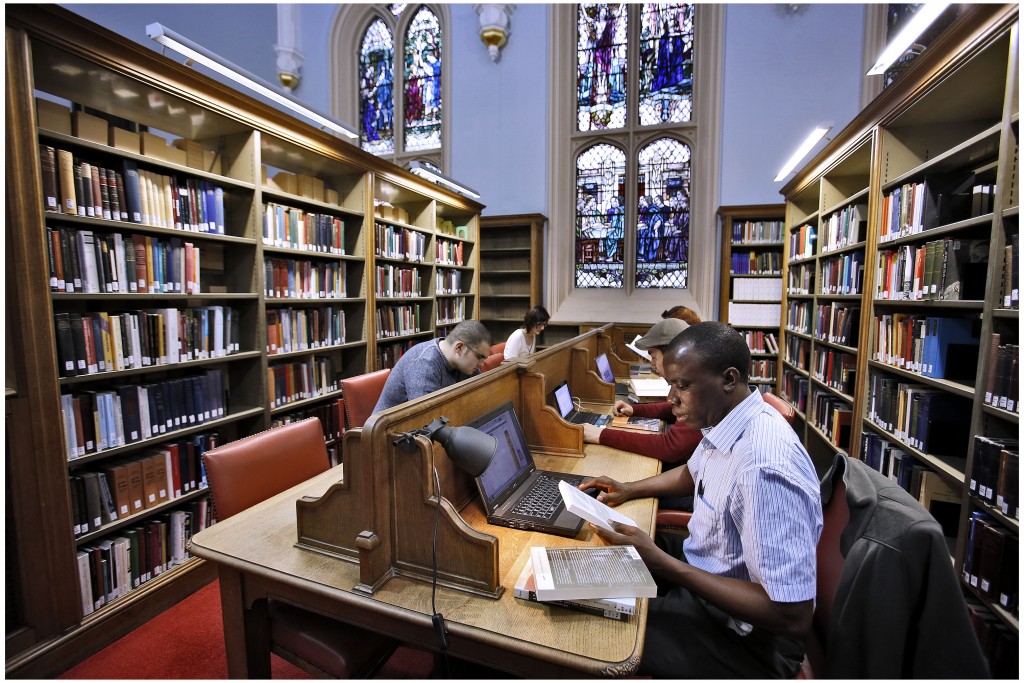
New College Library
New College Library’s opening hours are being extended for a trial period. The Library continues to be open on a Sunday afternoon, 12-5pm throughout this semester. From 9 April to 24 May 2018, New College Library will be open until 10pm in the evening, Monday to Thursday.
Thomson-Dunlop Research and Conservation Internship
Our blog this week comes from Michela Albano, who recently spent four weeks working with our Musical Instrument Conservator, Jonathan Santa Maria Bouquet…
Thanks to the Thomson-Dunlop Research and Conservation Internship, I had the opportunity to spend four weeks in the autumn of 2017 at St Cecilia’s Hall: Concert Room and Music Museum. This provided me with an amazing experience in an energetic and supportive environment where the deep knowledge of musical instruments preservation is fruitfully combined with a welcoming and enthusiastic team.
Travelling Images: Venetian Illustrated Books at the University of Edinburgh
We have a micro exhibition, of illustrated books from Renaissance Italy, running in CRC from 13th April to 15th June. This is in collaboration with Linda Borean of the Università degli Studi di Udine and Laura Moretti of the University of St. Andrews, and their project: Venetian Renaissance prints, drawings and illustrated books in Scottish collections. https://arts.st-andrews.ac.uk/venice-in-scotland/
There are very many wonderful illustrated books from Venice in our collections; far more than we have space to exhibit. Over the next few weeks we will be posting about the ones we have included, and some that we couldn’t fit in. On 16th April Laura will be giving a talk in CRC. We plan to get out everything we have blogged about for that.
Laura will be posting further information on the blog of her current project Thinking 3D. https://www.thinking3d.ac.uk/
Our first post is by Elizabeth Quarmby Lawrence, Rare Books Librarian
Girolamo Marafioti (1567-1626) De arte reminiscentiae, (Venice : Jo Baptistam Bertonum, 1602.) (Edinburgh University Library: EE.13.36/1)

“The art of memory” survives in the modern world mostly in the form of self-help books and motivational training courses, but it actually has a long and distinguished history, back to classical antiquity.
Classical lawyers and politicians, needing to be able to make lengthy, formally-structured speeches from memory, used the techniques of artifical memory. In their imagination they would turn each of the points of their speech into a strong visual image, and then arrange the images in order within a structure they could easily remember. Typically this would be a building, either real and familiar, or created in the imagination for the purpose.
These techniques remained in common use well into the seventeenth century. In a culture where public affairs were still largely conducted orally, the ability to speak fluently, persuasively and at length, in public, was vital to a professional career. As well as being useful to lawyers and politicians, artificial memory techniques were useful to students, whose academic exercises and examinations were largely based around oral disputations. The techniques were popular with the Friars, whose lives were dedicated to preaching and teaching religious knowledge, and who had to be able to explain complex doctrine accurately.
The technique of artificial memory was passed down from Classical antiquity through three texts – Cicero’s De Oratore, an anonymous handbook Ad C. Herennium, and Quintilian’s Institutio Oratoria. In the Middle Ages it was refined, improved and expanded on. This continued into the Renaissance, where artificial memory was often elaborated to the point that it became an intellectual game, rather than a practical technique. The Renaissance had a fascination for imagery, symbolism, emblems and hidden meanings, and keen interest in imposing a structure on knowledge. The symbolism of artificial memory very easily plays to all of these, and elaborate symbolism and word games can easily be incorporated into it. In some Renaissance examples of artificial memory it is difficult to tell which is the material to be memorised and which is the structure supposed to hold it.


This little handbook was written within this late tradition. Instead of using locations in a building as the places to lodge the memories, it uses both sides of both hands to create 92 places, each marked with a symbol – which had itself to be memorised before it could be used as a tool to remember anything else.
Many of the illustrated books which have been included in the project Venetian Renaissance prints, drawings and illustrated books in Scottish collections are high-quality, luxury productions. This little book was produced with quite different ambitions. It was intended for a relatively popular market – it was reprinted several times, including in an Italian translation – and the illustrations are entirely practical and very necessary to explain the text.
It is not clear how this copy reached Edinburgh, but in the late eighteenth and early nineteenth centuries it passed through the hands of two bibliophiles, or bibliomaniacs. First came Charles-Louis Van Bavière, (1767-1815), Secretary of the Academy and Faculty of Law, Brussels. His professional life seems not to have preoccupied him much: he was a dedicated bibliophile with a reputation for having an eye for a bargain, and for finding unlikely treasures in improbable-looking sales. After his death, his huge library was sold at auction over 22 days, in Brussels in 1817. 
This sort of sale undoubtedly appealed to the book’s next owner, the antiquarian and legendary bibliomaniac Richard Heber (1773 – 1833), whose vast library, collected all over Europe, and housed in half a dozen separate locations, was sold after his death in a series of sixteen sales, in England, France and Belgium, realizing the then enormous sum of more than £60,000. Books from both these scattered collections are in wide circulation today, readily identifiable from their owner’s bookplates and ink stamp.

Scotland’s Music and Dance: Songs and Musicians
This is the second post about music and dance in Scotland. Here, we look at some examples of Scottish songs, as well as eminent musicians, especially musical families, and people with a love of music.
Scottish songs
In the Statistical Accounts you can discover lyrics and references to particular Scottish songs. Actual people, events and settings are within their narrative, making them distinctly Scottish. Scenes of Scottish songs include the farm of Cowden Knows, about a mile outside of Banff, “justly celebrated for its rural beauty” and supposedly “the scene of the plaintive Scots ballad” The New way of the Broom of Cowden Knows (OSA, Vol. XX, 1798, p. 328), as well as the Yarrow Water in Yarrow, County of Selkirk, which is the location of many songs, including The Sang of the Outlaw Murray, The Dowie Dens of Yarrow (also known as The Braes of Yarrow) and Yarrow Vale. (NSA, Vol. III, 1845, p. 37)

Four excellent songs … by E. Johnstone, printer. Published 1820. Found on the Internet Archive.
People are also the subject of songs. One example is The Lass of Patie’s Mill who resided in the parish of Keithhall, County of Aberdeen. “Her father was proprietor of Patie’s mill, in Keithhall; of Tullikearie, in Fintray; and Standing Stones, in the parish of Dyce. From her beauty, or fortune, or from both causes, she had many admirers; and she was an only child. One Sangster, laird of Boddom, in New Machar parish, wished to carry her off, but was discovered by his dog, and very roughly handled by her father, who was called black John Anderson. In revenge, he wrote an ill-natured song, of which her great grandson remembers these words:
Ye’ll tell the gowk that gets her,
He gets but my auld sheen.
She was twice married; first, to a namesake of her own, who came from the south country, and is said to have composed the Song, to her praise, that is so generally admired, and partakes much of the music, which, at that time, abounded between the Tay and the Tweed.” (OSA, Vol. II, 1792, p. 542)
You can hear a recording of the song The Lass o Patie’s Mill on Tobar an Dualchais.
Another example is the song Fair Helen. “She was a daughter of the family of Kirkconnell, and fell a victim to the jealousy of a lover. Being courted by two young gentlemen at the same time, the one of whom thinking himself slighted, vowed to sacrifice the other to his resentment, when he again discovered him in her company. An opportunity soon presented itself, when the faithful pair, walking along the romantic banks of the Kirtle, were discovered from the opposite banks by the assassin. Helen perceiving him lurking among the bushes, and dreading the fatal resolution, rushed to her lover’s bosom, to rescue him from the danger; and thus receiving the wound intended for another, sunk and expired in her favorite’s arms. He immediately revenged her death, and flew the murderer. The inconsolable Adam Fleeming, now sinking under the pressure of grief, went abroad and served the banners of Spain, against the infidels. The impression, however, was too strong to be obliterated. The image of woe attended him thither; and the pleasing remembrance of the tender scenes that were past, with the melancholy reflection, that they could never return, harassed his soul, and deprived his mind of repose. He soon returned, and stretching himself on her grave, expired, and was buried by her side.” He was said to have written the song whilst he was in Spain. The lyrics can be found in the parish report of Kirkpatrick-Fleming, County of Dumfries (OSA, Vol. XIII, 1794, p. 274) There is also a recording of the song Fair Helen of Kirkconnel on Tobar an Dualchias.
Events such as battles, have also been immortalized in song. In the report given by the Chapel of Garioch, County of Aberdeen, there is a description of the Battle of Harlaw. “From the ferocity with which this battle was contested, and the dismal spectacle of civil war exhibited to the country, it appears to have made a deep impression on the national mind. It fixed itself on the music and the poetry of Scotland. A march called the Battle of Harlaw continued to be a popular air, down to the time of Drummond of Hawthornden; and a spirited ballad on the same event is still repeated in our own age, describing the meeting of the armies and the death of the chiefs in no ignoble strain.” (NSA, Vol. XII, 1845, p. 568) In Wamphray, County of Dumfries, “songs are still sung descriptive of the barbarous deeds and bloody feuds of some former age, of which this parish was the scene.” (OSA, Vol. XII, 1794, p. 606) One man named Mackay from Thurso, was an Adjutant to the Thurso Volunteers and “and as a specimen of his poetical abilities, the copy of a song, which he composed on that corps” can be found in the report of Thurso, County of Caithness. (OSA, Vol. XX, 1798, p. 532)
Other songs that you can find out about in the Statistical Accounts of Scotland include The Souters o’ Selkirk (OSA, Vol. II, 1792, p. 436), Logie o’ Buchan (NSA, Vol. XII, 1845, p. 812) and Gin I Were Where the Gadie Rins (NSA, Vol. XII, 1845, p. 1020).
_(14576688890).jpg)
Title page of the book ‘Scottish Songs – in Two Volumes’, 1794. By Internet Archive Book Images [No restrictions], via Wikimedia Commons.
Inhabitants of certain parishes became very accomplished musicians. In Towie, County of Aberdeen, “vocal and instrumental music, particularly the violin, form the most prominent amusements of the people in the winter evenings, and it is believed that few parishes in Scotland can boast of so many good Strathspey players, who are also temperate in their habits, and industriously employed in their other vocations.” (NSA, Vol. XII, 1845, p.418) A strathspey is a type of dance tune which has 4 beats to a bar. Examples include Auld Lang Syne and Coming through the Rye. It also refers to the dance performed to it. (In the last post we looked at some particular Scottish songs.) Whereas, in the County of Caithness, “the violin, and Highland bag-pipe, are the only musical instruments, played on by professional men in Thurso. The Highland reels are played particularly well, on both these instruments, in Caithness; but the proper flow bag-pipe tunes and marches, are not given in that perfection here, with seems almost peculiar to the West Highland pipers.” (OSA, Vol. XX, 1798, p. 531)
Specific eminent musical families are also mentioned in the Statistical Accounts of Scotland, including the MacCrimmons, who were the hereditary pipers of the MacLeods. “Certain it is that, what rarely happens, high musical talent as well as high moral principle and personal bravery, descended from father to son during many generations in the family of the MacCrimmons. They became so celebrated that pupils were sent to them from all quarters of the Highlands, and one of the best certificates that a piper could possess was his having studied under the MacCrimmons.” As reported by the parish of Duirinish, County of Inverness, “finding the number of pupils daily increasing, they at length opened a regular, school or college for pipe music on the farm of Boreraig, opposite to Dunvegan Castle, but separated from it by Loch Follart… Macleod endowed this school by granting the farm of Boreraig to it, and it is no longer ago than seventy years since the endowment was withdrawn.” Find out for what reason at NSA, Vol. XIV, 1845, p. 339.
Kilmuir was also famous for its pipers, the most notable of which were the MacArthurs. “When the proprietors resided in the parish, a free grant of the lands of Peingowen, a hamlet in the place, was given to the MacArthurs, in the same manner as Boreraig was given by the MacLeods of Dunvegan, to the MacCrimmons. Peingowen, like Boreraig, was a sort of musical college, to which pupils were sent by various chieftains, to acquire a correct knowledge of piobaireachd. A little green hill in close vicinity to Piengowen, called Cnoc-phail, was the general rendezvous of the MacArthurs and their pupils. To the top of this eminence, they almost daily resorted, and practised their tunes. The MacArthurs vied with the MacCrimmons of Dunvegan, the MacGregors of Fortingall, the Mackays of Gairloch, the Rankins of Coll, and the MachIntyres of Rannoch, who were all renowned performers in their day.” (NSA, Vol. XIV, 1845, p. 285)
It is not all just bagpipes and violins. Stevenston, county of Ayrshire, was well-known for the manufacture of trumps, also known as the Jew’s harp at Piperheugh. “The pipers and harpers, like their woodland village, have passed away; but they seem to have bequeathed the mantle of song, to their posterity, for the inhabitants of Stevenston are still distinguished for their musical propensities, as an instrumental band, and glee club, and, what is better, the excellent singing of the congregation in church, amply testify.” (NSA, Vol. V, 1845, p. 453)

Iain Lom’s memorial at Cille Choirille kirkyard. James Yardley [CC BY-SA 2.0 (https://creativecommons.org/licenses/by-sa/2.0)], via Wikimedia Commons.
Other prominent Scots who were music enthusiasts are:
- Allan Ramsey and John Gay; (OSA, Vol. XVII, 1796, p. 628)
- William Tytler, Esq. of Woodhouselee; (OSA, Vol. XV, 1795, p. 444)
- John Maxwell, Esq; of Broomholm, who wrote an Essay upon Tune. (OSA, Vol. XIII, 1794, p. 591 and OSA, Vol. XXI, 1799, p. 240)
- General Reid. (NSA, Vol. I, 1845, p. 676)
It is through the devotion and dedication of Scotland’s people that their music has become so distinctive and longstanding. Scotland’s songs chart the history of its people and events and so are central to the country’s identity. It is wonderful to be able to discover traditional songs and their origins, and, in so doing, helping to ensure that Scotland’s music and its meaning is not lost.
In our next post on Scotland’s dance and music we will explore musical education, music in a religious context (including weddings and funerals) and changes in attitudes to music.
New! Development Bookshelf from Practical Action
I’m pleased to let you know that the Library now has access to Development Bookshelf, produced by Practical Action. Development Bookshelf is a specialist peer-reviewed and evidence-based online book collection for International Development policy, practice and research professionals.
You can currently access Development Bookshelf via the International Development subject guide, relevant databases by subject lists or via the e-book pages.

The collection reflects the learning of multiple agencies and development professionals across a variety of specialist subject areas. Content can be browsed by subject area including topics such as agriculture and food, disasters and emergencies, gender, global public health, NGO management, social development and technology or by using keyword quick search. Read More
Repository Fringe 2018
 Venue: The Royal Society of Edinburgh
Dates: 2-3 July 2018
Registration: is now closed
Repository Fringe has now finished for 2018. The presentations have been deposited in – and are available to download – from the University of Edinburgh’s repository – the Edinburgh Research Archive
Repository Fringe will be taking a break in 2019 but we are excited to announce instead that Edinburgh will be host to the FORCE2019 annual meeting which will be held October 15-17. FORCE2019 will be held October 16 and 17, 2019 at the BT Murrayfield Rugby Stadium, with pre-conference workshops at the Hilton Grosvenor Hotel on October 15.
Problem Photographs in the Patrick Geddes Collection
This week’s blog comes from Project Conservator, Nicole Devereux, who has come across a sticky situation with some photographs during the ‘Evergreen: Patrick Geddes and the Environment in Equilibrium’ project…
The Patrick Geddes collection has a wide variety of material including large maps, photographs, bound volumes and letters, all of which have their unique conservation challenges. One interesting problem I have come across in this collection is a photograph stuck to glass. This is usually caused by humidity and can be prevented by stable environmental conditions or by placing a mount or spacer between the photograph and the glass so they don’t come in contact.
Collections
 Hill and Adamson Collection: an insight into Edinburgh’s past
My name is Phoebe Kirkland, I am an MSc East Asian Studies student, and for...
Cataloguing the private papers of Archibald Hunter Campbell: A Journey Through Correspondence
My name is Pauline Vincent, I am a student in my last year of a...
Hill and Adamson Collection: an insight into Edinburgh’s past
My name is Phoebe Kirkland, I am an MSc East Asian Studies student, and for...
Cataloguing the private papers of Archibald Hunter Campbell: A Journey Through Correspondence
My name is Pauline Vincent, I am a student in my last year of a...
Projects
Cataloguing the private papers of Archibald Hunter Campbell: A Journey Through Correspondence
My name is Pauline Vincent, I am a student in my last year of a...
Archival Provenance Research Project: Lishan’s Experience
Presentation My name is Lishan Zou, I am a fourth year History and Politics student....