Home University of Edinburgh Library Essentials
March 23, 2026
LaFollette’s International Encyclopedia of Ethics – now available online!

The International Encyclopedia of Ethics, edited by Hugh LaFollette, covers major philosophical and religious traditions, with entries wriitten by nearly 700 different highly respected thinkers from around the world.
On trial: Service Newspapers of World War Two
*The Library has now purchased access to this resource. See New to the Library: Services Newspapers of World War Two.*
Thanks to a request from staff in HCA the Library has been allowed trial access to the brand new digitised primary source collection Service Newspapers of World War Two by Adam Matthew Digital. This resource gives you unique insight into the story of war as told by the newspapers and magazines that brought information, entertainment and camaraderie to the forces.

You can access this online resource via the E-resources trials page.
Access is available both on and off-campus.
Trial access ends 14th May 2018.
Service Newspapers of World War Two contains an extensive range of both rare and well-known wartime publications for soldiers serving in major theatres around the world. Publications are included from many key nations involved in the conflict, such as the US, Canada, New Zealand, India, and the countries of Europe, Africa and the Middle East. Both Allied and Axis publications are presented, offering a broad view of the war and the experiences of those on its front lines. Read More
The Metamorphosis of Patrick Geddes
Work continues on re-cataloguing the Geddes family photographs. Working in such close proximity with these photographic collections has provided a rare opportunity to follow intimately the changing face of Patrick Geddes throughout his lifespan. We hope you enjoy the visual journey as much as we did.
Read More
MyiLibrary e-book changes

E-books hosted on the MyiLibrary website will transfer over to Ebook Central on the evening of Wednesday 18th April.
We have been advised that bookmarks, highlights and saved notes will not transfer – please see these instructions (opens PDF) on how to manually export notes if required.
If you had used the ‘Patron bookshelf’ facility, you will need to re-create this on Ebook Central.
Further info
Alerts have been added to the individual MyILibrary e-books in DiscoverEd.
Further information about the Ebook Central and MyiLibrary websites can be found via our E-Book AZ lists.
Food and Drink in Scotland: What Scots ate and drank
A recent scientific study [1] has been published showing that in the Victorian era people living in the country ate better than those living in the cities. This got me wondering what people ate and drank during the time of the Statistical Accounts of Scotland. Could a similar assertion be made looking at what is recorded in the parish reports? Other questions also came to mind, such as when did they eat and why did they have this particular diet?
I decided to do some of my own research and record some of my findings in three blog posts. This first post looks at what Scots ate and drank. The second will look at why they ate and drank what they did, while the third will look at food scarcity, provision of food, and the link between food and health.
______________________________________________
Looking through the Statistical Accounts it is clear to see that there were many similarities between parishes, with the staples being:
- Potatoes;
- Oat-meal;
- Bear-meal;
- Barley;
- Turnips;
- Kale/cabbage;
- Milk.
In Bathgate, County of Linlithgow, “the common people here subsist on oat meal, pease meal, barley, potatoes, milk, chiefly butter milk, greens, a little butter and cheese, sometimes the offals of beef, mutton, lamb, or veal, or a small piece of beef, and, on a particular occasion, a leg of lamb or veal. For three quarters of the year, potatoes constitute nearly two-thirds of the food of a labouring man’s family.” (OSA, Vol. I, 1791, p. 355) Whereas, in North Uist, County of Inverness, “the ordinary food is potatoes and barley-bread, which are almost exclusively used among the poorer class. The small tenants of a better class use, in addition, some milk in summer, and mutton and beef in winter.” (NSA, Vol. XIV, 1845, p. 173)
A great account of what people ate in the late 18th century can be found in the parish report of Speymouth, County of Elgin. (OSA, Vol. XIV, 1795, p. 400) There are even descriptions of what the Picts ate in the County of Caithness area (OSA, Vol. XX, 1798, p. 536) and what people in the Highlands ate back at the end of the 6th and beginning of the 7th centuries! (OSA, Vol. X, 1794, p. 541)
Class differences
There are also clear differences between the classes. Not all of the working class was able to include meat in their diet due to its cost or lack of availability. In Longforgan, County of Perth, “the farm servants formerly lived with the family; and their usual food was broth made of kait and barley, or grotts, (unhusked oats), without meat, and bannocks made of pease and bean meal. Now they live apart from the family in their bothie, and get what is called livery meal, i. e. w peeks of oat-meal per week, and 3 choppins (quarts) of skimmed milk per day.” (OSA, Vol. XIX, 1797, p. 492)
For many, meat was reserved for special occasions. For example, in the parish of Alvie, County of Inverness, “in regard to animal food, such as beef, mutton, and poultry, that is a luxury in which the small tenants never indulge, except at marriage feasts, baptisms, Christmas, and new year.” (NSA, Vol. XIV, 1845, p. 90) In Kirkden, County of Forfar, on Christmas Day “the servant is free from his master,” and goes about visiting his friends and acquaintance. The poorest must have beef or mutton on the table, and what they call a dinner with their friends” (OSA, Vol. II, 1792, p. 509) Many reports state that even though people had little money, they were still content with their situation. The people of Birsay and Harray, County of Orkney, “are as well contented as poor people can be expected; … can make a feast, at a wedding or a christening, on their own provisions, with a drink of their own ale.” (OSA, Vol. XIV, 1795, p. 332)
Even differences within the same class was noted. For the Scots in the parish of Kirkinner, County of Wigton, “their ordinary food is porridge and milk to breakfast, broth with bacon and potatoes or oat-cake to dinner, and porridge or beat potatoes to supper… The Irish population live mostly on potatoes and milk or salt herrings.” (NSA, Vol. IV, 1845, p. 17)
As for those of a higher standing in society, for example in the parish of Orwell, County of Kinross, “the better sort, however, live in a very different manner; most of the farmers and master tradesmen keep as good a table as any gentleman of L. 500 a-year; and their common drink after meals is whisky-punch…” (OSA, Vol. XX, 1798, p. 137)

Horsley, John Callcott; Coming Down to Dinner, 1876. Photo credit: Manchester Art Gallery.
For the upper classes in particular, food and drink was a way of showing their wealth and status in society. There are many references to grand dinner parties and feasts in the Statistical Accounts of Scotland. It was reported in Glasgow that “the first instance of a dinner of two courses in the neighbourhood of Glasgow was about the year 1786. Mrs Andrew Stirling of Drumpellier, who made this change in the economy of the table, justified herself against the charge of introducing a more extravagant style of living, by saying, that she had put no more dishes on her table than before, but had merely divided her dinner, in place of introducing her additional dishes in removes.”(NSA, Vol. VI, 1845, p. 229) You can find an account of one particularly lavish dinner “held on the 21st of August 1679, at the baptist of an early and distinguished benefactor of the country” in the parish report for Whitekirk and Tynninghame, County of Haddington. (NSA, Vol. II, 1845, p. 37)
Oats and potatoes
It is clear from reading the Statistical Accounts that oat-meal was one of the most important sources of food in Scotland, along with potatoes. The writer of the parish report for Bendochy, County of Perth, extolled the virtue of the most Scottish of staples – oats:
“The common people live on oatmeal pottage twice a-day. It is the most wholesome and palatable of all their food, being purely vegetable; notwithstanding the reflection in Johnson’s Dictionary, that ” oats are eaten by horses in “England, and in Scotland by men.” Such food makes men strong like horses, and purges the brain of pedantry. It produces hardy Highlanders, who by their strength and dress are so formidable to their enemies, that they call them, “Les diables des Montagnes.” (OSA, Vol. XIX, 1797, p. 349)
There is an interesting account on the value of oat-meal in the parish report for Cambuslang, County of Lanark. (OSA, Vol. V, 1793, p. 254) For information on the cultivation and use of potatoes it is worth reading the report for Glenurchy and Inishail, County of Argyle. (OSA, Vol. VIII, 1793, p. 338) If you would like to find out more on what Scottish farm labourers ate (and in particular oat pottage!) take a look at the British Farmers Magazine (Volume 2).

Recolte des Pommes de Terre, Jules Bastien Lepage, 1879. By Samuel austin [CC BY-SA 3.0 (https://creativecommons.org/licenses/by-sa/3.0)], from Wikimedia Commons.
Fish
There were also some differences between parishes, depending on where they were situated and what was abundant in the area. For example, people living near or on the coast also enjoyed fish and seafood, like the parish of North Uist, County of Inverness (NSA, Vol. XIV, 1845, p. 167) and St Andrews and St Leonards, County of Fife (OSA, Vol. XIII, 1794, p. 197). In Lochalsh, County of Ross and Cromarty, “during the summer and beginning of harvest, they are much employed in fishing of sythe, (a small species of the cole fish), herrings, and sometimes ling, cod and skate. The sythe are eat fresh; the herrings are pickled, to be eat with the potatoes during the harvest, winter, and spring. Though 63 boats be employed in this manner, there are no fish exported from the parish.” (OSA, Vol. XI, 1794, p. 425)
In Aberdeen “a considerable variety of fish are caught in the vicinity of this place, as haddock, whiting, cod, ling, turbot, skate, flounders of different kinds, halibut, plaice, sole, mackerel, dog-fish, and occasionally herrings… The market is well supplied with fish upon very reasonable terms. This is a great relief to the poor, as fish makes a principal part of their food.” (OSA, Vol. XIX, 1797, p. 155) However, in Portmoak, County of Kinross, a line was drawn at eels as a source of food! “As the bulk of the people have an aversion to them as food, from their serpentine appearance, this fishing turns to little account in the view of profit.” (OSA, Vol. V, 1793, p. 159)
Some parishes, however, was in stark contrast to places like Aberdeen. In St Cyrus, County of Kincardine, it was reported that there was a “reduction of the fishing boats, and of the number of hands that went to sea with them” which “leaves no foundation for a nursery of seamen, and prevents the inhabitants from enjoying that abundant supply of excellent food, with which the sea is stored.” (OSA, Vol. XI, 1794, p. 112)
Interestingly, it was noted that inhabitants of Leuchars, County of Fife, seem only to fish for amusement or when they fancy some fish to eat! “Is it not supposeable, that if their fishings were properly attended to, they might supply all the district with this wholesome and agreeable article of food?” (OSA, Vol. XVIII, 1796, p. 597)
Price of food
Many parish reports give the price of food, for example that of Dalgety, County of Fife (OSA, Vol. XV, 1795, p. 262), Kirkcaldy, County of Fife (OSA, Vol. XVIII, 1796, p. 53) and Kirkmichael, County of Dumfries (OSA, Vol. I, 1791, p. 61). This extract from the Falkirk parish report is very interesting as it provides a comparison between prices then and earlier, as well as pointing out the changes in its number of bakers.
“It appears from Dalrymple’s Annals of Scotland, that the price of a hen in 1295 was only one penny; but now one that is well fed will cost fifteen or eighteen pence. Forty years ago, the price of butcher meat in this market was only about 2 d. per pound; but now it is from 4 d. to 6 d. or 7 d…. About 60 years ago this town and neighbourhood were chiefly supplied with wheaten bread from Edinburgh and Linlithgow. There were then only 3 bakers in Falkirk, and they were but occasionally employed. Hence it is, that the people in the remote parts of the country, when they come to procure bread for feasts or funerals, do still enquire of the bakers if their ovens be heated. There are now 18 bakers in the town of Falkirk, and 6 in the different villages within the parish. They make excellent bread, and the price is regulated by the Edinburgh assize.” (OSA, Vol. XIX, 1797, p. 86)
The parish report from Holywood, County of Dumfries noted that farm labourers can survive on such little wages as they are given some land by farmers “from whom they have cottages, allowing them as much land for one year’s rent free, to plant potatoes in… and these potatoes constitute at least one half of their year’s food. (OSA, Vol. I, 1791, p. 28) (We will look at the provision of food as a means of payment in the next blog post.)
While exploring food and dink in Scotland, it has been fascinating to learn a little about labourers’ homes. In the parish report of Criech, County of Sutherland:
“Once in three years, all the earthy part of these houses is thrown on the dunghill, and new houses built again of the same materials. The cattle commonly occupy one end of the house, during the winter season. Some holes in the walls and roofs serve for windows and chimneys. An iron pot, for boiling their food, constitutes their principal furniture.” (OSA, Vol. VIII, 1793, p. 376)
In Campsie, County of Stirling:
“The houses of every decent inhabitant of this parish, consist at least of a kitchen and one room, generally two rooms, ceiled above, and often laid with deal floors, with elegant glass windows; and I believe, few of the tradesmen sit down to dinner without flesh meat on the table, and malt liquor to drink…” (OSA, Vol. XV, 1795, p. 385)
Changes in diet
Changes in what the Scots ate and drank is also reported in the Statistical Accounts. This was in the main due to better farming and production techniques, as well as there being exports from further afield. Formerly, in Kilsyth, County of Stirling, wheat bread was only eaten on special occasions, little or no meat (beef, mutton or veal) was consumed, and tea was not drunk. By the time of the parish’s report, this had all changed. (OSA, Vol. XVIII, 1796, p. 307) In the parish report of Luss, County of Dumbarton, it was reported that “there is… a more plentiful supply of food than formerly. The extended culture of potatoes, as well as the increased productiveness of population here than elsewhere, they continue much attached to their native soil, in which generally their forefathers have dwelt from time immemorial.” (NSA, Vol. VIII, 1845, p. 162) Other discussions on changes in diet can be found in the Appendix for Monquhitter, County of Aberdeen (OSA, Vol. XXI, 1799, p. 143) and the parish report for Carmylie, County of Forfar. (NSA, Vol. XI, 1845, p. 361)
For some fascinating comparisons between eating practices over the years take a look at the report for the parish of Glasgow, County of Lanark. For instance, “the dinner hour about the year 1770 was two o’clock: immediately after that, it came to three o’clock, and gradually became later and later, till about 1818 it reached six o’clock.” (NSA, Vol. VI, 1845, p. 229)
Conclusions
There is a wealth of fascinating information in the Statistical Accounts of Scotland on what Scots ate and drank. There are the common staples, such as oats and potatoes, but there also many differences between parishes, including their location and its population, as well as changes over time. As with everything, habits and technology have changed the landscape. In the next blog post on Scotland’s food and drink we will look at why Scots ate and drank what they did.
_____________________________
[1] Regional differences in the mid-Victorian diet and their impact on health, Peter Greaves, 2018. Published in JRSM Open.
On trial: The Stuart and Cumberland Papers
*The Library has now purchased access to The Stuart and Cumberland Papers. See New to the Library: The Stuart and Cumberland Papers*
I’m pleased to let you know that Gale Cengage are giving us trial access to their brand new digitised archive from State Papers Online, the Stuart and Cumberland Papers. This archive contains two remarkable collections from the Royal Archives at Windsor Castle, which have been digitised for the first time and are available online in their entirety.

You can access this online resource via the E-resources trials page.
Access is available both on and off-campus.
Trial access ends 10th May 2018.
The Stuart Papers represent the correspondence and personal documents of the exiled members of the Stuart dynasty after 1688. These papers were acquired by George IV when Prince Regent, following the death of Henry Bennedict Stuart, Cardinal York, and were originally kept in the Prince’s Library at Carlton House. The collection tells the story of the lives of James II and his heirs with the majority of papers concerning the period 1713 to 1770, and provide an insight into Jacobite attempts to regain the throne. The later papers in the collection concern Cardinal York’s relations with the Vatican until his death in 1807. Read More
On trial: Military Intelligence Files
I’m happy to let you know that British Online Archives (BOA) have given us trial access to their digitised primary source collection Military Intelligence Files: Land, Sea & Air, 1938-1974. This collection provides access to secret British government files produced by the intelligence branches of the Royal Navy, British Army and Royal Air Force and will be of particular interest to those of you looking at the Second World War or the beginnings of the Cold War.

You can access this online resource via the E-resources trials page.
Access is available both on and off-campus.
Trial access ends 9th May 2018.
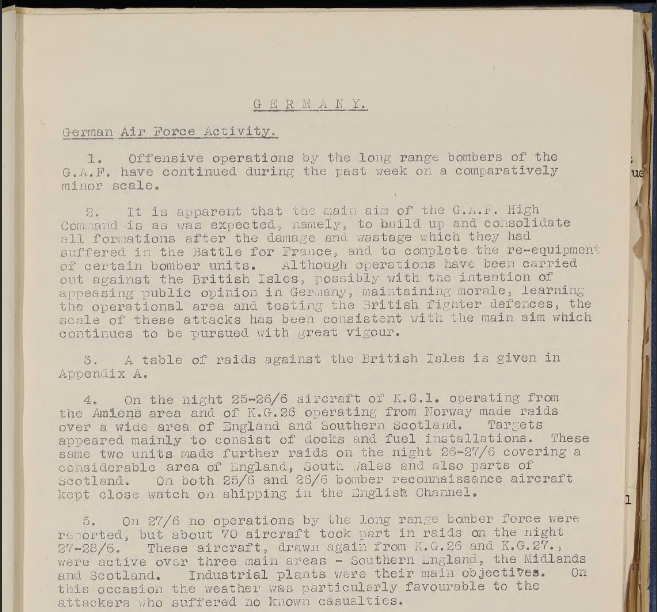
Screenshot from Royal Air Force: Weekly Intelligence, Jul 1940-Feb 1941 (Military Intelligence Files, British Online Archives).
Thomson-Walker Internship – Round 5!
Our final Thomson-Walker intern introduces herself in this week’s blog post….
“I feel like a pastry chef!”: this was my first thought while trying to smear an even layer of a carboxymethylcellulose (CMC) poultice on a strip of lens tissue to remove a very thick residue of what distinctively smelled like coccoina (a marzipan-scented Italian glue, made from potato starch and almond paste). Being Italian, I couldn’t help but recognise the fragrance bringing back so many childhood memories. I didn’t imagine, back then, how difficult it actually is to remove this adhesive from the back of a 17th century print!
Living Icons: Keeping with the “Archival Liveness” of the University’s Iconic Items

Jami’ al-Tawarikh, f.14v detail
As the other blog posts that I have written for the DIU will attest to, I repeatedly find myself drawn to archival artefacts and stories that show the always “in-process” nature of archives[1]. While the word archive might initially bring to mind shelves full of preserved books and artefacts, collections kind of frozen in time and stoically telling a particular story, those working in archives will attest instead to the truly dynamic nature of archives. In fact, Tom Schofield et al. have introduced the term “archival liveness” as a concept that “promotes a view of the archive as a set of on-going professional, institutional and technical processes and precipitates a focus on the different kinds of temporality embodied within these” (“Archival Liveness”, 2015). What the idea of archival liveness gets at is that as our socio-technological, historical, and cultural moments change, so too does our ability to engage with archives. Cataloguing must be done to make an archive discoverable and searchable, but this costs time and money, and so archives exist at different stages of complete or incomplete cataloguing. Moreover, as time passes, archives typically grow, or sometimes shrink if things are lost, and they are remediated through various preservation, restoration, and, in our current digital world, digitization processes, all of which requires new forms of discovery and engagement with the archived collections. Archives are therefore always embedded within shifting networks of mediation and distribution. Read More
Travelling Images: Venetian Illustrated Books 2
This week our Venetian illustrations turn theatrical, with an illustrated copy of the plays of Plautus, and we welcome as guest blogger, the exhibition curator, Laura Moretti, of the University of St. Andrews.
Titus Maccius Plautus (c.254-184 BC), Comedies, edited by Bernard Saraceni, and Giovanni Pietro Valla. (Venice: Lazzaro de’ Soardi, 1511). Edinburgh University Library JY 1082.
The comedies by the Roman dramatist Titus Maccius Plautus (c.254-184 BC) were the subjects of a period of rebirth during the course of the fifteenth century. This was due – along with the favor that theatrical plays by Roman authors saw as a genre during the Renaissance – to the fact that twelve comedies by Plautus were rediscovered in the first half of the Quattrocento. Together with the eight already known at the time, the group of twenty comedies came to constitute a fundamental corpus for the theatre in the following decades, being represented with great success in Rome, Milan and Ferrara. They were reworked, modified, and translated into vernacular. Besides being copied in several manuscripts, from the beginning of the 1470s also printed editions started to appear. The texts were edited and commented by various authors, including Giorgio Merula, Ermolao Barbaro, Angelo Poliziano, Giovan Battista Pio, Filippo Beroaldo.
The present edition was published in 1511 by Lazzaro de’ Soardi. Active as a printer in Venice between 1490 and 1517, he published about fifty editions, especially Latin classics, religious texts, and works of ascetic, theological and philosophical character. The commentary by Bernardo Saraceni and Giovanni Pietro Valla had already been published in Venice in 1499 by Simone Bevilacqua. The Soardi edition, though, was the first one fully illustrated, presenting a full-page woodcut of a theatre and numerous woodcuts throughout.

A theatre seen from the viewpoint of the actors
This illustration already appeared in a previous edition of comedies by the Roman dramatist Terentius (c.195/185- c.159? BC), published in 1497 by the same Soardi. It is a rare image of a theatre seen from the unusual point of view of the actors. The audience sits on semicircular stalls, and is dressed in contemporary fashion. One actor is performing at the centre of the scene, while another oneis entering from a lateral door on the right.
The 1511 edition is completed by 316 woodcuts of scenes from the comedies. The illustrations are not designed individually, but composed assembling smaller blocks. The resulting images generally present the names of the characters in scrolls aligned at the top – also repeated underneath – and normally four, but sometimes up to six elements combining: one to six characters, one to two doors, one or tree trees, and one to four thin rectangular floral borders. It is possible to notice many repetitions of the individual elements, although the resulting illustrations are always different.

Detail of illustrations from the comedy Amphitryo

Opening from the comedy Aulularia
The above-mentioned 1497 edition of Terentius also presented woodcuts illustrating the scenes, but they were crafted individually.

From 1497 Lazzaro de’ Soardi’s hand-coloured edition of Terentius comedies, digitised by the Bayerische Staatsbibliothek, München.

Opening with illustration from 1497 Lazzaro de’ Soardi’s hand-coloured edition of Terentius comedies, digitised by the Bayerische Staatsbibliothek, München.
These illustrations might look more coherent and better manufactered to our eyes than the ones from the 1511 edition, but in the latter, perhaps less refined and accurate, we can notice some elements of extreme relevance for the history of the printed book. In a period in which the industrialisation of the printing process was still in its infancy, these images represent the sign of a tendency and a way of thinking in terms of reproducibility, reuse, and flexibility.
Something similar, although more elaborated, already appeared in the edition of the comedies by Terentius published in Strasbourg in 1496 by Johannes Grüninger. This particular edition also presented in the titlepage the representation of a “theatre”, and might have inspired Soardi.

Johannes Grüninger’s 1496 edition of Terentius comedies, digitised by the Universitäts- und Landesbibliothek, Technische Universität Darmstadt.

Titlepage from 1496 Johannes Grüninger’s 1496 edition of Terentius comedies, digitised by the Universitäts- und Landesbibliothek, Technische Universität Darmstadt.
In the 1551 edition, while the characters often simulate some sort of stage action, the trees and – especially – the doors confer a sense of spacial recession, giving to the illustrations a three-dimensional effect and a stage-like appeareance, even if still pretty schematic. The page is composed presenting the original text in the central section, together with the illustrations, while the commentary unfolds around them.

Title page with previous ownership inscription
The book formed part of the collection of Dugald Stewart (1753-1828), who studied at the University of Edinburgh and was Chair of Moral Philosophy there from 1785. His library included the books of his father Matthew (1717-85), Professor of Mathematics at the same institution. The collection passed into the hands of Dugald’s son Matthew (c.1784-1851), who bequeathed it – along with many of his own books – to the United Service Club in London. In 1910 the whole collection was transferred to the University of Edinburgh. It contains 3,432 titles in some 4,000 volumes, covering many topics, but is particularly strong in political economy, moral philosophy, and mathematics. There are a large number of presentation copies reflecting Dugald’s wide circle of acquaintances and admirers. The younger Matthew Stewart added some early printed books (there are 33 incunabula in the collection) and works on oriental subjects. A signature of a previous owner is visible on the titlepage; the Rare Books staff think it may be an institution – S[ancti] Ip[politi?] … but at the moment I am not able to identify it.
Dr Laura Moretti (University of St Andrews)
Further reading:
Fully digitised copy of the 1511 Lazzaro de’ Soardi’s edition of Plautus comedies, digitised by the Bavarian State Library is available here.http://reader.digitale-sammlungen.de/resolve/display/bsb10195815.html
The 1496 Johannes Grüninger’s edition of Terentius comedies, digitised by the Universitäts- und Landesbibliothek, Technische Universität Darmstadt, is available here.http://tudigit.ulb.tu-darmstadt.de/show/inc-iv-77/0001?sid=094bbe50d4659af0b4134f5d1d57ff78
The 1497 Lazzaro de’ Soardi’s edition of Terentius comedies, digitised by the Bayerische Staatsbibliothek, München, is available here.http://daten.digitale-sammlungen.de/~db/0005/bsb00058998/images/index.html?id=00058998&groesser=&fip=eayaxdsydyztsxdsydeayawxdsydsdasqrsxdsydewqxs&no=2&seite=1
The 1499 Simone Bevilacqua’s edition of Plautus comedies, with commentary of Saraceni and Valla, digitised by the Bayerische Staatsbibliothek, München, is available here.http://daten.digitale-sammlungen.de/~db/0006/bsb00064398/images/
The full catalogue record for the Edinburgh University Library copy is here: https://discovered.ed.ac.uk/primo-explore/fulldisplay?docid=44UOE_ALMA21104958570002466&context=L&vid=44UOE_VU2&search_scope=default_scope&tab=default_tab&lang=en_US
Collections
 Hill and Adamson Collection: an insight into Edinburgh’s past
My name is Phoebe Kirkland, I am an MSc East Asian Studies student, and for...
Cataloguing the private papers of Archibald Hunter Campbell: A Journey Through Correspondence
My name is Pauline Vincent, I am a student in my last year of a...
Hill and Adamson Collection: an insight into Edinburgh’s past
My name is Phoebe Kirkland, I am an MSc East Asian Studies student, and for...
Cataloguing the private papers of Archibald Hunter Campbell: A Journey Through Correspondence
My name is Pauline Vincent, I am a student in my last year of a...
Projects
Cataloguing the private papers of Archibald Hunter Campbell: A Journey Through Correspondence
My name is Pauline Vincent, I am a student in my last year of a...
Archival Provenance Research Project: Lishan’s Experience
Presentation My name is Lishan Zou, I am a fourth year History and Politics student....