Home University of Edinburgh Library Essentials
March 22, 2026
Food and drink in Scotland: Food provision, scarcity and health
This is the third and final post exploring food and drink in Scotland during the late 18th and early 19th centuries. Here we look at the provision of food as payment, examples of when food was scarce, and the link between food and health.
Provision of food
There are many examples found in the Statistical Accounts of Scotland of food being provided as payment for services rendered. “Of old times, and at this very day, there is a proverb used in the Highlands, which, when translated, expresses literally, that it is, for decent food and accommodation, and not for wages, they (domestic servants) serve.” (OSA, Vol. XVI, 1795, p. 195) In Fossoway, County of Perth, “the wages of an able day-labourer throughout the year, is 1 s per day; the wages of a woman for the harvest, 8 d; for men between 10 d and 1 s per day; with breakfast and dinner for both.” (OSA, Vol. XVIII, 1796, p. 462) In the parish of King Edward, County of Aberdeen, it was reported that all rent was paid in grain (OSA, Vol. XI, 1794, p. 403), whereas tenants in the parish of Slamanan, County of Stirling, generally paid most of their rent with butter and cheese. (OSA, Vol. XIV, 1795, p. 83)
Interestingly, one landlord in the parish of North Knapdale, County of Argyle, had his rent paid to him chiefly “in feasts given at the habitations of his tenants. What he was to spend, and the time of his residence at each village, was known, and provided for accordingly. The men who provided these entertainments partook of them; they all lived friends together; and the departures of the chief and his retinue never failed to occasion regret.” This ‘friendship’, however, had changed in more modern times. “Till very lately, in this neighbourhood, Campbell of Auchinbreck had a right to carry off the best cow he could find upon several properties, at each Martinmas, by way of mart… The Crown now has converted these cows at 20 s. a head, and taken away this badge of slavery.” (OSA, Vol. VI, 1793, p. 257)
It was not just about farmers and farm-labourers. In the Statistical Accounts, you can also discover the eating habits of those working in mills at the time. In the parish of New Abbey, County of Kirkcudbright, it was reported that women who worked spinning yarn “make sorry wages of it, not above 3 d. per day;-which can afford very scanty food”. (OSA, Vol. II, 1792, p. 132)

Towne, Charles; Backbarrow Cotton Mill, near Newby Bridge; Lakeland Arts Trust; http://www.artuk.org/artworks/backbarrow-cotton-mill-near-newby-bridge-145131
In Lanark, County of Lanark, the diet of children working in the mills “consists of oatmeal porridge, with milk in summer or sowens, i.e. oat-meal flummery, with milk in winter twice a day, as much as they can take, barley broth for dinner made with good fresh beef every day and as much beef is boiled as will allow 7 ounces English a piece each day to one half of the children, the other half get cheese and bread after their broth, so that they dine alternately upon cheese and butchermeat with barley bread or potatoes; and now and then in the proper season they have a dinner of herrings and potatoes. They as well as the others, begin work at six in the morning, are allowed half an hour to breakfast, an hour to dinner, and quit work at 7 at night; after which they attend the school at the expense of the proprietor till 9.” (OSA, Vol. XV, 1795, p. 37) In Lochwinnoch, County of Renfrew, ” the persons employed in the cotton-mills work twelve hours five days in the week, and nine hours on Saturday. They have one hour and forty minutes for both breakfast and dinner.” (NSA, Vol. VII, 1845, p. 104)
There is even an example given of what prisoners ate! In Linlithgow, County of Linlithgow, the prisoners’ “diet is excellent, consisting of six ounce of oatmeal made into porridge, for breakfast, with three-fourths of a pint of buttermilk. Dinner, ox-head broth, four ounce barley, four ounce bread, and a proportion of vegetables, each alternate day, pease-brose, fish, and potatoes. Supper the same as breakfast.” (NSA, Vol. II, 1845, P. 187)
Food scarcity
Some parish reports mention the years 1782 and 1783 in particular, when many harvests in Scotland failed. It is really interesting to read about what caused the failure of crops, according to the parish report of Kilwinning, County of Ayrshire.
“Different causes, no doubt, contributed to this failure, in different parts of the country: But in this parish, and in others immediately on the sea coast, the chief cause of its failure was owing to a very severe west wind, about the middle, or towards the latter end of the month of August, which continued with the utmost violence for a considerable time. The corns had their roots loosened, and were otherwise much damaged by this storm. From being in general very green, when it happened, in a few days afterwards they grew white, but never filled. Snow also, in such parts of the parish as were at the greatest distance from the sea, fell earlier, and in greater quantities, than ever had been known at that season of the year.” (OSA, Vol. XI, 1794, p. 153)
In Peterhead, County of Aberdeen, “the crop of 1782 was as defective in this parish as in other parts of Scotland; and without very great efforts, both of a public and private nature, many would have perished for want of food.” Everyone rallied together to avert death and suffering. This included “a considerable quantity of meal sent by Government, partly gratis, and partly at a low price” and “collections were made in the different churches, and voluntary assessments raised from the greatest part of the heritors”. (OSA, Vol. XVI, 1795, p. 579)
In Gargunnock, County of Stirling, “a large quantity of white peas being commissioned from England by a man of public spirit, and grinded into meal, assisted the other expedients which were then adopted to prevent a famine in this part of the kingdom.” (OSA, Vol. XVIII, 1796, p. 121) The parish of Kilmadan, County of Argyle, was not so hard hit as others, “but the crop in general, over the whole, suffered from the summer’s cold and the wet harvest. The poor were the better for the supply granted by Government.” (OSA, Vol. IV, 1792, p. 340) A particularly poignant account of food scarcity during these years and the affect it had on people can be found in the parish report of Keithhall, County of Aberdeen. “One family wanted food from Friday night till Sunday at dinner”.(OSA, Vol. II, 1792, p. 544)
A long period of food scarcity was also experienced in the parish of Kilsyth, County of Stirling, during the last seven years of the 17th century (also know as the seven dear years). The price of food became exorbitant and even the more opulent residents could not buy any corn. “Greens boiled with salt, became a common food. Fodder was as scarce as grain. Many of the cattle perished at the stall, and many of them who were driven out to seek a scanty pittance expired in the field.” (OSA, Vol. XVIII, 1796, p. 302)
Food and health
There are several mentions of the link between food and health in the Statistical Accounts, with some opinions apperaing contradictory! In the parish of Carsphairn, County of Kirkcudbright, “scurvies are little known, though most of the inhabitants live all the year round on salted provisions, which they use in great abundance. The pernicious consequences of this mode of living are obviated by the plentiful use of potatoes, and other vegetables.” (OSA, Vol. VII, 1793, p. 514)
It was noted in the report for Kilbrandon and Kilchattan, County of Argyle, that “dropsies are likewise observed of late to be more frequent, particularly since potatoes have become the principal food of the lower classes of the people. And certainly, though this useful and wholesome root contains no hurtful quality, yet change of diet must gradually affect and change the constitution. While many, therefore, whole food was more solid in their early period of life, and to whom this root was scarcely known, but now live by this three-fourths of the year, no wonder though disorders should prevail which were formerly less common.” (OSA, Vol. XIV, 1795, p. 160)
In the parish of Kelso, County of Roxburgh, it was thought that the food eaten by the labouring classes and the large quantity “may be one cause of laying the foundation of glandular and visceral diseases. Although the mechanics in town generally eat meat for dinner, the labourers in town and country seldom do so; but one and all of them live much upon hasty pudding, and boiled potatoes with milk; without deviation, they all breakfast or sup upon the one or the other. Most of the adults eat of this food, at a meal, from 6 to 8 English pounds weight, including milk”, resulting in various unpleasant complaints and even death. (OSA, Vol. X, 1794, p. 594) In this parish, the sheer amount of food people ate, as well as the “sudden change from vegetable to animal food and the too frequent use of spirituous liquors” was believed to inflict many health problems on its residents.

Faed, Thomas; The Doctor’s Visit; 1889. Queen’s University, Belfast; http://www.artuk.org/artworks/the-doctors-visit-168946
In Banff, “an infectious fever prevailed here, with unusual violence, about the year 1782. Unwholesome food, particularly an immoderate use of potatoes, (that year of a bad kind), were among the secondary causes to which this fever was ascribed.” (As you know, the year 1782 was a bad year for crops!) Mr Skene, “the late minister of this parish, wrote a wrote a small treatise on this fever, in form of a “Serious Address to the People,” etc. This short address, which Provost Robinson had paid to print and publish, “contained several plain sensible instructions respecting the prevention and treatment of the disease, and points out the means by which health may be preserved from every disorder of an infectious nature.” For examples of his recommendations see OSA, Vol. XX, 1798, p. 347.
Scrofula was a disease that had prevailed in times of food scarcity (when food was lacking in both quantity and quality) in the parish of Duthil, County of Elgin. “In the summers of 1808, 1816, and 1817, many families subsisted for several successive weeks on the tops of nettles, mugwort, turnip thinnings, and milk, without any corn food; and such as subsisted on this miserable substitute for food, are labouring under the […] disease.” (NSA, Vol. XIII, 1845, p. 125) There was, however, better news for residents of the parish of Borgue, County of Kirkcudbright. “From greater attention to cleanliness, and a more plentiful use of vegetables and fresh animal food, scorbutic and cutaneous diseases are less prevalent than formerly.” (OSA, Vol. XI, 1794, p. 34)
Surprisingly, tea was seen as bad for the health in several parish reports! In the parish of Delting, County of Shetland, some thought that the increase of diseases “may be ascribed to the change in the mode of living, especially to the general use of tea, of which the consumption is amazing, even in the poorest families, who will stint themselves in many essential necessaries of life, in order to procure this article of luxury.” (OSA, Vol. I, 1791, p. 386) This extract on the use of tea found in the report for Gargunnock, County of Stirling, is very amusing. “Tea is universally used. Even the poorest families have it occasionally, and the last cup is qualified with a little whisky, which is supposed to correct all the bad effects of the tea.” (OSA, Vol. XVIII, 1796, p. 121) Conversely, in the parish report for Kirkcudbright, County of Kirkcudbright, tea and coffee are called “wholesome and enlivening beverages”. (NSA, Vol. IV, 1845, p. 37)
Conclusions
It has been fascinating to discover what the Scots ate and drank during the times of the Statistical Accounts. People had to grow and rear what they could to eat. This makes us think that those in the countryside would have had a better diet than those in the cities. But, this was not necessarily always the case. There were certainly differences between parishes due to their topography and climate. In some cases, inhabitants did not make the most of what the land and water had to offer, either because of a lack of knowledge and/or not enough hard work! There were also periods of food scarcity due to poor harvests, which affected everyone, both rich and poor. It must also be pointed out that, in many instances, the farmers sold their produce in the town and city markets.
Looking through the reports, it is clear that many changes took place between the Old and New Statistical Accounts, with improved agricultural practices and a growth in industry and technology, all resulting in increased production and trade. These benefited both those in the country and those in built-up areas. It was particularly interesting to find out what and when mill workers ate during the day, as well as what the link between food and health was believed to be in the eighteenth and nineteenth centuries. There is a wealth of information on food and drink in the Statistical Accounts. Why not explore it and see what you can find?
Springer e-books – new titles added to DiscoverEd

We have now loaded over 3,200 e-books across most subject areas into DiscoverEd.
We will add the remainder of 2018 copyright year e-books available to us on the Springer website as the records become available.
Lift your head and look out
“When we finally arrived at the boundary wall of the early 19th century cottage, now known as ‘Gean Cottage’, I found myself quite moved. Here I was, where Geddes had been…albeit there was almost 100 years between our existence”. Recently, our project archivist, Elaine MacGillivray, took some time out from her cataloguing work to reflect on Patrick Geddes in his native Perthshire environment.
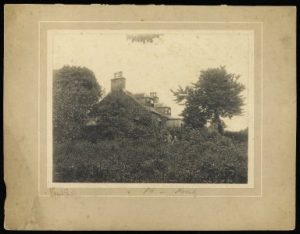
Patrick Geddes and his daughter Norah in the garden at Mount Tabor, Perth, c.1899 (Coll-1167/GFP)
Archivists bear a weight of responsibility in our privileged position as custodians of society’s memory; what we do will matter hundreds of years from now. We aim to effectively manage collections by creating well-informed, reliable and detailed information about the content of the collections to ensure their long-term survival and access to the collections’ content. To do this requires a deep understanding of the collection and its creator.
Archivists, as a breed, are renowned for immersing ourselves in the detail of our work and, whilst the detail is important, we are often guilty of forgetting to lift our heads to look to the big picture. Working so closely with the Geddes collections is a constant reminder to lift your head and look out. The collections abound with illustrations of panoramic views of regions, cities and landscapes. There are thousands of illustrations and diagrams which demonstrate the interrelationships and connections between and beyond the boundaries of specialisms. Prolific correspondence and writings reveal Geddes’s beliefs, one of which was that, to better understand a place, one should view it from a position of outlook.
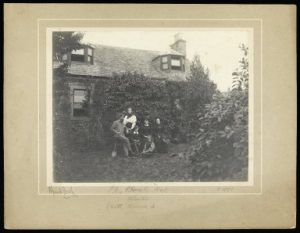
Patrick Geddes and family at Mount Tabor, Perth, c.1899 (Coll-1167)
In 1857, the Geddes family moved from Ballater, Aberdeenshire, to ‘Mount Tabor’, a cottage on the side of Kinnoull Hill overlooking Perth. Patrick Geddes was three years old at the time and he remained there until he was twenty when he left to continue his studies. I recently had the opportunity to take to the Perthshire hills in his footsteps, to see the world through something of his eyes and experience. This was also a chance to remove myself from the detail of collections cataloguing and to lift my head and look out. I could immerse myself in quiet reflection in the natural environment and by doing so to deepen my understanding of Patrick Geddes. I think he would have approved.
One rather fresh but clear weekend in early April a colleague and I set out from the Den of Scone on our Perthshire/ Geddes pilgrimage. We began surrounded by mature trees and despite being spring there were not yet buds on the trees and the remnants of autumn detritus still covered the woodland floor. We followed a muddy track (insert squelching noises) and to our right ran a burn. We crossed the burn by a footbridge and then the path climbed more steeply eastward. Occasionally we crossed a single track road banked by a high beech hedge on one side and spiked holly bushes on the other. At Bonhard House we turned southwards and navigated the path alongside the ploughed fields which flank the eastern edge of the valley, stopping periodically to watch and listen to a buzzard being harassed by crows.
We ascended the steep Coronation Path and at the top took a rest and absorbed what we could of the impressive panoramic vista, looking west towards Ben Lomond and north-west toward Ben Lawers, Schiehallion and finally the snow-capped Grampian mountains in the far north. Having checked historical maps before embarking on our journey I mentally picked off the farms and place-names which would have been extant c.1860 and which Geddes would also have seen: Springfield; Parkfield; Limepotts; Muirhall; Corsiehill; Gannochy, and Kinnoull Hill. My colleague and I chatted about the probability of Geddes walking and exploring these very routes 150 years before us, all the time learning and forming the beginnings of ideas which hold such significance and relevance to us today.
We came by way of the back-streets of Corsiehill and here I tried to visually erase all of the new housing which post-dates Geddes’s time at ‘Mount Tabor’. When we finally arrived at the boundary wall of the early 19th-century cottage, now known as Gean Cottage, I found myself quite moved. Here I was, where Geddes had been. This man that I had been working so closely with for the best part of a year, albeit that there was almost 100 years between our existence.
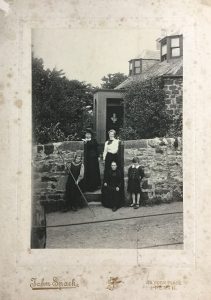
Anna Geddes, Miss Scott, Janet Cuthbertson, Norah and Alasdair Geddes at the garden gate of Mount Tabor cottage, Perth, c.1899 (Ref: Coll-1167/GFP)
Among the many wonderful family photographs there is an image by Perth photographer, John Spark, of Geddes’s wife, Anna and their children at the garden gate. The ivy has grown up and over the garden wall now and the garden itself is much more manicured. I found myself placing my hand on the garden wall beside the gate, wondering how many of the Geddes family had touched the same spot. And while I have never taken for granted the immediate and emotional connection to our past that archive collections can afford us, I was struck afresh by this new and very tangible connection to Patrick Geddes.
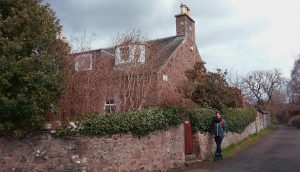
Project Archivist, Elaine MacGillivray, at the garden gate of childhood home of Patrick Geddes, the former Mount Tabor cottage, Perth, 2018.
I was able to experience first-hand much of the environment that informed Geddes’s understanding of place, ecology, botany and so much more and which was undoubtedly instrumental in the formulation of his geographical vision, the Valley Section. I reflected on how Geddes was able to perceive the inter-connectedness and inter-relationships of just about everything, fueled by his place of outlook from Kinnoull Hill. That interconnectedness and those interrelationships are so key to his ideas and beliefs that as archivists, we have a duty to find a way to reflect them through our archive finding aids and collections catalogues. But that’s a whole other blog post. The next time I lift my head and look out, I might write that.
Read more about Patrick Geddes and Perth in this blog post from Professor Murdo MacDonald
Find out more about Kinnoull Hill and Perthshire in the time of Geddes by viewing historical maps online via the National Library of Scotland and a little earlier in the 1845 Statistical Account for the Parish of Perth
Trial access to Practical Research and Academic Skills (video)

We have trial access until the 6th July to Practical Research and Academic Skills – a new streaming video collection available on the SAGE Research Methods website.
The videos cover key areas such as writing a research proposal, planning and designing a research project and securing ethical approval. Practical skills such as project management, writing for publication, presenting work, and building networks are also presented through helpful explanatory videos.
This video collection will give researchers the confidence to successfully navigate their research work, take responsibility for their professional development and identify the transferable skills they need to progress their careers.
A preliminary title list of the videos included in the collection can be found here and a link to our trial feedback form can be found here. Please complete a feedback form if you found these videos useful, your comments help support purchase decisions.
Further info
All of our current and historical trials can be found on the Trials Webpage.
New books in the Library for History, Classics and Archaeology
Thanks to recommendations from members of staff and requests via RAB from students the Library is continually adding new books to its collections both online and in print. Here are just a (very) small number of the books that have been added to the Library’s collections in semester two, 2017/18 for the School of History, Classics and Archaeology and these demonstrate the wide range of subjects being taught, studied and researched within School.
–> Find these and more via DiscoverEd.
 Ritual matters: material remains and ancient religion edited by Claudia Moser and Jennifer Knust (shelfmark: Folio BL808 Rit.)
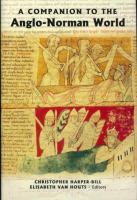
A companion to the Anglo-Norman world edited by Christopher Harper-Bill and Elisabeth van Houts (shelfmark: DA195 Com. Also available as e-book).
Jefferson: architect of American liberty by John B. Boles (shelfmark: E332 Bol.)
The Pacific war and its political legacies by Denny Roy (shelfmark: D767 Roy.)
Decolonizing the map: cartography from colony to nation edited by James R. Akerman (shelfmark: GA108.7 Dec. Also available as e-book). Read More
Law E-books – Hart 2018

We have purchased the Hart 2018 law e-book collection from Bloomsbury Publishing. We will add the 127 titles listed in this spreadsheet to DiscoverEd as records become available.
Further info
Our E-Book AZ list lists these books under Bloomsbury.
Public art walk – The fragment(ed) trail
The library museums volunteers Ellen Embleton and Tom Roeder recently explored some of the University’s public art dotted around its extended campus. In the first part of this series, they’re visiting 3 artworks around Bristo Square. With the warmer weather and the end of exams in sight, this free art walk is the perfect way to enjoy the spring while inviting inspiration. Ellen and Tom explain:
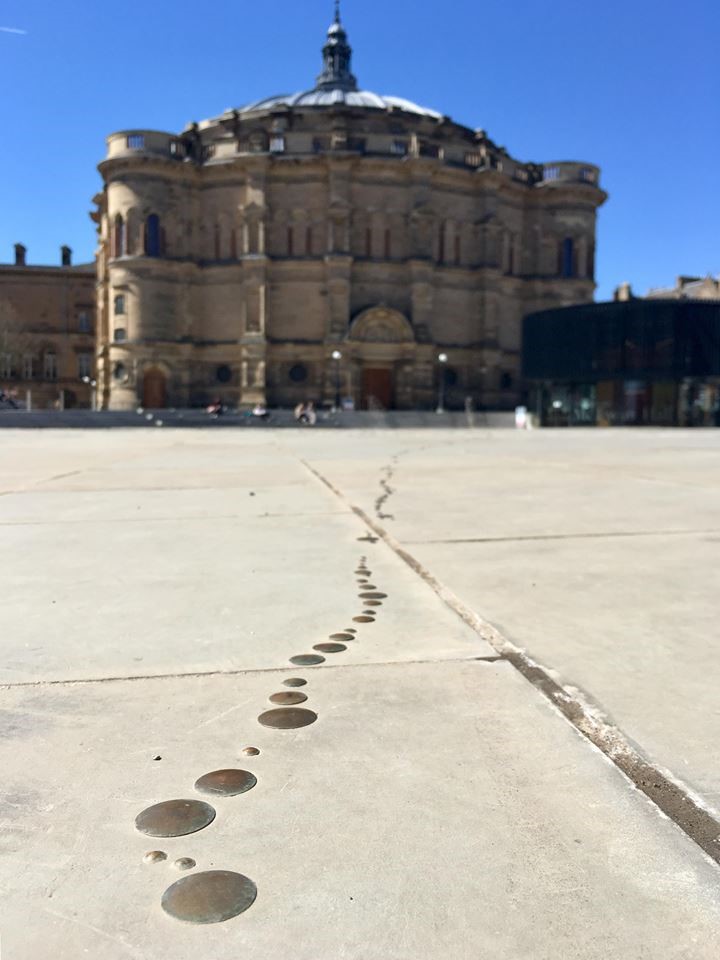
Have you ever noticed the bronze coloured drops on Bristo Square? They run from the entrance of McEwan Hall and trail off towards the other side. Maybe you have, but weren’t sure exactly what their story is? Well, neither were we. That is until we followed the library’s trail of art.
The trail consists of six artworks, all inspired by the main library’s 2017 exhibition – Shored Against Ruin: Fragments from the University Collections. By highlighting works that explore the concept of fragmentation, the trail hopes to extend the life of the exhibition beyond the gallery and blend it with the University’s surrounding environment. Here’s a little more information on three out of the six pieces you’ve no doubt come across.
The Next Big Thing is a Series of Little Things (2017) is the first piece on the trail. It was designed by Susan Collis, and invites visitors to follow the trail of someone who has seemingly just walked through Bristo with a leaking tin of bronze coloured paint. Deliberately unobtrusive, it adds a subtle but pretty cool artistic flourish to the revamped Square.
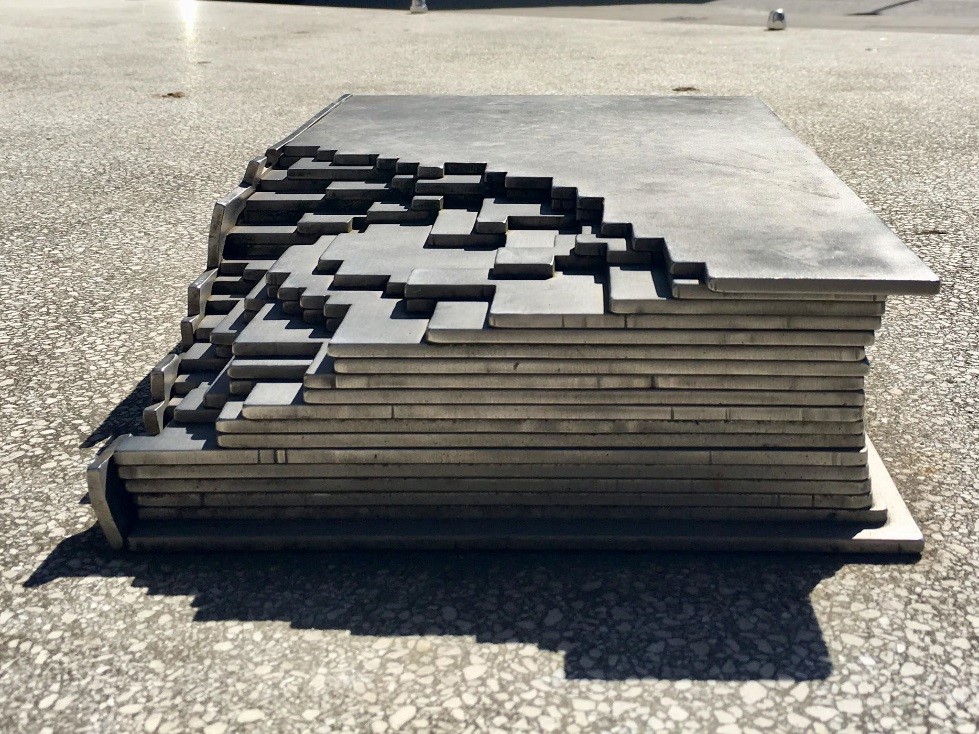
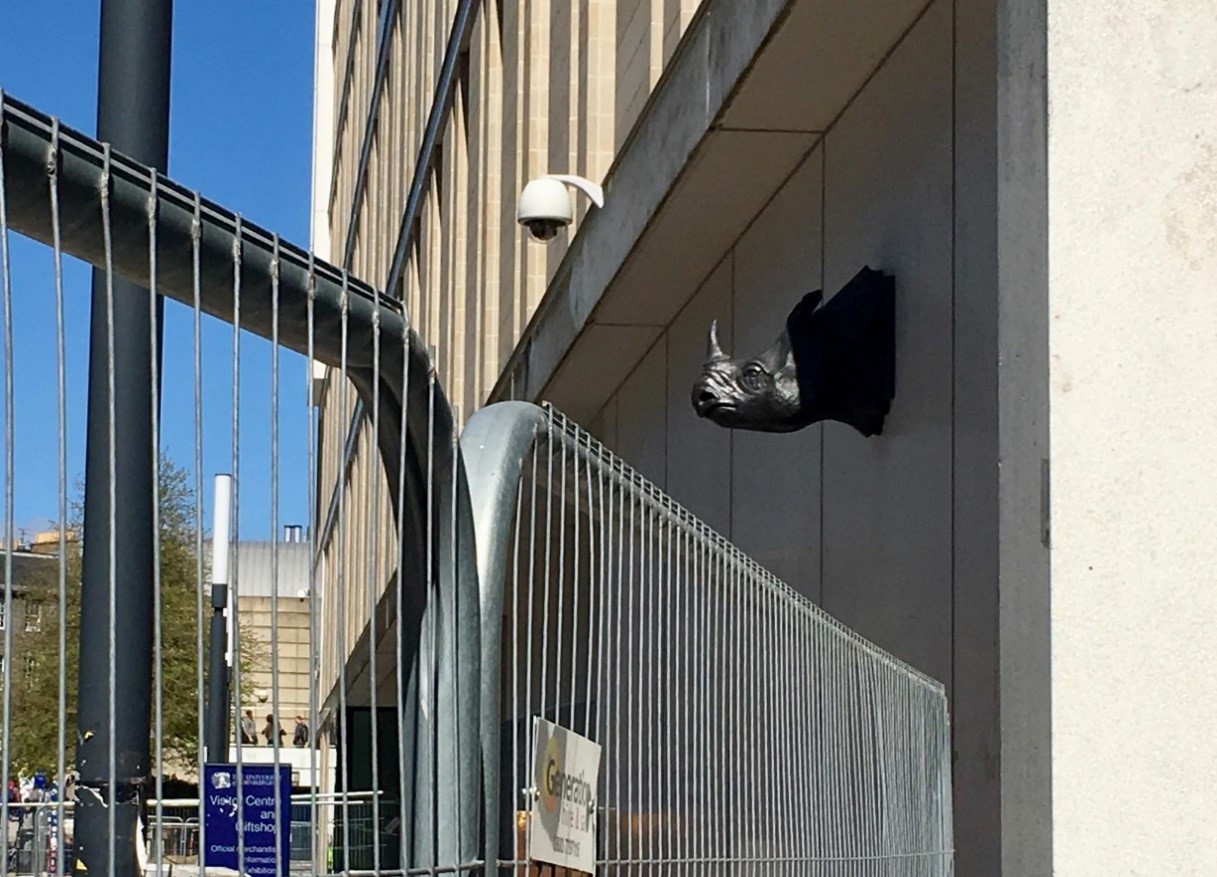
Bite/The Haynes Nano Stage (2012) was stop number two, just a short walk from Collis’ drips up Charles Street outside the School of Informatics. This is a stainless steel sculpture by Davy Forsyth. It is intended to celebrate the cultural richness of Jim Haynes’ 1960s Paperback Bookshop that once stood here, as well as commemorating the University’s merger with the College of Art. It was commissioned along with the nearby Untitled (Rhino Head) by William Darrell, something that we’ve all seen before but perhaps never understood…
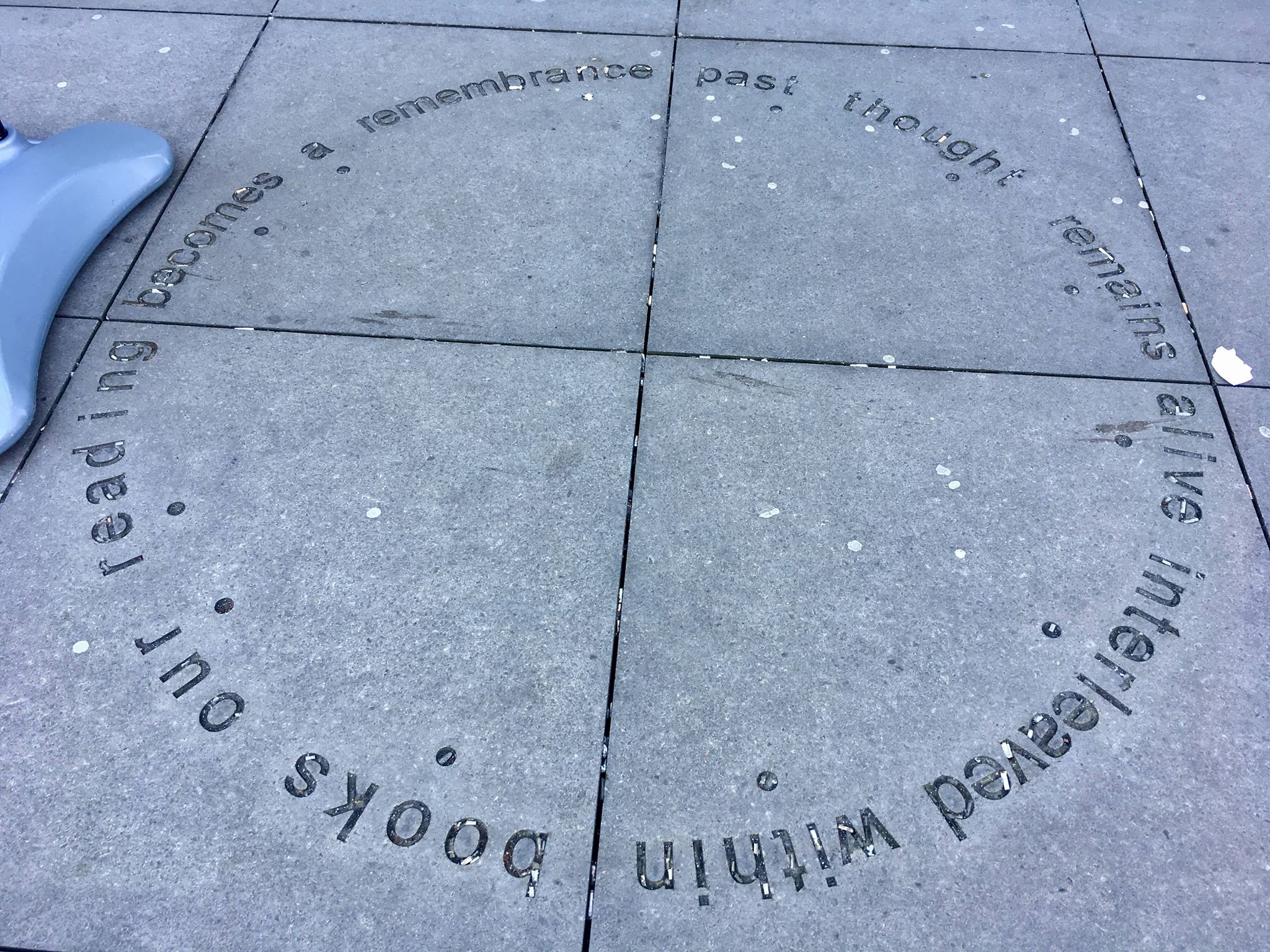
The third piece was Alec Finlay’s Mesostic Interleaved (2009), right outside the Main Library building on George Square. Finlay’s circular poem was commissioned by the University during renovations to the library in 2010. While you’ve probably walked over it thousands of times, and maybe even read it a hundred or so times, you may not have picked up on the embedded quote, “thair to remain”, signalled by the dots. This was taken from the will of the library’s first benefactor in 1580, who stated that his books were given to the library, “thair to remain” for safekeeping.
Watch this space for the next three artworks on the trail!
If you would like to visit these artworks and others, the university library’s Public Art Officer, Liv Laumenech, will be giving two free tours on International Museum Day – Friday 18th May. Spaces are limited (but free!) so book your tickets by 17th May to avoid disappointment.
Book your ticket to the New Art on Campus Walk n Talk event on EventBrite.

The University of Edinburgh’s Main Library is celebrating its 50th anniversary at George Square – where connections come alive. The library is currently creating an archive of current and former students and staff memories. Submit your memories via our website, Facebook or Twitter pages #UoElib50. Photos and videos are welcome!
Check out our current memories here in our interactive timeline.
Digital Resource trials for Biblical Studies and Jewish Studies May 2018
We have four new digital resource trials for Biblical Studies this month. They’re all accessible from the E-resource trials web page.
Brill’s Dead Sea Scrolls Electronic Library Non-Biblical Texts offers a unique opportunity to study state of the art photographs of these ancient scripts, and understand their meaning using the translations of text and interpretations for missing fragments
 Flavius Josephus Online is the first comprehensive literary-historical online commentary on the works of Flavius Josephus in English including the Greek text by Niese from the late 19th century. About 65% of the project is complete, consisting of Life, and Against Apion, book 2 of the Judean War, and books 1-11 and 15 of the Judean Antiquities.
 The Littman E-Library of Jewish Civilisation has over 30,000 pages of leading research in Jewish studies from Arthur Szyk: Artist, Jew, Pole to The Zohar: Reception and Impact. The LEJC includes international perspectives on Jewish civilization from scholars across the world, including the USA, Israel, Germany, Poland, and the UK.
 The Textual History of the Bible Online (THBO) is unique in providing, for the first time, a cross-searchable platform with all available information regarding the textual history, textual character, translation techniques, manuscripts, and the importance of each textual witness for each book of the Hebrew Bible, including its deutero-canonical scriptures. In addition, it includes articles on the history of research, the editorial histories of the Hebrew Bible, as well as other aspects of text-critical research and its auxiliary fields, such as papyrology, codicology, and linguistics.
You can access the trials at: https://www.ed.ac.uk/information-services/library-museum-gallery/finding-resources/library-databases/e-resources-trials (Scroll down the page a little to find the links).
Please let us know what you think! Feedback and usage data from trials like these supports our case to purchase them when funds are available.
Christine Love-Rodgers, Academic Support Librarian – Divinity
Admirable Geometry
This week’s guest blogger is Hannah DeWitt, from the University of Edinburgh, School of Languages, Literatures and Cultures.
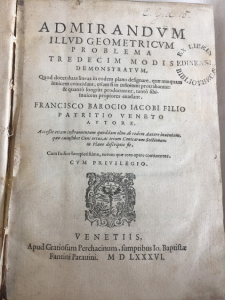
Francesco Barozzi, Admirandvm Illud Geometricum, (Venice: Apud Gratiosum Perchacinum, sumptibus Io. Baptistæ Fantini Patauini, [1586] (Edinburgh University Library *O.21.3 and *O.21.4)
This week’s look at Venetian Images encounters mathematical figures that have remarkable continuity with modern textbooks.
This text, Admirandum Illud Geometricum, was written by the influential Italian mathematician and astronomer Francesco Barozzi (1537-1604). Barozzi was born in Crete. He studied at the University of Padua and later lectured at the university. He is known for his efforts revive science and maths through re-examining the work of ancient mathematicians and philosophers. His work includes new interpretations and applications of ancient theories, particularly those of Euclid. Previous to Admirandum Illud Geometricum, Barozzi translated and added commentary to Euclid’s Elements in Procli Diadochi (1560). He also translated texts by Archimedes and Hero.
Barozzi led a tumultuous private life. At university, he was accused of taking someone’s hair without consent, an act that has been suggested to be linked with occult practices. Later in his life he was convicted by the Inquisition of an unknown charge. He was accused and tried for causing a terrible rainstorm in Crete. Eventually he was convicted and fined for sorcery. His translations of Nostradamus and interest in predictions contributed to his reputation for engaging in occult practices and his final conviction essentially ended his academic career.
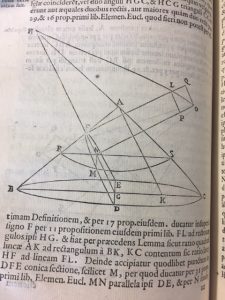
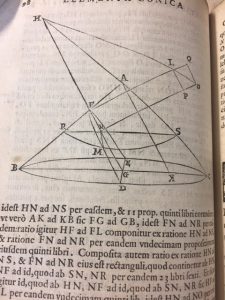
Admirandum Illud Geometricum is an exhaustive instructional text detailing thirteen different methods for producing parallel lines on a plane. While Barozzi more typically worked on translation or commentary, this work is original, though it does frequently reference ancient mathematicians and classical theories.
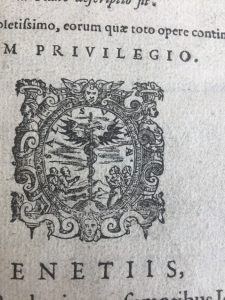
While the more interesting images are the mathematical figures, the title page printer’s device belonging to Gratioso Perchacino of Venice is worth mentioning. This woodcut of a winged serpent on a pole is most immediately associated with the caduceus, the staff of Hermes with two snakes and wings that is commonly misused to represent medical practices. The staff of Asclepius, the god of medicine, is meant to have one snake and no wings it the symbol which is appropriately meant to represent medicine. But as in the Barozzi image, it is often mixed with characteristics of the caduceus. Included in the device is “SALVS VITÆ” or “The Help of Life.” This phrase is frequently associated with the Roman goddess, Salus, the goddess of health and well-being.
.
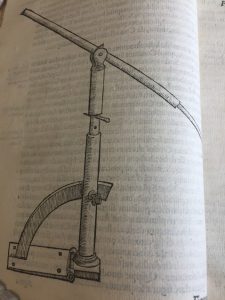
The most impressive images in the book are full page renderings of mathematical compasses. These are simple images with enough detail and exacting scale to elicit a startling recognition of similarities between and lack of change in the depicted compasses the modern versions of the same tool. It is also very likely that the exact dimensions of the woodcuts themselves were created by tracing the figures with similar tools.
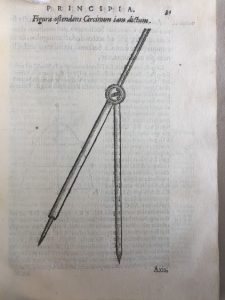
All other images in the text are mathematical diagrams. Some of the figures appear more than once, with identical figures appearing up to four times. The image below appears three times, but is made by two seperate woodcut blocks. It appears on two sides of one leaf and again on a leaf printed separately. In order to duplicate the images this way, the printing block would have needed to be painstakingly carved a second time. This suggests that the printer expected to print the images at least twice on the same side of the same sheet, but it wasn’t necessary. This effort emphasises the importance the author attributed to having the image visible for each point made about the diagram.This process is duplicated throughout the text, but the difference in these particular images is made obvious through an error. The first and third image were printed using a block with an error, a backwards ‘K,’while the second image is identical in scale and precise measurement, but has a correctly facing ‘K.’
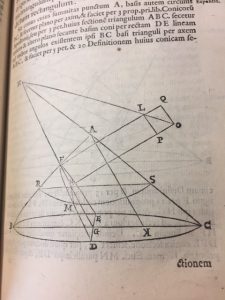
A second set of figures has a similar error. The three images appear on the same sheet in this instance, making the use of two blocks necessary. In these figures, a ‘N’ is inverted.
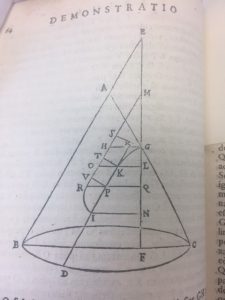
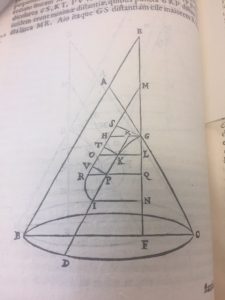
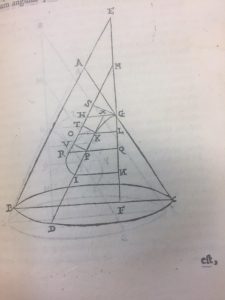
While a majority of the images had the lettering carved into the woodcut, a few used type. This can be seen in diagrams labeling the names of the shape.
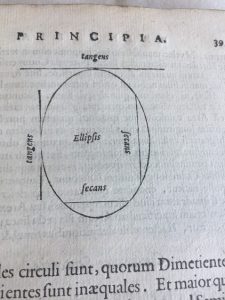
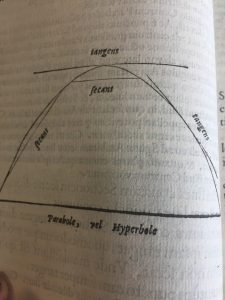
As the text progresses, the complicity of the figures and lessons increase. These more complex shapes frequently build on a simpler figure. In order to achieve the precision of these diagrams, the first image would have needed to be traced or carefully measured and redrawn before adding the new elements of the second, more complex printing block.
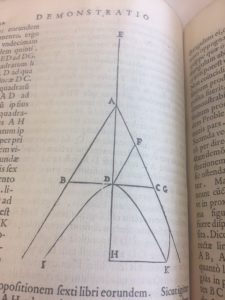
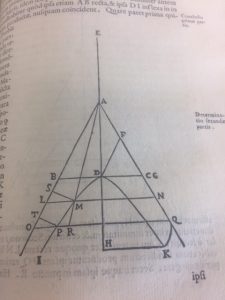
The variety and replication of the diagrams attest to Barozzi’s particular dedication to images as part of his teaching method.
Two copies of this edition of the book are owned by the University of Edinburgh. One is bound in a light vellum binding and the other in a dark, ornate leather binding. The first copy (*O.21.3) bears no indication of ownership previous to the university. It has an 18th century Edinburgh shelfmark suggesting that it arrived in the second half of the century.
The second copy (*O.21.4) is more expensively bound and is stamped with a gilded owner’s stamp belonging to Sir John Rivers, 1st Baronet, who died in 1651. Rivers’ books, with this memorable stamp are scattered among a number of libraries in the U.K. and U.S.A. The signature of a second owner, C Hutton 1785, can be found on a flyleaf. Hutton was Professor of Mathematics at the Royal Military Academy in Woolwich, and would have had an obvious interest in .
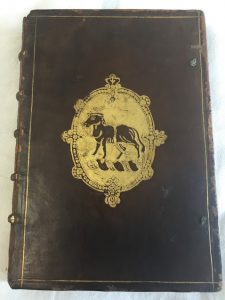
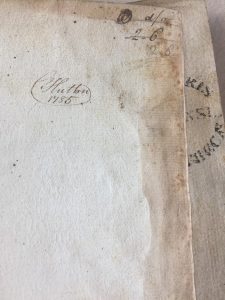
The precision and frequent duplication of images are unique to the care Barozzi shows in having this text printed. His dedication to what he believed was the superiority of mathematical certainty is evident in the attention to detail and effort placed in producing his diagrams.
Hannah DeWitt
University of Edinburgh
For references and further reading:
http://www-history.mcs.st-andrews.ac.uk/Biographies/Barocius.html
http://data.cervantesvirtual.com/manifestation/289947
https://www.british-history.ac.uk/no-series/court-of-chivalry/559-rivers-bowton
http://emlo-portal.bodleian.ox.ac.uk/collections/?catalogue=charles-hutton
New books in the Library for Social and Political Science
Thanks to recommendations from members of staff and requests via RAB from students the Library is continually adding new books to its collections both online and in print. Here are just a (very) small number of the books that have been added to the Library’s collections in semester two, 2017/18 for the School of Social and Political Science and these demonstrate the wide range of subjects being taught, studied and researched within School.
–> Find these and more via DiscoverEd.
 The politics of borders: sovereignty, security, and the citizen after 9/11 by Matthew Longo (shelfmark: JC323 Lon. Also available as e-book.)
Routledge Handbook of the Philosophy of Paternalism by Jason Hanna Kalle Grill (e-book).
The unending hunger: tracing women and food insecurity across borders by Megan A. Carney (shelfmark: JV6602 Car.)
Big data, little data, no data: scholarship in the networked world by Christine L. Borgman (e-book).
“Return” in post-colonial writing: a cultural labyrinth edited by Vera Mihailovich-Dickman (shelfmark: PR9085 Ret.)
Havens in a storm: the struggle for global tax regulation by J.C. Sharman (shelfmark: K4464.5 Sha.) Read More
Collections
 Hill and Adamson Collection: an insight into Edinburgh’s past
My name is Phoebe Kirkland, I am an MSc East Asian Studies student, and for...
Cataloguing the private papers of Archibald Hunter Campbell: A Journey Through Correspondence
My name is Pauline Vincent, I am a student in my last year of a...
Hill and Adamson Collection: an insight into Edinburgh’s past
My name is Phoebe Kirkland, I am an MSc East Asian Studies student, and for...
Cataloguing the private papers of Archibald Hunter Campbell: A Journey Through Correspondence
My name is Pauline Vincent, I am a student in my last year of a...
Projects
Cataloguing the private papers of Archibald Hunter Campbell: A Journey Through Correspondence
My name is Pauline Vincent, I am a student in my last year of a...
Archival Provenance Research Project: Lishan’s Experience
Presentation My name is Lishan Zou, I am a fourth year History and Politics student....