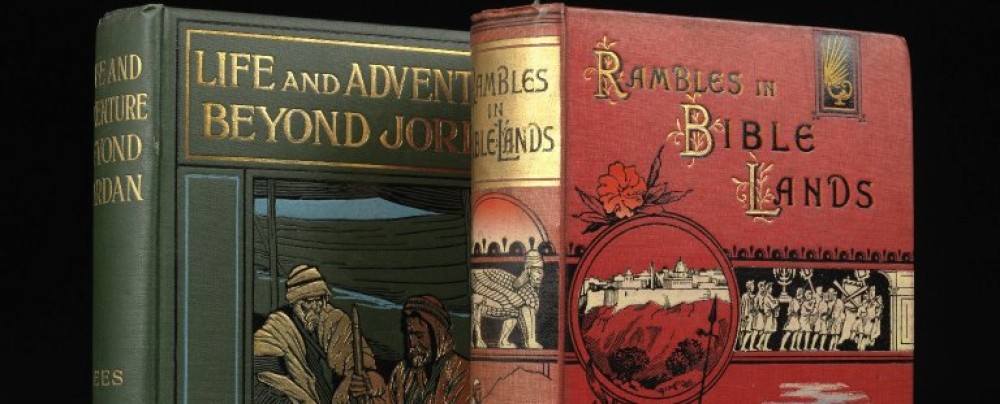

It all began with The Disruption. Not 2020’s lockdown but The Disruption of 1843 when ministers and elders left the Church of Scotland to set up the Free Church of Scotland. They started from scratch creating churches, manses, schools and a place to train and educate the new Free Church ministers: the New College. In June 1846 Rev Dr Thomas Chalmers, one of the leaders of The Disruption and New College’s first Principal laid the foundation stone.
To celebrate a remarkable 175 years, the School of Divinity planned an array of events including conferences, reunions, re-enactments and an online exhibition, much of which required access to the New College archives. Unfortunately research and planning coincided with the closure of New College Library for essential works so staff facilitated access to the archives at the Centre for Research Collections (CRC) instead: that was until the coronavirus lockdown which was quickly dubbed ‘the third Disruption’.
Throughout 2020, conversations continued with the School of Divinity team researching, planning and designing the online exhibition, with the Digital Imaging Unit, and with staff physically in the CRC. This allowed items to be selected for digitisation and incorporation into the 21st century telling of New College’s story: how a Capital landmark came to be; mischievous students helpers in the 1890s; one class’s 50 years of reunion memories; records of WWII air raids; changes to the campus; changes in diversity, and more.
Thanks are due to all the CAHSS, L&UC and USD staff who collaborated so well in such trying times to produce a fascinating exhibition.
Lose yourself in the online exhibition featuring remarkable historic photographs: https://exhibition.div.ed.ac.uk/
Follow the celebrations and join in: https://www.ed.ac.uk/divinity/news-events/new-college-175 :: https://twitter.com/uoedivinity :: #NewCollege175
Kirsty M Stewart, New College Collections Curator


 Flavius Josephus Online is the first comprehensive literary-historical online commentary on the works of Flavius Josephus in English including the Greek text by Niese from the late 19th century. About 65% of the project is complete, consisting of Life, and Against Apion, book 2 of the Judean War, and books 1-11 and 15 of the Judean Antiquities.
 The Littman E-Library of Jewish Civilisation has over 30,000 pages of leading research in Jewish studies from Arthur Szyk: Artist, Jew, Pole to The Zohar: Reception and Impact. The LEJC includes international perspectives on Jewish civilization from scholars across the world, including the USA, Israel, Germany, Poland, and the UK.
 The Textual History of the Bible Online (THBO) is unique in providing, for the first time, a cross-searchable platform with all available information regarding the textual history, textual character, translation techniques, manuscripts, and the importance of each textual witness for each book of the Hebrew Bible, including its deutero-canonical scriptures. In addition, it includes articles on the history of research, the editorial histories of the Hebrew Bible, as well as other aspects of text-critical research and its auxiliary fields, such as papyrology, codicology, and linguistics.

 A big welcome to all students starting and returning to the University of Edinburgh, at the beginning of Welcome Week 2016. We’re looking forward to meeting you. To help you get started with Library & IT services at the University, check out this ‘Useful Information for New Students’ page :

 China, Culture & Society