Keeping the faith in wartime

A short New College  Act of Remembrance will take place on Friday 9th November at 1pm at the War Memorial in the corridor leading to the Assembly Hall.
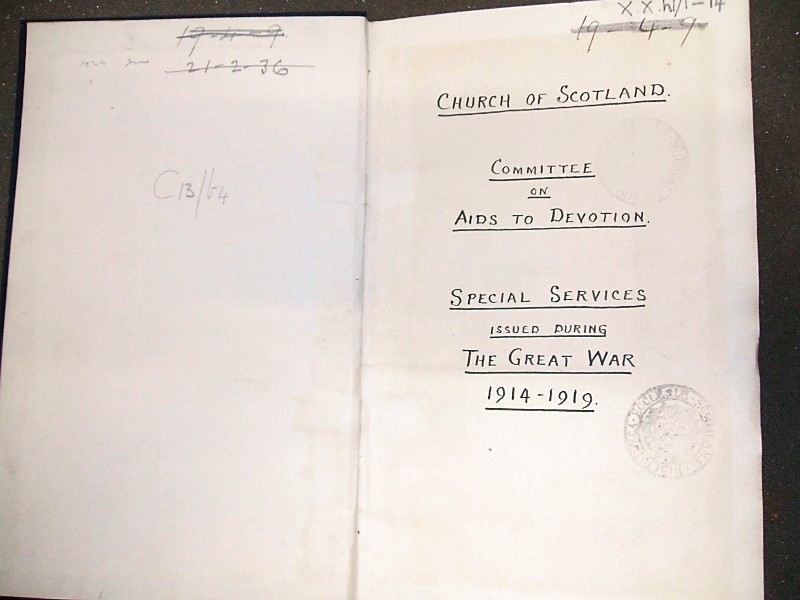
Church of Scotland – Committee on Aids to Devotion. Special Services issued during the Great War 1914-1919. New College Library Pamphlets Collection X.X.h.1.1-14

This item from New College Library’s Pamphlets Collections was recently catalogued as part of the Funk Cataloguing Projects. It is a collection of Church orders of services and guides for public prayer in a family or school setting. All the pamphlets date from the First World War Period, ending with a form of Divine service for Remembrance Day on the eleventh of November.The pamphlets and their binding are flimsy and utilitarian but their content bears witness to the cost of war for those at home as well as those out on the front.

Pamphlet X.X.h. 1/2 Form of prayer for schools in time of war, includes the text:

“Throw the shield of Thy protection over all who have gone forth to fight our battles by land or sea or air. We especially remember those near and dear to ourselves.”
The Bible on Film – Film Industry magazines on trial now

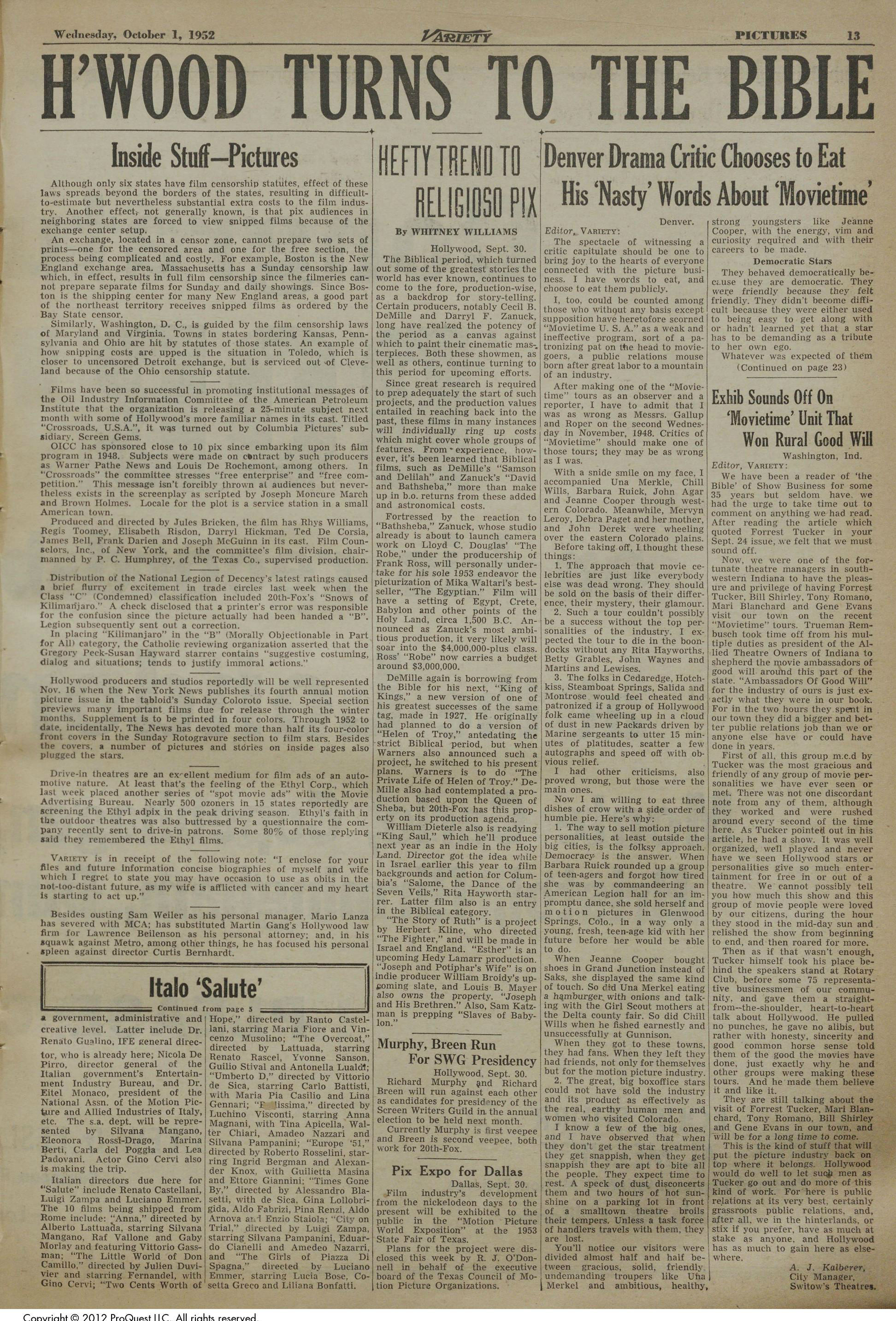
On trial now for University of Edinburgh users is the Entertainment Industry Magazine Archive from ProQuest. This archival research resource contains the core US and UK trade magazines covering film, music, broadcasting and theatre, together with film fan magazines and music press titles. Magazines have been scanned cover-to-cover with  indexing of all articles, covers, ads and reviews.

This article by Whitney Williams from Variety Magazine Wednesday October 1, 1952, features the plans by Hollywood director Cecil B. de Mille to make another ‘King of Kings’ epic, and William Dieterle is reported as planning to make ‘King Saul’.

University of Edinburgh users can access the trial on the E-resources trials page.

The trial ends on 27 November.

New books at New College Library – November

A new title that has gone straight to the shelves is Religion and the news, edited by Jolyon Mitchell and Owen Gower. Newly published this October, two copies of this book were acquired in support of a number of undergraduate and postgraduate Divinity courses on religion, contemporary culture and the media. One copy can be found in the Reserve Section and one in Standard loan at PN4756 Rel.

New College Library also  has a regular display of new books at the far end of the Library Hall, close to the door to the stacks.You can see an regularly updated list of new books for New College Library on the Library Catalogue – choose the New Books Search and limit your search to New College Library. Here’s a quick link to new books arriving in the last few weeks. A word of caution – some of the books listed here may still be in transit between the Main Library (where they are catalogued) and New College Library, so not on the shelf just yet.

The ghosts on the shelves

It’s difficult to walk around Stack III, the rare books stack of New College Library, without feeling the weight of history. On these shelves Tyndale rubs shoulders with Calvin, and fifteenth century incunabula are a few steps away from nineteenth century treatises on religion and science. So many of these texts are witnesses of strongly held beliefs, beliefs that changed the religious and the political landscapes of their day. In addition to these historic voices, we can also find the ghosts of former owners and former libraries that have been donated and absorbed into New College Library. Many rare books are inscribed by their owners, and often  a succession of owners.

As new books join the ranks on the shelves in New College Library,  and are borrowed, read and absorbed into learning, they join in the community of the written word that makes up a library and enter the conversation of scholarship that was begun by the generations before. In the minds of the scholars and students these voices from the past are still watchful, possibly censorious, always listening and still alive.

From Greek to Gaelic

Just over 400 items which together form the Gaelic Collections at New College Library have now been catalogued online and their details can now be browsed online using the shelfmark “Gaelic Coll.”  This collection of monographs and pamphlets was put together from various sources, including thirty nine books from the bequest of the Rev. Roderick Macleod.

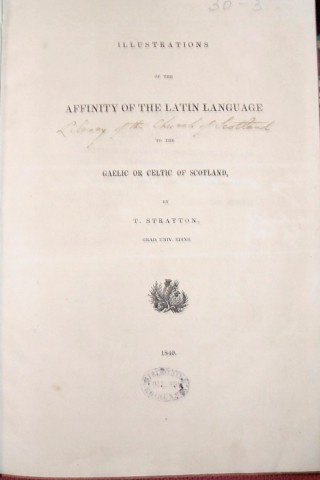
A contender for the oddest item in New College Library’s Gaelic Collections are a series of works by Thomas Stratton trying to prove the Celtic source of Latin and Greek, including “Proofs of the Celtic origin of a great part of the Greek language”. 1840 ; Gaelic Coll 213 and  “Illustrations of the affinity of the Latin language to the Gaelic or Celtic of Scotland”. 1840 Gaelic Coll 213. This copy has a handwritten inscription identifying it as previously belonging to the Library of the Church of Scotland.

With thanks to Patrick Murray, our Gaelic Cataloguer, for supplying details of this item.

Gaelic hymns from the Highlands

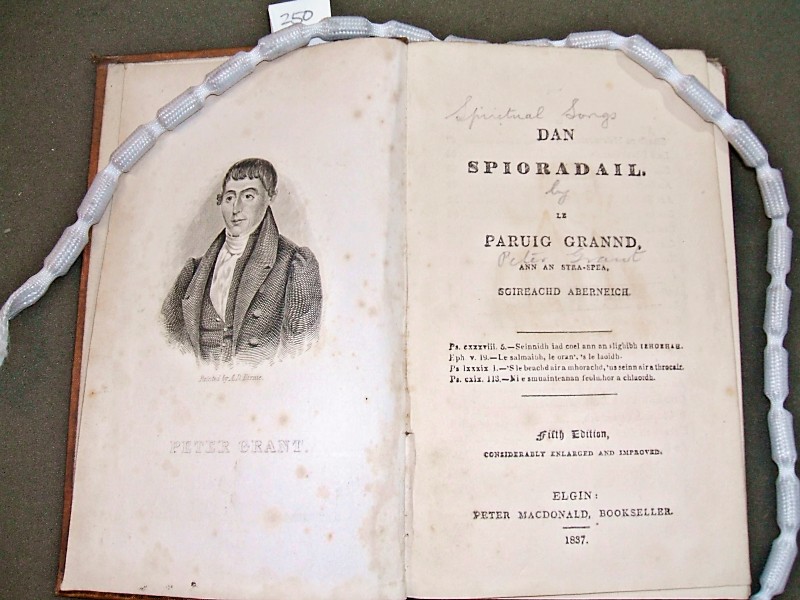
Grant, Peter. Dain spioradail. Elgin : Peter Macdonald, bookseller, 1837. New College Library Gaelic Collections 250.

New College Library’s recently catalogued Gaelic Collections contain several editions of  “Dain spioradail ” by the celebrated hymn writer Peter Grant.

This edition at Gaelic Coll. 250  is the fifth edition, considerably enlarged and improved from earlier editions. It was published in Elgin, in the highlands of Scotland.

The title page information refers to Grant’s Gaelic name Pàdraig Grannd nan Òran, which means ‘Peter Grant of the songs’. Grant was a Baptist minister, born on 30 January 1783 at Ballintua, Strathspey, Scotland. He was a skilled fiddle player, who was able to set his poems on evangelical themes to well known tunes which were popular into the twentieth century.  This work is typical of the works in the Gaelic Collection, which contains many volumes of religious poetry.

With thanks to Patrick Murray, our Gaelic Cataloguer, for supplying details of this item.

Bagpipe music of the Isles

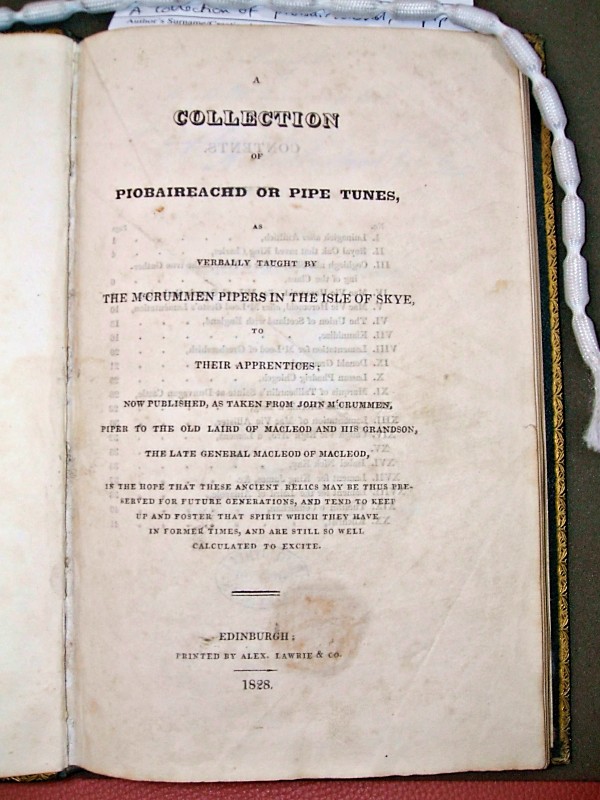
A collection of piobaireachd, or pipe tunes : as verbally taught by the M’Crummen pipers in the Isle of Skye to their apprentices / now published, as taken from John M’Crummen … [by Neil MacLeod, Gesto]. Edinburgh : Printed by Alex. Lawrie & Co., 1828. New College Library Gaelic Collections 137

I’m delighted to announce that just over 400 items which together form the Gaelic Collections at New College Library have now been catalogued online and their details can now be browsed online using the shelfmark “Gaelic Coll.”

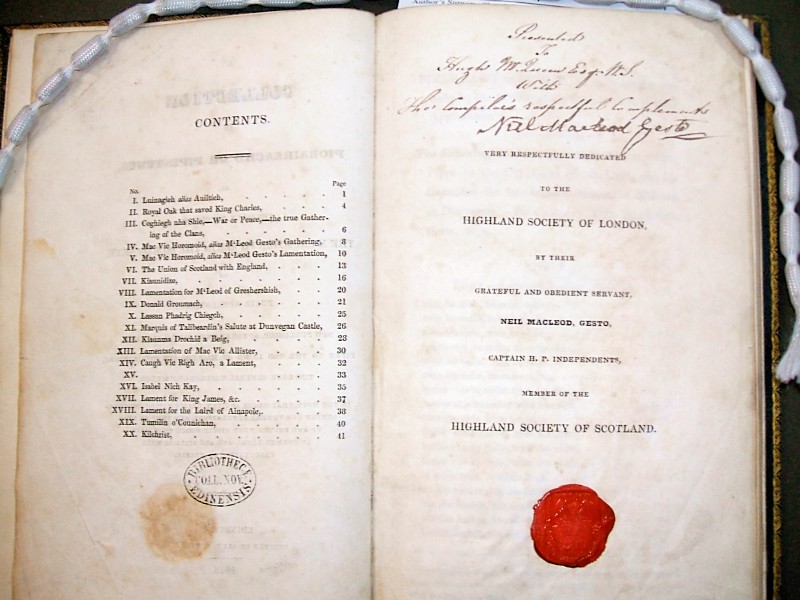
One particularly interesting and unique item in New College Library’s Gaelic Collections  is an instruction book on the bagpipe  (in Gaelic Pibroch, or, Ceol mor, or, literally, Big music). Entitled “A collection of piobaireachd, or pipe tunes”  it  includes ” Canntaireachd notation” which was a way of teaching pibroch using verbal sounds.

At first sight this looks like a collection of texts, but is actually music in the traditional ‘verbal notation’ that pipers used. It was published by Captain Niel MacLeod of Gesto, in Skye and  it has a handwritten dedication to Hugh MacQueen, a Writer to the Signet.

With thanks to Patrick Murray, our Gaelic Cataloguer, for supplying details of this item.

A puzzle of Presbyterian history

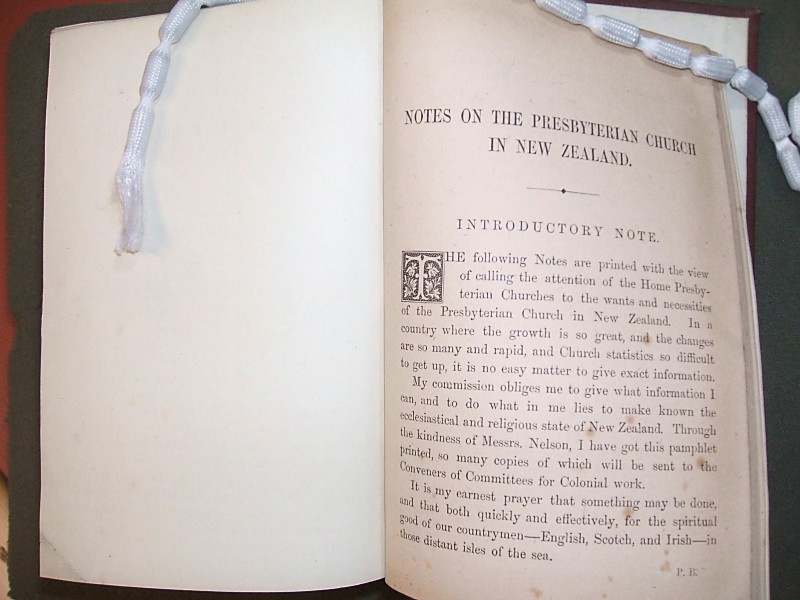
Notes on the Presbyterian church in New Zealand. By P. B., fl. ca 1860. New College Library – Special Collections. P.f.14/24

Today the School of  Divinity welcomes Dr Hugh Morrison, a visiting Fellow from Otago, who is speaking at the World Christianity Research Seminar on “Doing religious history ‘down under:’ challenges and opportunities in the New Zealand context.”

A recent challenge for the the Funk Cataloguing Projects here at New College Library was this nineteenth century pamphlet, “Notes on the Presbyterian Church in New Zealand”. Little is known about this item or its author, P.B. From clues within the pamphlet we have garnered that the writer was active in the 1860s and the item was probably published in Scotland.

The union catalogue of UK research libraries, COPAC, lists New College Library as the only known location in the UK for this pamphlet

Biblical reflections of Christina Rossetti

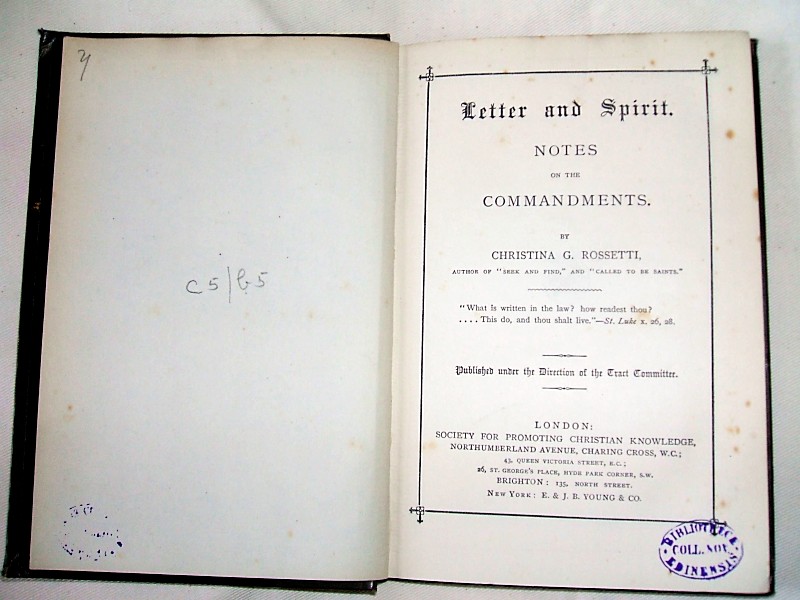
Letter and Spirit : notes on the Commandments. Christina Rossetti, London : Society for Promoting Christian Knowledge, [1883]. New College Library, Unclassified Sequence, C5/b5

At this week’s Biblical Studies Research Seminar in the School of Divinity, the speaker is  Dr Alison Jack,  on“Reading the Parable of the Prodigal Son with Christina Rossetti”.

Down in the depths of New College Library’s Stack II, I found this slim volume by Christina Rossetti, Letter and Spirit, or, Notes on the Commandments.

Although better known in the twentieth century for her poetry such as Goblin Market and A Birthday, and for her associations with the Pre-Raphaelite group of painters and writers,  in her later life Christina Rossetti also produced more sombre devotional writings.

Early twentieth-century Christianity in Korea

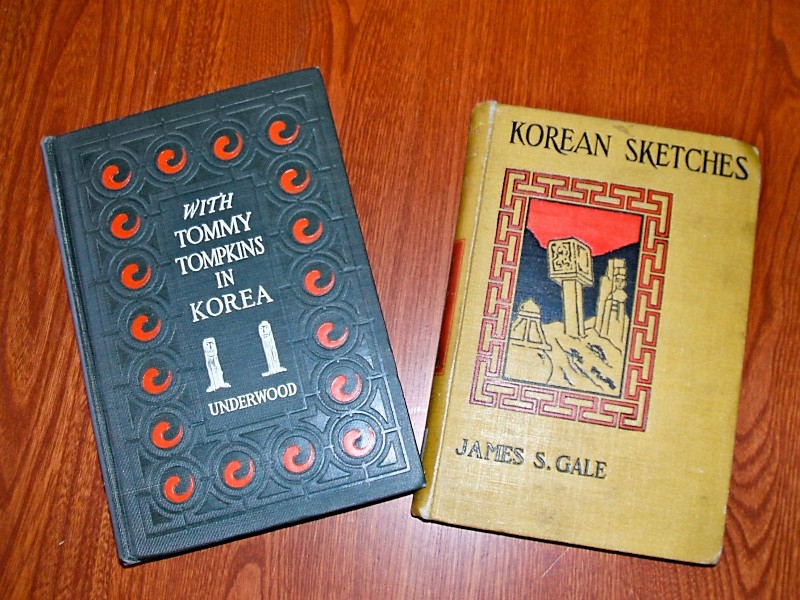
With Tommy Tompkins in Korea by Lillian H. Underwood, (Edinburgh 1905). New College Library sMS1 UND
Korean Sketches by Rev. James S. Gale, of the American Presbyterian Mission, Wunsan, Korea. sMS 1 GAL

The School of Divinity’s World Christianity seminar series  continues with  “No Neutrality for Brutality”: The Missionary Position on Indigenous Resistance Movements in Colonial Korea, 1910-1919 by Han Kang-Hee.

These two books from New College Library’s stacks give us contemporary views of Korea by missionaries, and describe their engagement  – or otherwise – with Korean culture.

With Tommy Tompkins in Korea by Lillian H. Underwood is an attempt to describe the everyday life of a Western boy living in Korea “… Hoping that this book may serve to show the contrast, between the family of a happy little western boy, and the poor children born in the dark, so that the hearts of the readers may ask, “How can this be changed?”

Korean Sketches by Rev. James S. Gale, aims to give an idea of the Korean life and character, and is well illustrated with photographs and drawings. The original publishers’s flyer still in the book describes it as “A Missionary’s Observations in the Hermit Nation”.