Psalms for St Cecilia’s Day

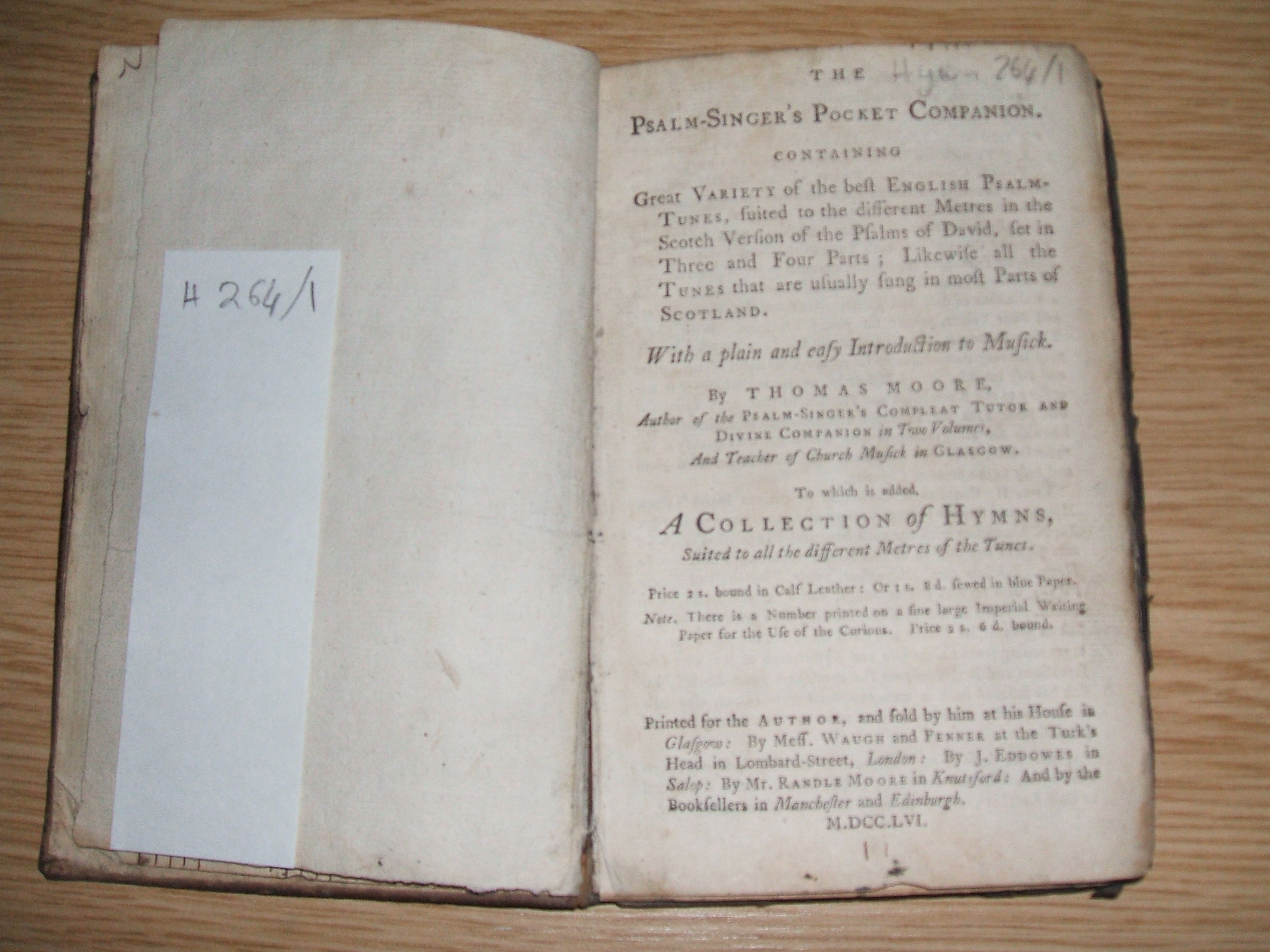
Moore, Thomas “Psalm singers’ pocket companion”, Glasgow 1756. Hymn 264/1

The feast of St Cecilia’s Day is traditionally celebrated on November 22nd.  A 3rd century martyr, St Cecilia is known as the patron saint of musicians. Her legend relates that, as a young Christian,  she was betrothed to a pagan but she had already vowed her virginity to God. As the organs played at at her wedding feast, Cecilia sang (in her heart) to the Lord, asking that her heart remain pure.

Here’s a book of Psalms to remember her by. Thomas Moore’s Psalm singers’ pocket companion is a publication from the revival era known as Gallery Psalmody, where leading singers and choir were located in a loft of the church. The new style lasted for about a century from 1755, and its main features were choirs singing in harmony of usually three parts, with some solo sections. Thomas Moore (- d. 1792) was a music teacher from Manchester Cathedral who came to Glasgow to teach singing.
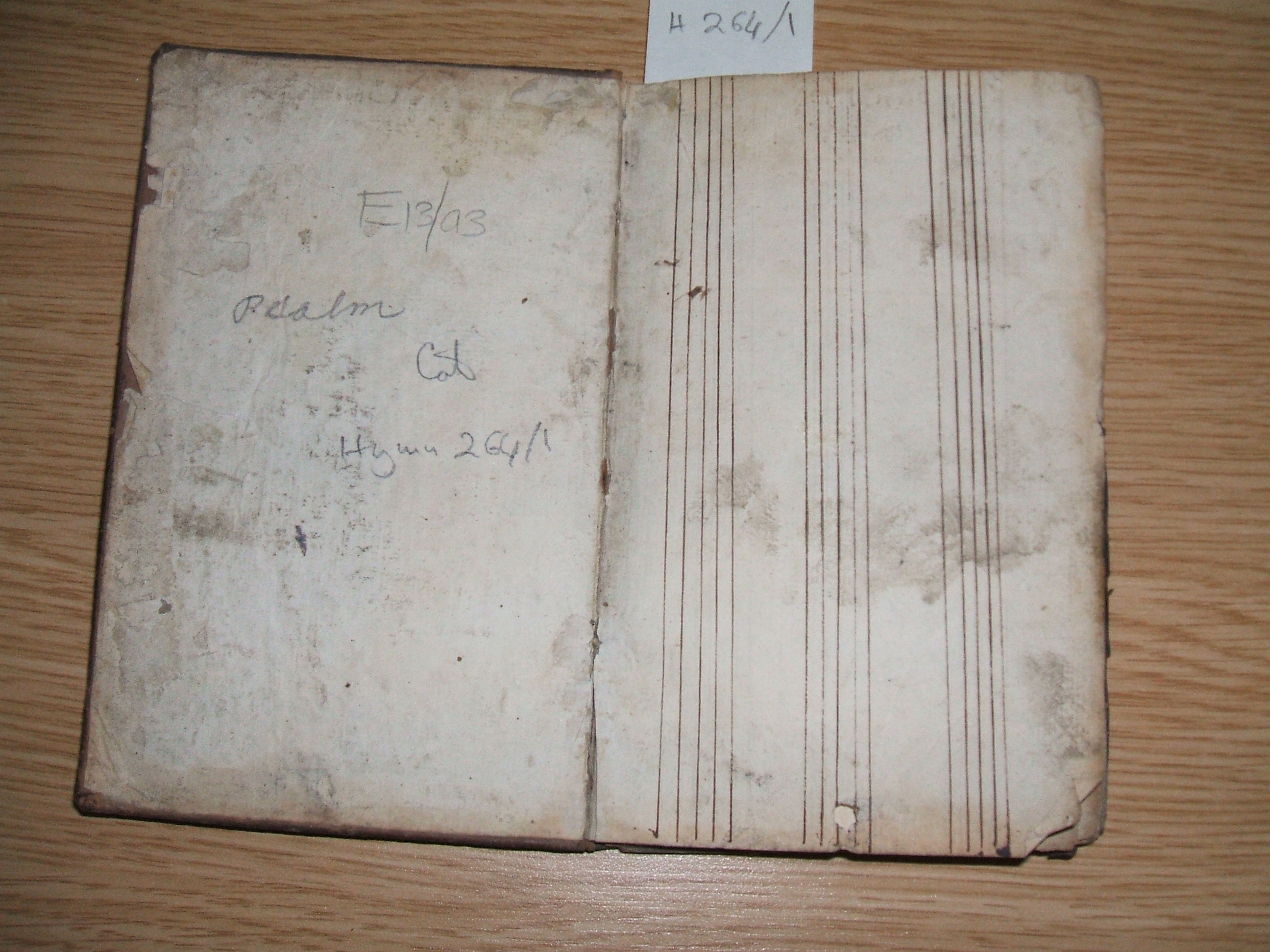
This item is small, or pocket sized, and contains a number of manuscript doodles which may testify to the singer’s mind wandering elsewhere. Also interesting are the pages of handwritten music staves, perhaps to allow the singer to make notes of new tunes or harmonies.

The Psalm singers’ pocket companion belongs to the Hymnology Collection, and was catalogued as part of the Funk Cataloguing Projects. With thanks to our Project Cataloguer, Oreste de Tommaso, for supplying details of this item.

New College Library image collections online

I’m very pleased to be able to tell you that over 200 images from New College Library’s collections are now available online through the University of Edinburgh Image Collections database.

The collection includes images from some of New College Library’s iconic items such as the first edition of Calvin’s Institutes of Religion (1536) and the manuscript of Covenanter James Renwick’s last speech in 1688.

This is a growing collection, as New College Library items catalogued as part of the Funk cataloguing projects which are found to be unique on ESTC are being photographed and their images added to the database.

New College Library’s earliest Bible

Novum Testamentum Graece, Strassburg 1524. New College Library B.r.316.

This Greek New Testament Novum Testamentum Graece, is the earliest Bible held at New College Library.

It was printed in Strassburg in 1524, and in his preface the printer speaks of this edition as the first fruits of his Strassburg press. Combined with the same printer’s Greek Old Testament of 1526 it  forms a complete Bible, but this New Testament appears to have been first issued separately.

This New Testament was published in Strassburg during the period that Protestant reformer Martin Bucer was active there. Bucer was part of a significant group of reformers including Matthew Zell and Wolfgang Capito, and he corresponded with the theologians Martin Luther and Huldrych Zwingli. During his time in Strassburg he is known to have taught classes on books of the Bible so may have used a Greek Testament like this one.

This copy has a number of manuscript inscriptions testifying to its former ownership and a printed book plate from James Walker, Christ Church. It is likely to have been donated to New College Library in the early years of its foundation. Part of the Early Bibles Collection, it was catalogued as part of the Funk Cataloguing Projects here at New College Library.

With thanks to our Rare Books cataloguer Finlay West for supplying details of this item.

Keeping the faith in wartime

A short New College  Act of Remembrance will take place on Friday 9th November at 1pm at the War Memorial in the corridor leading to the Assembly Hall.

Church of Scotland – Committee on Aids to Devotion. Special Services issued during the Great War 1914-1919. New College Library Pamphlets Collection X.X.h.1.1-14

This item from New College Library’s Pamphlets Collections was recently catalogued as part of the Funk Cataloguing Projects. It is a collection of Church orders of services and guides for public prayer in a family or school setting. All the pamphlets date from the First World War Period, ending with a form of Divine service for Remembrance Day on the eleventh of November.The pamphlets and their binding are flimsy and utilitarian but their content bears witness to the cost of war for those at home as well as those out on the front.

Pamphlet X.X.h. 1/2 Form of prayer for schools in time of war, includes the text:

“Throw the shield of Thy protection over all who have gone forth to fight our battles by land or sea or air. We especially remember those near and dear to ourselves.”

The ghosts on the shelves

It’s difficult to walk around Stack III, the rare books stack of New College Library, without feeling the weight of history. On these shelves Tyndale rubs shoulders with Calvin, and fifteenth century incunabula are a few steps away from nineteenth century treatises on religion and science. So many of these texts are witnesses of strongly held beliefs, beliefs that changed the religious and the political landscapes of their day. In addition to these historic voices, we can also find the ghosts of former owners and former libraries that have been donated and absorbed into New College Library. Many rare books are inscribed by their owners, and often  a succession of owners.

As new books join the ranks on the shelves in New College Library,  and are borrowed, read and absorbed into learning, they join in the community of the written word that makes up a library and enter the conversation of scholarship that was begun by the generations before. In the minds of the scholars and students these voices from the past are still watchful, possibly censorious, always listening and still alive.

From Greek to Gaelic

Just over 400 items which together form the Gaelic Collections at New College Library have now been catalogued online and their details can now be browsed online using the shelfmark “Gaelic Coll.”  This collection of monographs and pamphlets was put together from various sources, including thirty nine books from the bequest of the Rev. Roderick Macleod.

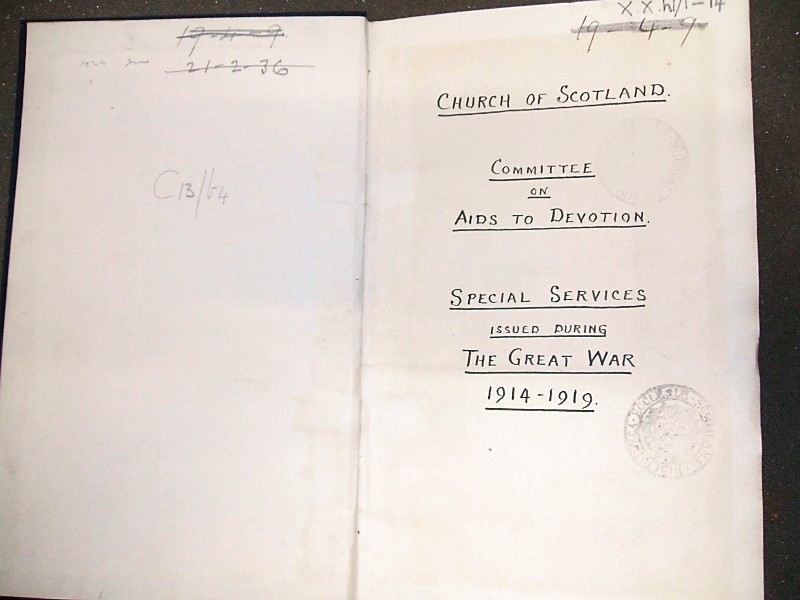
A contender for the oddest item in New College Library’s Gaelic Collections are a series of works by Thomas Stratton trying to prove the Celtic source of Latin and Greek, including “Proofs of the Celtic origin of a great part of the Greek language”. 1840 ; Gaelic Coll 213 and  “Illustrations of the affinity of the Latin language to the Gaelic or Celtic of Scotland”. 1840 Gaelic Coll 213. This copy has a handwritten inscription identifying it as previously belonging to the Library of the Church of Scotland.

With thanks to Patrick Murray, our Gaelic Cataloguer, for supplying details of this item.
Gaelic hymns from the Highlands

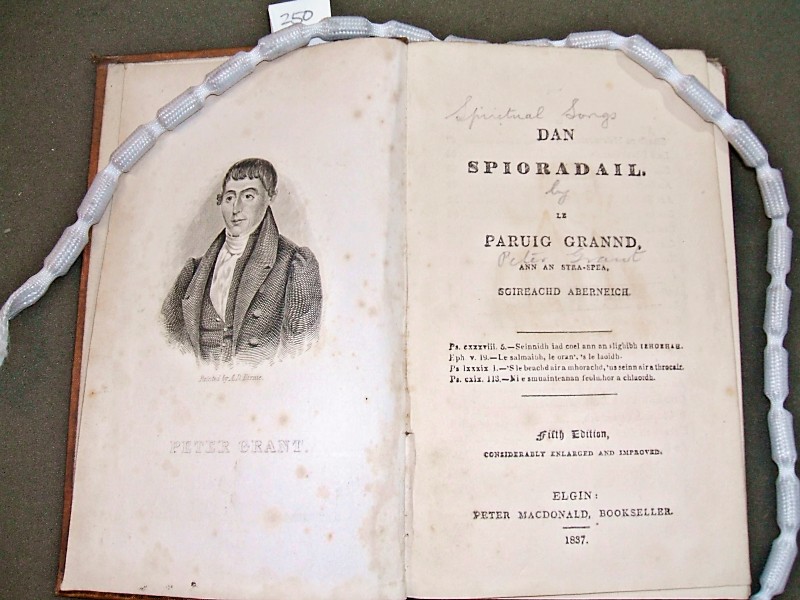
Grant, Peter. Dain spioradail. Elgin : Peter Macdonald, bookseller, 1837. New College Library Gaelic Collections 250.

New College Library’s recently catalogued Gaelic Collections contain several editions of  “Dain spioradail ” by the celebrated hymn writer Peter Grant.

This edition at Gaelic Coll. 250  is the fifth edition, considerably enlarged and improved from earlier editions. It was published in Elgin, in the highlands of Scotland.

The title page information refers to Grant’s Gaelic name Pàdraig Grannd nan Òran, which means ‘Peter Grant of the songs’. Grant was a Baptist minister, born on 30 January 1783 at Ballintua, Strathspey, Scotland. He was a skilled fiddle player, who was able to set his poems on evangelical themes to well known tunes which were popular into the twentieth century.  This work is typical of the works in the Gaelic Collection, which contains many volumes of religious poetry.

With thanks to Patrick Murray, our Gaelic Cataloguer, for supplying details of this item.

Bagpipe music of the Isles

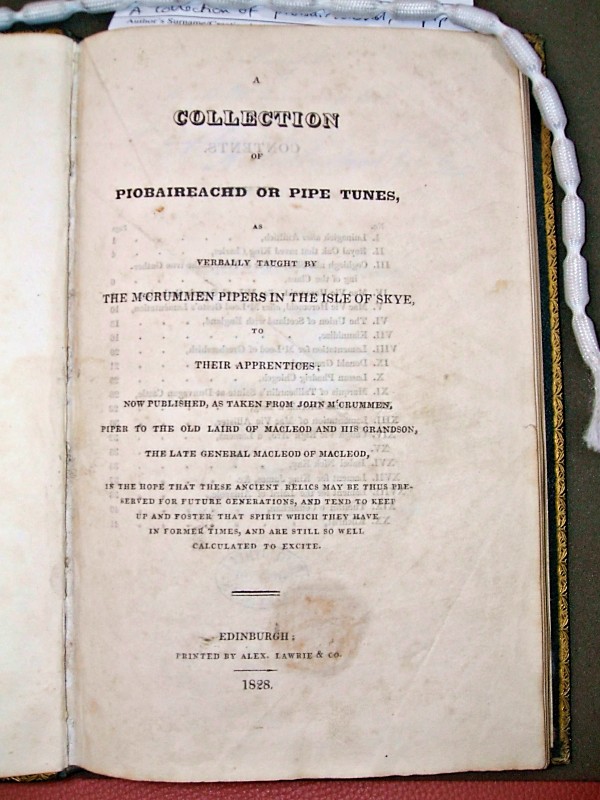
A collection of piobaireachd, or pipe tunes : as verbally taught by the M’Crummen pipers in the Isle of Skye to their apprentices / now published, as taken from John M’Crummen … [by Neil MacLeod, Gesto]. Edinburgh : Printed by Alex. Lawrie & Co., 1828. New College Library Gaelic Collections 137

I’m delighted to announce that just over 400 items which together form the Gaelic Collections at New College Library have now been catalogued online and their details can now be browsed online using the shelfmark “Gaelic Coll.”

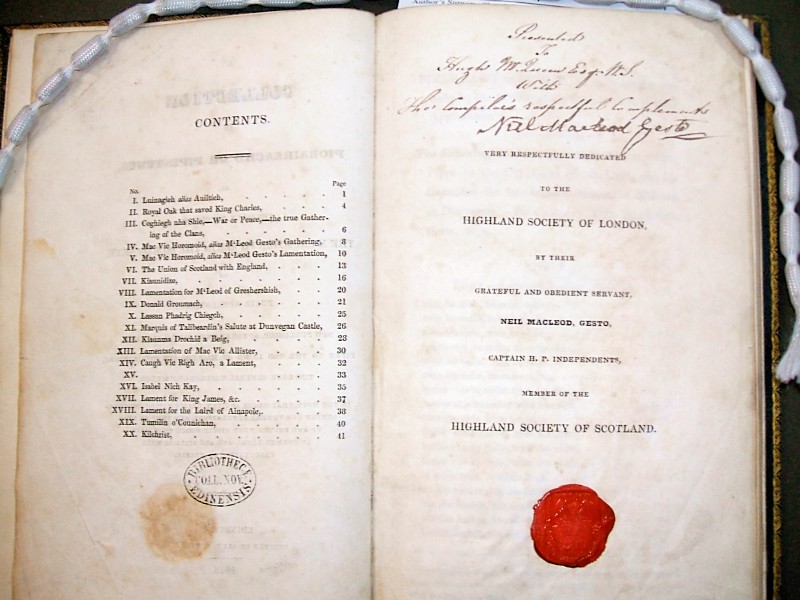
One particularly interesting and unique item in New College Library’s Gaelic Collections  is an instruction book on the bagpipe  (in Gaelic Pibroch, or, Ceol mor, or, literally, Big music). Entitled “A collection of piobaireachd, or pipe tunes”  it  includes ” Canntaireachd notation” which was a way of teaching pibroch using verbal sounds.

At first sight this looks like a collection of texts, but is actually music in the traditional ‘verbal notation’ that pipers used. It was published by Captain Niel MacLeod of Gesto, in Skye and  it has a handwritten dedication to Hugh MacQueen, a Writer to the Signet.

With thanks to Patrick Murray, our Gaelic Cataloguer, for supplying details of this item.
A puzzle of Presbyterian history

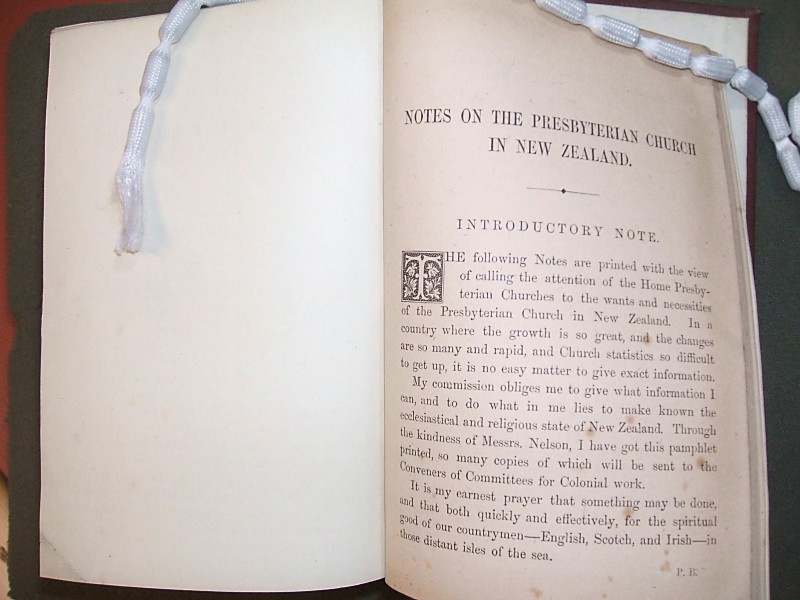
Notes on the Presbyterian church in New Zealand. By P. B., fl. ca 1860. New College Library – Special Collections. P.f.14/24

Today the School of  Divinity welcomes Dr Hugh Morrison, a visiting Fellow from Otago, who is speaking at the World Christianity Research Seminar on “Doing religious history ‘down under:’ challenges and opportunities in the New Zealand context.”

A recent challenge for the the Funk Cataloguing Projects here at New College Library was this nineteenth century pamphlet, “Notes on the Presbyterian Church in New Zealand”. Little is known about this item or its author, P.B. From clues within the pamphlet we have garnered that the writer was active in the 1860s and the item was probably published in Scotland.

The union catalogue of UK research libraries, COPAC, lists New College Library as the only known location in the UK for this pamphlet

Happy Birthday New College Library

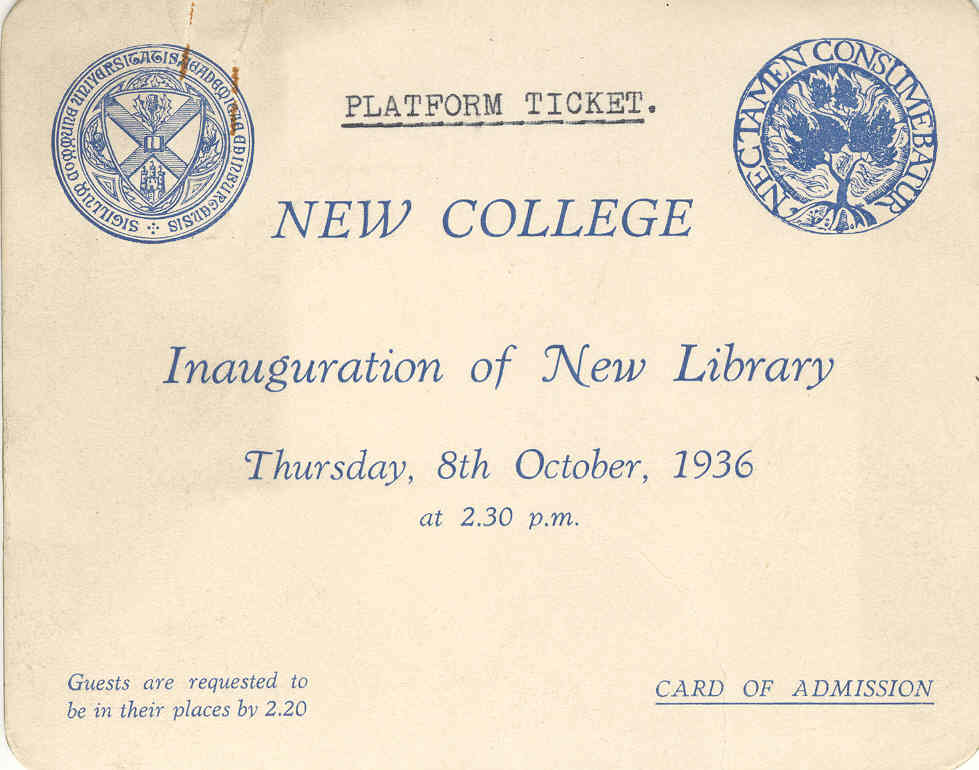
Seventy six years ago on the 8th of October, New College Library, Edinburgh, was formally opened to students and staff in its current building, the former Free High Kirk. The earth under the church floor had been excavated to allow the three stackrooms below the Library Hall.

The New College Archive preserves this original admission ticket to the inauguration ceremony, as it also preserves the suggestions books, committee minutes and account books of the business of New College Library since its foundation back in the 1840s.  The ticket bears the arms of Edinburgh University on the left and the Church of Scotland’s burning bush emblem on the right. This represents the union which had been effected in  January 1935 of the Church of Scotland’s  New College with the University’s Faculty of Divinity in the New College building.