Science and religion : a natural history #ILW2013

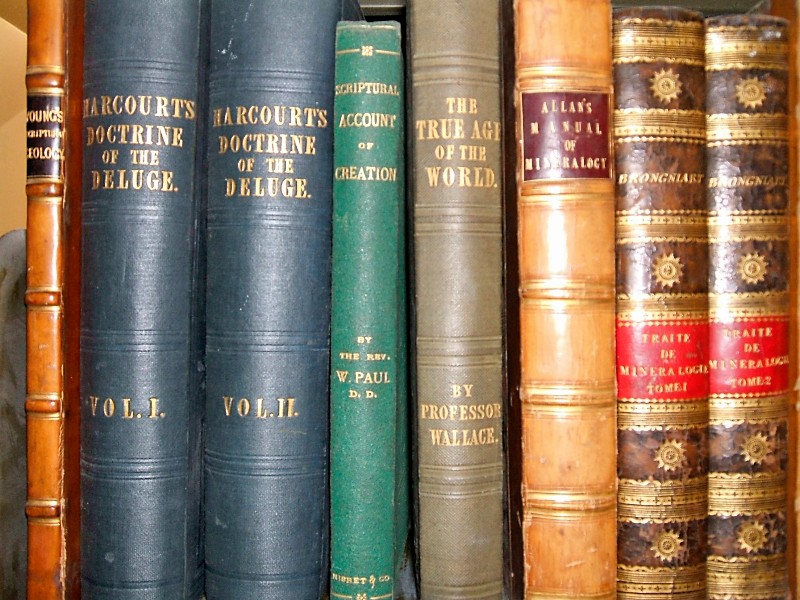
Natural History CollectionInnovative Learning week kicks off at New College Library with a chance to see some of the scientific books in New College Library’s Special Collections and find out where they came from and why they were collected at New College Library. Please drop in to look at the book display in the Funk Reading Room, Monday 18 February 11-12am and ask questions.

Several of the items in this display are drawn from New College Library’s Natural History Collection, a Special Collection numbering about 175 books. This dates from the early days of New College, where ‘Natural Science’ was taught until 1934. The collection covers the mid-nineteenth century controversies over evolution and natural selection, with geology particularly well represented. There is a focus on Scottish natural history and on texts by Scots writers.

Can’t come to the display? See the presentation slides on slideshare.

The Rescue that never was – remembering Holocaust Memorial Day #HMD2013

Nazi massacres of the Jews & others : some practical proposals for immediate rescue made by the Archbishop of Canterbury and Lord Rochester in speeches on March 23rd 1943 in the House of Lords /William Temple. London : Victor Gollancz, [1943] Z.h.30/24

Nazi massacres of the Jews & others : some practical proposals for immediate rescue made by the Archbishop of Canterbury and Lord Rochester in speeches on March 23rd 1943 in the House of Lords /William Temple. London : Victor Gollancz, [1943] Z.h.30/24

Holocaust Memorial Day marks the liberation of the Nazi concentration camp Auschwitz-Birkenau in 1945, and remembers those who died in the Holocaust and under Nazi persecution, and during subsequent genocides, such as Cambodia, Bosnia, Rwanda and Darfur.

New College Library holds this pamphlet, Nazi massacres of the Jews & others : some practical proposals for immediate rescue made by the Archbishop of Canterbury and Lord Rochester in speeches on March 23rd 1943 in the House of Lords. The author, William Temple (1881-1944) was a bishop in the Church of England who served as Archbishop of York  Archbishop of Canterbury between 1942–44.

One of the founders of the Council of Christians and Jews in 1942,  Temple was at the forefront of the Church of England’s campaign to draw attention to the plight of the Jews in Europe and to demand that the British Government provide rescue and sanctuary for Jewish victims. His speech urges:

The Jews are being slaughtered at the rate of tens of thousands a day on many days … we cannot rest as long as there is any sense among us that we are not doing all that might be done.”

Sadly no changes to refugee policy were made by the British Government and after William Temple died in 1944, the impetus for rescuing the Jews did not continue.

This item is part of the Pamphlets Collection, and it was catalogued as part of the Funk Cataloguing Projects at New College Library

The Hammond Organ in history

Hymn 19Today, 11 January, is the anniversary of the birth of Laurens Hammond, inventor of the Hammond organ. New College Library holds this pamphlet, The Hammond Organ, published in the 1930s,  in the Hymnology collections.

Patented eighty years ago in 1933-4, the Hammond Organ was aimed at church and domestic use, and  it offered a new and cheaper alternative to the traditional pipe organ for church music. Later, it became popular for jazz, blues and rock music, as well as for church and gospel music.

Laurens Hammond was awarded the Franklin Institute’s John Price Wetherill Medal in 1940 for the invention of the Hammond electric organ.

This item was recently catalogued as part of the Funk Cataloguing Projects at New College Library.

Works of King James I & VI now on display at New College Library

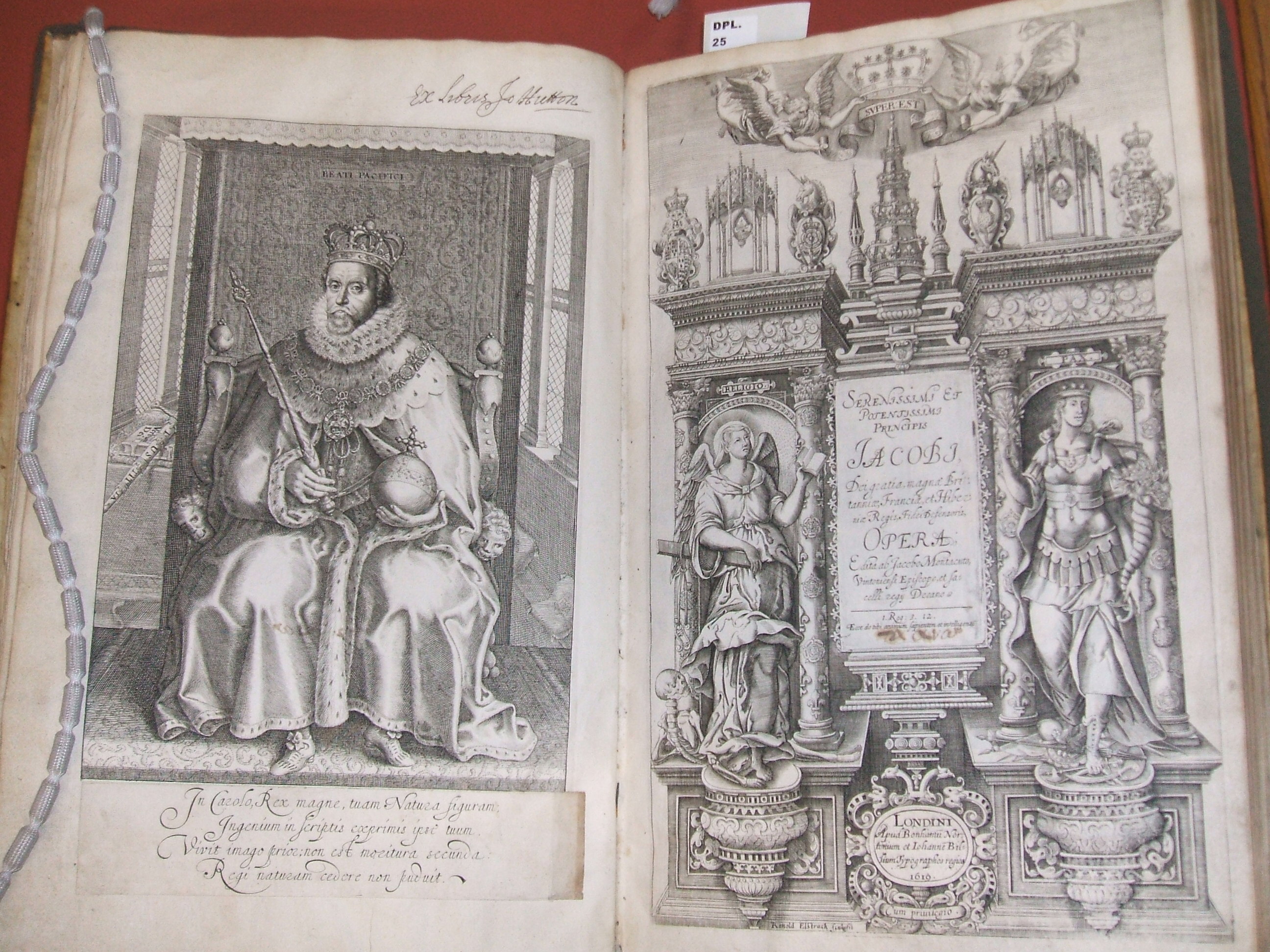
Works of King James I & VI

Serenissimi et potentissimi Principis Iacobi, Dei gratia, Magnae Britanniae, Franciae, et Hiberniae Regis, fidei defensoris, opera …
New College Library DPL.25

New on display in the entrance to New College Library is the Works of King James I of England and VI of Scotland edited by  James Montagu, Bishop of Winchester, and Dean of the Royal Chapel.

With an engraved portrait  of Prince Charles (later King Charles I), and later the Royal Coat of Arms this contains James’  paraphrase of the apocalyptic books of the Bible, as well as works on royalty and church and state.

The volume has a vellum binding covered in a stamped gilded decoration of scattered flowers around a central image of a wild boar.

Part of the Dumfries Presbytery Library, the volume is inscribed Ex Libris Johannes Hutton.  Dr John Hutton, a graduate of the University of Edinburgh, became the first Treasurer of the Royal College of Physicians of Edinburgh (1681–82), and Court Physician to King William III and Queen Mary (1688–1702).
Later he was also MP for Dumfries Burghs (1710–12) and when he died in London, in November 1712, he gave as a bequest his library of 1,500 volumes to the Presbytery of Dumfries. Much of this is preserved as the  Dumfries Presbytery Library, now kept in New College Library.

This item was recently catalogued online as part of the Funk Cataloguing Projects.

The wood-walls of Scotland : a Christmas Carol

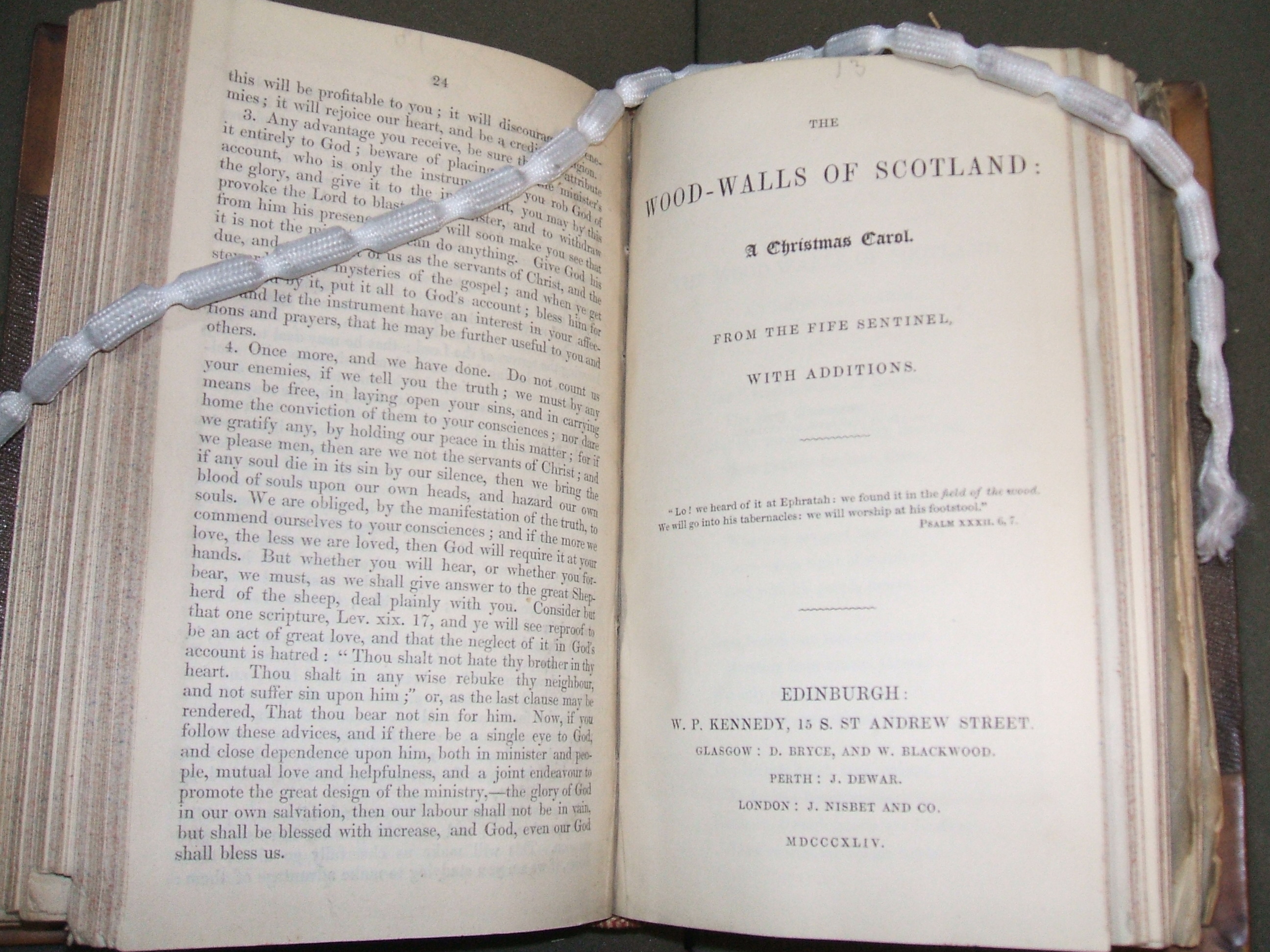
The wood-walls of Scotland : a Christmas carol, from the Fife Sentinel, with additions. Edinburgh : W. P. Kennedy … etc., 1844. New College Library F.a.12/13

New College Christmas Carol Service is taking place today at 5pm in the Martin Hall, led by members of the New College community and with singing from the New College Choir. Here’s a Christmas carol from  New College Library’s collections.

This pamphlet, The wood-walls of Scotland, was originally published in the newspaper the Fife Sentinel.  It contains a carol that would have been sung to a popular hymn tune, inspired by the verse from Psalm 132 “Lo, we heard of it at Ephratah: we found it in the fields of the wood.” Published after the Disruption of 1843, the carol is celebrating the outdoor services held to accommodate congregations who had separated to form the new Free Church of Scotland.

“On hill-side and green valley

Our wooden temples placed

The faithful, round they rally

The Gospel-standard rais’d”

To fast or feast? Celebrating Christmas in the eighteenth century

A discourse concerning the lawfulness and right manner of keeping Christmas and other Christian holy-days, by way of question and answer : intended for the use of a charity-school. London: Printed for, and sold by H. Hills, in Black-fryars, near the Water-side, 1708 New College Library Z.851/3

A discourse concerning the lawfulness and right manner of keeping Christmas and other Christian holy-days, by way of question and answer : intended for the use of a charity-school. London: Printed for, and sold by H. Hills, in Black-fryars, near the Water-side, 1708 New College Library Z.851/3

Many folk will be going to Christmas lunches and parties this week – including New College Library staff. Outside our office window the Edinburgh Christmas fair is in full (and noisy) swing, celebrating the season.

This eighteenth century pamphlet,  A discourse concerning the lawfulness and right manner of keeping Christmas,  gives an eighteenth century view on seasonal celebrations.  It takes the form of a dialogue between a master and scholar, prefacing the discussion with the quotation of Bible texts that urge sincere and temperate behaviour. It unpicks the theology of Christmas from an early eighteenth century Anglican point of view,  negotiating the scriptural and historical justifications of the observance of Christmas as a holy day and the contemporary differences in practice with other Protestant Churches. The author looks back on the abolishment of Christmas celebrations (including plum pudding) under Oliver Cromwell’s Puritan regime after the English Civil War. It is possible both this period and the Restoration of 1660 may have been within the author’s living memory.

This book is also available online to University of Edinburgh users via Eighteenth Century Collections Online, where it can be read online in full.

This item is from New College Library’s Z Collection, currently being catalogued as part of the Funk Cataloguing Projects at New College Library.

Festival Prayers for Hanukkah

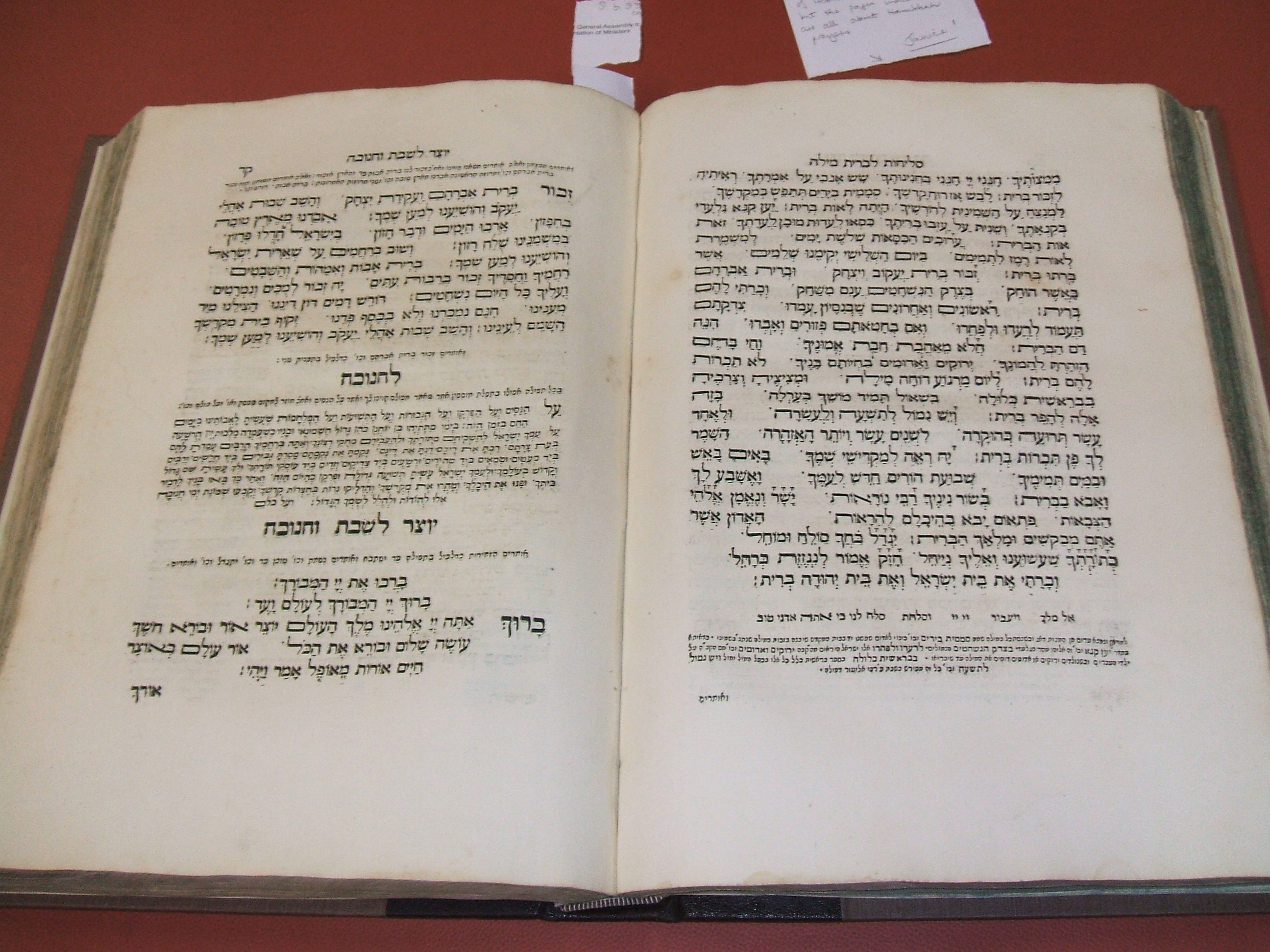
Shaar Bat Rabim Mahzor Helek Rishon : ke-minhag kahal kadosh Ashkenazim. Ṿinitsiʾah : Stamperia Bragadina, 1716-[1731/32. New College Library Dal-Chr 9(1)

Shaar Bat Rabim Mahzor Helek Rishon : ke-minhag kahal kadosh Ashkenazim. Ṿinitsiʾah : Stamperia Bragadina, 1716-[1731/32. New College Library Dal-Chr 9(1)

The Mahzor Ashkenazim  is an example of a mahzor, or festival prayer book, for Ashkenazi usage, published in Venice in the early eighteenth century. Its large size makes it likely that it was intended for synagogue use rather than personal prayer. The Encyclopedia Judaica (available online to University of Edinburgh users) notes that mahzorim, which originally developed  in medieval south western Germany, started to appear in the Ashkenazi communities of  northern Italy in the fifteenth century.

This item is part of the Dalman-Christie Collection,  catalogued as one of the Funk Cataloguing Projects at New College Library. The Dalman-Christie Collection was transferred to New College Library in 1946 from the Church of Scotland Hospice in Jerusalem. With thanks to our Hebrew Cataloguer, Janice Gailani, for helping to identify this item.

This opening shows festival prayers for Hanukkah, the Jewish festival of lights.

This opening shows festival prayers for Hanukkah, the Jewish festival of lights.

The saint, the saltire and a Scottish legend

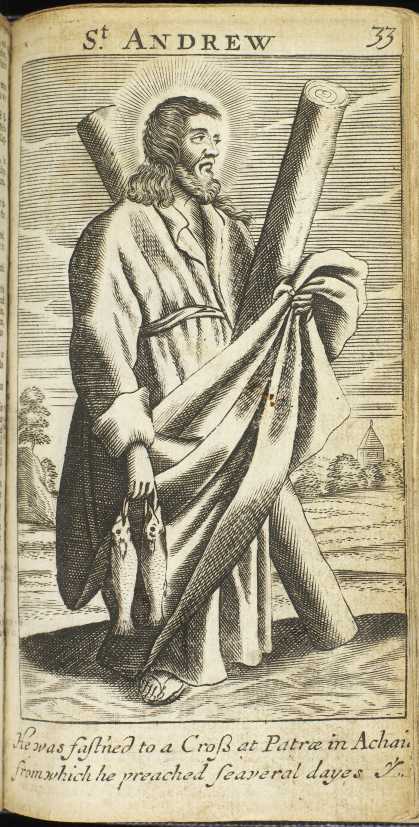
The Holy Bible : containing the Old and New Testaments … Oxford : Printed by the University Printers, 1695. New College Library B.r.468

Today, November 30, is Saint Andrew’s day,  also celebrated as Scotland’s national day.

The Oxford Dictionary of Saints (available online to University of Edinburgh users)  notes that the cult of St Andrews was evident in England from Anglo-Saxon times, when the church in Rochester was the earliest of 637 medieval dedications to St Andrew.  His legend grew to include the translation of his relics from Patras to Scotland by St Rule or Regulus in the 8th century.  It is said that under angelic instruction, St Rule stopped at the place in Fife now known as  St Andrews and built a church there, which became a centre for Christian evangelization and learning.  St Andrew is commonly depicted with the saltire cross (X), which is used to represent Scotland on the Union Jack.

This image of St Andrew, patron saint of Scotland, comes from a seventeenth century English Bible which contains attractive illustrations of Bible scenes and pictures of the saints. It has bound with it metrical Psalms in the version of the Scottish Psalter, 1564. It is part of New College Library’s Early Bibles Collection, catalogued online as part of the Funk Cataloguing projects.

Remembering the life of Guru Nanak

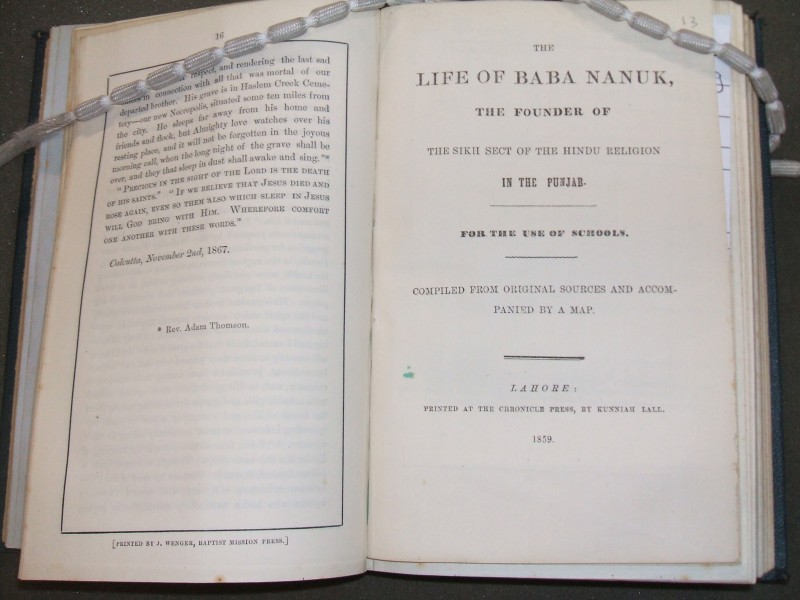
The life of Baba Nanuk, the founder of the Sikh sect of the Hindu religion in the Punjab : for the use of schools : compiled from original sources and accompanied by a map. Lahore : The Chronicle Press, by Kunniah Lall, 1859. New College Library P.g.21.13/2

Sikhs around the world will celebrate the birthday of Guru Nanak on Wednesday 28 November. Guru Nanak (1469-1539) was the founder of the Sikh religion.

The life of Baba Nanuk, from New College Library’s Pamphlets collection aims to give an introduction for schools to Sikhism’s founder and the early history of the religion. New College is the only library in Scotland to hold a copy of this work.

This item was catalogued as part of the Funk Cataloguing Projects at New College Library.

A prayer for a pudding?

The booke of the common prayer and administracion of the Sacramentes : and other rites and ceremonies of the Churche, after the vse of the Churche of England.1549. New College Library DPL 70

25 November 2012 is traditionally Stir Up Sunday, when cooks plan to make their Christmas puddings so they have time to mature before eating on Christmas Day.

This tradition is linked with the opening words of the collect for the day in the Book of Common Prayer of 1549, which reads  ‘Stir up, we beseech thee, O Lord…’ Always read just before Advent, this became remembered as a reminder  to start stirring up the puddings for Christmas.

New College Library holds this copy of the  Book of Common Prayer printed in London in 1549, the year the Book of Common Prayer was adopted by the Church of England.  We can see the exhortation to “Stir up ..” , spoken over 450 years ago in the reign of Edward VI of England, about two thirds of the way down the page.

This book is part of the Dumfries Presbytery Library, currently being catalogued as part of the Funk Cataloguing Projects at New College Library. It bears the signature of Dr John Hutton, who donated the collection of books that form the foundations of the Dumfries Presbytery Library.