Psalms for St Cecilia’s Day

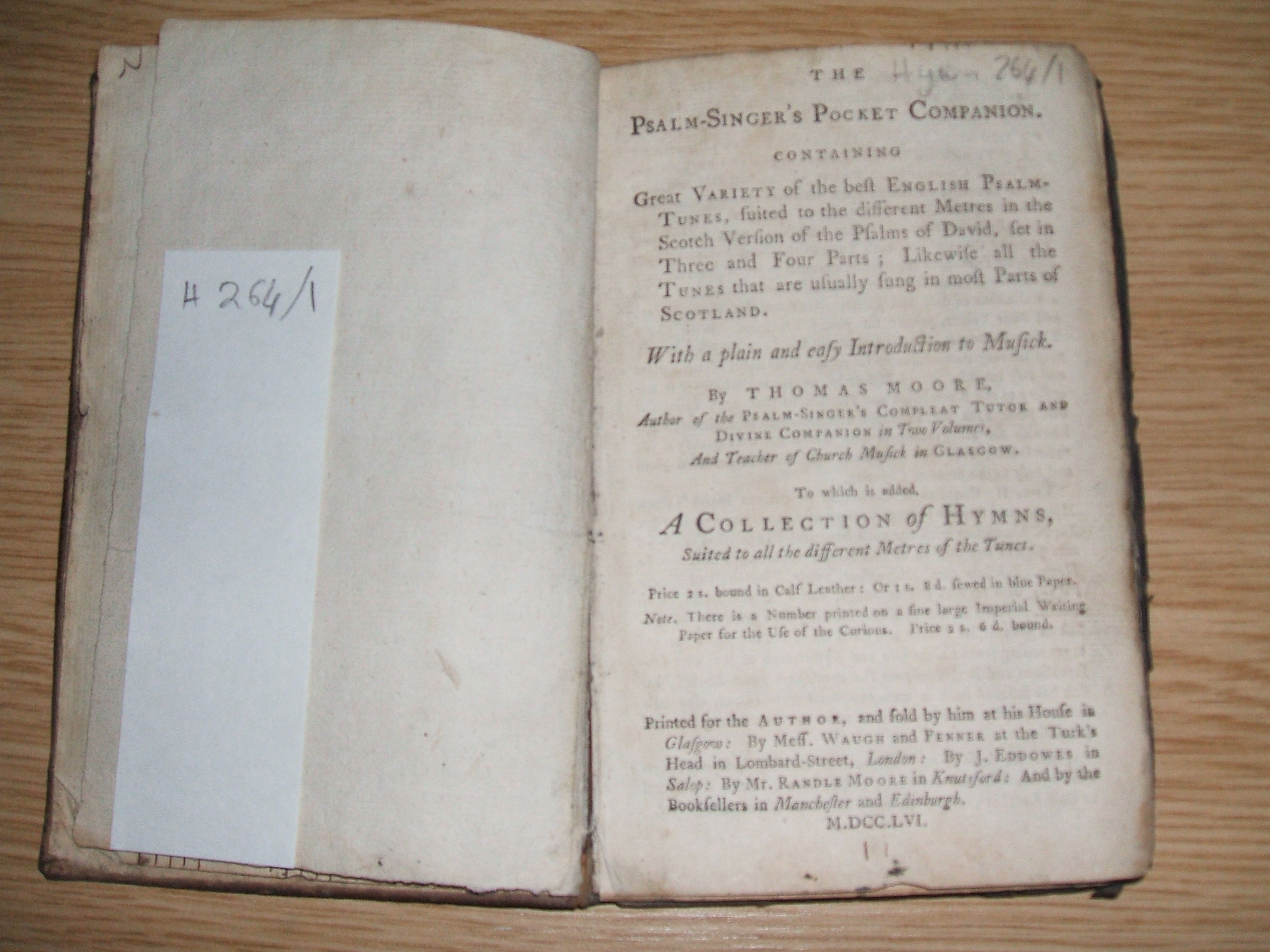
Moore, Thomas “Psalm singers’ pocket companion”, Glasgow 1756. Hymn 264/1

The feast of St Cecilia’s Day is traditionally celebrated on November 22nd.  A 3rd century martyr, St Cecilia is known as the patron saint of musicians. Her legend relates that, as a young Christian,  she was betrothed to a pagan but she had already vowed her virginity to God. As the organs played at at her wedding feast, Cecilia sang (in her heart) to the Lord, asking that her heart remain pure.

Here’s a book of Psalms to remember her by. Thomas Moore’s Psalm singers’ pocket companion is a publication from the revival era known as Gallery Psalmody, where leading singers and choir were located in a loft of the church. The new style lasted for about a century from 1755, and its main features were choirs singing in harmony of usually three parts, with some solo sections. Thomas Moore (- d. 1792) was a music teacher from Manchester Cathedral who came to Glasgow to teach singing.
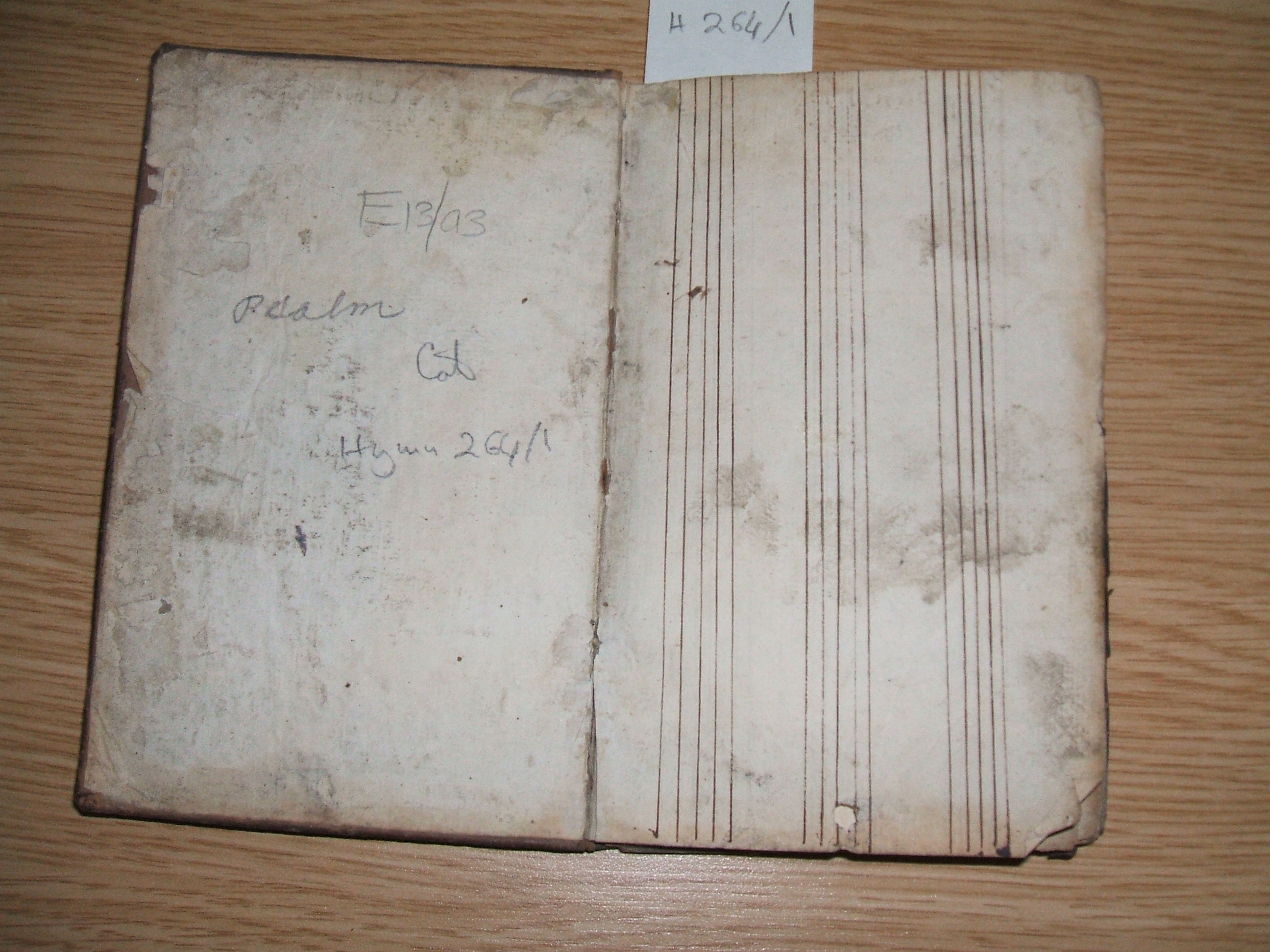
This item is small, or pocket sized, and contains a number of manuscript doodles which may testify to the singer’s mind wandering elsewhere. Also interesting are the pages of handwritten music staves, perhaps to allow the singer to make notes of new tunes or harmonies.

The Psalm singers’ pocket companion belongs to the Hymnology Collection, and was catalogued as part of the Funk Cataloguing Projects. With thanks to our Project Cataloguer, Oreste de Tommaso, for supplying details of this item.

New College Library image collections online

I’m very pleased to be able to tell you that over 200 images from New College Library’s collections are now available online through the University of Edinburgh Image Collections database.

The collection includes images from some of New College Library’s iconic items such as the first edition of Calvin’s Institutes of Religion (1536) and the manuscript of Covenanter James Renwick’s last speech in 1688.

This is a growing collection, as New College Library items catalogued as part of the Funk cataloguing projects which are found to be unique on ESTC are being photographed and their images added to the database.

Manchester Contributes to the Friedberg Genizah Project

A growing resource for Jewish / Ancient World Studies – I see that as well as the digitized images of Genizah collections at Cambridge and Birmingham there are links to related open access journals and pdfs of all the 8 volumes of “Ginzei Kedem” – a Journal devoted to Genizah research and published by the Ben-Zvi Institute.

New College Library’s earliest Bible

Novum Testamentum Graece, Strassburg 1524. New College Library B.r.316.

This Greek New Testament Novum Testamentum Graece, is the earliest Bible held at New College Library.

It was printed in Strassburg in 1524, and in his preface the printer speaks of this edition as the first fruits of his Strassburg press. Combined with the same printer’s Greek Old Testament of 1526 it  forms a complete Bible, but this New Testament appears to have been first issued separately.

This New Testament was published in Strassburg during the period that Protestant reformer Martin Bucer was active there. Bucer was part of a significant group of reformers including Matthew Zell and Wolfgang Capito, and he corresponded with the theologians Martin Luther and Huldrych Zwingli. During his time in Strassburg he is known to have taught classes on books of the Bible so may have used a Greek Testament like this one.

This copy has a number of manuscript inscriptions testifying to its former ownership and a printed book plate from James Walker, Christ Church. It is likely to have been donated to New College Library in the early years of its foundation. Part of the Early Bibles Collection, it was catalogued as part of the Funk Cataloguing Projects here at New College Library.

With thanks to our Rare Books cataloguer Finlay West for supplying details of this item.
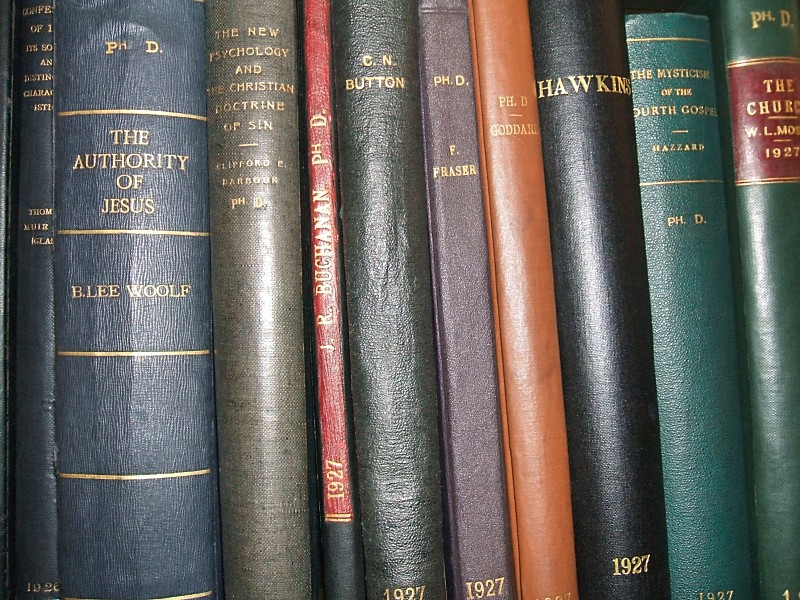
Top ten tips for finding theses

Postgraduate students often ask me about how to find theses. Unfortunately there’s no single source for information on all theses worldwide.

However here are a few tips that might help …
1. All Divinity theses and post 1984 other University of Edinburgh theses are now catalogued onto the online catalogue. See my earlier blog post for tips on searching for New College theses …

2. Older University of Edinburgh theses are listed in sheaf-binder indexes, which are held in the CRC Research Suite – see the useful CRC Guide to Theses

3. Remember that most University of Edinburgh printed theses are kept as archival copies and can only be read in the Library.

4. The Edinburgh Research Archive (ERA) has full text online versions of all Edinburgh University theses submitted from 2005.

5. Go to the Theses subject guide on the University of Edinburgh Library website to find a gateway to information sources from universities worldwide  – such as …

6. [University of Edinburgh restricted] … The Index to Theses database finds details of UK & Ireland theses from 1715- present (no full text)

7. [University of Edinburgh restricted] The Dissertations and Theses database from ProQuest finds details of primarily US & Canada theses. Currently the University of Edinburgh has not subscribed to the full text option, but if you want the full text you could apply for an inter-library loan.

8. New to me is the Networked Library of Theses and Digital Dissertations – SCIRUS Search. This freely available search of public domain theses will include subscribed content from University of Edinburgh subscriptions if you’re on a University network machine, or going through MyEd or VPN at home (No need to alter settings as you would for Google scholar). There’s more full text here than I’d expected.

9. The DART Europe E-Theses portal  – at the time of writing, this is offering access to 362030 open access research theses from 523 Universities in 27 European countries.

10. For theses from further afield, you could try the Center for Research Libraries Global Resources Network.

Keeping the faith in wartime

A short New College  Act of Remembrance will take place on Friday 9th November at 1pm at the War Memorial in the corridor leading to the Assembly Hall.

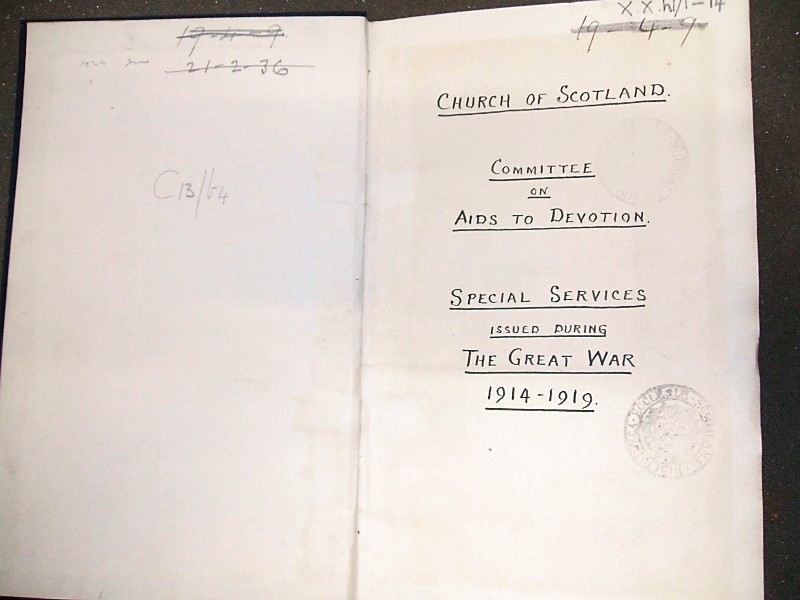
Church of Scotland – Committee on Aids to Devotion. Special Services issued during the Great War 1914-1919. New College Library Pamphlets Collection X.X.h.1.1-14

This item from New College Library’s Pamphlets Collections was recently catalogued as part of the Funk Cataloguing Projects. It is a collection of Church orders of services and guides for public prayer in a family or school setting. All the pamphlets date from the First World War Period, ending with a form of Divine service for Remembrance Day on the eleventh of November.The pamphlets and their binding are flimsy and utilitarian but their content bears witness to the cost of war for those at home as well as those out on the front.

Pamphlet X.X.h. 1/2 Form of prayer for schools in time of war, includes the text:

“Throw the shield of Thy protection over all who have gone forth to fight our battles by land or sea or air. We especially remember those near and dear to ourselves.”

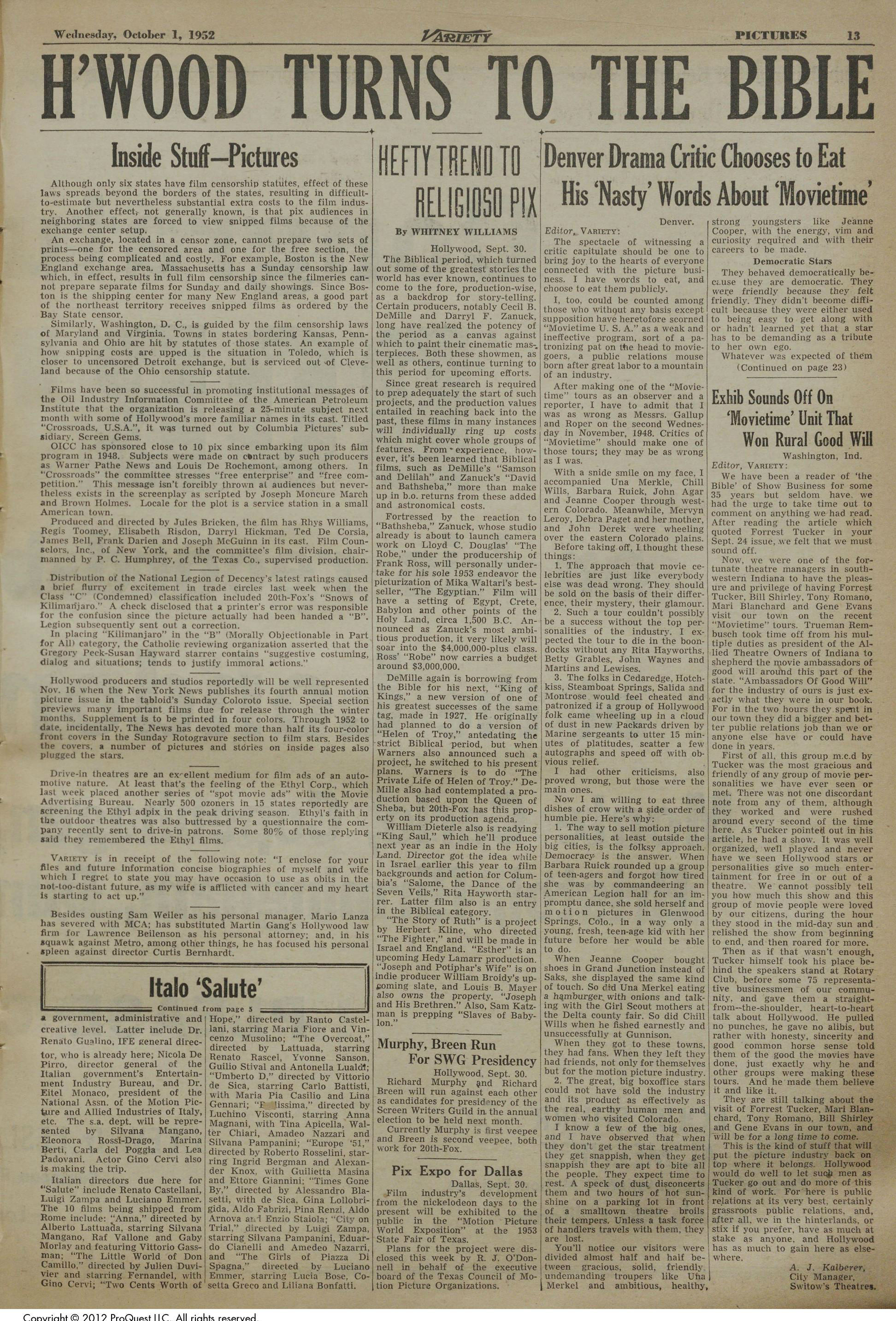
The Bible on Film – Film Industry magazines on trial now

On trial now for University of Edinburgh users is the Entertainment Industry Magazine Archive from ProQuest. This archival research resource contains the core US and UK trade magazines covering film, music, broadcasting and theatre, together with film fan magazines and music press titles. Magazines have been scanned cover-to-cover with  indexing of all articles, covers, ads and reviews.

This article by Whitney Williams from Variety Magazine Wednesday October 1, 1952, features the plans by Hollywood director Cecil B. de Mille to make another ‘King of Kings’ epic, and William Dieterle is reported as planning to make ‘King Saul’.

University of Edinburgh users can access the trial on the E-resources trials page.

The trial ends on 27 November.

New books at New College Library – November

A new title that has gone straight to the shelves is Religion and the news, edited by Jolyon Mitchell and Owen Gower. Newly published this October, two copies of this book were acquired in support of a number of undergraduate and postgraduate Divinity courses on religion, contemporary culture and the media. One copy can be found in the Reserve Section and one in Standard loan at PN4756 Rel.

New College Library also  has a regular display of new books at the far end of the Library Hall, close to the door to the stacks.You can see an regularly updated list of new books for New College Library on the Library Catalogue – choose the New Books Search and limit your search to New College Library. Here’s a quick link to new books arriving in the last few weeks. A word of caution – some of the books listed here may still be in transit between the Main Library (where they are catalogued) and New College Library, so not on the shelf just yet.

The ghosts on the shelves

It’s difficult to walk around Stack III, the rare books stack of New College Library, without feeling the weight of history. On these shelves Tyndale rubs shoulders with Calvin, and fifteenth century incunabula are a few steps away from nineteenth century treatises on religion and science. So many of these texts are witnesses of strongly held beliefs, beliefs that changed the religious and the political landscapes of their day. In addition to these historic voices, we can also find the ghosts of former owners and former libraries that have been donated and absorbed into New College Library. Many rare books are inscribed by their owners, and often  a succession of owners.

As new books join the ranks on the shelves in New College Library,  and are borrowed, read and absorbed into learning, they join in the community of the written word that makes up a library and enter the conversation of scholarship that was begun by the generations before. In the minds of the scholars and students these voices from the past are still watchful, possibly censorious, always listening and still alive.

From Greek to Gaelic

Just over 400 items which together form the Gaelic Collections at New College Library have now been catalogued online and their details can now be browsed online using the shelfmark “Gaelic Coll.”  This collection of monographs and pamphlets was put together from various sources, including thirty nine books from the bequest of the Rev. Roderick Macleod.

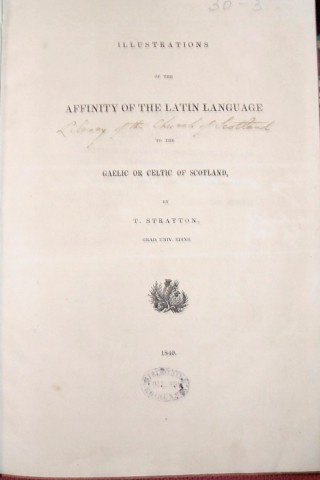
A contender for the oddest item in New College Library’s Gaelic Collections are a series of works by Thomas Stratton trying to prove the Celtic source of Latin and Greek, including “Proofs of the Celtic origin of a great part of the Greek language”. 1840 ; Gaelic Coll 213 and  “Illustrations of the affinity of the Latin language to the Gaelic or Celtic of Scotland”. 1840 Gaelic Coll 213. This copy has a handwritten inscription identifying it as previously belonging to the Library of the Church of Scotland.

With thanks to Patrick Murray, our Gaelic Cataloguer, for supplying details of this item.