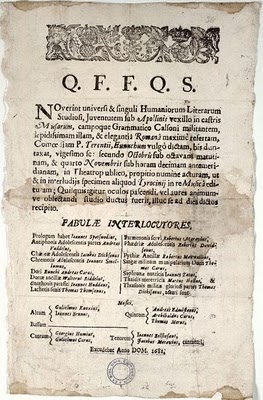
Edinburgh University Student Performance of Terence’s "Eunuchus", 1681

This printed notice/advertisement, written in Latin, concerns the performance of an amateur production of a play which interestingly seems to involve a joint operation with some pupils of Kelso High School. It may well be one of the earliest surviving amateur playbills.
Interest in the dramatic arts evidently continued at Edinburgh, and by the middle of the 20th century the E.U. Dramatic Society was meeting weekly and holding classes in mime and movement, make-up and voice production, as well as lighting and production. It also presented three full length plays annually.

Participation in clubs and societies has a very long history at Edinburgh University, stretching back into the eighteenth century. But the greatest expansion of such activity took place after the establishment of the Students’ Representative Council in 1884, and throughout the 20th century when vast numbers of organisations reflecting the great variety of interests of the student body were formed.
Edinburgh University Library foundations, 1965

The University Main Library is today in the middle of a major refurbishment, the first comprehensive work done to the building since it was built. Now an A-listed building, its origins were firmly rooted in the campus redevelopments of the late 1950s-1960s.

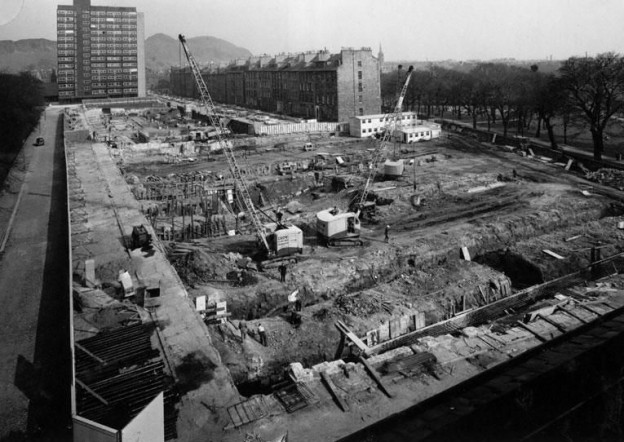
This photograph shows a scene that is very much a turning point in the University’s history. Cowan House and Masson Hall, which were student residences located in George Square have been demolished to make way for the University’s new Library building, the foundations of which have been constructed.

The building site for the Library and the adjacent Adam Ferguson Building are cordoned off, and various cranes and workmen can be seen progressing the construction work. A solitary vehicle on the south side of the square, the David Hume Tower and the tenement buildings on Buccleuch Place can also be seen.

The redevelopment of George Square to house the expanding accommodation needs of the University was controversial and the original plan was never fully realised, explaining the present mix of Georgian terraced houses and 1960s buildings.

Polish School of Medicine at the University of Edinburgh

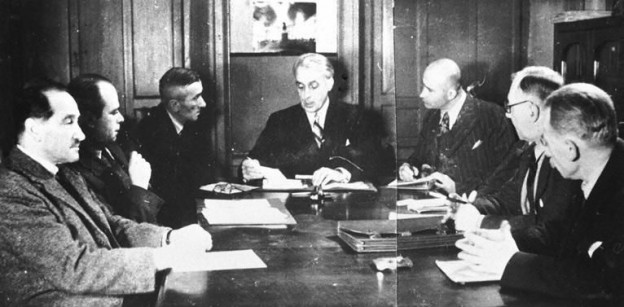
This photograph shows the Faculty Council Members of the Polish School of Medicine.

In 1941, as a result of World War II, many members of the Polish Army found their way to Britain. Amongst them were some medical specialists from Polish Medical Schools.
On 24 February 1941, the President of the Polish Republic issued a decree officially instituting the Polish School of Medicine. On the same day, the University of Edinburgh signed an agreement with the Polish exiled government.

Part of the Western General Hospital became the Polish or Paderewski Hospital. 120 beds were made available for soldiers and civilians, while clinical medicine was also taught. The School closed in 1949, having admitted a total of 337 students.

University Sports

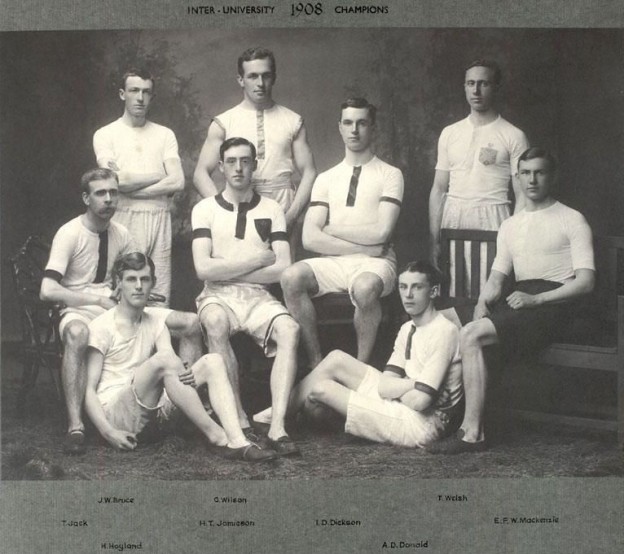
Sports are still an important part of University life and we have a good photographic record of them from the later 19th century onwards. The photograph here shows the 1908 Athletics Team.

The first athletic club annual sports were held in 1866, pre-dating the formation of the Scottish Amateur Athletic Association by 17 years. There were 16 events including a stilt race. Thousands of spectators were often present in the later 1860s and these early events later led to Inter-University championships.

The team members are shown in a fairly close-up view, even allowing hairs on the athletes’ legs to be seen! Most of the nine strong team are seated on chairs and on grass but the studio ‘feel’ suggests the backdrop of trees is artificial.

At this time Ian Dickson was one of the most prominent athletes winning many sprint races and finishing second in the Scottish Amateur Athletics Championships in the 440 yards to an athlete who was soon to become an Olympic medallist.