Author Archives: abrodin

Link

Re-discovering a forgotten songwriter: the archive of Louisa Matilda Crawford.

Daisy Stafford, CRC intern who catalogued the papers of Louisa Matilda Crawford, talks about her experience.

This summer I was offered the opportunity to undertake an archiving internship in the Centre for Research Collections, cataloguing the personal papers of Louisa Matilda Crawford, a nineteenth century songwriter. Other than her name and occupation, little information about Louisa was known. Through two months of close examination of her archive, I was able to stitch together a narrative of Louisa’s life. Here’s what I found…

Louisa Matilda Jane Crawford was born on the 27th September 1789 at Lackham House in Wiltshire. She was the daughter of Ann Courtenay (d. 1816) and George Montagu (1753-1815), an English army officer and naturalist. Louisa was related to nobility on both sides of the family; her maternal grandmother, Lady Jane Stuart, was the sister of Scottish nobleman John Stuart, 3rd Earl of Bute and Prime Minister to George III. Her father, meanwhile, was a descendent of Sir Henry Montagu, the first Earl of Manchester and also the great-grandson of Sir Charles Hedges, Queen Anne’s Secretary.
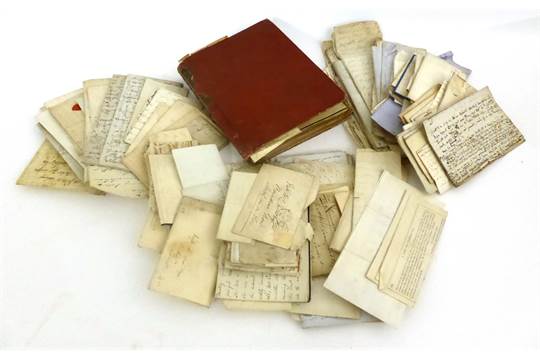
Papers of Louisa Matilda Crawford. Coll-1839 (picture from the seller’s catalogue)

Louisa had three older siblings; George Conway Courtenay (b. 1776), Eleanora Anne (b. 1780) and Frederick Augustus (b. 1783). Little direct information is known about Louisa’s childhood, but it must have been turbulent; in 1798 Montagu left his wife and family and moved to Kingsbridge in Devon to live with his mistress Elizabeth Dorville, with whom he had four more children. It is here that he wrote his two pioneering works, the Ornithological Dictionary; or Alphabetical Synopsis of Birds (1802) and Testacea Britannica, a History of British Marine, Land and Freshwater Shells, which saw several bird and marine species named after him, most notably Montagu’s harrier. The family’s disapproval of his relationship with Dorville ultimately cost him his ancestral home. On the death of his unmarried brother, James, the will stipulated that he would not inherit Lackham House, but had only “a rent charge of £800 a year subject to which the estates were left to his eldest son, George, for life.” The ensuing lawsuit between the pair resulted in huge debts which cost the family the estate; as Louisa wrote in The Metropolitan Magazine in 1835; “The thoughtless extravagance of youth, and the unwise conduct of mature age, caused the estates to be thrown into chancery” (vol. 14, pp. 308-309). Louisa reflected on seeing the native woods of her family home cut down upon its sale in a later poem (Coll-1839/7 pp.415-416):

Those brave old woods, when I saw them fall,

                Where they stood in their pride so long,

The giant guards of our ancient hall,

                And the theme of our household song;

I wept, that one of my Father’s race

                Could forget the name he bore,

And turn the land to a desert place,

                Where an Eden bloom’d before.

Louisa began courting Matthew Crawford, a barrister of Middle Temple, in 1817. Many of the papers consist of love letters and poems exchanged between the pair during this early period of their relationship, including three locks of hair, presumably Louisa’s. In 1822 the couple were married and Louisa moved to London, although their continued correspondence evidences that Matthew spent much of their marriage away working in the North of the country. It is then that Louisa began to earn an income through song writing and poetry, although the couple always struggled financially and frequently appealed to their wealthier relatives for aid.

Much of Louisa’s work appeared, often anonymously, in magazines and journals, was sold to publishers, and was set to music by composers Samuel Wesley, Sidney Nelson, Edward Clare and others. She frequently contributed both poems and prose, including several “autobiographical sketches”, to London literary journal The Metropolitan Magazine (which has subsequently been digitised by the HathiTrust and can be fully searched here). Many of her songs and poems related to historical events and persons; songs titled “Anne Boleyn’s Lamentation” (Coll-1839/7 p. 285) or “Chatelar to Mary Queen of Scots” (Coll-1839/7 pp. 381-382) are written from the point of view of famous queens. One poem (Coll-1839/3/1/9) tells the story of Frederick the Great (1712-1786), King of Prussia, who, in order to deceive his enemies as to his position during the Seven Years’ War, commanded that no light should be kindled throughout his encampment. However, a young soldier lit a taper to write a letter to his new bride. The second stanza reads:

His head was bent in act to write,

                The memories gusting o’er him –

When through the gloom of gathering night,

                Stood Frederick’s self before him!

Oh sternly spoke the Monarch then

                His doom of bitter sorrow

“Resume the seat – Resume the pen

                And add “I die tomorrow.”

Other poems in the collection are more personal, including reflections on her childhood and family, such as “The Home of Our Childhood” (Coll-1839/7 pp. 17-18) and “On the Death of a Sister” (Coll-1839/7 p. 394). Many verses are addressed to her husband Matthew; one poem (Coll-1839/1/2/5) dated 23rd July 1817 and titled “To Him I Love”, begins:

Oh! Doubt not the faith of a heart which is thine

Nor cast on its feelings a thought thats unkind

For believe me thine image whilest life shall be mine

Cannot fail to be cherish’d and dear to my mind

Like a miser I hoard in my hearts hidden core

Every look every word that from thee I receive

And never ah! never till lifes dream is o’er

Will the love which I bear thee be alter’d believe
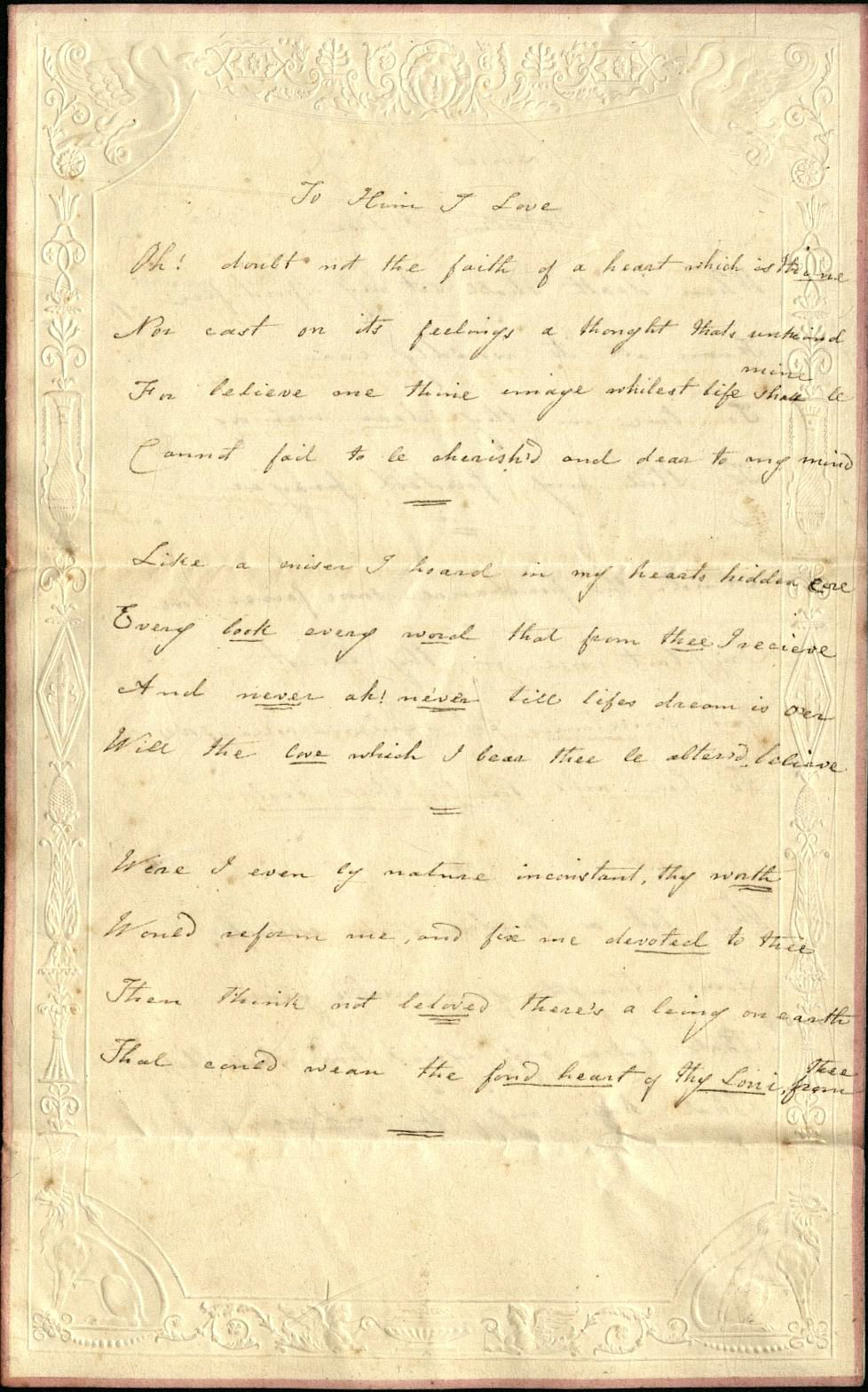
Coll-1839/1/2/5. Poem addressed to Matthew Crawford titled “To Him I Love” in the hand of Louisa Matilda Crawford, 23 July 1817.

Matthew often responded with poems of his own, and seems to have played a collaborative role in Louisa’s writing. She frequently included stanzas of her work in letters to him, asking him to look over and edit them.

Louisa’s most successful song, “Kathleen Mavourneen,” was set to music by composer Frederick Crouch and enjoyed wide success in America where it was popularised by Irish Soprano Catherine Hayes on her international tours. Recordings of it still exist, and a version by Irish tenor John McCormack (1884-1945) can be found on youtube here. No original version of the song is amongst her papers, although there is a poem titled “On hearing Miss Catherine Hays [sic] sing “Kathleen Mavourneen!”” (Coll-1839/3/1/17). However, the song was frequently attributed solely to Crouch, or erroneously to Annie, Julia, or Marion Crawford.
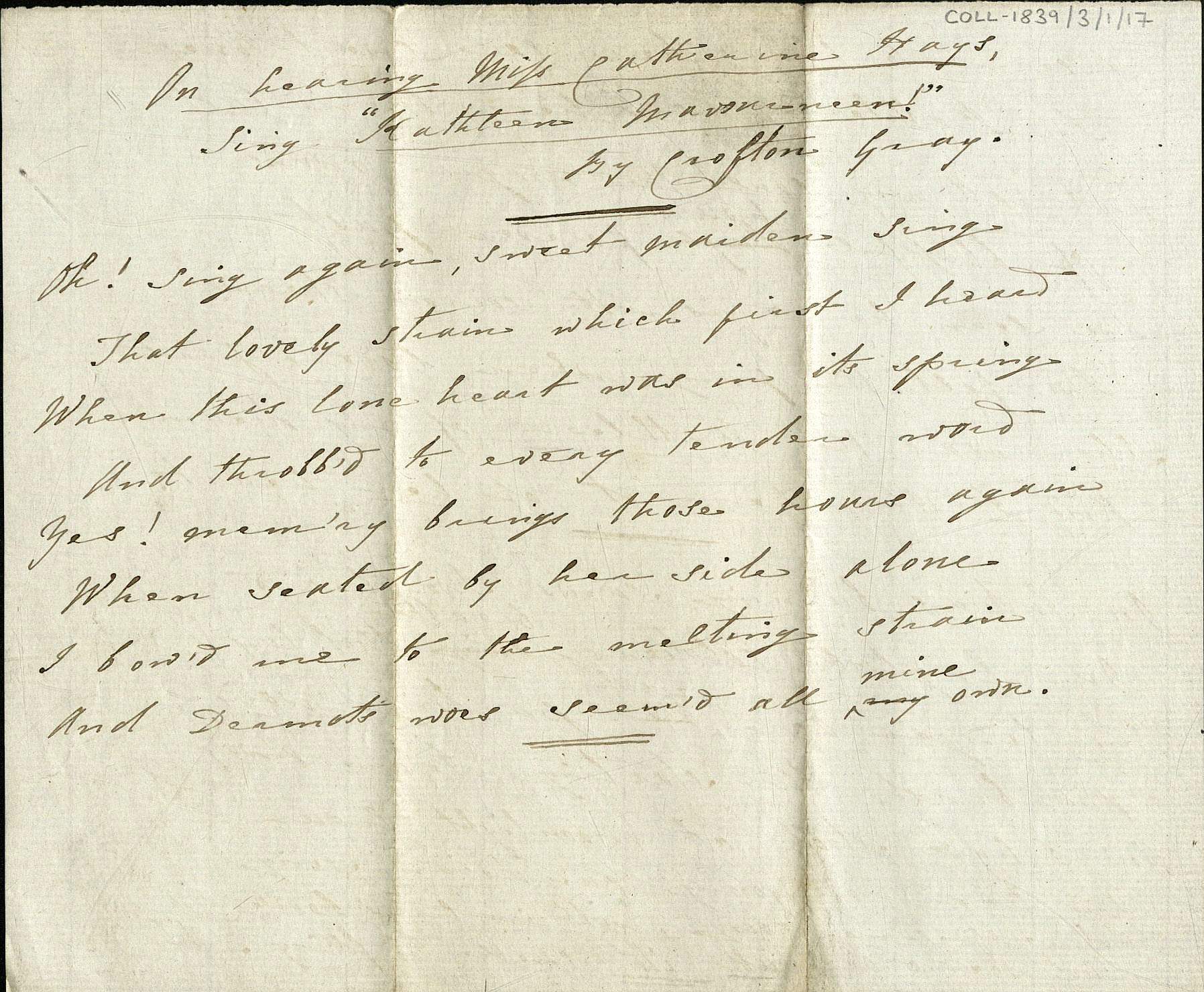
Coll-1839/3/1/17. Poem titled “On hearing Miss Catherine Hays, sing “Kathleen Mavourneen!” by Crofton Gray” in the hand of Louisa Matilda Crawford, 1837-1857.

Louisa arranged her poems into small series, and the collection includes ten stitched booklets with titles such as “Irish ballads” and “Scotch songs”. Attempts to track down her work can be seen in correspondence with her publishers. In an undated later to magazine editor Mr Emery (Coll-1839/1/1/22) she requests copies of her published songs, writing; “I am not wanting them to give away, but to have them bound up in a volume since I find it impossible to keep single songs…I am going to beat up for recruits in all quarters where my bagatelles have been published, in order that I may have a little memorial to leave to those that will value the gift when I am gone.” A notebook containing 165 poems and songs neatly written in Louisa’s hand seems to be the result of these efforts.

Some outlying items in the collection initially seemed not to relate to Louisa at all, including a 17th century indenture on vellum, recording the sale of a messuage or house between waterman Thomas W Watson and master mariner Josiah Ripley of Stockton-on-Tees. However, a bit of biographical research revealed the answer. Many of these miscellaneous items reference Bayley and Newby, a firm of solicitors operating out of Stockton-on-Tees in the 19th century, which may explain the presence of the indenture. Matthew Crawford’s first cousin, William Crawford Newby (1807-1884) worked at the firm, and it seems that, since the couple were childless, their papers passed to him upon their deaths and thence on to his heirs. The latest item in the collection (Coll-1839/1/3/16) is a 1930 letter by William’s son, who writes:

I enclose a manuscript book written by Mrs Crawford including many well-known songs…Mrs Crawford was a Montagu of the Duke of Manchester family and died in 1857. She was married to Matthew Crawford a barrister. They had independent means which however they frittered away. My late father who was a 1st cousin of Matthew Crawford’s assisted them from time to time and their M.S.S. came to him on their death and through him to me. I am not anxious to part with them, but I am an old man and my family may not attach the same importance to their possession.

This would seem to account for how the papers came to be in the possession of the bookseller and for the few items relating to the Newby’s present in the collection.

Louisa died in 1857, the cause unknown, although Matthew refers to a long affliction of heart disease supplemented by attacks of Bronchitis in an 1846 letter (Coll-1839/2/6). Despite her obvious talent, and the clear enjoyment she derived from her work, she received little notoriety for her song writing during her lifetime and even less so after her death. Alongside gaining invaluable archival skills during this project it has been a pleasure to think that I have been able to increase the visibility of Louisa’s work and make her collection available to interested researchers. Although separated by over two centuries, I have come to know more about Louisa than any person living, and that is a great privilege.

You can see the catalogue of the papers on ArchivesSpace: https://archives.collections.ed.ac.uk/repositories/2/resources/86789

References:

Cleevely, R. J. “Montagu, George.” Oxford Dictionary of National Biography Online, 23 Sep. 2004, https://doi.org/10.1093/ref:odnb/19017. Accessed 19 Jul. 2018.

Crawford, Louisa Matilda Jane. The Metropolitan Magazine. Accessed 19 Jul. 2018.

  • “An Auto-Biographical Sketch. Lacock Abbey.” Vol. 12, Jan-Apr. 1835, pp. 400-402, https://babel.hathitrust.org/cgi/pt?id=nyp.33433081737904;view=1up;seq=412.
  • “Autobiographical Sketches Connected with Laycock Abbey.” 14, Sept-Dec. 1835, pp. 306-318, https://babel.hathitrust.org/cgi/pt?id=nyp.33433081737888;view=1up;seq=322.
  • “Autobiographical Sketches.” Vol. 22, 1838, pp. 310-317, https://babel.hathitrust.org/cgi/pt?id=umn.319510007530342;view=1up;seq=325.
  • “Autobiographical Sketches.” Vol. 23, Sept-Dec. 1838, pp. 189-194, https://babel.hathitrust.org/cgi/pt?id=nyp.33433081737839;view=1up;seq=203.

Cummings, Bruce F. “A biographical sketch of Col. George Montagu (1755-1815).” Zoologisches Annalen Würzburg, vol. 5, 1913, pp. 307–325, http://www.zobodat.at/pdf/Zoologische-Annalen_5_0307-0325.pdf. Accessed 19 Jul. 2018.

“Kathleen Mavourneen.” Wikipedia, https://en.wikipedia.org/wiki/Kathleen_Mavourneen. Accessed 19 Jul. 2018.

Pratt, Tony. Two Georgian Montagus: the manor of Lackham. Wiltshire College, second edition, 2015, https://tinyurl.com/y7tpp39h. Accessed 19 Jul. 2018.

Urban, Sylvanus. “Obituary – Rev. George Newby.” The Gentleman’s Magazine, vol. 26, 1846, pp. 100-101, https://tinyurl.com/yatonw6n. Accessed 19 Jul. 2018.

Written by Daisy Stafford, July 2018.
Link

A more personal take on our archives…

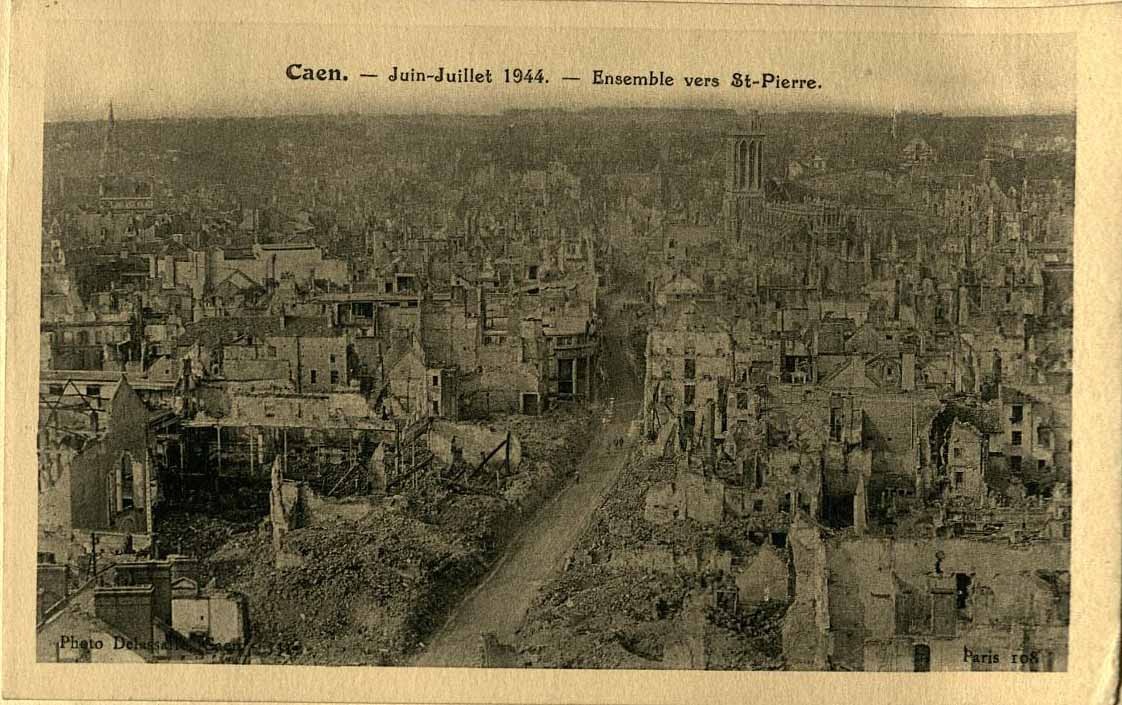
As any archivist knows, you can sometimes stumble upon archives with an unexpected and personal connection: this was the case for me when I found out that in the Special Collections of the Library was an album containing 175 photographs and postcards showing my home city, Caen, before and during the Second World War (Coll-164)… It immediately reminded me of my own grandparents, who had lived through the occupation, the bombing and finally the liberation of this medium-sized Norman city. They would always tell me stories about life during the war, and describe the way Caen looked before it: indeed, about 80 percent of the city was destroyed, in particular during the controversial bombing raid that preceded the ‘Operation Charnwood’ in July 1944. 

Aerial view of Caen after the bombings in July 1944 (Coll-164/4)

As you can see in the picture, the city was ravaged. The central area around the castle, St Pierre Church, and the neighbourhood called îlot St Jean were particularly affected. Post-war Caen looks like a field of ruins, and I was moved when I browsed the album for the first time and saw the full extent of the devastation.  When it happened my grandmother, who was around 15 at the time, had taken shelter in a town a few kilometres away; but my grandfather was there and took part in the rescue effort to help searching the rubbles for survivors. He was only 18.

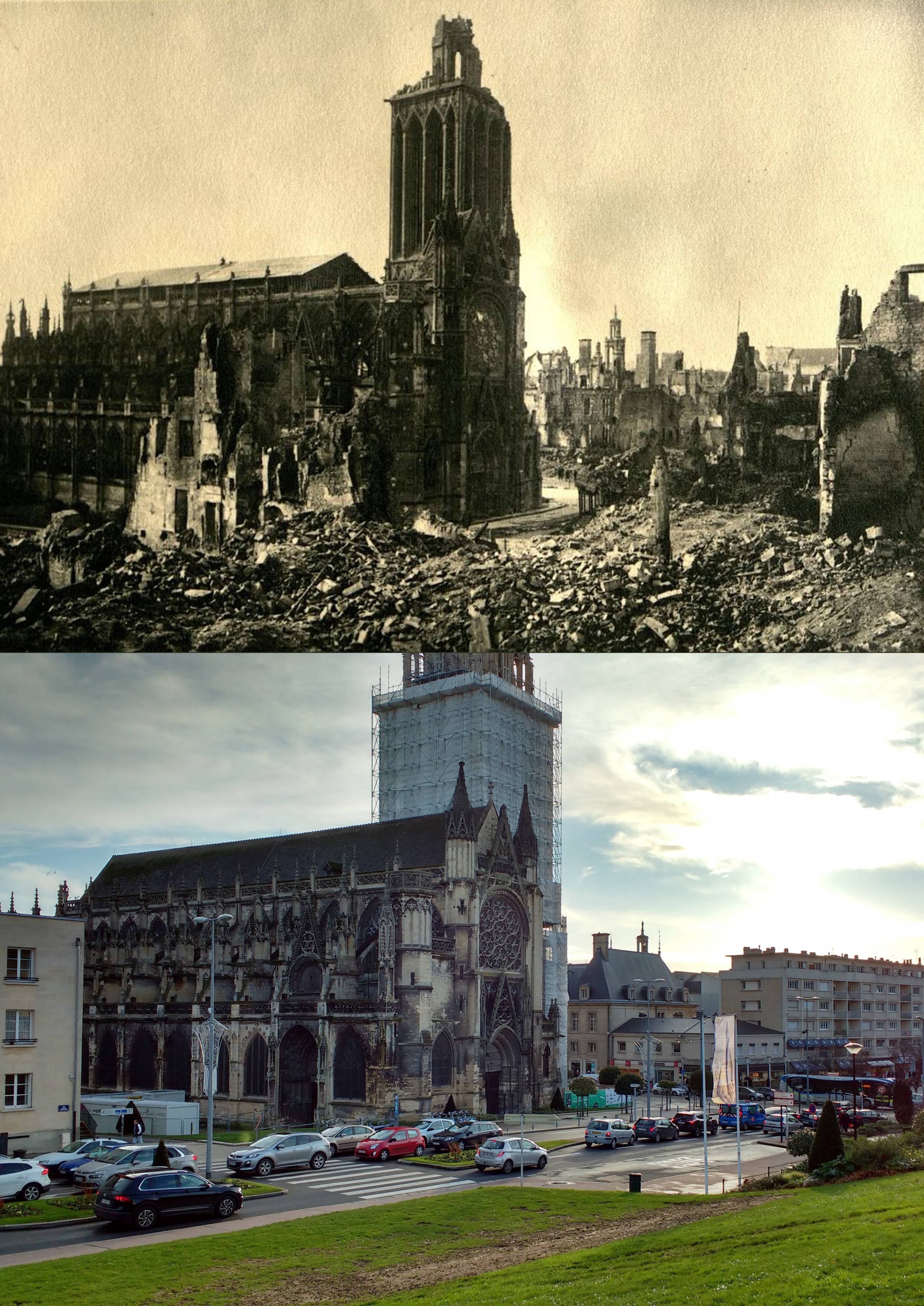
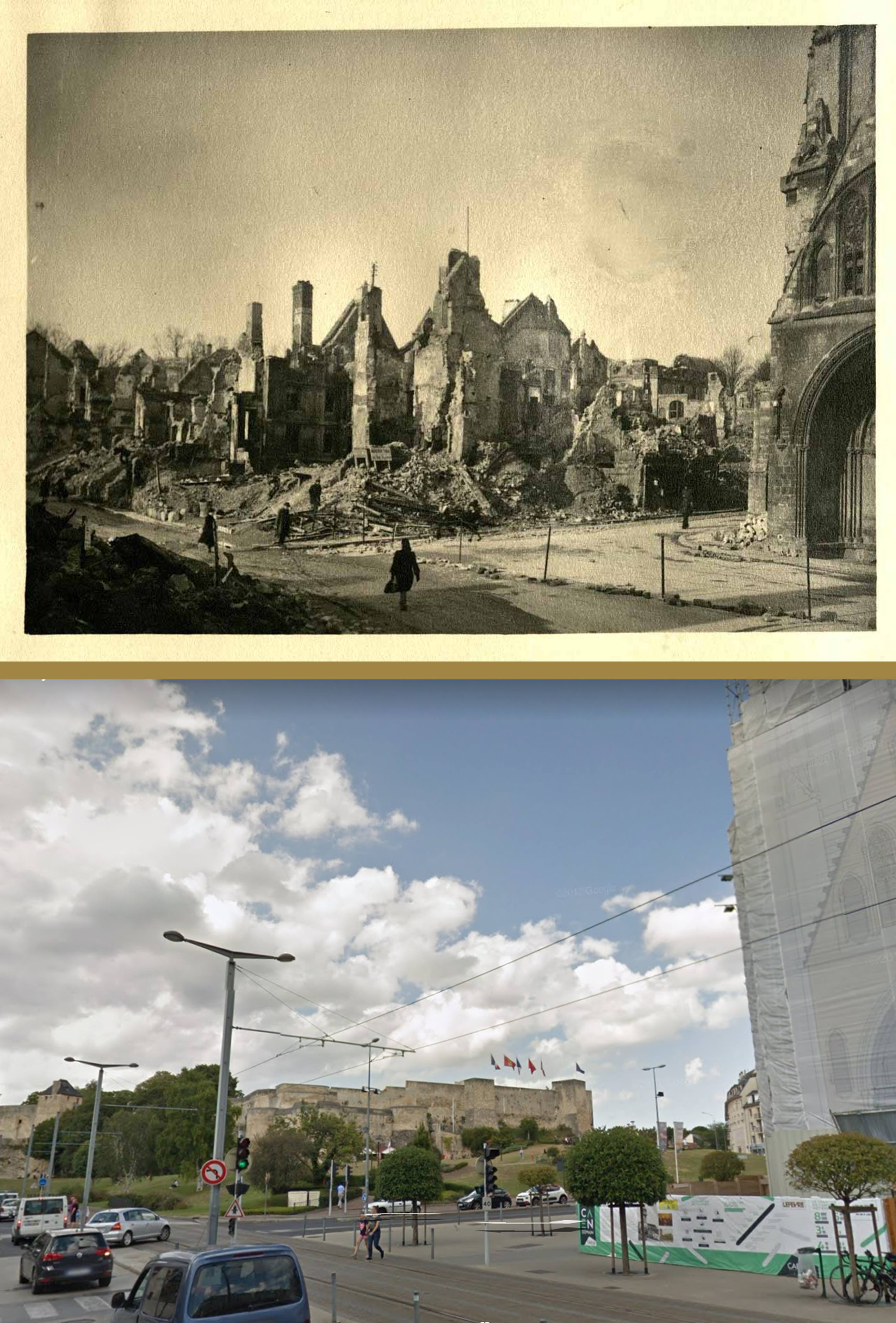
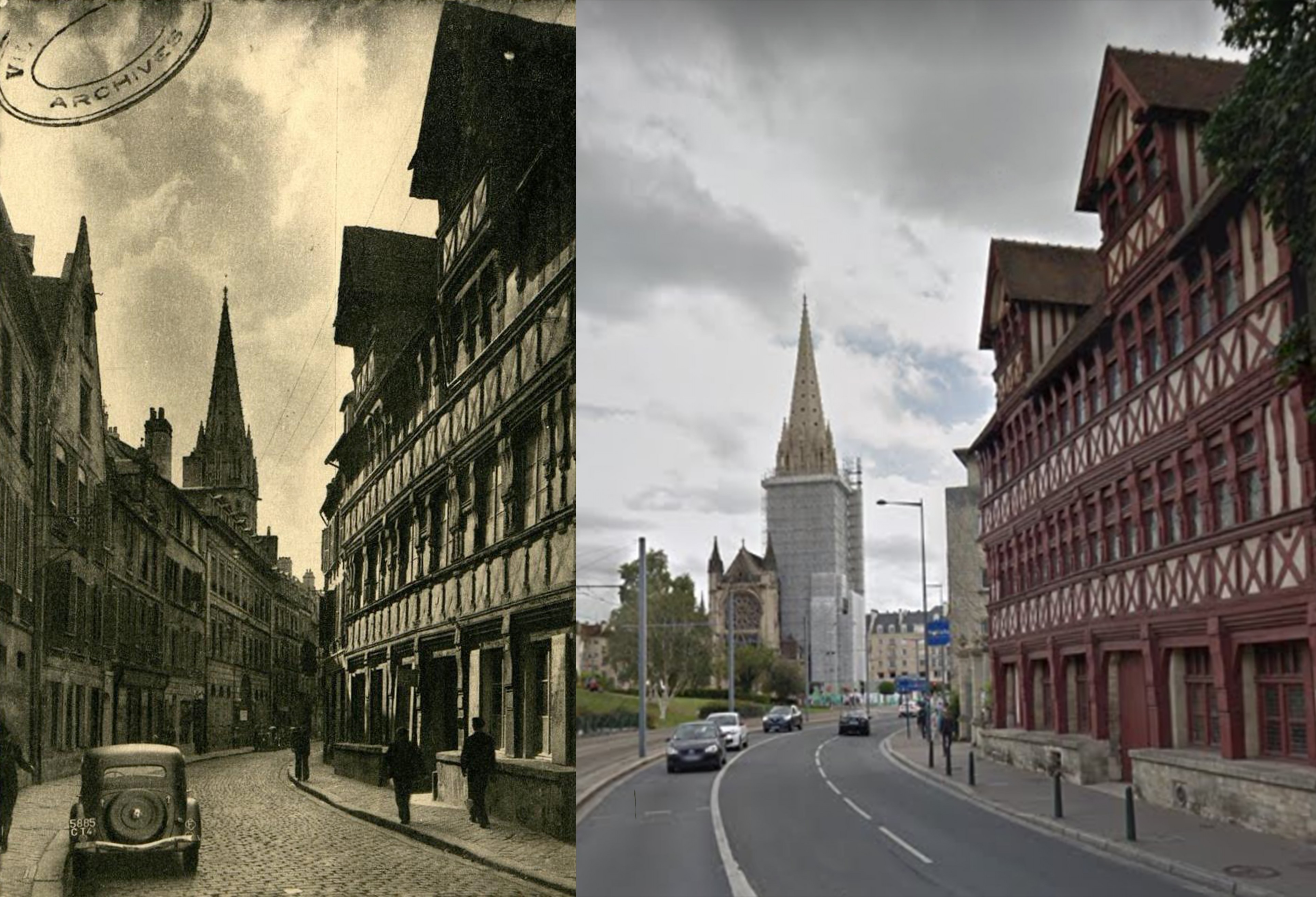
Looking through the album, I was able to recognise a few familiar buildings amid the destruction: churches, streets, houses, the castle… I knew exactly where these were and what they looked like now. I found the comparison really interesting, and this is why I decided to do a little before/after photo shoot when I went home for the Christmas holidays.

St Pierre Church and surrounding area (Coll-164/58)

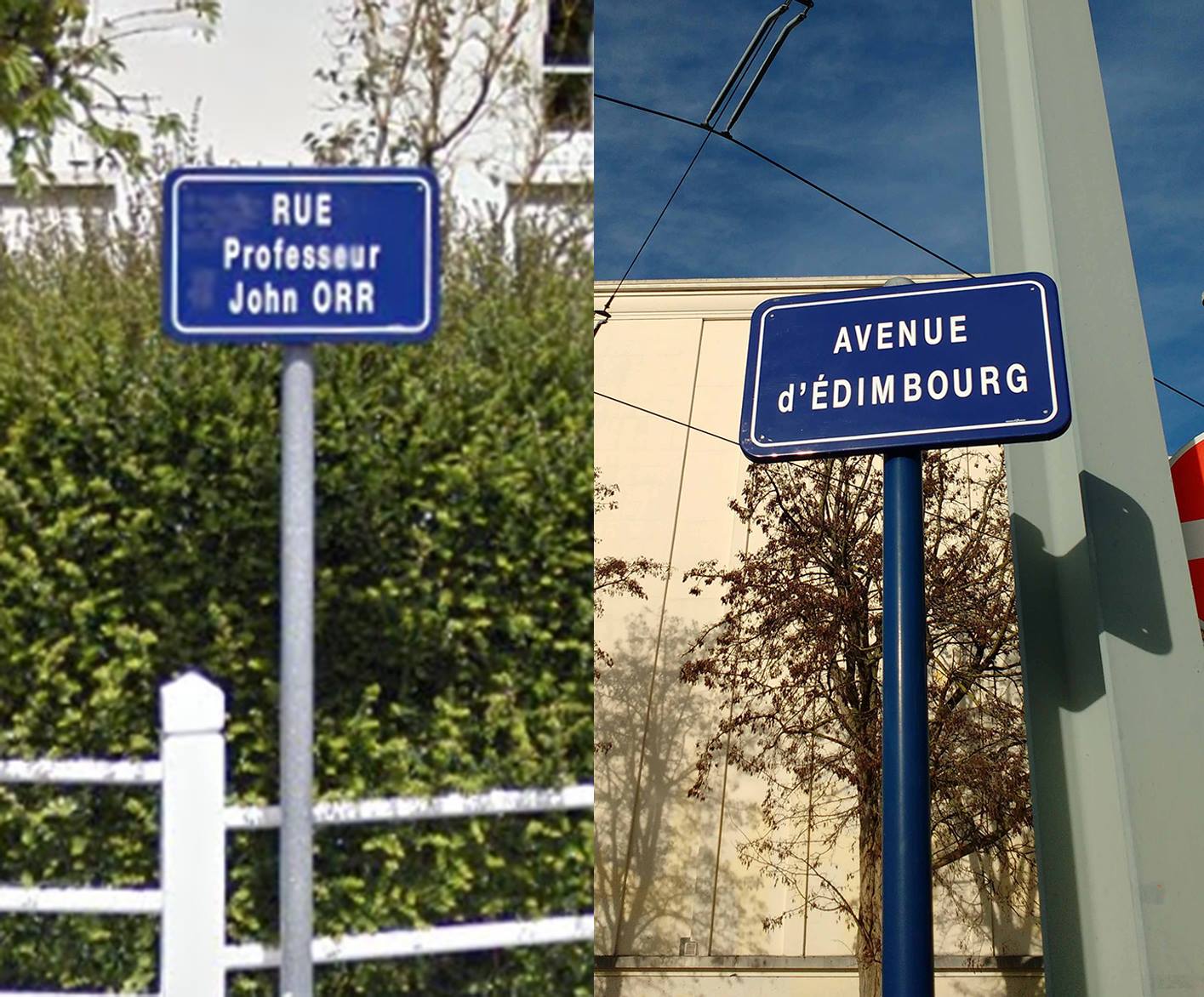
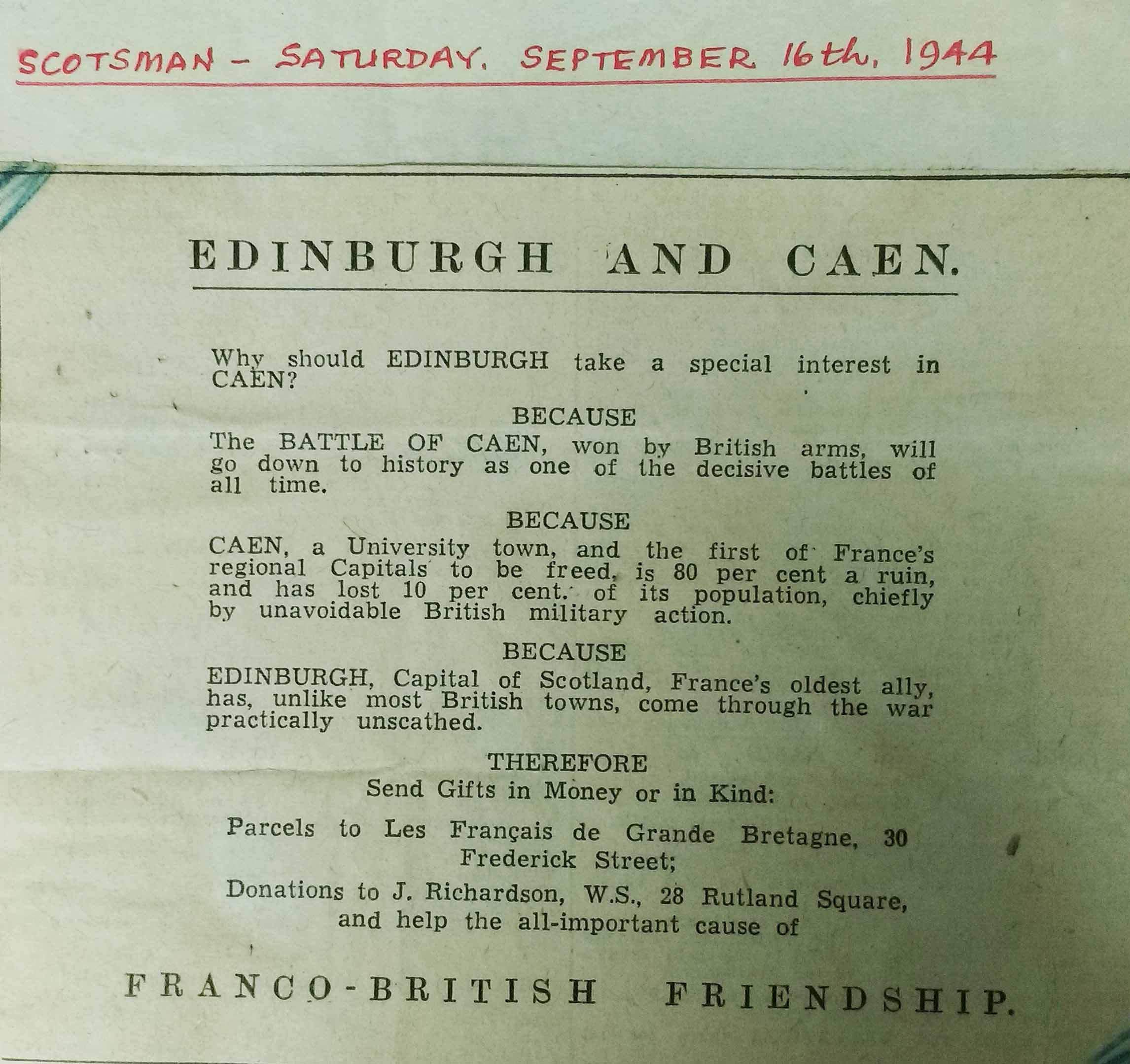
I started my little project on a sunny winter afternoon. Walking past my old university, I remembered that one of the nearby avenues was called ‘Avenue d’Edimbourg‘; and I finally understood why! Edinburgh was one of the cities that sent help and supplies to Caen after the bombing raid. The album is testimony to this connection: it was donated by John Orr, Professor of French at the University of Edinburgh and founder of the Caen-Edinburgh Fellowship. The latter was set up after the war to help the inhabitants of Caen by sending food, clothes, and supplies to the devastated city. John Orr himself organised for books to be sent to the library of the University, which was completely destroyed and had to be rebuilt from scratch, and for this he’s also had a street named after him.   

Street signs named after John Orr.

Call for donations to Caen from the papers of Professor John Orr held in the Special Collections (Coll-77).

I soon arrived in the city centre. The most noticeable building in Caen is its massive castle, founded in 1060 by William the Conqueror. It was used as barracks between 1789 and 1945, and occupied by German troops during the War, which explains why it was targeted by bombings. Some buildings and parts of walls were damaged, but most of it survived in decent condition. The same cannot be said for the houses build alongside its walls…And so, after the clearing of the ruins, the castle reappeared, and it was decided to restore and showcase this millennium-old building that overlooks the city. The words of my grandmother came back to me: ‘We didn’t even know we had a castle because there were so many houses around it! After the war it came a bit as a surprise…’  

Castle of Caen seen from St Pierre Church. The surrounding buildings which were hiding it for centuries were not rebuilt after the war. (Coll-164/61)

Maison des Quatrans. The buildings which were in-between the house and the castle have been destroyed. (Coll-164/71)

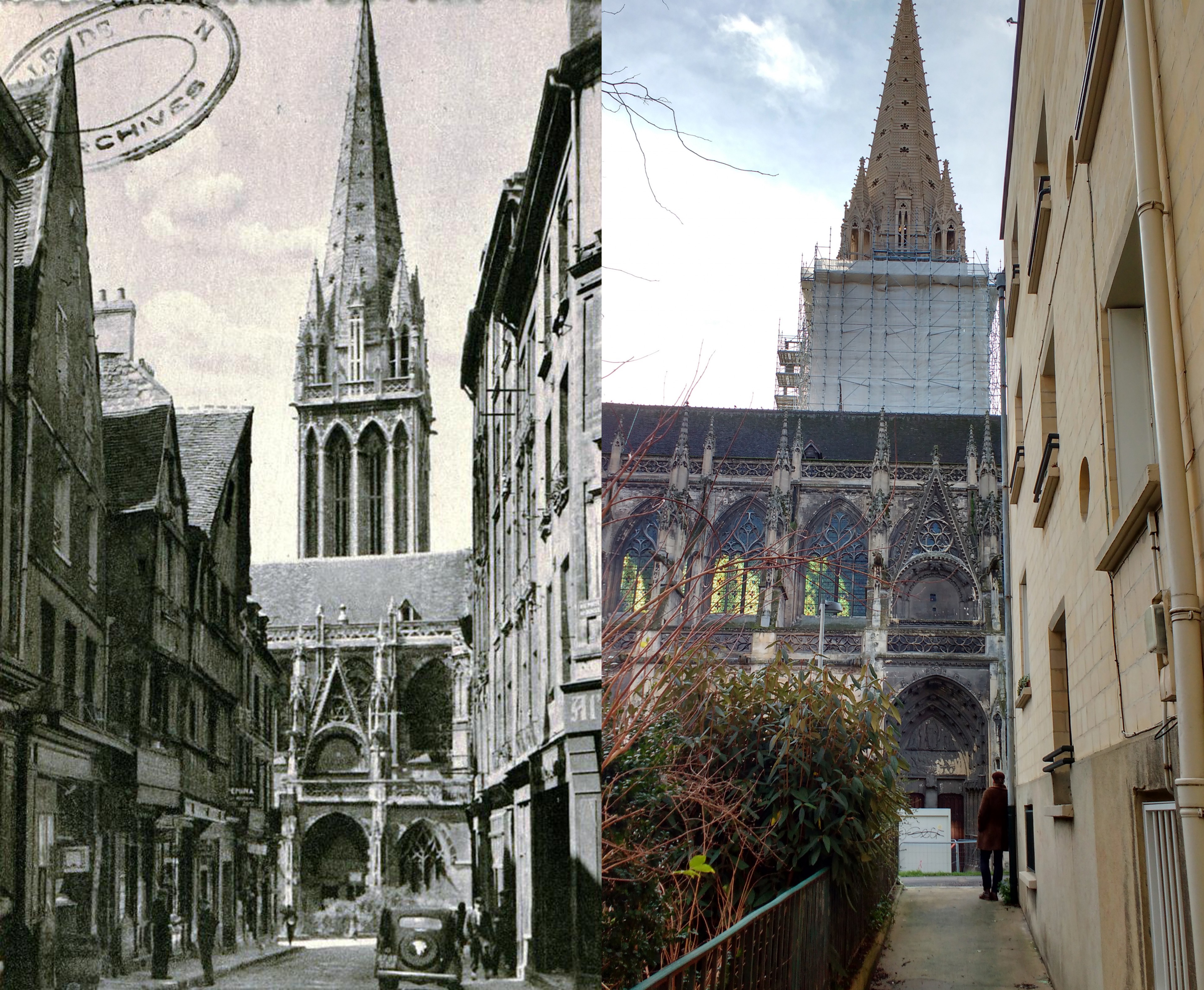
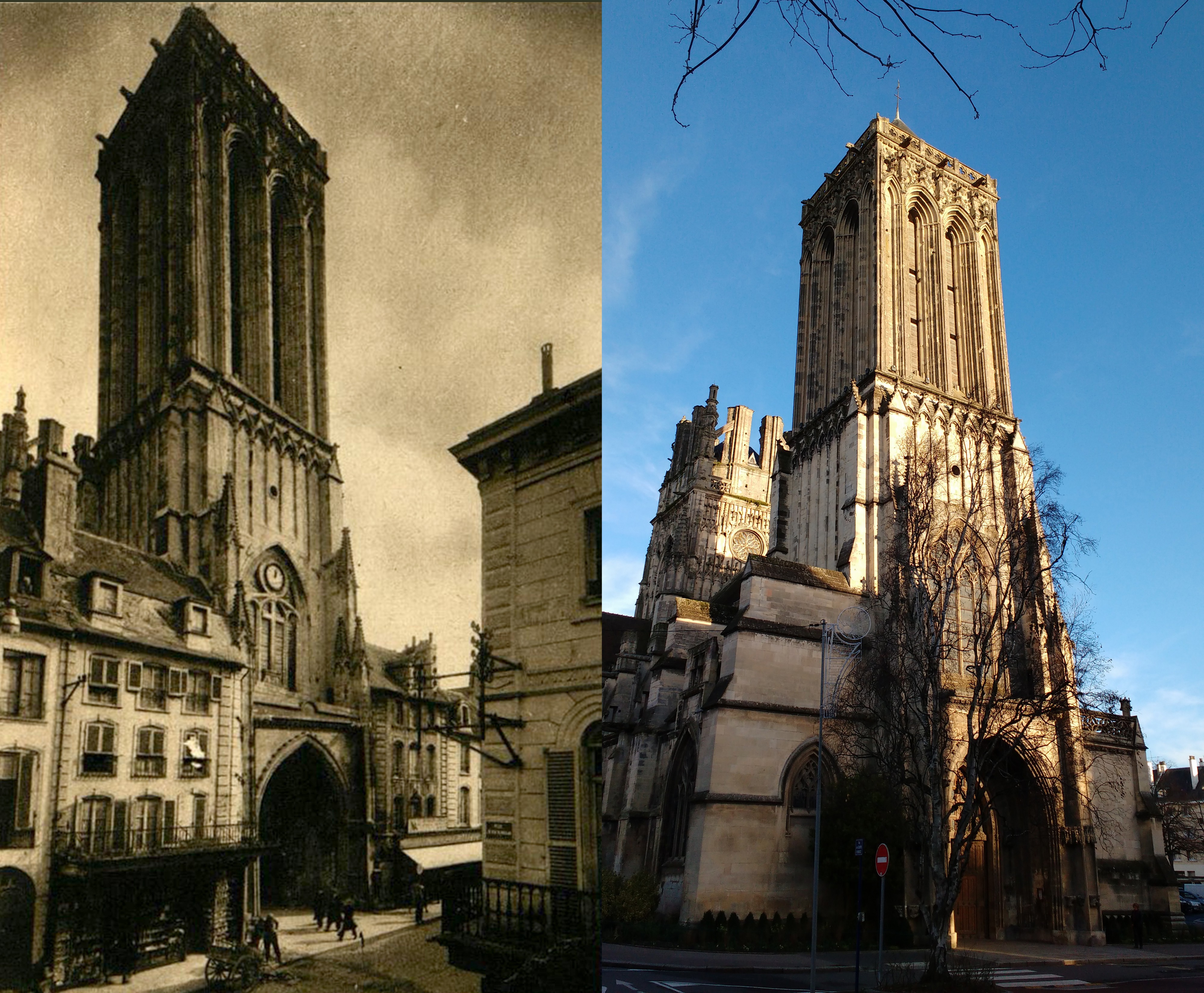
But not everything was completely destroyed in Caen! Our old town centre, the Quartier St-Pierre (‘St Pierre neighbourhood’), still has many original features. The Church, for starter – the tower was destroyed and then rebuilt, and is now being cleaned to restore its original white-yellowish colour, darkened by pollution. The buildings around it, however, went up in smoke. La Rue Montoire Poissonerie (Montoire Poissonerie Street), for example, has vanished.  

St Pierre Church from Rue Montoire Poissonerie (now an apartment building). (Coll-164/11)

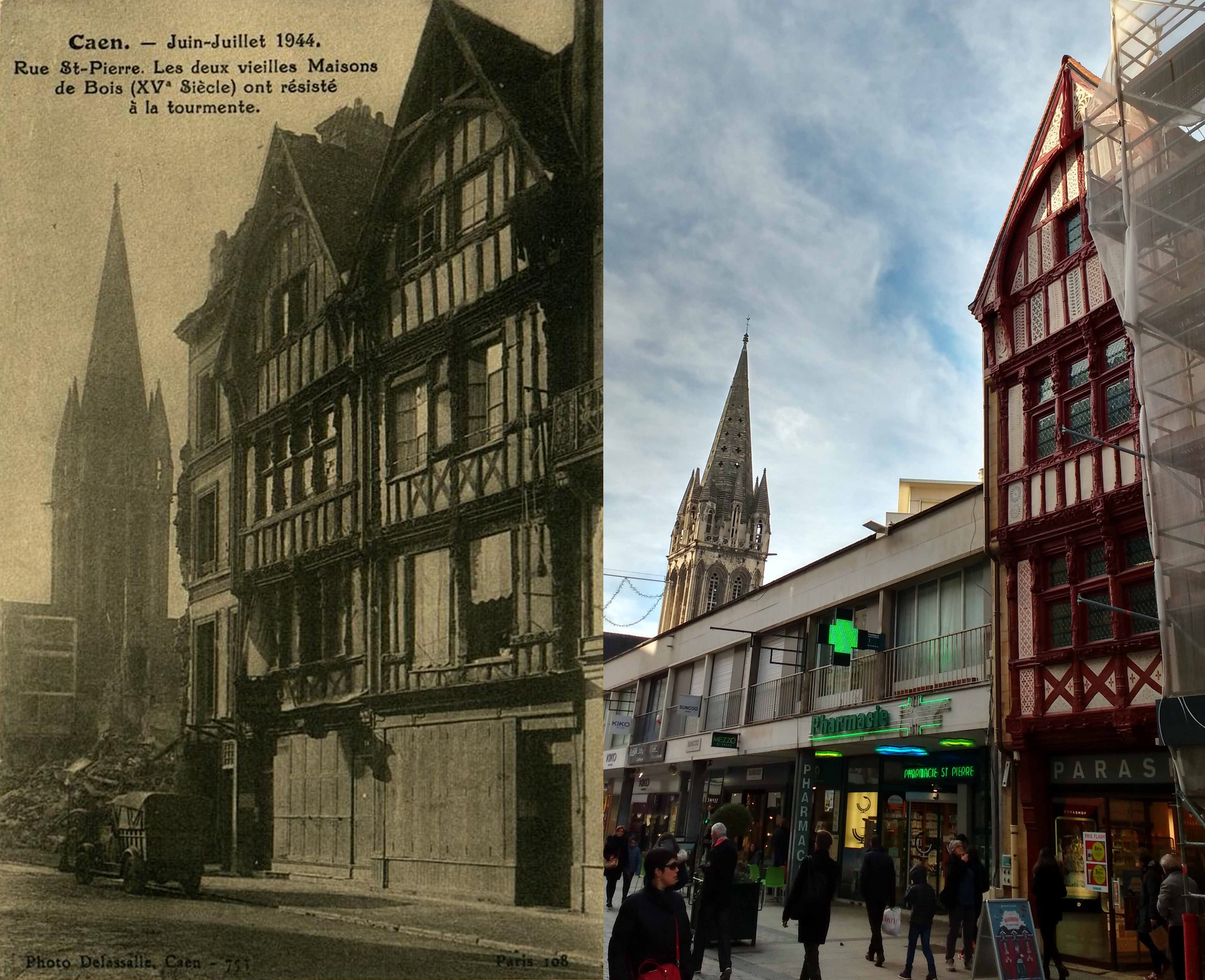
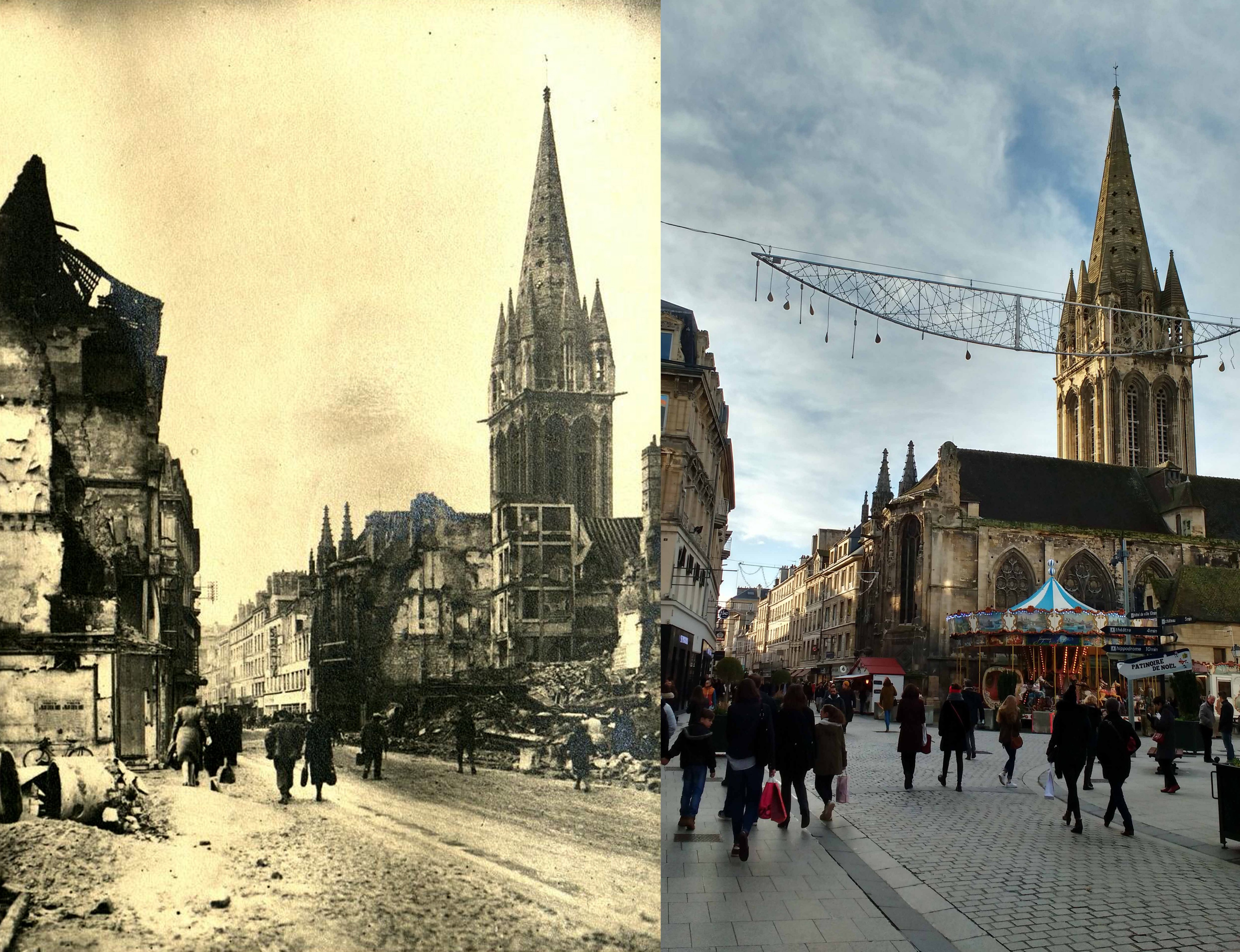
On the other hand, the main street of the neighbourhood, la rue St Pierre, has been more or less spared, and the old stands alongside the new. In the picture below you can see the busy Place St Pierre, full of shoppers and tourists, with the church Notre-Dame-de-Froide-Rue in the background and a beautiful half-timbered house from the 15th century. They miraculously survived, and are now being restored to get their lively colours back!  

Place St Pierre and its 15th century half-timbered houses. (Coll-164/18)

Place St Pierre and Notre-Dame-de-Froide-Rue Church. (Coll-164/38)

As a medievalist, I still regret the loss of the Rue St Jean, a once beautiful street full of hôtels particuliers and ancient half-timbered houses just like the one in the picture above. One of the only original buildings still standing is the very curious Eglise Saint-Jean – which has the particularity of being completely wonky! Our very own modest Pisa Tower, which is leaning because Caen was built on unstable grounds. Everybody thought this fragile building would never last – little did they know it would be the only monument to survive the raid of St-Jean street.  

Eglise Saint-Jean, which is much sturdier than it looks…(Coll-164/72)

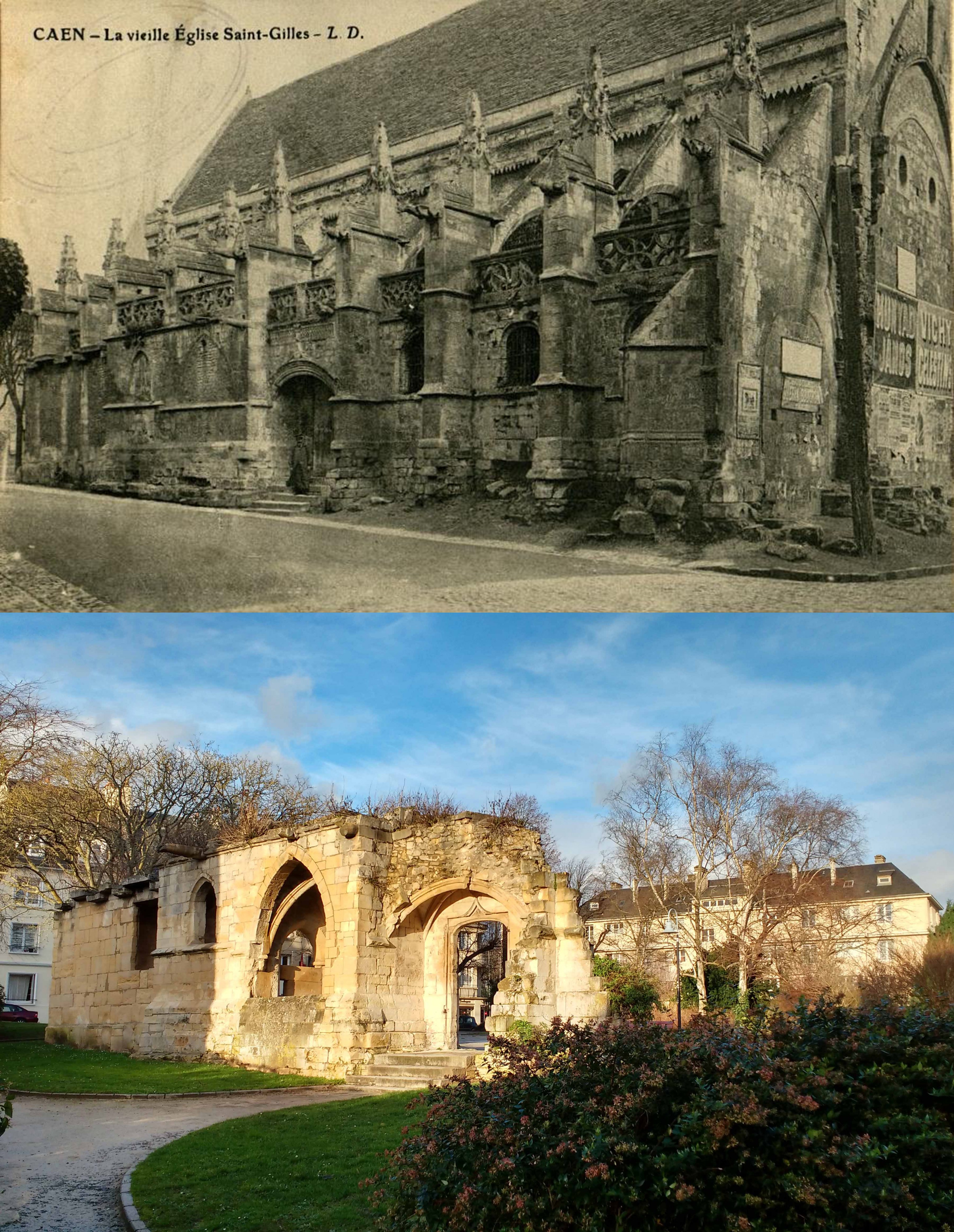
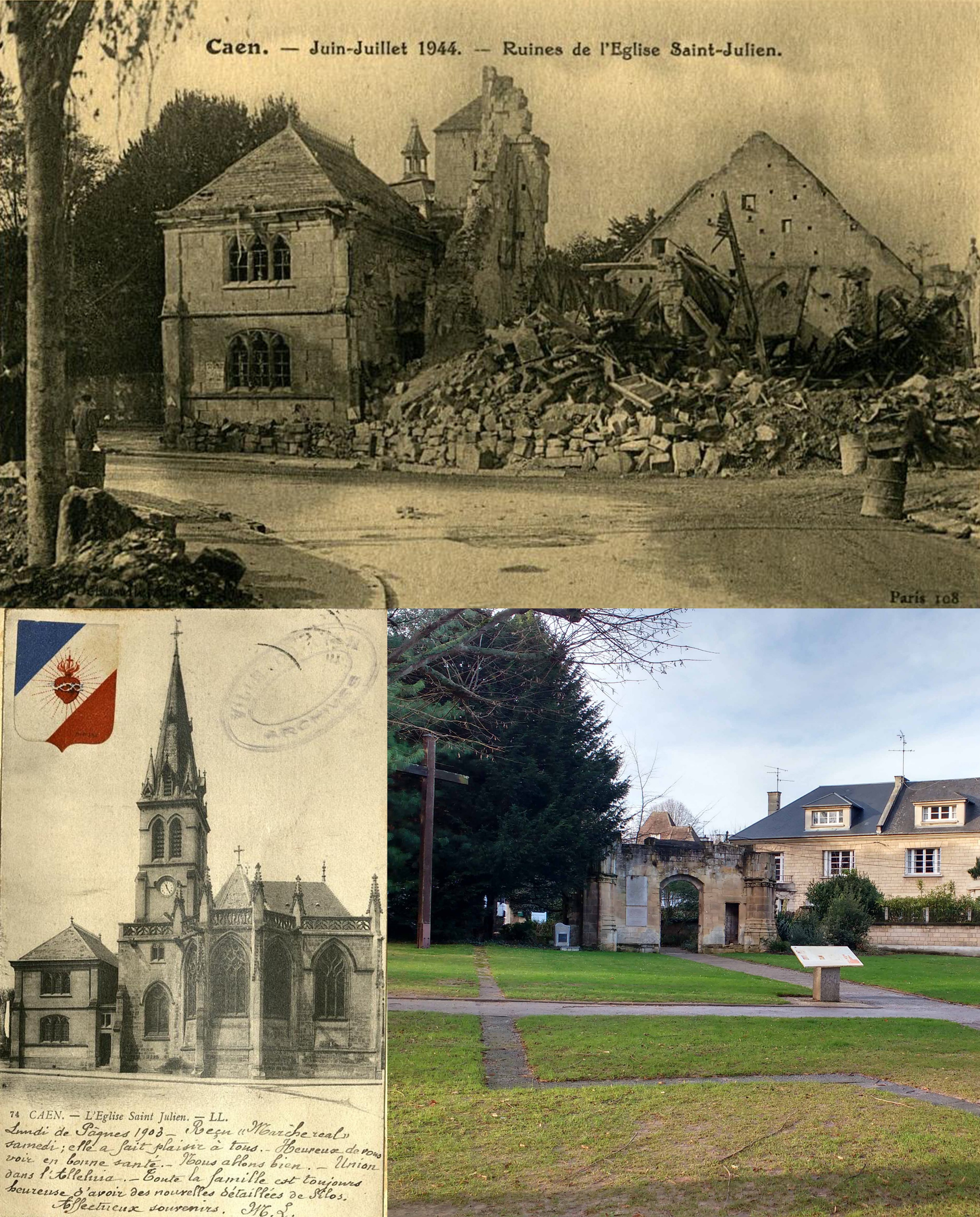
Sometimes, there was nothing to save but a section of wall, a half-collapsed doorway, the base of a pillar…left as a memory, a reminder of what the city had gone through: 

Saint-Gilles Church, now a small park. The only recognisable feature is an archway. (Coll-164/36)

Saint-Julien Church before, during and after the bombings. (Coll-164/45 and Coll-164/48)

Like many French towns and cities, old Caen was full of narrow, dark medieval streets that would add a lot of charm to a city nowadays. I remember lamenting about the destruction of these quaint quarters – some of the largest boulevards in Caen have actually been shaped by American bulldozers –, and my grandfather replying: ‘it was dark and dirty before, very cold and inconvenient. It’s nicer now. They did a good job rebuilding everything’. The inhabitants rebuilt their home with the very typical Caen stone, which has a light and warm yellow colour, and the new blends in with the old. The city may not be as beautiful as other French towns spared by the war, but it is a nice place to live, where history has left its mark.  

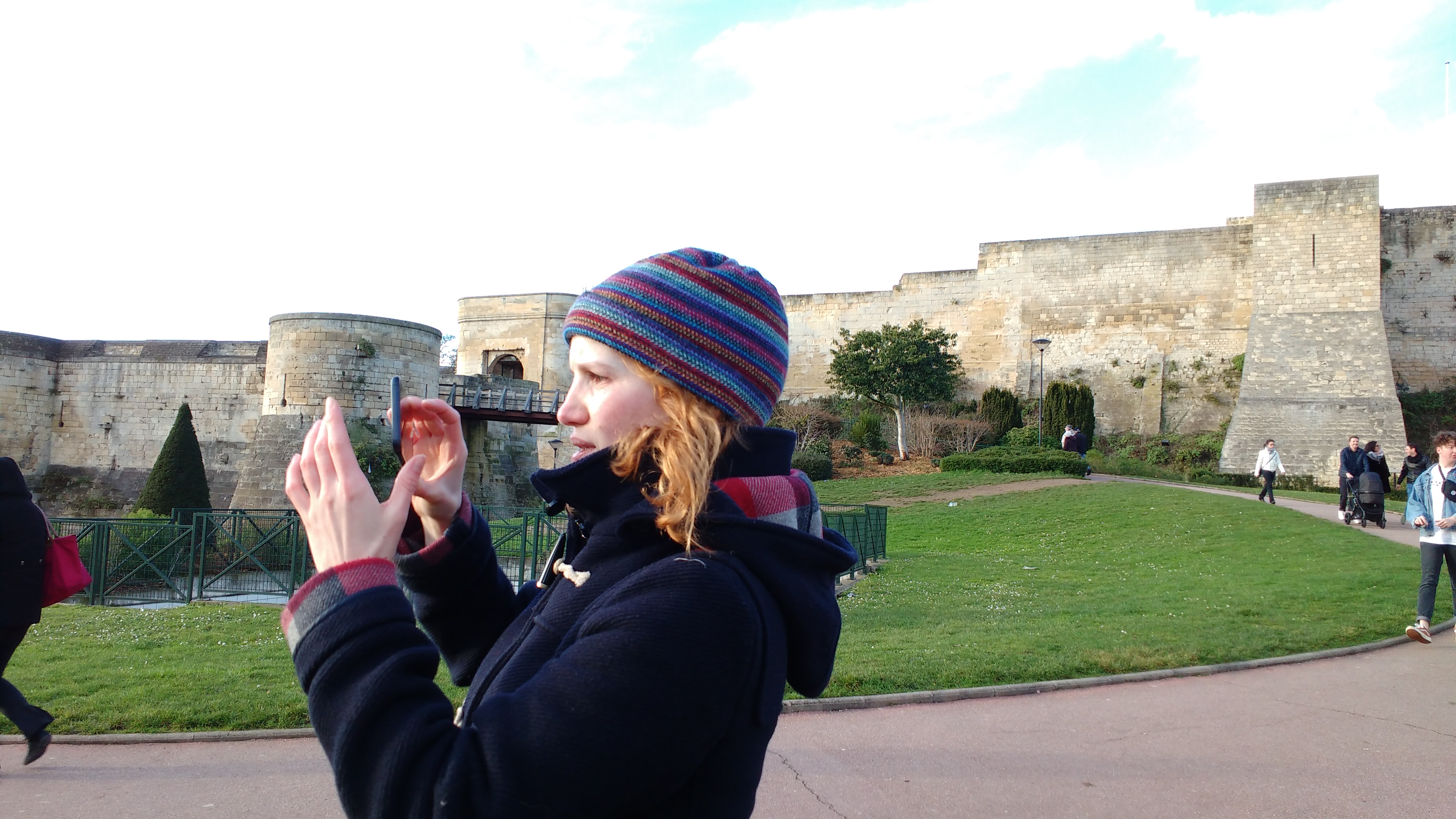
Our archivist doing some fieldwork…

Description of the album on ArchivesSpace: https://archives.collections.ed.ac.uk/repositories/2/resources/312

Aline Brodin, cataloguing archivist, 6 June 2018.

Special thanks to Clément Guézais and Inès Prat for their help in taking and editing the photographs.

Earlier this year, our two interns Sarah and Devon spent a few months re-housing and listing the papers of the Hungarian violinist Joseph Joachim (1831-1907), recently donated to the CRC. They share their experiences with us.

Sarah Hendriks:

When I was about eight years old my violin teacher gave me a new piece of music and said, ‘now you get to play a real piece’. It was Joachim’s Hungarian Dance No. 4 and I loved it. It’s remained one of my favourite pieces to play and its folksy, vibrant style inspired my later love of other composers like Bloch and Kreisler.

Despite loving his music, I knew relatively little about Joachim the man until I took on this internship at Special Collections. By going through the collection I discovered so much about Joachim, his family, his music, and his life. I also got to meet his relatives and talk about the collection and hear their recollections of the items. Matching the stories to the items I’d been reading and examining for the last two months reinforced the human aspect of the material I’d been working with: such a rare experience!

Over the last three months I’ve catalogued what feels like hundreds of newspaper clippings, notes, concert programmes, photographs, and music. I’ve had the chance to brush up my German whilst reading the mountain of obituaries and anecdotes about him, his violins and his performances. There were also notes about his life in Hungarian and a poem in French on the occasion of his death. Buried amongst the newspaper clippings was a handwritten account of a family holiday: I’d never read a more touching portrait of the man.

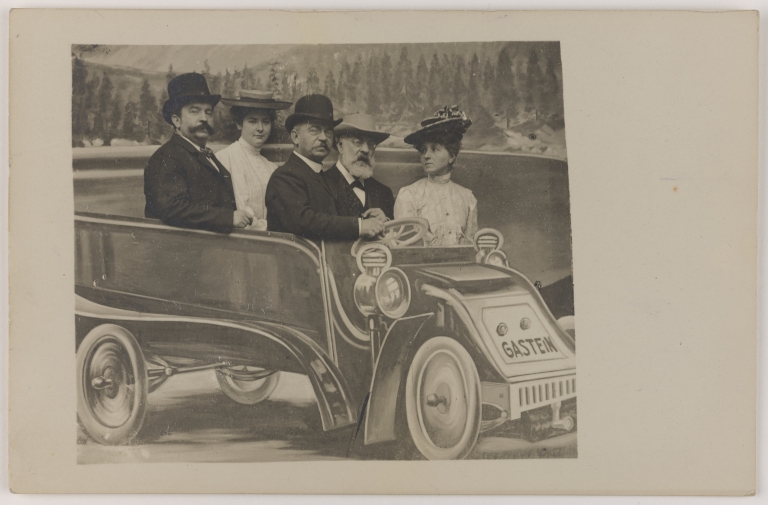
Postcard of Joseph Joachim in a fake car with the Mendelssohn brothers, 1890-1907 (Coll-1711/5/5)

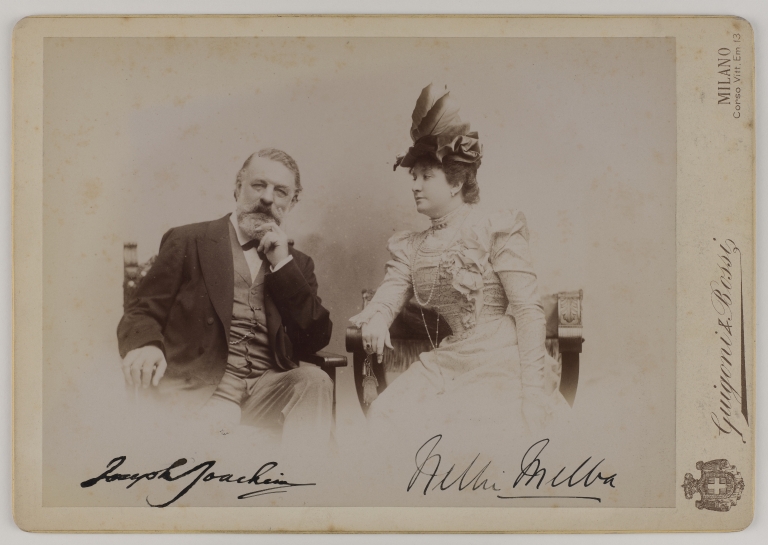
The highlights for me, however, were the photographs. Joachim apparently loved a joke and you can see this in the picture of him in a fake car. The images also captured his pensive side, reading his letters in front of a fire or concentrating on some German verse. A particularly special picture for me is the one of Joachim with Nellie Melba, a fellow Australian whose alma mater I also attended. Apparently they were great friends with an equally adventurous sense of fun that often perplexed those around them. I like to think you can see a touch of this camaraderie in their portrait.

Working with archives is, for me, always exciting. You never quite know what you’re going to come across or discover and so often the material hasn’t been examined in a long time. The Joachim archive was so full of delights and surprises and it exceeded all my expectations. This internship has been a wonderful experience and one I would highly recommend. It would not have been possible without the generosity of the Joachim family and the support of the Special Collections Team and I’d like to thank them both for the opportunity. I’ve learnt so much about the practical side to archive management and processing, but also had an awful lot of fun learning about a hero in the process. I can’t wait for the next one!

Signed image mounted on card of Joseph Joachim and Nellie Melba, taken by Guigoni & Bossi, Milan, late 19th/early 20th c. (Coll-1711/5/7)

Devon Barnett: 

I wanted to be an Archive Intern so that I could learn first-hand the processes behind turning a collection of items into an organised and usable resource. As a Music graduate, it was an added benefit that the archive I would be working on centred around an important figure in classical music – Joseph Joachim. While working on the Joseph Joachim collection I have learned how to box list items, how to identify anything that may need to be sent to conservation, how to think about what items may be useful and beneficial to be digitised, and how to best categorise, arrange, and reference the items as well as a collection of books.

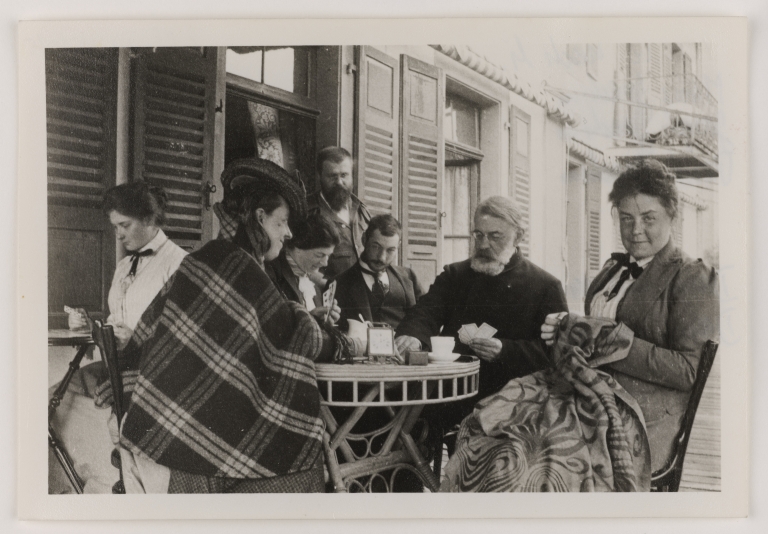
Image of Joseph Joachim playing cards outside a coffee shop, 1890-1907 (Coll-1711/5/12/5)

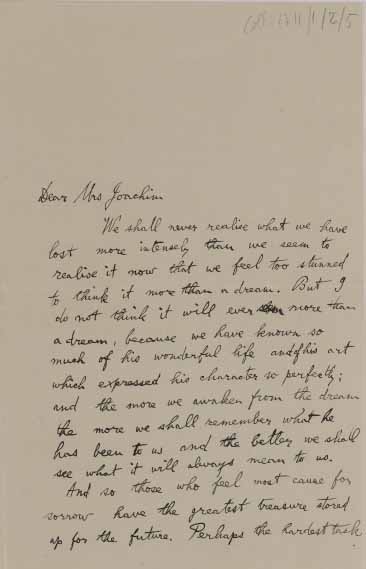
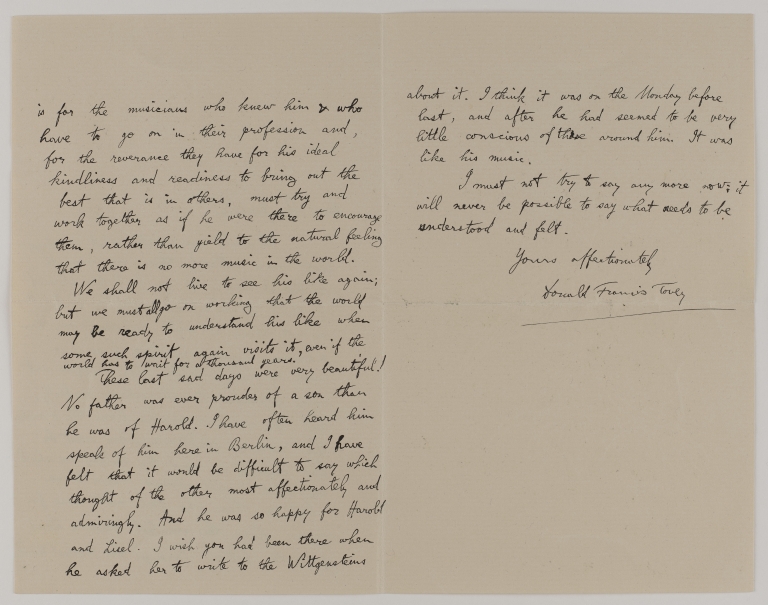
I have also learned a lot about Joseph Joachim, both his musical output and his personal life. Shockingly, I had never heard his name even once in my entire four years of studying a music degree and I did not know that he is owed at least in part for helping Johannes Brahms to find success and for helping Clara Schumann to care for Robert Schumann in his final years of critical mental illness. My favourite item of the collection by far was a letter written in 1907 by Donald Francis Tovey. It was written to an unspecified ‘Mrs Joachim’ and concerned the recent passing of Joseph Joachim. The letter is beautifully and poetically written, and really shows the loss felt by the music world. The letter is also important for its personal connection to Edinburgh. Tovey was a composer, musician, musicologist, and close friend of Joseph Joachim. Tovey became the Reid Professor of Music at the University of Edinburgh’s Reid School of Music (from which I have just graduated), and at which there now exists the position of Tovey Professor and the award of the Sir Tovey Memorial Prize for outstanding promise shown in composition or performance. As the university is home to not only the Joseph Joachim collection but also a collection of Tovey’s large collection of books and music scores, this letter is significant and relevant to both, tying them nicely together to both each other and the university.

Letter to ‘Mrs Joachim’ from Donald Francis Tovey on the subject of Joseph Joachim’s death, 1907, p.1 (Coll-1711/1/2/5) (click here for a higher resolution image)

Letter to ‘Mrs Joachim’ from Donald Francis Tovey on the subject of Joseph Joachim’s death, 1907, p.2 (Coll-1711/1/2/5) (click here for a higher resolution image)

Their fantastic work has enabled us to create a great resource on our online discovery platform, ArchivesSpace. Click here to see the catalogue.