Home University of Edinburgh Library Essentials
March 27, 2026

Commonplace Book of Harriet Holmes
Posted on November 19, 2025 | in Uncategorized | by lbeattieToday we are publishing an article by Ash Mowat, a volunteer in the Civic Engagement team, on the common-place book of Harriet Holmes, an 1818 – 1820 notebook which references a wide variety of material, from the voting and election system in Great Britain, to Icelandic musical instruments, to the dangers of pearl fishing in the Persian Gulf.
In this blog, we shall explore the common-place book of Harriet Holmes, an 1818-1820 notebook held in the University of Edinburgh’s Centre for Research Collections. [1] Harriet Holmes, later Harriet Spencer, shows a diversity of interests and subjects in her journal, which includes both observational writings of her own experiences, together with commentary of other texts and events. They clearly demonstrate her extensive and diverse level of education that would have been unconventional for a woman of the period.
The journal comes to an abrupt halt mid-sentence around the time of the birth of her son Herbert Spencer, who was to become a celebrated polymath with areas of specialism in many fields such as anthropology, philosophy and biology, having first employing the term “the survival of the fittest”.[2]
It is not always clear in her notes when she is referencing another author’s text and if so the identity of the source, therefore I have striven to mainly focus on pieces which are her own compositions.
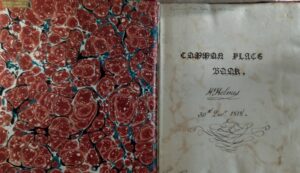
(Image above from opening cover of the book).
In an early entry she is found recording English history from the 800s. “England is said to have been first divided into shires or counties by Alfred the Great. All our historians agree in representing him as one of the most valiant and best of Kings that ever reigned in England, and it is generally allowed that he….laid the first foundation of our present happy constitution. There is great reason to believe that we are indebted to this Prince for our trials by Jury’s.”
She goes on to examine, detail and question some current demographics on the voting and election system with Great Britain. “Electors of Members of Parliament for Great Britain: England has a total of 112, 875 eligible voters (all men, of course in this era), Wales 6752, and Scotland 2657, a total of 122,044. Should this be correct what proportion does the number bear by a population of nearly 12 million?”
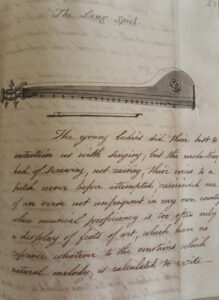
(An image from the notebook showing an illustration by Harriet Holmes and her written observations).
There then follows an account by Harriet of her visit to Iceland and of hearing a performance on the musical instrument native to this country. She was clearly impressed by the technicality and musical capabilities of instrument, if less enthused by and a somewhat harsh critic of Icelandic fiddle players and singing. [Note: if you would like to view a Langspil there is one on display in the Education Room at St Cecilia’s Hall]
“Description of the Lang Spiel (Langspil).[3] Having heard nothing of the kind before in Iceland, except the miserable scraping of the fiddle in the Reykjavik ball-room, the pleasure was now derived from agreeable sounds and harmonious music was very great. When our first surprise was over we thought that the music, which proceeded from the apartment above, was from a pianoforte, but we were told it was from an Icelandic instrument called the Lang Spiel, and that the performers were the son and daughter of Mr Stephenson, whose proficiency upon the instrument was very great. The Lang Spiel, which was brought down for our inspection, consists of a narrow wooden box about three feet long, bulging at one end, where there is a sound hole, and terminating at the other like a violin. The young ladies did their best to entertain us with singing, but the mode they had of soaring not raising their voices to a pitch never before attempted, reminded me of an error not infrequent in my own country, where musical proficiency is too often only a display of feats of art, which have no reference whatsoever to the emotions which natural melody is calculated to excite.”
Commenting further on the role and origins of Icelandic music she records some illuminating details that hint at the rich folklore embedded in the Icelandic arts. “It appears that music was known as a science-we were advised by Mr Stephenson and others that these were very old and native compositions.”
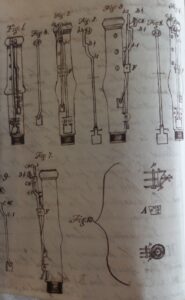
(In the image above, we see another fine example of the excellent artistic skills of Harriet Holmes, in this brilliantly captured image of a woodwind instrument, observed from several angles).
In another short piece, also on a musical note, she annotates the following attributed to Caroline Stephanie-Delicite (Madame De Genlis).[4] “Musical cascades, by an ingenious mechanical contrivance, the cascade in the garden of the Villa Borghese really performs Corelli’s beautiful sonata for the harpsichord and flute obligata. There is, at Naples, a musical cascade of the same description.” I was intrigued reading this on the nature of the instrument described but have not been able to identify what it was. It could be a work of fiction as De Genlis was a both a novelist and playwright, in addition to being an educationalist.
In her final entries she reports on her travels to the Persian Gulf and of the Pearl fishing trade. It is refreshing and welcoming that she takes time to describe, detail and empathise with the harsh working conditions of the divers employed in this industry, and of the hazards and hardships that they endure.
“Pearl Fishers- There is, perhaps, no place in the world where those things which are esteemed richer among men, abound more than in the Persian Gulf. The island of Bahrain, on the Arabian shore, has been considered the most productive bank in pearly oysters. There are two kinds, the yellow pearl which is sent to the Mahratta market, and the white pearl which is circulated through Bagdad and into Asia minor, and hence into the heart of Europe. The divers seldom live to a great age, their bodies break out in sores, their eyes become very weak and bloodshot. They can remain under water 5 minutes, and their dives succeed one after another very rapidly, as by delay the state of their bodies would soon prevent the renewal of the exertion. In general, they are restricted to certain regimes, and to food composed of dates and other light ingredients. They can dive from 10 to 15 fathoms (27 meters) and sometimes even more.”
The journal concludes still in Persia with an account of a royal equestrian event. “The master of ceremonies in the field was Persian who carried an ornamental and gilded spear. One of the two princes was mounted on white horses, the legs belly and lower part of the buttocks of which were dyed a rich orange colour, terminated at the top by little flowers”.
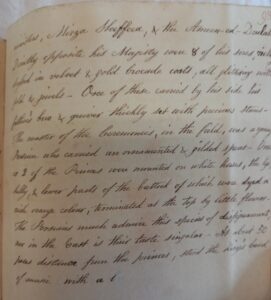
And thus, abruptly as above, the journal ends dramatically mid-sentence not to be resumed. According to the archive history halting at this point just as Harriet gave birth to her son.
It was fascinating to get this insight into early 19th century English life, from a well-educated writer who clearly both was a keen observer of life. and one with a diverse range of experiences and interests. It was a privilege to view this well- preserved journal, and I should like to express my gratitude to my supervisor Laura Beattie (Community Engagement Officer, University of Edinburgh) and to the library staff at the Centre for Research Collections.
[1] Collection: Common-place book of Harriet Holmes, 1818 | University of Edinburgh Archive and Manuscript Collections
Collections
 Hill and Adamson Collection: an insight into Edinburgh’s past
My name is Phoebe Kirkland, I am an MSc East Asian Studies student, and for...
Cataloguing the private papers of Archibald Hunter Campbell: A Journey Through Correspondence
My name is Pauline Vincent, I am a student in my last year of a...
Hill and Adamson Collection: an insight into Edinburgh’s past
My name is Phoebe Kirkland, I am an MSc East Asian Studies student, and for...
Cataloguing the private papers of Archibald Hunter Campbell: A Journey Through Correspondence
My name is Pauline Vincent, I am a student in my last year of a...

Projects
Cataloguing the private papers of Archibald Hunter Campbell: A Journey Through Correspondence
My name is Pauline Vincent, I am a student in my last year of a...
Archival Provenance Research Project: Lishan’s Experience
Presentation My name is Lishan Zou, I am a fourth year History and Politics student....