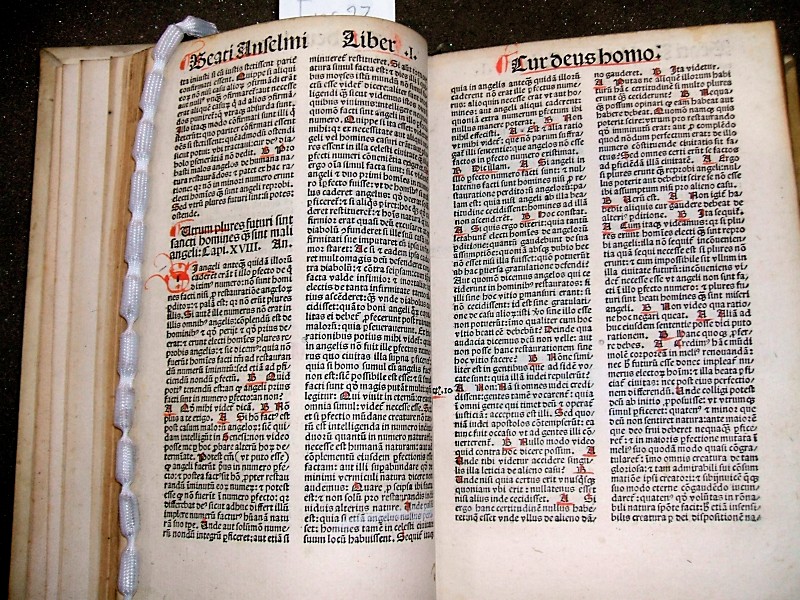
Early printed works of St Anselm on display at New College Library

Inc 27New on display in the Funk Reading Room is the Works of St Anselm,  Opuscula beati Anselmi archiepiscopi Ca[n]tuarie[n]sis ordinis Sancti Benedicti, printed in 1497.

April 21 is the Feast Day of St Anselm (1033-1109). A Benedictine monk who lived during the reigns of William the Conqueror and William Rufus, he became the abbot of the monastery at Bec in  Normandy, France. Named as Archbishop of Canterbury in 1093  by William Rufus, under the rule of Henry I Anselm faced the challenges of preserving the secular and spiritual rights of the Church in the face of the authority of the King. Despite these political difficulties, Anselm held two great ecclesiastical councils at Lambeth and York  where many decrees for church reform were made.

Anselm’s prayers and meditations (accessible online to University of Edinburgh users in the Patrologia Latina)  had a lasting influence through the middle ages, but his writings also made a significant contribution to theological debate into the twentieth century and beyond.

New College Library holds two copies of Anselm’s works in the Incunabula Collection, which was recently catalogued online as part of the Funk Cataloguing Projects.

Sources

D.H. Farmer, ‘Anselm (1033-1109)’, The Oxford Dictionary of Saints, Oxford University Press, 2011; online edn 2012 [http://www.oxfordreference.com, accessed 17 April 2013]

The medieval monk who gave his name to Ockham’s Razor

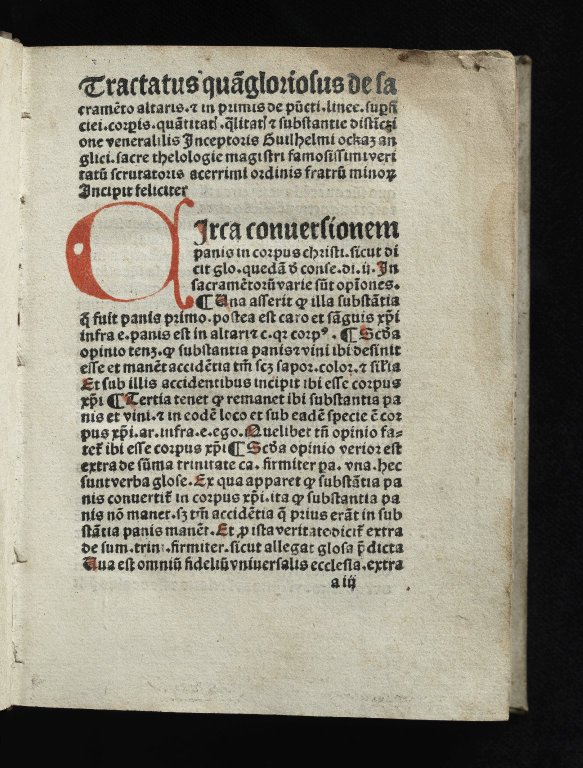
De Sacramento Altaris

Tractatus venerabilis Inceptoris Guilgelmi Ocka[m] de sacramento altaris. William, of Ockham. Paris, [1495].

New College Library holds this copy of William of Ockham’s  De Sacramento Altaris,  a treatise on the Eucharist, in the Incunabula collection.

William of Ockham was born at Ockham, near Guildford in Surrey in 1287 and he died on the night of April 9 1347 in Munich. The future theologian and  philosopher entered the Franciscan order before the age of fourteen. He was educated at the Franciscan convent in London, and developed an academic career as a  lecturer and theological writer in Oxford and London. His unconventional views attracted attention within the Church and in1324 Ockham was apparently summoned to Avignon to have his writings examined for heresy, but in the end no formal condemnation took place. However his life came to a crisis after he challenged the doctrine of  Pope John XXII, saying that Jesus and the apostles owned no property but,  like the Franciscans,  lived by begging and the generosity of others. Along with other Franciscans he fled to Munich where he ended his days.

The methodological principle known as “Ockham’s Razor” states that among competing hypotheses, the one that makes the fewest assumptions should be selected. It is described as a razor because it distinguishes between hypotheses by “shaving away” unnecessary assumptions.

Sources:

(1) Spade, Paul Vincent and Panaccio, Claude, “William of Ockham”, The Stanford Encyclopedia of Philosophy (Fall 2011 Edition), Edward N. Zalta (ed.), URL = <http://plato.stanford.edu/archives/fall2011/entries/ockham/>.

(2) W. J. Courtenay, ‘Ockham, William (c.1287–1347)’, Oxford Dictionary of National Biography, Oxford University Press, 2004; online edn, May 2010 [http://www.oxforddnb.com/view/article/20493, accessed 8 April 2013]
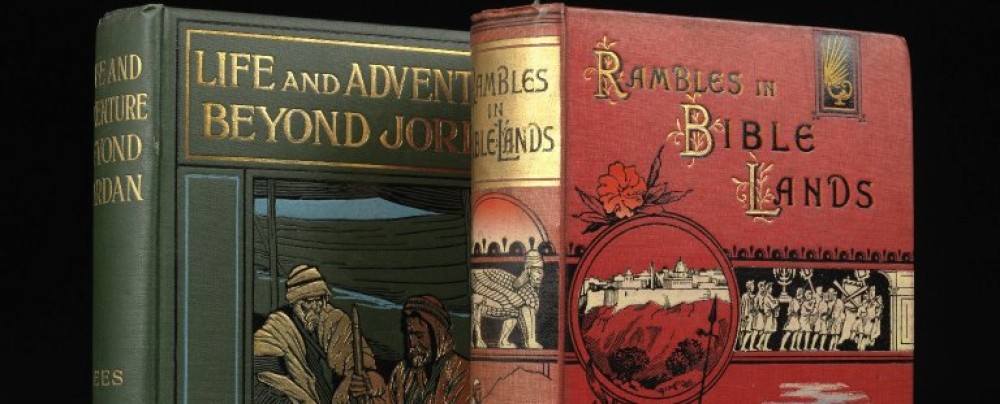
New College Library Edinburgh rare books to be added to Early English Books Online #EEBO

EEBO LogoPhotographers are occupying my office again today  for digital photography of a number of rare books from New College Library’s collections, to be loaded onto Early English Books Online (EEBO).  Available to University of Edinburgh users, EEBO contains digital facsimile page images of virtually every work printed in England, Ireland, Scotland, Wales and British North America and works in English printed elsewhere from 1473-1700.  We’re delighted that New College Library’s collections will be shared with the world in this way.  The earliest book to be filmed is Hemmingsen, Niels, The professions of the true church, and of poperie compared,  Oxford, J. Barnes, 1585 . Most of the other examples are seventeenth century works, such as Austin, William, Hæc homo, wherein the excellency of the creation of woman is described, 1639.

Divinity Student book recommendations now available

All these books (and more) were recommended by Divinity students and are now available to University of Edinburgh Library users – more details on the library catalogue. 100+ book recommendations from Divinity students have been received over the last four months, via the student recommendation form on the Library website.

Historic Papal politics : Platina’s Lives of the Popes

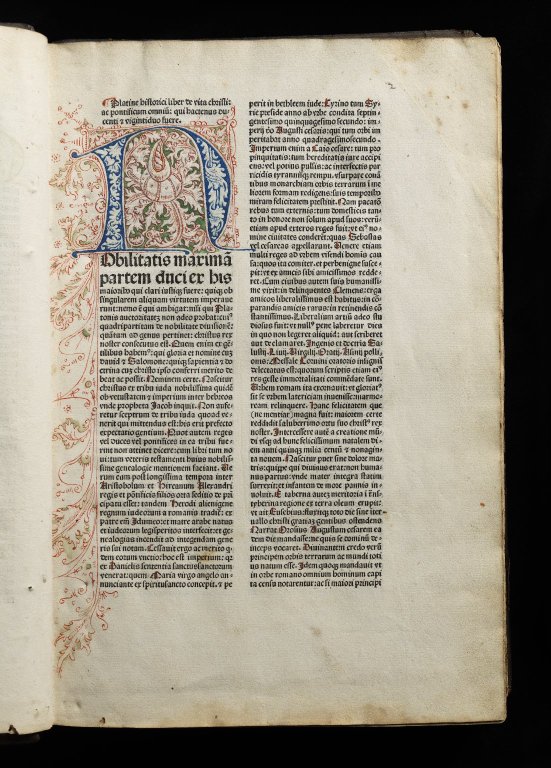
Platine historici liber de vita Christi ac pontificum omniu : qui hactenus ducenti et vigintiduo fuere. New College Library, Inc. 66

Platine historici liber de vita Christi ac pontificum omniu : qui hactenus ducenti et vigintiduo fuere, 1481. New College Library, Inc. 66

Bartolomeo Platina, (1421-1481) was a writer and member of the College of Abbreviators in Rome, a body of writers in the papal chancery who prepared the Pope’s bulls, briefs and decrees before they were formally written out by scribes. Deprived of his office and imprisoned by Pope Paul II, he left a lasting vengeance for his enemy in his Vitæ Pontificum Platinæ historici liber de vita Christi (1479). As well as being a polemic against his enemy, Platina’s Lives of the Popes was an invaluable early handbook of papal history which had an enduring influence on historical opinions.

New College Library holds this 1481 edition of Platina’s Vitæ Pontificum in the Incunabula Collection, catalogued online as part of the Funk Cataloguing Projects. A manuscript note records the original owner as F. Sargent, the donor of other rare and valuable items to New College Library.

Scotland’s last saint : St John Ogilvie

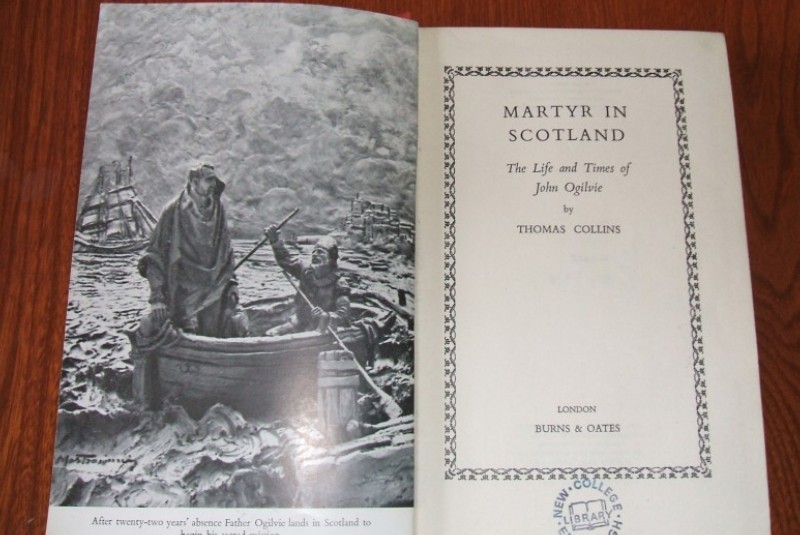
Martyr in ScotlandThe 10th of  March is celebrated as the feast day of St John Ogilvie in the Roman Catholic Church. The only post-Reformation saint from Scotland.  John Ogilvie (1578/9–1615) was born and brought up as a Calvinist in Strathisla, Banffshire. After studying at the Protestant University of Helmstedt in northern Germany, he became a Catholic, and after further study took his vows as a Jesuit priest in 1601. Ogilvie volunteered for missionary work in Scotland, and arrived in Leith in 1613. Ogilvie’s work was to administer the sacraments to Catholics, bring doubters back to the fold, and seek new converts throughout  Edinburgh, Glasgow and Renfrewshire. It On 4 October 1614 he was betrayed and captured while walking in a Glasgow street. The authorities’ narrative of his trial and execution was printed as A true relation, of the proceedings against Iohn Ogiluie, a Iesuit … (1615), available  to University of Edinburgh users via Early English Books Online. While other Catholics suffered trial and imprisonment at this time, “Ogilvie was the only Catholic in Scotland ever to be judicially sentenced and executed for his religion” (1).

In the nineteenth century John Ogilvie was rediscovered with the publication of Scottish historical sources, leading to the publication of a number of works on his life. New College Library holds  Jean Ogilvie, ecossais, jesuite : torturé et mis à mort pour la foi  by James Forbes, (Paris : 1901) and Martyr in Scotland : The life & times of John Ogilvie by Thomas Collins (London: 1955). John Ogilvie was beatified in 1929 and canonized in 1976.

(1) Mark Dilworth, ‘Ogilvie, John [St John Ogilvie] (1578/9–1615)’, Oxford Dictionary of National Biography, Oxford University Press, 2004 [http://www.oxforddnb.com/view/article/20586, accessed 28 Feb 2013]

Treasures of New College Library : The Longforgan Free Church Ministers Library

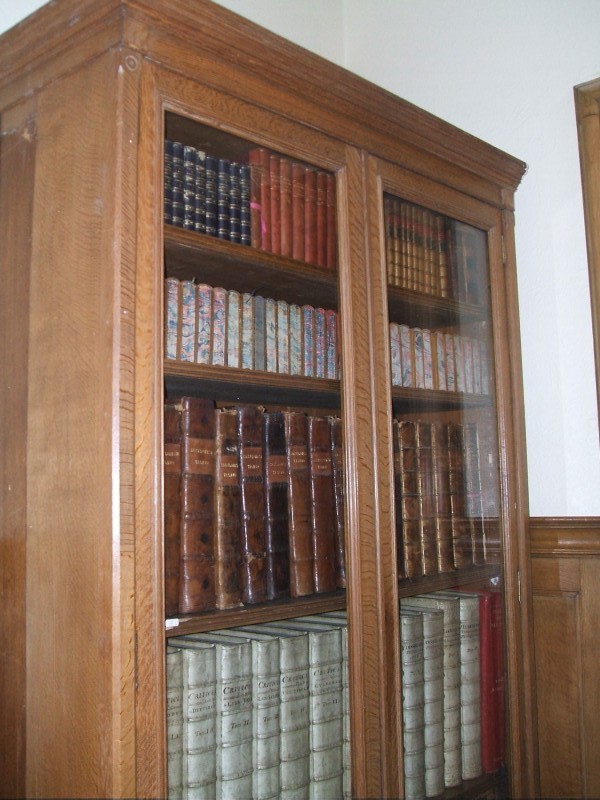
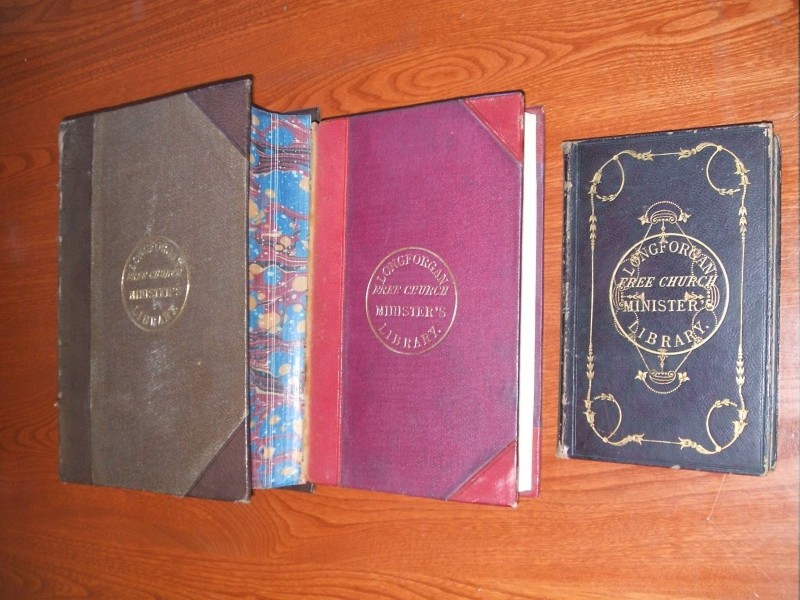
Longforgan LibraryThe Longforgan Free Church Ministers Library is a collection of handsomely bound volumes, particularly rich in patristic and theological texts. The rare books in the collection include Knox’s Liturgy (1611), the Babylonian Talmud and Athanasii opera (1600). Each volume is embossed in gold with the distinctive stamp of the Longforgan Library.  It is kept in its own custom made glazed shelving, now housed at the entrance to New College Library and in the David Welsh Reading Room.

The Longforgan Library was originally gifted to the Free Church at Longforgan, Dundee by Mr David Watson, son of the Rev Dr Charles Watson,  who was the owner of Bullionfield Paperworks at Invergowrie. The original deed of gift records that the books were given along with the bookcases and £100 invested in stocks and shares for the library’s upkeep(1). The library that was formally handed over to the Deacons Court at Longforgan Free Church (who acted as trustees) had its own printed catalogue in a bound volume, still in use at New College Library today.  Longforgan2

The next chapter in its history came in 1962  when ownership of the Longforgan Free Church Minister’s Library was transferred to New College Library. The move had been set in motion by the Revd James Torrance (who had been minister at Longforgan) and Professor T.F. Torrance (who was then curator of New College Library) (2).

Last week  we welcomed descendants of David Watson at New College Library, who shared details of the Longforgan Library’s original donor, and who were able to see David Watson’s lasting legacy here. The Longforgan Library is due to be catalogued online as part of the Funk Cataloguing Projects 2012-14.

(1) Gould, Four Churches of Invergowrie.  Dundee : 1997, p. 79

(2) Howard, John. In :  Disruption to Diversity. Edinburgh : 1996, p. 193.

New books at New College Library – March

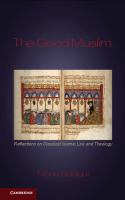
The lovelorn ghostThe Good MuslimNew College Library has a regular display of new books at the far end of the Library Hall, close to the door to the stacks.

Currently in the display is The good Muslim : reflections on classical Islamic law and theology by Mona Siddiqui. Professor Mona Siddiqui, Professor of Islamic and Interreligious Studies at the School of Divinity, will deliver her Inaugural Lecture ‘Love and Law in Christianity and Islam‘ today,  Monday 4 March 2013 at St Cecilia’s Hall.

Also new is The lovelorn ghost and the magical monk : practicing Buddhism in modern Thailand  by Daniel McJustin.  These titles were purchased for Religious Studies at the School of Divinity, Edinburgh University.

You can see an regularly updated list of new books for New College Library on the Library Catalogue – choose the New Books Search and limit your search to New College Library. Here’s a quick link to new books arriving in the last few weeks. A word of caution – some of the books listed here may still be in transit between the Main Library (where they are catalogued) and New College Library, so not on the shelf just yet.