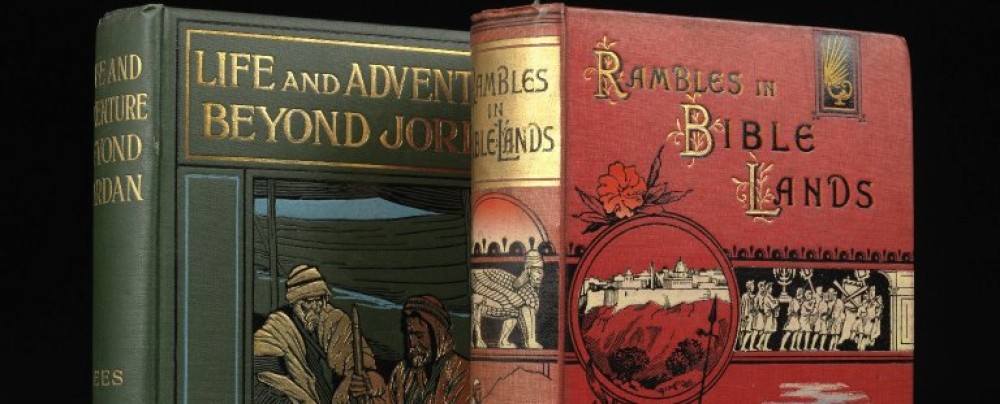
New College Library welcomes the Yale-Edinburgh Conference

The Centre for the Study of World Christianity at the University of Edinburgh is hosting the Yale-Edinburgh Group Conference on the History of the Missionary Movement and World Christianity this week, with the theme of  Religious Movements of Renewal, Revival, and Revitalization in the History of Missions and World Christianity.

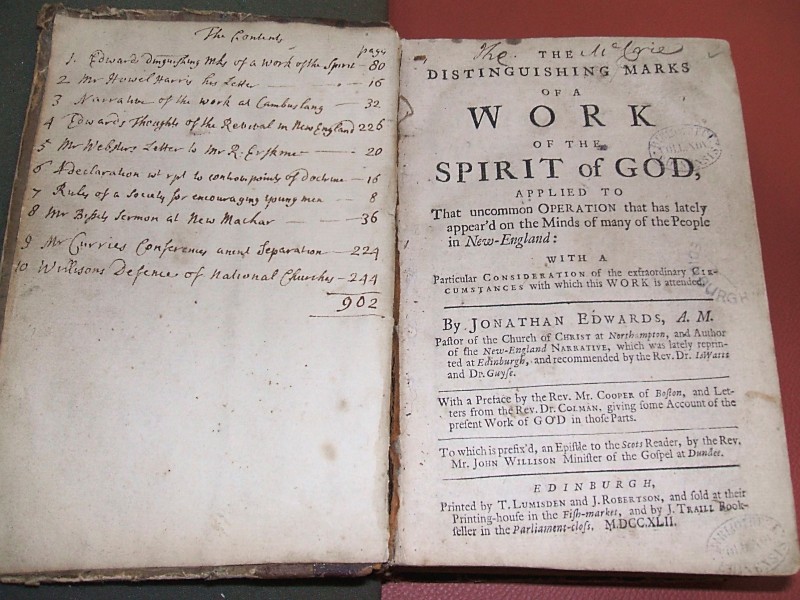
Jonathan Edwards (1703-1758)
The distinguishing marks of a work of the spirit of God : applied to that uncommon operation that has lately appear’d on the minds of many of the people in New-England ; with a particular consideration of the extraordinary circumstances with which this work is attended. Edinburgh : 1742
New College Library B.b.c.17/1

We have set out a small display of pamphlets from New College Library’s Special Collections on the theme of revival in the display case in the Funk Reading Room. The display includes this pamphlet on the  revival & awakening of the Holy Spirit in New England, United States.  The author, Jonathan Edwards, was a prominent American preacher and theologian, who was closely involved in the spiritual revival of the 1730s, the Great Awakening. His pamphlet deals with the revival’s controversial  phenomena : the swoonings, outcries and convulsions of believers overwhelmed by their powerful spiritual experiences.

This pamphlet was catalogued recently as part of the Pamphlets Cataloguing Project, funded by the Funk Donation. A similar item is also held by Yale University. University of Edinburgh users can read it online via Eighteenth-Century Collections Online.
Acta Sanctorum now available online to University of Edinburgh

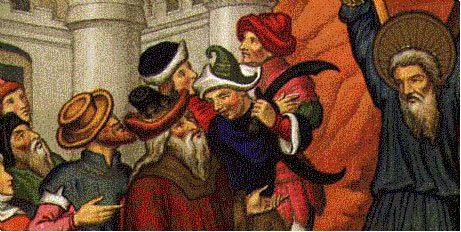
The online Acta Sanctorum, published by ProQuest Databases, is now available to University of Edinburgh users. It is an electronic version of the complete printed text of Acta Sanctorum,which examines the lives of saints, organised according to each saint’s feast day, and runs from the two January volumes published in 1643 to the Propylaeum to December published in 1940. The original printed volumes are held in New College Library’s Special Collections.

University of Edinburgh registered users can access the database via the link on the Library’s A-Z Databases page.

Studying away from Edinburgh over the summer?

If you’re a School of Divinity student moving away from Edinburgh over the summer but continuing to work on your thesis, you’ll be thinking about how to obtain the library materials you need.

All of the University of Edinburgh’s online services remain open to you, of course. Just log in remotely using your EASE user name and password.

As long as you remain a University of Edinburgh student, the Library can continue to process inter-library loan requests for you, and photocopies of  journal articles and book chapters can be posted to you (We can’t supply physical loans of books or microfilms by post). If an electronic copy has been supplied, we will email it to you. You’ll need to register for the ILLiad system first, if you haven’t already done so, and then submit your requests online. 

In the UK, you can usually request inter-library loans using the services available at your local public library. This will depend on the services offered locally, and there may be a charge. Always allow a minimum of two weeks, and more if possible, for an inter-library loan item to be delivered.

If you live within easy travelling distance of a University library, it’s probably worth joining the SCONUL access scheme. This allows University of Edinburgh staff and students to have access to 170+ Higher Education Libraries in the UK. You might find visiting one of these libraries quicker than waiting for inter-library loans. You need to register with Edinburgh University as  your home library first – so do it before you leave Edinburgh.  Use the COPAC Union library catalogue http://copac.ac.uk/ to help you see which academic libraries have the materials you want.

A plea from us to all of you going away over the summer – please keep checking your e-mail notices for library books that have been recalled. We need you to return these books for the benefit of other library users. Thank you!

Researching the motherhood of God

The School of Divinity at New College hosts a colloquium on June 7, 1:00 – 4:30 on Women, Language, and Worship in the Church of Scotland – see the blog or facebook page for more details.

 In 1984, a report was submitted to the General Assembly by Anne Hepburn,  president of the Women’s Guild, which explored how God might be referred to as a Mother figure as well as a Father in the New Testament, and the implications for gender inclusive language within the Church. New College Library holds this report in the Reports of the General Assembly (at  sLX 50 B) and it was also reprinted separately as a volume in its own right (at pRQ 20 MOT, New College Library). The report received a hostile reception, which was widely reported in the Scottish and National Press.

New College Library holds substantial collections of order of service books and hymnbooks, which researchers can access to see if the 1984 report did have an impact on Church practice. These include the Hymnology Collections as well as the fourth edition of the Church Hymnary (2005),  on the shelf at New College Library at Ref. BV431 Chu.

New College Theses collection now fully catalogued online

Over 700 New College theses covering the period 1920-1985 have now been catalogued online as part of the Funk Cataloguing Projects.  Some of these theses have second  copies at the main Library, but many others are unique copies only held in New College Library. The completion of this project means that all of New College Library’s theses are now listed on the University of Edinburgh Library’s online catalogue.

The Theses collection demonstrates the richness and diversity of Divinity research in the twentieth century, with topics ranging from  the Buddhist conception of Man in relation to the Christian conception, to the Church in Shetland during the sixteenth and seventeenth centuries – to pick just a few. Current Divinity PhD students now have improved access to the range of previous research done at New College, and New College alumni with PhDs will now be able to find the fruits of their efforts on the online catalogue.

Now that these theses are included in the University of Edinburgh online catalogue, the details of this research will be shared worldwide, not only by researchers looking for University of Edinburgh material but also by researchers using tools such as COPAC, the union catalogue of the UK’s major research libraries.

Early Bibles at New College Library

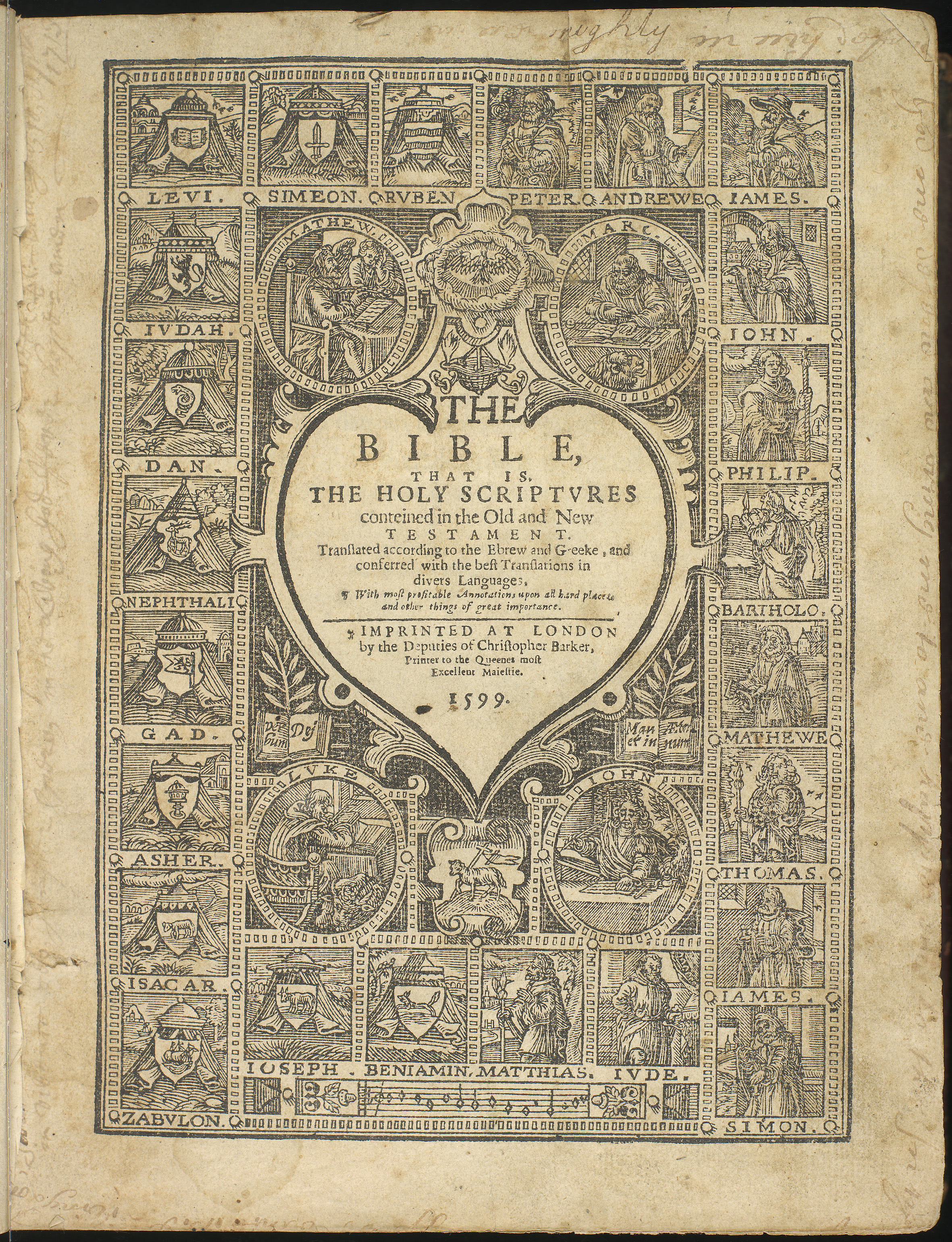
New College Library has rich and distinct Bible collections. This  Geneva Bible, printed in 1599 with an illustrated frontispiece is just one example.  Called a Geneva Bible because it was produced by a group of Protestant scholars who fled to Geneva during the time of Queen Mary I of England (1553 – 1558), it was innovative in being a  mass-produced Bible which came with a variety of scriptural study guides and aids.

Bible, Book of Common Prayer and Psalter. London, 1599. New College Library B.r.438/1

 This 1599 edition also inclues the new “Junius” version of the Book of Revelation, in which the notes were translated from a new Latin commentary by Fransiscus Junius on Revelation. It was the Bible used by John Knox and Oliver Cromwell, making it hugely important to the study of sixteenth and seventeenth century Britain.

University of Edinburgh Edinburgh Divinity students on programmes such as the Masters degree in  Theology in History have the opportunity to handle rare books like this as part of their studies.

 This Bible is newly catalogued online as part of the Funk Cataloguing Projects at New College Library, which has enabled the cataloguing of 631 early Bibles.

Treasures of New College Library : the Acta Sanctorum

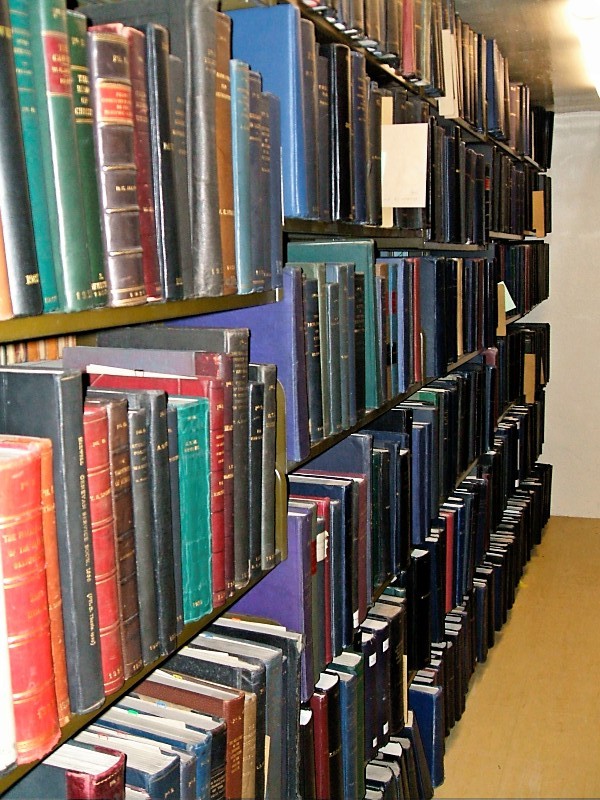
Down in the depths of New College Library’s Stack III, one of the first rows of shelves that faces you when you enter contains the Acta Sanctorum. This huge Latin work in sixty-eight volumes examines the lives of saints, organised according to each saint’s feast day in the calendar year.  Fifty-three of the volumes were published between 1643 and 1794 by the Bollandist Fathers in Antwerp. Hugh Watt, in his New College Library : A Centenary History (Edinburgh: Oliver and Boyd, 1946), relates a story that Cardinal Hume had intended to purchase this set of the Acta Sanctorum for himself as a birthday present, but arrived at the bookseller’s only to find that Dr William Cunningham, second Principal of New College, had beaten him to it and purchased the volumes for New College Library.

University of Edinburgh users have trial access to the online Acta Sanctorum Database until 24 May 2012.  The Acta Sanctorum Database contains the entire Acta Sanctorum, including all prefatory material, original texts, critical apparatus and indices. Bibliotheca Hagiographica Latina reference numbers, essential references for scholars, are also included.

The General Assembly and New College Library

New College is preparing for the  General Assembly of the Church of Scotland 2012, which will take place between 19 and 26 May 2012.

Inside the General Assembly

This year’s debates include reports on sectarianism, domestic abuse and Gaza. Researchers wanting to trace the history of these debates, and other challenging topics such as the principles of a just war, and same-sex relationships, can consult the Reports to the General Assembly which are held in New College Library at  sLX 50 B.  Minutes of recent meetings are available from the Church of Scotland website.  The historical records of the Church of Scotland’s General Assembly are held at the National Archives of Scotland , including shorthand notes of General Assembly meetings. We expect to welcome many delegates from the Assembly as visitors to the Library, where they are welcome to use our collections of print books and journals.

New College itself will be very busy during this period, with all of the teaching rooms occupied by the Assembly. This includes the David Welsh Reading Room in New College Library which is being used for Assembly purposes. Library users are advised to carry their  UoE staff/student card with them at all times as there may be a security presence at the entrance to New College.

Following in the footsteps of the New College Librarian

Spent some time this morning sculling through the New College archives looking for correspondence about some of the New College Special Collections, the Dumfries Presbytery Library and the Longforgan Free Church Ministers’ Library. There’s a fascination to leafing through the thin typewritten sheets that measured out the business of New College Library over the decades. One envelope contains the daily diary notes of the New College Librarian for the autumn term (no semesters then) of 1965 – jottings and tick lists of meetings about the finances, measuring up the space needed for new periodicals, noting library staff who’ve gone home feeling ill.  Other letters are handwritten enquiries to the Librarian, and his replies –  “Dear Miss Grant, I have very little to tell you about the revival of the use of the saints names as dedications of Church of Scotland Parish Kirks …” this said, the letter went on to give a full page of information. My life as a librarian is measured out in e-mails, with paper letters like these occasionally lurking at the fringes.