Preserving the Dumfries Presbytery Library for the future

A guest post from Finlay West, Funk Projects Cataloguer

The recently completed cataloguing of the Dumfries Presbytery Library Collection housed at New College Library, finally allows the volumes to be readily available after an often fractured history .

Originally held in the Dumfries Presbytery Library until 1884, the collection had to be moved after the roof was damaged and the library was flooded. The volumes were kept in storage until 3rd March 1885 when they were lent to General Assembly Library. There they stayed until 1958 when the entire General Assembly Library was transferred to New College Library where they were dispersed by subject.

It was after John Howard became Librarian in 1965 that he noticed there were many items that had marks of provenance in the form “Ex libris bibliothecae presbyterii Dumfriesiensis ex dono Joan. Hutton M.D. 1714”, and that many were distinctive because of the water damage they received in the flooding a century before. Intriguingly almost all had the words “Ta ano” (ta ano) inscribed on the title page. Having identified them as part of a distinct collection he brought them together again.

The Practice of Piety  / Lewis Bayly, 1672. New College Library  DPL 912

The Practice of Piety / Lewis Bayly, 1672. New College Library DPL 912

The aforementioned John Hutton was born in Caerlaverock, Dumfriesshire and donated his book collection to the Dumfries Presbytery Library in 1714. He had an interesting history being personal physician to William of Orange and was with the King as his physician and advisor during the Battle of the Boyne in 1690.

The collection is made up of around 1500 volumes from the 16th to 18th century, with a range of subjects including, science, medicine, philosophy, politics, history , travel, and of course bibles, biblical studies and theology. It contains numerous interesting items such as “The Booke of Common Prayer and Administration of the sacraments …” (Edinburgh : Robert Young, 1637). This is the famous “Laud’s Liturgy”, the service book forced on the Church of Scotland by Charles I’s bishops.

After the collection was catalogued, it was surveyed by Caroline Scharfenberg, a specialist book conservator based at the University of Edinburgh’s Main Library, who made a number of recommendations for the future conservation and preservation of the collection.
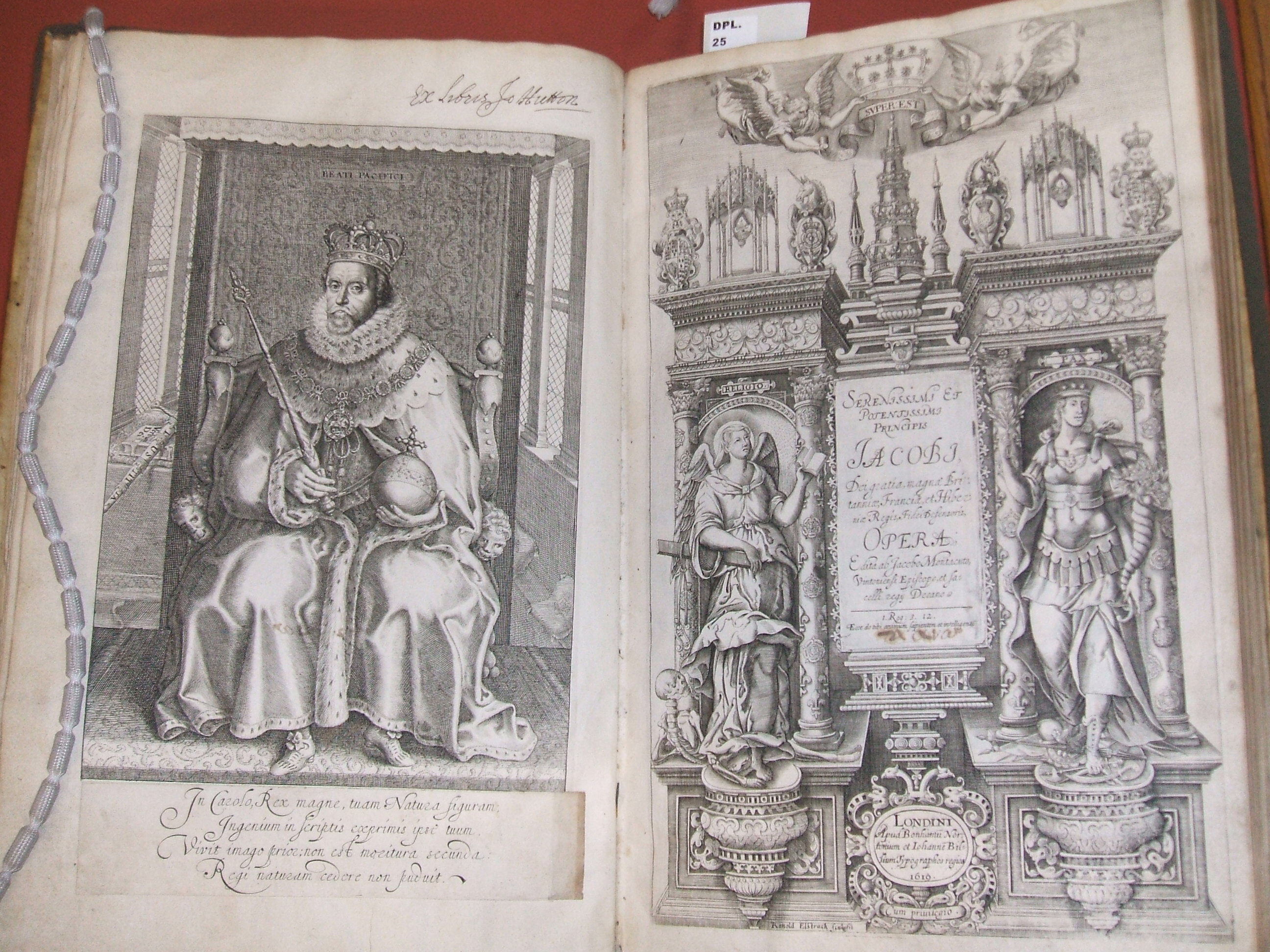
Serenissimi et potentissimi Principis Iacobi, Dei gratia, Magnae Britanniae, Franciae, et Hiberniae Regis, fidei defensoris, opera … New College Library DPL.25

Serenissimi et potentissimi Principis Iacobi, Dei gratia, Magnae Britanniae, Franciae, et Hiberniae Regis, fidei defensoris, opera …
New College Library DPL.25

Both the cataloguing and the conservation survey for this collection were made possible by the generous donation of the Rev. Dr Robert Funk.

Finlay West, Funk Projects Cataloguer
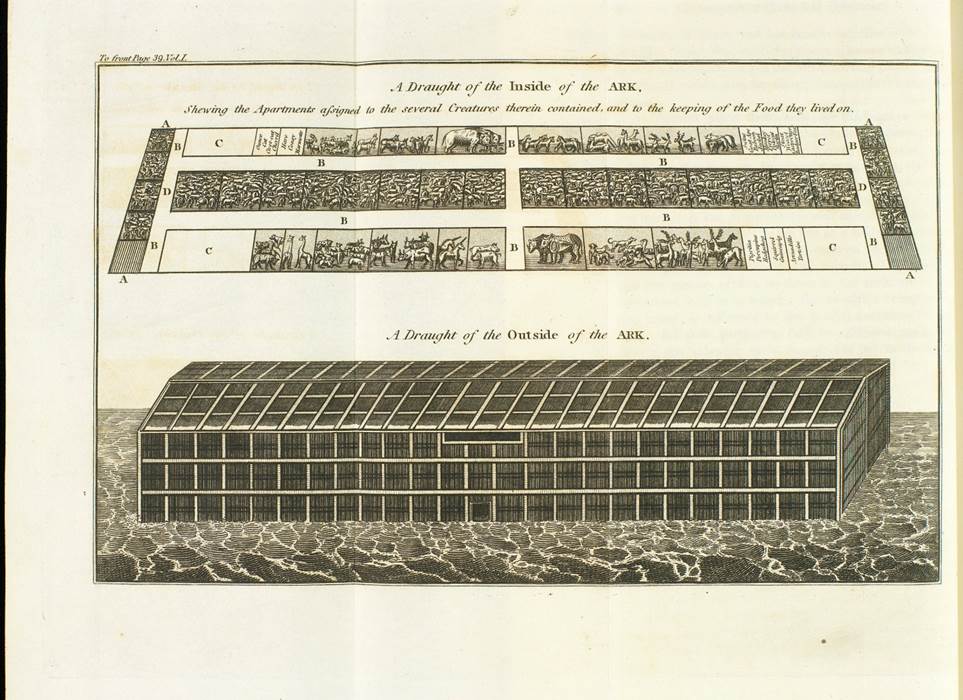
Imagining Noah’s Ark : Special Collections on display at New College Library

Noah’s Ark has been in the news lately with the recent block buster film Noah. Currently on display in the entrance to New College Library is a nineteenth-century imagining of Noah’s Ark, in a work by Edward Wells (1667–1727), a Church of England clergyman and educationist.Ark

This image from An historical geography of the Old and New Testament (1809) shows a fold out engraved illustration of the ‘Inside of the Ark‘. Wells has attempted to provide a rational plan of how all the animals required could be fitted into Noah’s Ark.  The text on adjoining pages details the precise numbers and nature of the species considered to be housed in each area.This book is part of the Natural History Collection at New College Library, numbering about 175 books. This dates from the early days of New College, where ‘Natural Science’ was taught until 1934. The collection includes examples of the mid-nineteenth century controversies over evolution and natural selection, with geology particularly well represented. The collection was catalogued online as part of the Funk Projects.

Christine Love-Rodgers, Academic Support Librarian – Divinity

Finding love in the Library – new books at New College Library in May

Love OnlineMarriageLove is in the air this month in the new books coming into New College Library. Currently in our new books display is Love online by Jean-Claude Kaufmann ; translated by David Macey edited by Andrew Crome and James McGrath  at  HQ801.82 Kau.   Also new is Has marriage for love failed?  by Pascal Bruckner ; translated by Steven Rendall and Lisa Neal at HQ503 Bru.

These titles were purchased for Theology & Ethics at the School of Divinity, Edinburgh University.

New College Library has a regular display of new books at the far end of the Library Hall, close to the door to the stacks.You can see an regularly updated list of new books for New College Library on the Library Catalogue – choose the New Books Search and limit your search to New College Library. Here’s a quick link to new books arriving in the last few weeks. A word of caution – some of the books listed here may still be in transit between the Main Library (where they are catalogued) and New College Library, so not on the shelf just yet.

Christine Love-Rodgers, Academic Support Librarian – Divinity

Scotland’s Religious Past : Unique Special Collections at New College Library, Edinburgh

Here at New College Library we’re rediscovering unique Special Collections items which tell the story of Scotland’s radical religious past.

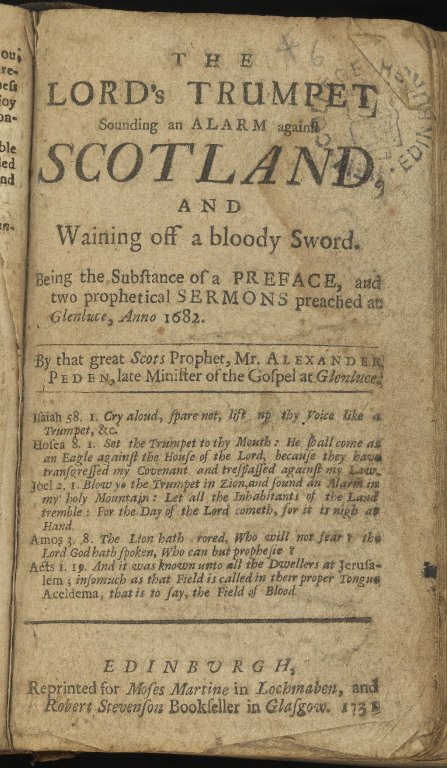
The Lord's Trumpet Sounding an Alarm Against Scotland. Edinburgh, 1731, New College Library S.b.32

The Lord’s Trumpet Sounding an Alarm Against Scotland. Edinburgh, 1731, New College Library S.b.32

This item, The Lord’s trumpet sounding an alarm against Scotland, and waining off a
bloody sword, reprints sermons originally preached in 1682 by Alexander Peden, one of the leading figures of the Covenanter movement in Scotland. Part of the New College Library Pamphlets Collection, it was identified when catalogued as unique on ESTC, or the English Short Title Catalogue, meaning that this imprint had never previously been identified.

The story of Scotland’s religious history is also evident in this eighteenth century pamphlet by Ralph Erskine, brother of Ebenezer Erskine, leader of the Secession Church which broke away from the Church of Scotland in the eighteenth century. Samuel VII and covenant theology. Faith’s Plea Upon God’s Word and Covenant is another example of a New College Library Pamphlet that has been identified as unique in the world.

Faith's plea upon God's word and covenant : a sermon preached on a preparation-day before dispensing the sacrament of the Lord's Supper, at Burnt-island .. New College Library, H.d.288

Faith’s plea upon God’s word and covenant : a sermon preached on a preparation-day before dispensing the sacrament of the Lord’s Supper, at Burnt-island ..
New College Library, H.d.288

Both these items were catalogued as part of the Funk Cataloguing Projects at New College Library, University of Edinburgh, where over 700 items unique on ESTC have been discovered.

Christine Love-Rodgers, Academic Support Librarian – Divinity

Index Religiosus Online now on trial

Index ReligiosusNew on trial for University of Edinburgh users from 10 April to 11 May 2013 is the Index Religiosus Online.

The Index Religiosus replaces the bibliography of the Revue d’histoire ecclésiastique and of the ‘Ephemerides Theologicae Lovanienses’ (Elenchus Bibliographicus). These two tools are internationally recognized as essential working instruments for Theology and Religious Studies.

As a key reference bibliography for Theology, Religious Studies and Church History, it includes publications written in multiple European languages (English, French, German, Italian, Spanish, Dutch), and enables users to export records in several formats (EndNote, Refworks, Zotero, etc.)

From January 2014 onwards, the printed version of the bibliography of the Revue d’histoire ecclésiastique and the Elenchus Bibliographicus will no longer be available.

You can access the trial via the link at : http://www.ed.ac.uk/is/databases-trials. Please give us your feedback as this is a key part of making a case to subscribe to resources like this.

Christine Love-Rodgers, Academic Support Librarian – School of Divinity


From Noah to New Labour – New books at New College Library in April

The rocks don't lieA political theology of climate changeFloods are a theme linking two of our new books this month. Looking back to the Biblical Flood is The rocks don’t lie : a geologist investigates Noah’s flood, by David Montgomery, available at QE39.5.P3 Mon. Also new is A political theology of climate change by Professor Michael Northcott from the School of Divinity, at Folio BR65.A9 Oxf.

You can see an regularly updated list of new books for New College Library on the Library Catalogue – choose the New Books Search and limit your search to New College Library. Here’s a quick link to new books arriving in the last few weeks. A word of caution – some of the books listed here may still be in transit between the Main Library (where they are catalogued) and New College Library, so not on the shelf just yet.

Christine Love-Rodgers, Academic Support Librarian – School of Divinity

Missionary to the North – The Paterson Bible Collection

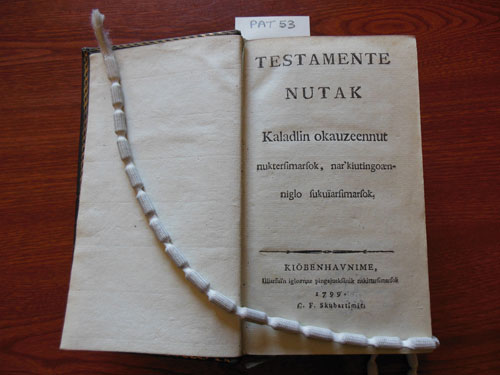
Testamente nutak : Kaladlin okauzeennut nuktersimarsok. Copenhagen, 1799. New College Library PAT 53

Testamente nutak : Kaladlin okauzeennut nuktersimarsok [Eskimo Bible]. Copenhagen, 1799. New College Library PAT 53

In early 2014 we began work to catalogue the Paterson Bible Collection, as part of the Funk Cataloguing Projects at New College Library. This collection of over 300 Bibles in a huge variety of languages and scripts represents the interests and life’s work of John Paterson (1776–1855). Paterson was a Glasgow trained missionary for the Congregational Church, who originally intended to serve in India but instead forged a career in northern Europe (1).

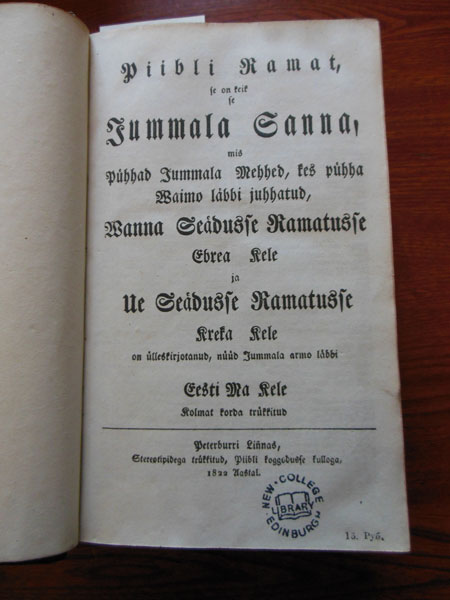
Bible. New Testament. Estonian

Piibli Ramat, se on keik se Jummala Sanna [Bible. New Testament. Estonian]. Peterburri Linnas, 1822. New College Library PAT 60

His work involved translating and printing portions of the scriptures into Finnish, Georgian, Icelandic, Sami, Latvian, Moldavian, Russian, Samogitian, and Swedish. First based in Sweden, where he founded the Finnish Bible Society, in 1812 Paterson moved to St Petersburg, where he was involved in the work of what became the Russian Bible Society.  In later life he returned to Scotland where he continued to be active in the Scottish Congregational Church, but was also involved with early attempts to produce Bibles for the blind, in a precursor of Braille writing (2).

Meije Issanda Jesusse Kristusse Wastne Testament [Bible. New Testament. Estonian]. Riga, 1686

Meije Issanda Jesusse Kristusse Wastne Testament [Bible. New Testament. Estonian]. Riga, 1686 New College Library PAT 58


The Paterson Bible Collection reflects the linguistic spectrum of his Northern European work, but also includes Bibles in languages as diverse as Amharic, Armenian and Ethiopian.  It was received by the National Bible Society of Scotland in 1957 from A. G. C. Baxter of Gilston, Largoward, Paterson’s descendant, and subsequently gifted  to New College Library in 1991.


(1) G. C. Boase, ‘Paterson, John (1776–1855)’, rev. H. C. G. Matthew, Oxford Dictionary of National Biography, Oxford University Press, 2004 [http://www.oxforddnb.com/view/article/21533, accessed 19 Feb 2014]

(2) Alexander, James M. (1974) ‘Title John Paterson, Bible Society Pioneer, 1776-1855.  The later years – 1813-1855, Records of the Scottish Church History Society, vol viii, p196.

New Books at New College Library – March (recommended by students)

Newman and his familyHistorical Reception of AugustineStudent recommendations are in at New College Library! New in this month is Newman and his family, by Edward Short, available as an ebook via the library catalogue.   Also new is The Oxford guide to the historical reception of Augustine,  by Karla Pollmann, at Folio BR65.A9 Oxf.

Students are encouraged to recommend books for the library using the online form at http://www.ed.ac.uk/is/RAB.

You can see an regularly updated list of new books for New College Library on the Library Catalogue – choose the New Books Search and limit your search to New College Library. Here’s a quick link to new books arriving in the last few weeks. A word of caution – some of the books listed here may still be in transit between the Main Library (where they are catalogued) and New College Library, so not on the shelf just yet.

Behind the Scenes at New College Library #ILW2014

Objects for innovative Learning WeekA guest post from Liz Louis, student on the MLitt in Museum and Gallery Studies at the University of St Andrews and volunteer at New College Library Object Strongroom. Liz presented on a selection of New College objects as part of the Behind the Scenes at New College Library Innovative Learning Week event.

I want to show you some of the highlights of the collection and also how the resources which New College Library can provide us with are invaluable to my research.

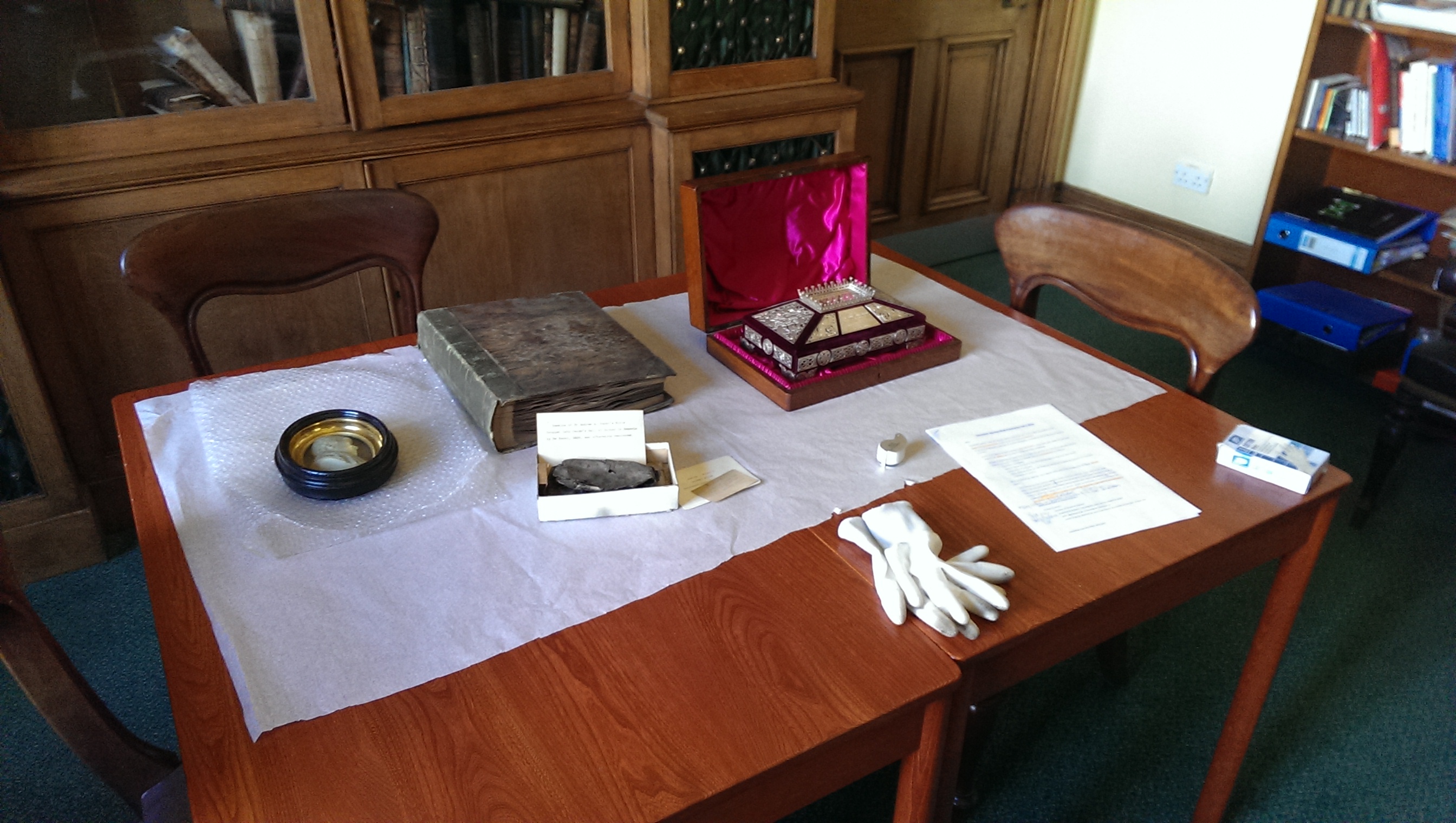
New College Library’s impressive holdings on Thomas Chalmers, chair of theology at Edinburgh University and first Principal of New College include many portraits of Chalmers in the form of paintings, photos and prints. As an art historian, the Wax Relief Portrait of Thomas Chalmers is interesting because it is intensely sculptural and ‘photorealistic’: with wax best suited to imitate human skin and most eerily similar to the moment of arrested life.   No paper trail for the original paper has been discovered as of yet, although I have found a label which suggests that the portrait was made by Mme Tussaud’s. We do know that it was given to Prof Hugh Watt (Principal 1946-50) by Margaret Macphail, who was given the object by her friend who inherited it from Chalmers’s goddaughter.

Many objects in the strong room reflect the nineteenth century interest in sciences. The album with dried plants has a handwritten inscription on first page: In Memoriam / A Flower, a Plant, or a Weed, / gathered from every place/ mentioned in the Bible / which I visited in Palestine / 1852 / W.D. (William Dickson) 1852.  This makes it particularly interesting for us: we’re not often lucky to have name and date of objects ON an object. We know that it was donated by his sons to complete New College’s Dickson collection of objects related to Middle East. It was addressed to John Duns (Professor of Natural Science at New College, 1864-1909). To a modern eye one thing that stands out is that the names written in pencil next to the plant never refer to the plant itself, but always to the place where it was found, e.g. ‘Place where they stoned Stephen’; ‘Gethsemane’.

New College Library’s objects collection contains other objects collected by travellers to  the East, and the written accounts of their experiences are equally marked by the influence of their reading & knowledge of the Bible. One of these is Bonar’s Bible, a Bible dropped in (and subsequently retrieved from)  Jacob’s Wellin Samaria near the city of Sychar (north of Jerusalem). We know about this because the owner, Andrew Alexander Bonar, documented the event in his Narrative of a Visit to the Holy Land, and Mission of Inquiry to the Jews[1] This trip to Middle East in April 1839 was the first mission sent by Church of Scotland to Palestine, making Bonar’s Bible part of the story of the Church of Scotland’s efforts to convert the Jews. [2]

CasketAnd finally one of our favourite objects, a casket presented to the Rev. John Sinclair McPhail.  It contains an illuminated letter from the Members of the United Free Presbytery of Skye congratulating McPhail on his 50th anniversary of being ordained, praising his devotion and adherence to the Church’s Principles as well as his personal qualities and ‘sound wisdom’.
It’s one of the few objects in the collection that we know when and where it was made thanks to the marks. We know where because of the Assay mark is applied by the Assay Office as a guarantee for the purity of the precious metal (here: silver) according to national and international  standards. The casket’s mark has three towers with one at front and two at back, the symbol of the Edinburgh Assay Office. We know when from the assay mark,  indicated by a single letter and font – here,  sans serif Y: probably 1880-1. And we know who made it from the maker’s mark MC&Co = Mackay,Cunningham and Company, Edinburgh, in the second half of the nineteenth century. In addition, the sovereign’s head, (in this case profile of Queen Victoria) aka duty mark certifies payment of tax to the Crown; Scottish thistle=silver standard mark: Sterling .925 for Edinburgh.

All of this shows how objects can begin to tell us stories if we know how to read them. So why are we doing all of this?
Firstly, to establish and record the collection that New College Library holds. This should enable collaboration with other institutions through shared knowledge and resources, and also enable preservation of sensitive objects and information about them as ethical obligation towards future generations (so nobody has to do my job all over again). Revealing the hidden stories should enable the University student and staff community to access basic information on objects as part of their own research, and make objects available to researchers for exploring new topics.


[1] Rev. Andrew A. Bonar, D.D., & Rev. R. M. M’Cheyne, Narrative of a Visit to the Holy Land, and Mission of Inquiry to the Jews (Edinburgh: William Oliphant & Co., 1878), pp.211.2

[2] Michael Marten, Attempting to Bring the Gospel Home. Scottish Missions to Palestine, 1839-1917 (London & New York: Tauris Academic Studies, 2006), pp.9-26.12.

Top Tips for Finding Theses #ILW2004

New College ThesesNeed to find out what research has already been conducted in your topic area? Some PhD research ends up being published but not all, so doing a specific search for theses may be the only way that you will come across it. This Innovative Learning Week seminar will cover search techniques for theses in online and print form.


Today, 15:00-16:00, New College – Room 1.07.

Can’t attend today’s session? Book on the IS Skills Finding Theses seminar, or explore the Theses Subject Guide online.