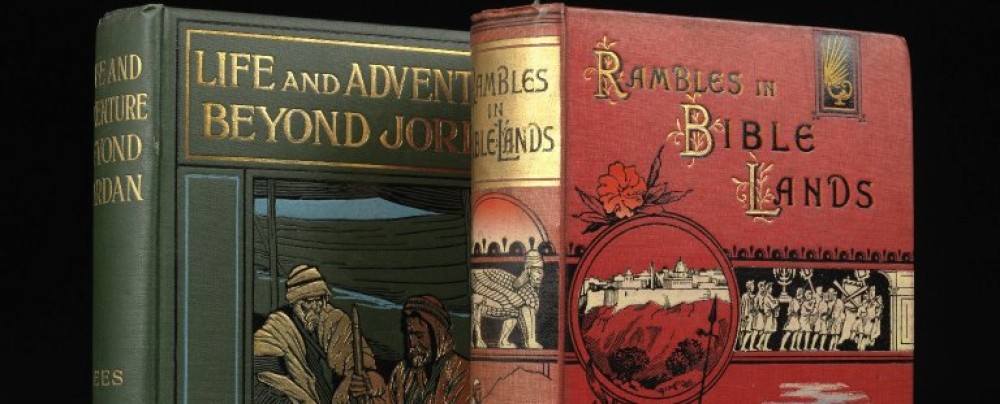
Shorthand in the New College Special Collections

by Danielle Fox, Archive & Library Assistant, New College Library

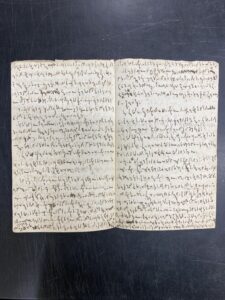
Shorthand writing, also known as tachygraphy, stenography, or brachygraphy, is a system of writing that uses symbols and abbreviations to represent words. This method allows the writer to transcribe speech at the same rate it is spoken, making it ideal for recording sermons, lectures, and court sessions. While modern technology has reduced its widespread use, shorthand played a crucial role in communication for centuries and existed in various forms. We are lucky enough to have many wonderful examples of shorthand in our New College collections.
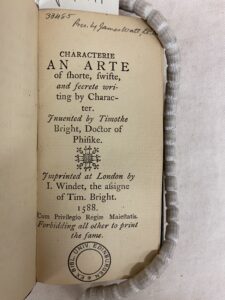
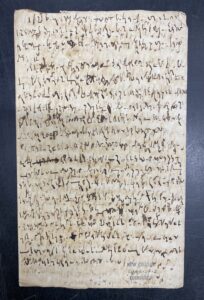
Bright, Timothy. Characterie (1588). University of Edinburgh, Heritage Collections. Df.9.141.


While shorthand can trace its origins back to ancient times, modern English shorthand systems largely emerged in the 16th and 17th centuries[1]. In 1588, Timothy Bright published Characterie; An Arte of Shorte, Swifte and Secrete Writing by Character, which introduced a refined system of shorthand that set the stage for future developments.

Other systems followed, such as Thomas Shelton’s Short Writing in 1626, and Isaac Pitman’s shorthand in 1837. Early English systems used arbitrary symbols for words or letters but eventually adopted phonetic systems. This meant that shorthand symbols focused on how words sounded, rather than how they were spelled, allowing writers to transcribe faster and capture the pace of speech.

Shorthand was especially popular in the 19th and early 20th centuries for tasks like journalism and secretarial work. However, with the advent of modern technology (like computers and voice recognition software), the use of shorthand has declined. Even though shorthand is less common today, it remains a part of history as a crucial tool for efficient writing. Continue reading
From tablets to computer screens; digitising some of the oldest texts at the University

by Elin Crotty, Archive & Library Assistant, New College

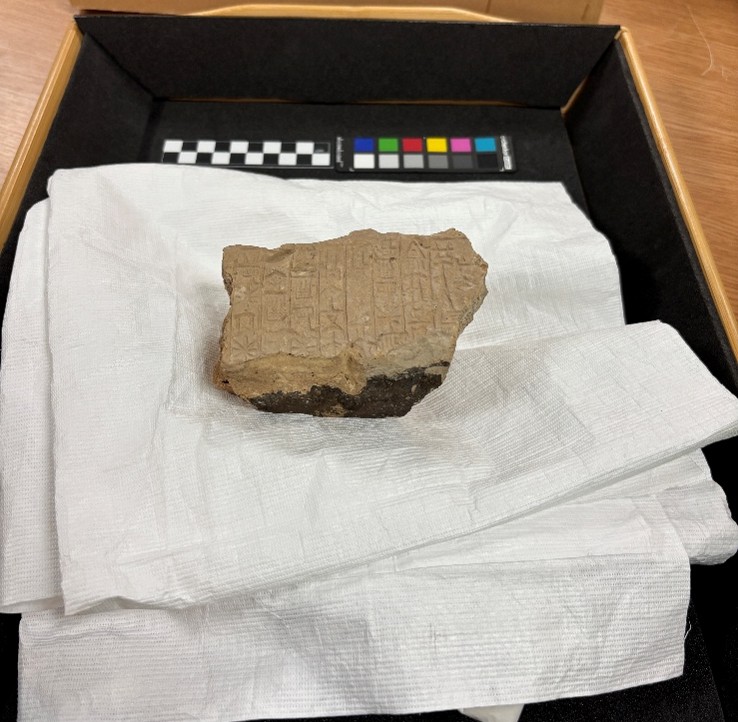
Over the past few months, the two New College Archive and Library Assistants (ALAs) have been liaising with the Cultural Heritage Digitisation Service (CHDS) about digitising our cuneiform tablets. The New College Library cuneiforms are 4 fragments of carved text, which range in date from the Neo-Babylonian Empire, (circa 626 – 539 BCE) to the Neo-Sumerian Empire (circa 2046 – 2038 BCE). The Neo-Sumerian tablet (NCL/Object/2025/3), which has split into two pieces, is thought to be one of the oldest examples of writing in the University’s collections at circa 4070 years old.

CHDS have recently been using Reflectance Transformation Imaging (RTI) to experiment with creating 3D representations of surface texture. You can read a much more thorough description of how the process works on their blog post here, but essentially the objects are placed upon a flat surface under a dome, with a camera positioned directly above them. Lights are fixed inside the dome at all angles and they flash in sequence as 72 photos are taken. This changes the light angle and resultant shadows for the camera, throwing details upon the surface of the object into high relief. The photos with the varying shadows are stitched together using specialist software, creating a 3D model of the surface of the object. A few months ago, the ALAs worked with CHDS to bring the New College cuneiforms to the uCreate MakerSpace, to use the RTI dome there.

The actual photography was very quick, but it was a careful process ensuring that the cuneiforms were supported and kept as flat as possible. After assessment by our conservation team, we built the fragments some temporary supports and handled them using nitrile gloves – no Hollywood white cotton gloves in our library! To get the cuneiforms in and out of the dome, CHDS had come up with a simple but very effective solution; a tea tray, lined with plastazote foam.

Piece of stone (cuneiform tablet) place on wrapping paper, in a tray with colour guidance strips.

Figure 1 NCL/Object/2025/3, cuneiform tablet from Neo-Sumerian Empire (c.2046-2038 BCE).

Continue reading

Celebrating the Presbyterian Church of South Formosa

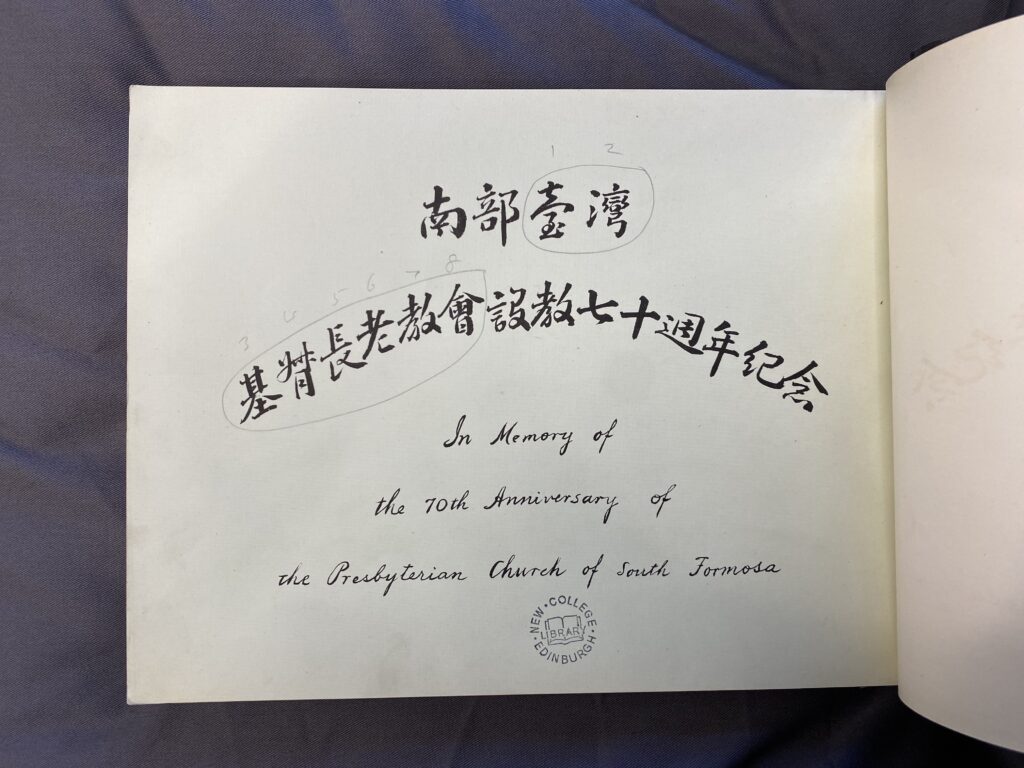
Opening from "In memory of the 70th anniversary of the Presbyterian Church of South Formosa"

In memory of the 70th anniversary of the Presbyterian Church of South Formosa

南部基督長老教會設教七十週年紀念寫真

“In memory of the 70th anniversary of the Presbyterian Church of South Formosa”

Yi-Chieh Chiu, Library Collections Services

During recent cataloguing work at New College Library, this interesting volume was discovered in the open access folio sequences and subsequently moved into New College Rare Books. The book is entitled In memory of the 70th anniversary of the Presbyterian Church of South Formosa and there are very few extant copies of the original edition remaining, with only one known copy in Taiwan.

Continue reading

New College marks its 175th Anniversary with online exhibition 

Screenshot from 175th Anniversary Exhibition


It all began with The Disruption. Not 2020’s lockdown but The Disruption of 1843 when ministers and elders left the Church of Scotland to set up the Free Church of Scotland. They started from scratch creating churches, manses, schools and a place to train and educate the new Free Church ministers: the New College. In June 1846 Rev Dr Thomas Chalmers, one of the leaders of The Disruption and New College’s first Principal laid the foundation stone. 

To celebrate a remarkable 175 years, the School of Divinity planned an array of events including conferences, reunions, re-enactments and an online exhibition, much of which required access to the New College archives. Unfortunately research and planning coincided with the closure of New College Library for essential works so staff facilitated access to the archives at the Centre for Research Collections (CRC) instead: that was until the coronavirus lockdown which was quickly dubbed ‘the third Disruption’. 

 Throughout 2020, conversations continued with the School of Divinity team researching, planning and designing the online exhibition, with the Digital Imaging Unit, and with staff physically in the CRC. This allowed items to be selected for digitisation and incorporation into the 21st century telling of New College’s story: how a Capital landmark came to be; mischievous students helpers in the 1890s; one class’s 50 years of reunion memories; records of WWII air raids; changes to the campus; changes in diversity, and more. 

Thanks are due to all the CAHSS, L&UC and USD staff who collaborated so well in such trying times to produce a fascinating exhibition. 

Lose yourself in the online exhibition featuring remarkable historic photographs: https://exhibition.div.ed.ac.uk/ 

Follow the celebrations and join in: https://www.ed.ac.uk/divinity/news-events/new-college-175 :: https://twitter.com/uoedivinity :: #NewCollege175 

Kirsty M Stewart, New College Collections Curator 

Caring for the New College Library Torah Scroll

A guest post by Valentina Flex, New College Library & Archive Assistant.

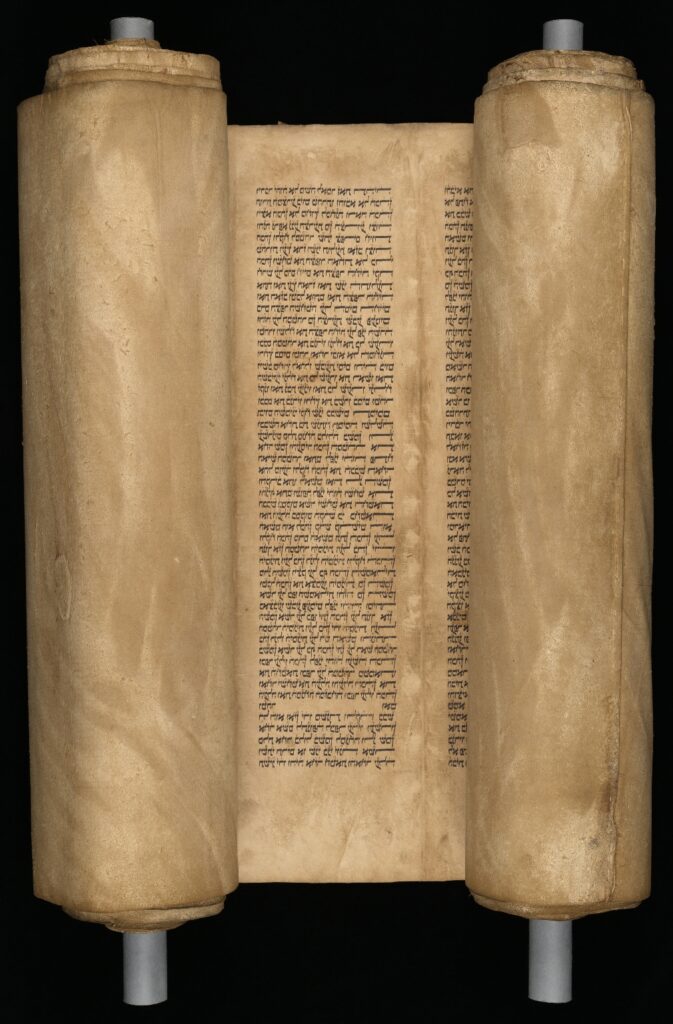
In order to ensure the safe and successful decant of collections at New College Library, myself and my fellow Archive and Library Assistants have wrapped (with acid-free tissue paper or Tyvek) and cotton-taping tied particularly fragile objects within the archives in order to stabilise and reinforce them before they move. The preparation for this task involved surveying the collections and taking notes of items in need of special attention. Surveying the items in New College Library archives and assessing the best method of collections care for them made me think about the context of each object’s creation and use. Specifically, I wondered if there were any implications involving certain items in a religious setting that would affect the ways we treat and care for them.

Torah Scroll, New College Library

Continue reading

New College Library Project Update by the Library & Archive Assistants

New College Library Hall during the General Collection moves to DHT

Post by Jamie Sutherland, New College Library Project Assistant

New College Library moved to its temporary home in David Hume Tower in January 2020. This new space will allow continued access to books and journals from the General Collections while an Estates Project is carried out in  our stunning Mound Place home. The General Collection moves have covered over 3.25km of books and, whilst the project team has been glad to see these securely in their new location, this has only been the first stage of the move project. New College Special Collections, one of the UK’s largest collections of theological rare books and archives, have also been prepared for safe relocation to other secure University sites and specialist off-site storage.

New College Library Hall during the General Collection moves to DHT

Pre-1900 Journals labelled and stabilised with cotton-tape ties ready for the move.

With the General Collections safely relocated to David Hume Tower, the past few months have focused on the even more daunting task of preparing our Special Collections materials. Here are some ongoing tasks which have formed part of this work:

Collections Care: New College Special Collections include a number of rare and wonderful materials which require their own special attention to move and store safely. These include rolled scrolls, glass plate negatives, photograph albums, books bound in animal hide, palm-leaf manuscripts, and even the academic gowns belonging to Thomas Chalmers, the first Principal of New College. Most of our work has focused on securely boxing or wrapping these items ready for the move. This has also given us the opportunity to consider their long-term storage requirements and what we might do to enhance their preservation once they return to their permanent home. As a team, we have been working on creating bespoke boxes and housing arrangements for some of the more unusual items as well as working on research projects to identify the best practices of collections care for particular types of material. Many items also had detached spines and covers which we were determined not to lose during transit. Our older journals were systematically checked for any damage or special care needs and either wrapped in acid-free tissue or ‘stabilised’ with cotton-tape ties to keep them together.

Archive ‘Mapping’: The collections include an extensive archive containing the papers of significant individuals or groups connected to New College, the University and the Church of Scotland. The project has focused on ensuring that these archive materials are fully listed, secured ready for the move, and suitably stored within the University. This began with the major task of identifying and measuring all the archive material. The final figure comes out at over 900 archive boxes and over 1,500 volumes! These figures help us to work out the optimal way of arranging shelving and storage arrangements, balancing collection storage needs with the ever-present concern of saving space. Having this information will also prove useful in the future in allowing us to identify potential rehousing projects such as the work of the Crowdsourcing Conservation Events.

Flat Folio Sequence: Many of the volumes in New College Special Collections are oversized. At the moment, these volumes are stored standing upright on the shelves alongside their smaller companions. Since these books have very heavy text-blocks, storing them upright exerts a lot of pressure on their spines which can cause damage to the book itself as well as risking damage to smaller items on the shelves which could become stuck or crushed between them. The project move has provided us with the opportunity to extract these larger items from the collection and bring them together into a dedicated ‘Flat Folio’ sequence (defined as any item over 42cm in height). These books can now be stored horizontally, which is a far better arrangement from the consideration of collections care. This project has required identifying, listing, and conducting basic collections care work on these items. Our inventory team have also been working on extracting these items ready for the move and updating their records with new temporary call numbers. The new flat folio sequence will contain over 900 volumes to be stored on much improved flat shelving.

Improving Shelf Space: Moving such a large collection poses the difficulty of finding enough shelf space to store it during the project. Whilst approximately two-thirds of the collection is moving to specialist off-site storage, we also have to retain a large portion on campus to facilitate collections care, cataloguing, and readers’ access to high-use material. As part of the project, we have been identifying ways to compact and re-pitch existing shelving in secure University stores to create additional space for the New College collections. Since January, we have successfully created an additional 39 linear metres of shelving which will provide space to store the New College archives and incunabula collection. Once the project has been completed, this space will be available to accommodate future projects or allow room for the acquisition of new Special Collections material.

Bound copies of ‘The Witness’ newspaper, forming part of the new Flat-Folio Sequence in NCL Special Collections

Over the next few weeks, we’ll be dedicating our blog posts to some of the particularly interesting items we have been working on in the New College Library collections. Keep an eye on this blog where we will be posting new case studies and insights into some of these remarkable items and the work which has been ongoing to keep them safe and accessible to future generations.


1893: A story of scary librarians and brave students

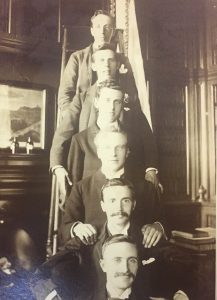
Student helpers at New College Library 1893 ( from the New College Library Archives AA 1.8.1)

New College Library and its students have always had a special relationship. Recently, for example, our students chose their preferred most iconic items from our special collections and contributed to our beautiful exhibition ‘Steps through Time’ (you can check the corresponding post here).

However, not everyone knows that from the early stages of New College Library’s existence, students have played a fundamental role in the organisation and establishment of the library. For example, in 1843, when New College was founded, it was ‘student curators’ who stamped and listed the first donations that arrived at the library from various sources (see Disruption to Diversity, D.Wright and G.D.Badcock, p.187).

In spite of their initial involvement though, in its early days browsing New College Library was not a particularly student friendly experience. In fact, until 1893, the library was entirely the domain of the Librarian – he was the only one who had an overview of the entirety of the catalogue and the only one who was able to peruse the shelves and collect the books requested by the students.

Not only were students not allowed to browse the shelves freely, they were also kept in relative ignorance of the contents of the library, especially if some of the books did not meet with the Librarian’s criteria of safe readings. For example, Dr Kennedy, who was the Librarian of New College Library from 1880 until 1922,  ‘even adopted the stratagem of frustrating any reader, privileged to inspect the shelves, who sought to escape his lynx-like vigilance, by secreting scores of “dangerous” volumes on shelves hidden behind tables or forms ’, as Hugh Watt writes in New College a centenary history (p.162). The catalogue was also a fairly complicated affair, since for several years it consisted of written slips kept in packages accessible only to the Librarian.

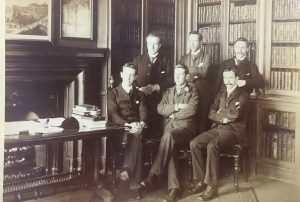
Unsurprisingly, this was a most unsatisfactory system for the poor students. Therefore, in 1892, six students braved the phenomenal Dr Kennedy, and under his ‘lynx-like’ vigilance, they assisted him in re-arranging the catalogue to make it more user accessible. After a year of hard work, they published what you can consider as one of DiscoverEd’s ancestors: The Abridged Catalogue of Books in New College library, Edinburgh,1893.

And here, from the depths of New College Library’s Archive collection, is the picture of our student heroes:

From the New College Library archive, ref..AA.1.8.1

New College Library Archives (AA.1.8.1)

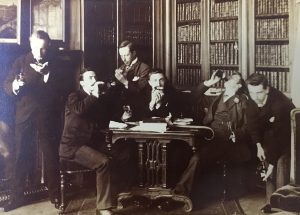
And here, with a well-deserved drink after a year of work with the impressive Dr Kennedy:

New College Library Archives (AA 1.8.1.)

While we are not encouraging you to drink beer in the library, or to rebel against our lovely library staff (nowadays, certainly not as scary as good, old Dr Kennedy), we want to celebrate those students with you today. It was also thanks to their hard work that New College Library became the much loved library that it is today.

Not much is known about those student heroes, their names are faded, a scribble at the back of an old photograph. But perhaps next time you wander through the library, send them a grateful thought. They will surely appreciate it.

Barbara Tesio, IS Helpdesk Assistant, New College Library


That would be an ecumenical matter … Celebrating 70 years of the World Council of Churches

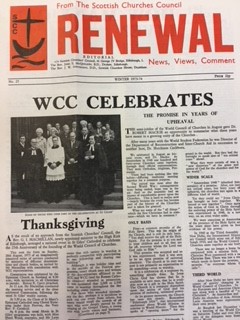
In our New College Library Hall display for September 2018, we’re celebrating the 70th anniversary of the foundation of the World Council of Churches. Inaugurated in 1948, the World Council of Churches (WCC) is one of the leaders of the modern ecumenical movement, working towards the goal of Christian unity. The WCC brings together churches, denominations and church fellowships in more than 110 countries and territories throughout the world, representing over 500 million Christians. New College Library contains nearly a thousand WCC publications, including many unique or rare pamphlets. In the New College Library Archives, we hold the papers of several individuals and organisations who worked with the WCC, including Rev J.H. Oldham, Rev Robert Mackie and Rev. Tom Allaallenn. Continue reading

Thomas Chalmers and The West Port Experiment

Those with an interest in Scottish church history are likely to be very familiar with Thomas Chalmers and the role he played in the Disruption of 1843 but how many know much of his West Port experiment? Continue reading

The Myth of Robert Burns

It was some months ago that among the many sermons and talks given by Rev Tom Allan (1916-1965), one entitled ‘The Myth of Robert Burns’ caught my eye (ref. AA6.2.18). While the Kirk and Burns were not exactly best pals, there has been many an Ayrshire minister who would definitely subscribe to the term ‘Burnsian’. The question was, with a title such as this, on which side was the Ayrshire born Tom Allan going to stand?

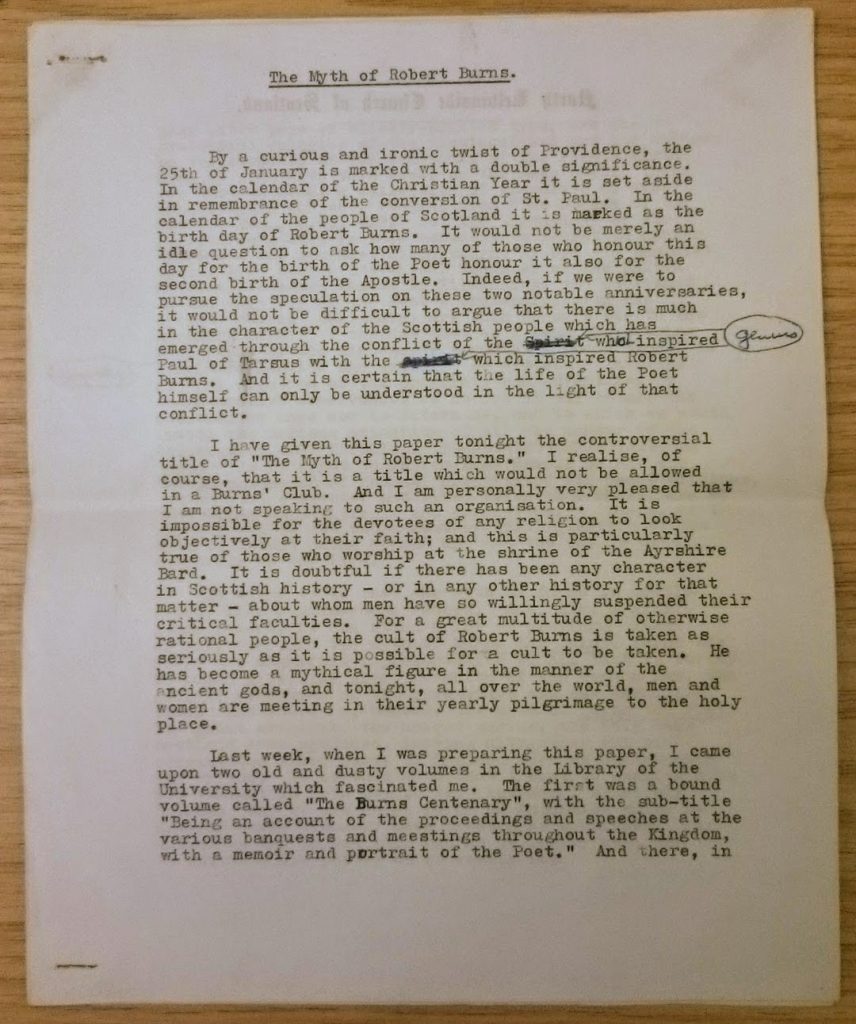
The talk (definitely not a sermon) opens by observing that the 25th of January, Burns Night, is also ‘the day set aside in the remembrance of St Paul.’ As Allan writes,

“Indeed, if we were to pursue the speculation on these two notable anniversaries, it would not be difficult to argue that there is much in the character of the Scottish people which has emerged through the conflict of the genius which inspired Paul of Tarsus with the genius which inspired Robert Burns. And it is certain that the life of the Poet himself can only be understood in the light of that conflict.”

He goes on to state,

“It is doubtful if there has been any character in Scottish History – or in any other history for that matter – about whom men have so willingly suspended their critical faculties. For a great multitude of otherwise rational people, the cult of Robert Burns is taken as seriously as it is possible for a cult to be taken. He has become a mythical figure in the manner of the ancient gods, and tonight, all over the world, men and women are meeting in their yearly pilgrimage to the holy place.”

First page of Rev Tom Allan's talk 'The Myth of Robert Burns' (ref. AA6/2/18).

First page of Rev Tom Allan’s talk ‘The Myth of Robert Burns’ (ref. AA6/2/18).

Allan certainly seems to be taking the Kirk’s tone something which is underlined in his comments on ‘two old and dusty volumes in the Library of the University’ he consulted while preparing his talk. He goes on to state that the myth he intends to examine is that of ‘Burns the Saint’ and ‘Burns the Poet’ because

“I sincerely believe that we are doing Burns an injustice which he himself would probably have treated as a colossal joke unless we try to see this man as he really was, and try to estimate his poetry as it really is.”

As far as ‘Burns the Saint’ goes, the talk deals with the reality of his morality, the manner in which ‘the popular Burns orator… attempts to clothe this very human man in the robes of sainthood’, and the excuses others make for his behaviour: whether it is to blame him as a child of his time, society or indeed the Church for it. He concludes,

“There is little of nobility in the life of Robert Burns: there is much that is tragic. It is not ours to judge him. Neither is it ours to worship him for qualities he never possessed.”

When he turns to examine the myth of ‘Burns the Poet’, Tom Allan observes that Burns’ writing is at its best when in his native Ayrshire dialect. Interestingly, he questions how many people could truly say that they understood every word of even the best-loved poems such as ‘Tam o’ Shanter’. He takes a swipe at some other poems such as the ‘Ode to General Washington’s Birthday’ for being ‘woefully artificial’ and ‘bombastic, insincere and trivial.’ However, it is when Allan draws to the conclusion of his talk that his genial side, for which he was renowned, makes itself known. He states that it is Burns’ satiric verse, his narrative poems and songs which are the best of his compositions, the last of these being described as ‘incomparable’.

“Here in the Songs I could almost submit myself to the myth of Robert Burns. Here at last is sincerity and tenderness and a great compassion and a bewitching sadness and an irresistible appeal.”

He might have been a man of the Kirk but this is certainly not the conclusion of a man agin the National Bard.

The papers of Rev Tom Allan (ref. AA6) are available for consultation in New College Library and the catalogue for the collection can be found here: http://archives.collections.ed.ac.uk/repositories/5/resources/86134

Kirsty M. Stewart, New College Collections Curator

Images of The Myth of Robert Burns by Rev Tom Allan (ref. AA6/2/18) [PDF – 1.3MB]