This blog is one year old now and has had over 5,000 hits – thank you! I’d love to know a bit more about who out there is reading my blog, so I’d appreciate it if you could fill in this 5 second poll. Thanks again!
Author Archives: cloverodgers
New College Library is Historic Library of the Month
New College Library is currently Library of the Month on the Library and Information History Group of CILIP – have a look at the Library and Information History Group blog.
New online EndNote course now available
The IS Skills Development team in Information Services has released an online course to help University of Edinburgh staff and students get started with the reference management software, EndNote. The course is available through Learn, the University’s Virtual Learning Environment (VLE) as a self-enrol course. Learn can be accessed by MyEd.
Early printed works of St Anselm on display at New College Library
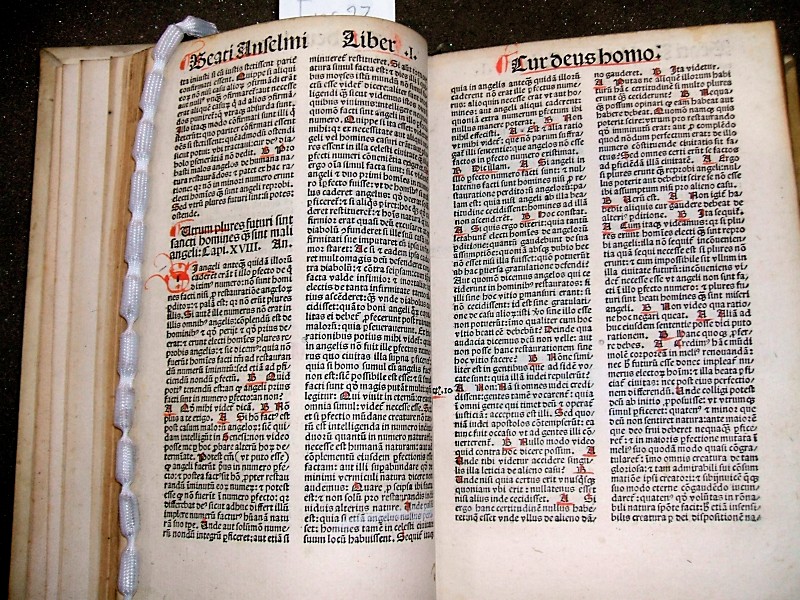
New on display in the Funk Reading Room is the Works of St Anselm, Opuscula beati Anselmi archiepiscopi Ca[n]tuarie[n]sis ordinis Sancti Benedicti, printed in 1497.
April 21 is the Feast Day of St Anselm (1033-1109). A Benedictine monk who lived during the reigns of William the Conqueror and William Rufus, he became the abbot of the monastery at Bec in Normandy, France. Named as Archbishop of Canterbury in 1093 by William Rufus, under the rule of Henry I Anselm faced the challenges of preserving the secular and spiritual rights of the Church in the face of the authority of the King. Despite these political difficulties, Anselm held two great ecclesiastical councils at Lambeth and York where many decrees for church reform were made.
Anselm’s prayers and meditations (accessible online to University of Edinburgh users in the Patrologia Latina) had a lasting influence through the middle ages, but his writings also made a significant contribution to theological debate into the twentieth century and beyond.
New College Library holds two copies of Anselm’s works in the Incunabula Collection, which was recently catalogued online as part of the Funk Cataloguing Projects.
Sources
D.H. Farmer, ‘Anselm (1033-1109)’, The Oxford Dictionary of Saints, Oxford University Press, 2011; online edn 2012 [http://www.oxfordreference.com, accessed 17 April 2013]
R. W. Southern, ‘Anselm [St Anselm] (c.1033–1109)’, Oxford Dictionary of National Biography, Oxford University Press, 2004; online edn, Oct 2009 [http://www.oxforddnb.com/view/article/572, accessed 17 April 2013]
New Divinity digital resources available
New Divinity digital resources are now becoming available. New Brill resources already added to the A-Z list of databases are Context of Scripture Online, Coptic Gnostic Library, Encyclopedia of Hinduism, Encyclopedia of Women & Islamic Cultures and Religion Past and Present. Due to appear shortly are World Christian Database, World Religion Database and Library of Latin Texts.
All Divinity databases are available on the Divinity Databases by subject list at http://edin.ac/115ga9T.
News: Index of Christian Art Launches new Byzantine resource
Freely available addition to the Index of Christian Art, which we subscribe to …
The medieval monk who gave his name to Ockham’s Razor
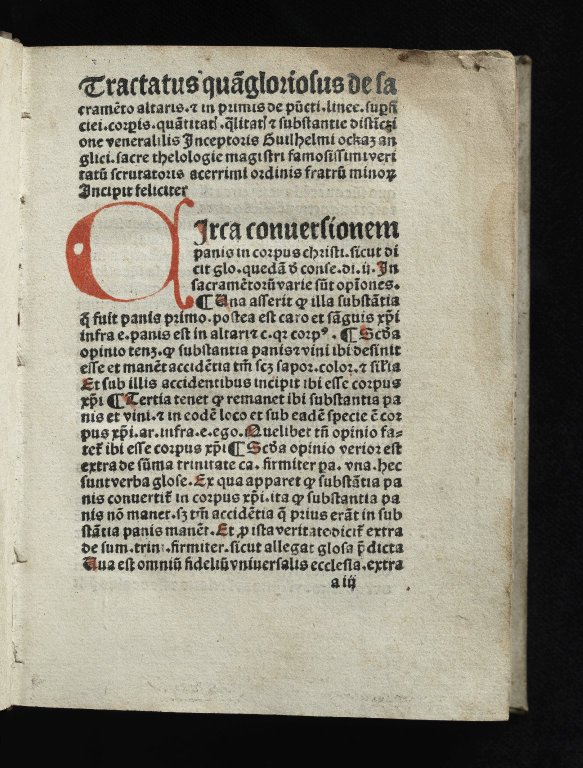
![Tractatus venerabilis Inceptoris Guilgelmi Ocka[m] de sacramento altaris. De Sacramento Altaris](http://libraryblogs.is.ed.ac.uk/newcollegelibrarian/files/2013/04/inc-13.jpg?w=227)
Tractatus venerabilis Inceptoris Guilgelmi Ocka[m] de sacramento altaris. William, of Ockham. Paris, [1495].
William of Ockham was born at Ockham, near Guildford in Surrey in 1287 and he died on the night of April 9 1347 in Munich. The future theologian and philosopher entered the Franciscan order before the age of fourteen. He was educated at the Franciscan convent in London, and developed an academic career as a lecturer and theological writer in Oxford and London. His unconventional views attracted attention within the Church and in1324 Ockham was apparently summoned to Avignon to have his writings examined for heresy, but in the end no formal condemnation took place. However his life came to a crisis after he challenged the doctrine of Pope John XXII, saying that Jesus and the apostles owned no property but, like the Franciscans, lived by begging and the generosity of others. Along with other Franciscans he fled to Munich where he ended his days.
The methodological principle known as “Ockham’s Razor” states that among competing hypotheses, the one that makes the fewest assumptions should be selected. It is described as a razor because it distinguishes between hypotheses by “shaving away” unnecessary assumptions.
Sources:
(1) Spade, Paul Vincent and Panaccio, Claude, “William of Ockham”, The Stanford Encyclopedia of Philosophy (Fall 2011 Edition), Edward N. Zalta (ed.), URL = <http://plato.stanford.edu/archives/fall2011/entries/ockham/>.
(2) W. J. Courtenay, ‘Ockham, William (c.1287–1347)’, Oxford Dictionary of National Biography, Oxford University Press, 2004; online edn, May 2010 [http://www.oxforddnb.com/view/article/20493, accessed 8 April 2013]

New books at New College Library – April

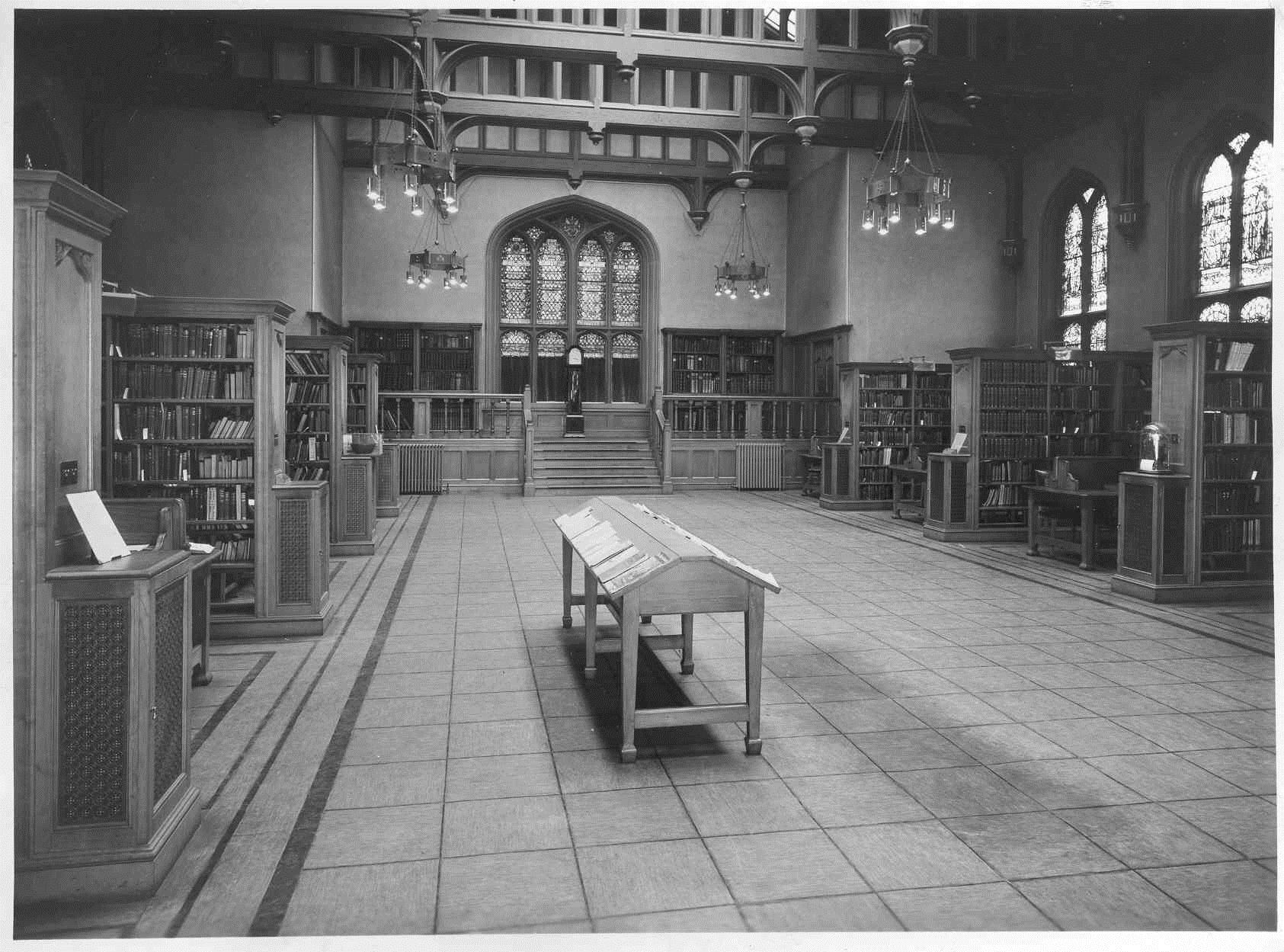
New College Library has a regular display of new books at the far end of the Library Hall, close to the door to the stacks.
New in the library is Theology on the Menu: Asceticism, Meat Eating and the Christian Diet by David Grumett , Chancellor’s Fellow for Christian Ethics and Practical Theology at the School of Divinity, Edinburgh University. Also new is Nations and Nationalism in the Theology of Karl Barth by Carys Moseley, a former British Academy Fellow here at New College.
You can see an regularly updated list of new books for New College Library on the Library Catalogue – choose the New Books Search and limit your search to New College Library. Here’s a quick link to new books arriving in the last few weeks. A word of caution – some of the books listed here may still be in transit between the Main Library (where they are catalogued) and New College Library, so not on the shelf just yet.
Still places available at Searching Research Literature and Managing Bibliographies 27 March
There’s still time to book a place on Searching Research Literature and Managing Bibliographies course run by the Institute for Academic Development for College of Humanities and Social Sciences postgraduate students. Go here to book a place (link only works for eligible students).
I’ll be co-tutoring on this course, with a mixture of presentations and hands on practical computer-based sessions.
Aimed at first year HSS PhD students, this course offers information and techniques to equip students with the essential skills for PhD research. We cover search tips and strategies for databases, good practice in literature searching and managing bibliographies using Endnote.
New College Library Edinburgh rare books to be added to Early English Books Online #EEBO
Photographers are occupying my office again today for digital photography of a number of rare books from New College Library’s collections, to be loaded onto Early English Books Online (EEBO). Available to University of Edinburgh users, EEBO contains digital facsimile page images of virtually every work printed in England, Ireland, Scotland, Wales and British North America and works in English printed elsewhere from 1473-1700. We’re delighted that New College Library’s collections will be shared with the world in this way. The earliest book to be filmed is Hemmingsen, Niels, The professions of the true church, and of poperie compared, Oxford, J. Barnes, 1585 . Most of the other examples are seventeenth century works, such as Austin, William, Hæc homo, wherein the excellency of the creation of woman is described, 1639.