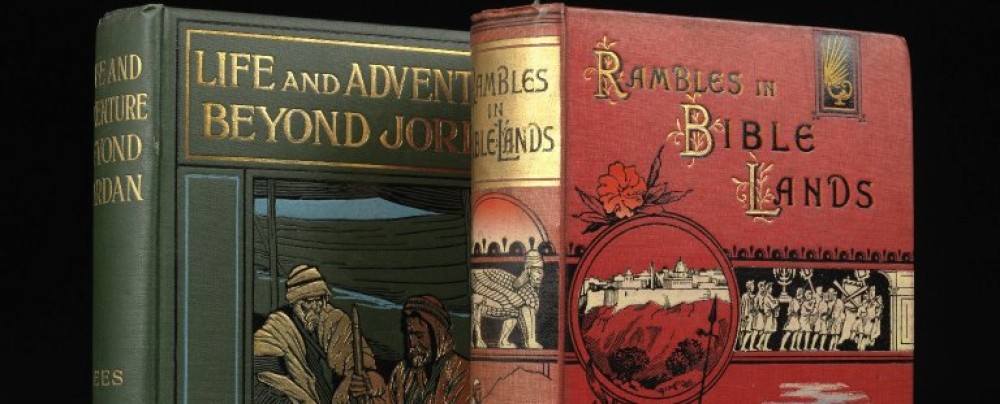
Shorthand in the New College Special Collections

by Danielle Fox, Archive & Library Assistant, New College Library

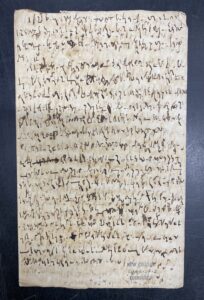
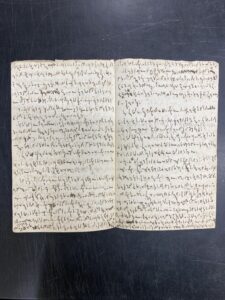
Shorthand writing, also known as tachygraphy, stenography, or brachygraphy, is a system of writing that uses symbols and abbreviations to represent words. This method allows the writer to transcribe speech at the same rate it is spoken, making it ideal for recording sermons, lectures, and court sessions. While modern technology has reduced its widespread use, shorthand played a crucial role in communication for centuries and existed in various forms. We are lucky enough to have many wonderful examples of shorthand in our New College collections.
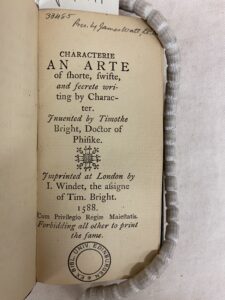
Bright, Timothy. Characterie (1588). University of Edinburgh, Heritage Collections. Df.9.141.


While shorthand can trace its origins back to ancient times, modern English shorthand systems largely emerged in the 16th and 17th centuries[1]. In 1588, Timothy Bright published Characterie; An Arte of Shorte, Swifte and Secrete Writing by Character, which introduced a refined system of shorthand that set the stage for future developments.

Other systems followed, such as Thomas Shelton’s Short Writing in 1626, and Isaac Pitman’s shorthand in 1837. Early English systems used arbitrary symbols for words or letters but eventually adopted phonetic systems. This meant that shorthand symbols focused on how words sounded, rather than how they were spelled, allowing writers to transcribe faster and capture the pace of speech.

Shorthand was especially popular in the 19th and early 20th centuries for tasks like journalism and secretarial work. However, with the advent of modern technology (like computers and voice recognition software), the use of shorthand has declined. Even though shorthand is less common today, it remains a part of history as a crucial tool for efficient writing. Continue reading
From tablets to computer screens; digitising some of the oldest texts at the University

by Elin Crotty, Archive & Library Assistant, New College

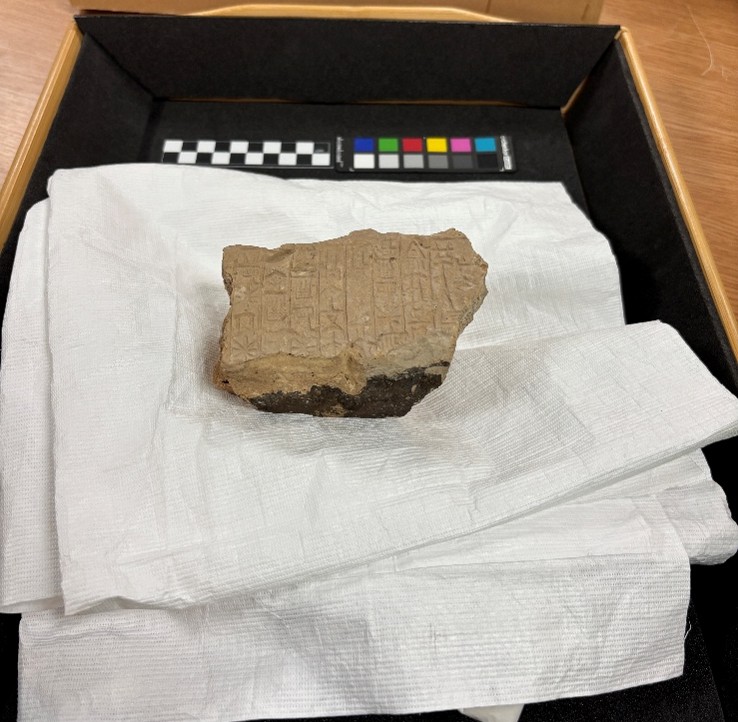
Over the past few months, the two New College Archive and Library Assistants (ALAs) have been liaising with the Cultural Heritage Digitisation Service (CHDS) about digitising our cuneiform tablets. The New College Library cuneiforms are 4 fragments of carved text, which range in date from the Neo-Babylonian Empire, (circa 626 – 539 BCE) to the Neo-Sumerian Empire (circa 2046 – 2038 BCE). The Neo-Sumerian tablet (NCL/Object/2025/3), which has split into two pieces, is thought to be one of the oldest examples of writing in the University’s collections at circa 4070 years old.

CHDS have recently been using Reflectance Transformation Imaging (RTI) to experiment with creating 3D representations of surface texture. You can read a much more thorough description of how the process works on their blog post here, but essentially the objects are placed upon a flat surface under a dome, with a camera positioned directly above them. Lights are fixed inside the dome at all angles and they flash in sequence as 72 photos are taken. This changes the light angle and resultant shadows for the camera, throwing details upon the surface of the object into high relief. The photos with the varying shadows are stitched together using specialist software, creating a 3D model of the surface of the object. A few months ago, the ALAs worked with CHDS to bring the New College cuneiforms to the uCreate MakerSpace, to use the RTI dome there.

The actual photography was very quick, but it was a careful process ensuring that the cuneiforms were supported and kept as flat as possible. After assessment by our conservation team, we built the fragments some temporary supports and handled them using nitrile gloves – no Hollywood white cotton gloves in our library! To get the cuneiforms in and out of the dome, CHDS had come up with a simple but very effective solution; a tea tray, lined with plastazote foam.

Piece of stone (cuneiform tablet) place on wrapping paper, in a tray with colour guidance strips.

Figure 1 NCL/Object/2025/3, cuneiform tablet from Neo-Sumerian Empire (c.2046-2038 BCE).

Continue reading