
Access To Research – A Public Library Initiative

[This post first appeared online at The Informed Blog and is re-posted here with their kind permission. Since it is licensed under a Creative Commons Attribution (CC-BY) license it doesn’t actually need their permission to do this but it is always polite to ask] 

Introduction

In January 2014 the Access to Research initiative was launched. This initiative was sparked by and is a response to a key recommendation in the Finch Report – “Accessibility, sustainability, excellence: how to expand access to research publications” (Page 7; recommendation v). The two year pilot co-ordinated by the Publishers Licensing Society aims to give free at the point of use, walk-in access to academic literature in public libraries across the UK. The launch quickly generated a fair amount of publicity, albeit with equal measures of scorn poured upon it.

This blog post is not going to spend a long time explaining what the initiative is and how it works – others do it better here – but rather I’d like to talk about some of the good points and some of the not so obvious bad points so you can make up your own mind on the matter.

Before we start, it should be pointed out that, despite arising from the Finch report which has rather a lot to say about open access, this initiative actually has nothing to do with open access as most people understand the term, and should not be confused with developments in this area.

Lets begin by looking at some of the good stuff that the initiative promises:

1. Costs

Firstly, the cost to participating libraries and the general public is zero. The initiative is intended to be free at point of use for the user, and free for libraries to sign up to participate with all the costs being borne by the publishers. While we are not aware of the actual costs they are presumably not trivial. Hazarding an educated guess I doubt you’ll see much change from £100k if you wanted to set up a two year pilot preceded by a 3 month technical trial.

2. Content

The 17 publishers that are included at the start of the pilot have contributed between 1.25 to 1.5 million articles from a portfolio of approximately 8000 journals. The figures remain a bit hazy as David Willetts in his launch presentation mentions one figure and the promotional text states another. However, knowing how these kind of statistics are pulled together I can appreciate the vagueness.  At a first glance this is a sizable corpus of material to access for free, although I will return to this point to put the figure in more context later on.

3. Building bridges

One of the less tangible benefits of this initiative is that it could help to break down barriers between research and the wider community. The portrayal of science in the popular media is personal bug bear of mine. For many people the only exposure they have to current research topics is when they are covered in the newspapers and television news. Unfortunately lazy journalism seems to propagate an ‘us v them’ mentality – one of the most commonly heard phrases in the news must be “Scientists state that X causes cancer*” which is rarely productive for all involved. If journalists or the public can engage better with the primary literature (i.e. find more interesting news articles to broadcast/ carry out follow up reading) then this can only help with perceptions and engagement with research. Even proponents of the Access to Research initiative admit that a key challenge is how to digest information obtained from scholarly journals. At least making the literature available for citizens to begin to make informed decisions is a good start.

*where X is an activity/thing regularly done/consumed by the public

4. Footfall

At a time when public libraries are struggling in the face of cuts to maintain services and prove their relevance librarians will seize upon any opportunity to offer more services for no initial outlay (other than staff training). Already there is anecdotal evidence* that offering new services such as Access to Research will entice new users who wouldn’t normally think of visiting. Although most people would agree that providing information online is much more desirable, an increased footfall at public libraries is a good thing.

* Sarah Faulder at 7min20 mentions  “ ….a glowing testimonial”

5. Usability

Although I’ve not yet actually used the pilot Access to Research service, from all accounts the search delivery service – Summon from ProQuest – is extremely easy to use and doesn’t require specialised training to use. Furthermore, it doesn’t require tricky authentication to access on site which is a major failing whenever I’ve tried to use some online electronic public library services in the past.

6. Leadership

Another less tangible benefit mentioned by David Willetts is ‘thought leadership’ and UK PLC to be seen to be doing the right thing.

Now lets move on to some of the criticisms raised against the initiative:

1. Terms & Conditions

Perhaps some of the most serious criticisms are the limitations imposed on accessing the content. It always pays to read the small print which reveals serious restrictions on use – here are some of the worst:

  • I will only use the publications accessed through this search for my own personal, e.g. non-commercial research and private study
  • I will not download onto disc, CD or USB memory sticks or other portable devices or otherwise save, any publications accessed through this search;
  • I will not allow the making of any derivative works from any of the publications accessed through this search;
  • I will not copy otherwise retain, store or divert any of the publications accessed through this search onto my own personal systems;

Some of these points are extremely patronising – the derivative works one for example. We have all heard the famous quote that science is based upon standing on the shoulders of giants. To not be able to make derivative works goes against one of the underlying principles of scholarship. What this point makes clear is that users are meant to be consumers not creators of knowledge.

Other more knowledgeable folk like Cameron Neylon make a more eloquent assessment of the problems these terms and conditions create. All I want to add to this discussion is that in this day and age there is no reason to force users to adopt restrictions on use that are only appropriate for print media, unless you wish to severely handicap the usefulness and therefore the uptake of the service.

2. Postcode lottery

Closely related to the point above, but sufficiently serious to warrant its own point is the postcode lottery of whether you can actually use the walk in service. With 10 local authorities participating in the technical pilot and 11 new authorities joining, that means there are 400 libraries at the start of the initiative. There are around 4,265 public libraries which means the coverage is less than 10%. You could say that some access to public is better than no access at all, however the fact remains that currently the majority of UK citizens are excluded from the service. In mitigation, this is the start of a 2 year pilot and the initiative hopes to sign up a lot more local authorities as the pilot progresses. I would fully expect coverage to increase over time as more libraries opt in – although it’s hard to estimate quite what the final coverage will be.

3. Content put in context

1.25 – 1.5 million articles sound like a lot of content to read. However, if you consider that there are around 46.1 million records in Web of Science; and it is estimated that in 2006 the total number of articles published was approximately 1.35 million, the range of articles you can access through the initiative is a drop in the ocean. So if you are lucky to live close to enough to walk in to a participating library you can only access the equivalent of the research that was produced last year. As far as I know the selection process to be included in Access to Research is opaque – what papers are chosen and who decides?

4. Preserving the status quo

Perhaps one the most disappointing points for me is that this initiative is trying to preserve the status quo of academic publishing. It’s firmly rooted in the print distribution model and has built in sufficient obstacles for users to overcome that it is setting itself up for failure. The initiative goes against nearly all of Ranganathan’s five laws of library science:

i. Books are for use
…but the articles are digitally chained to prevent their removal.
ii. Every reader his [or her] book
…but the majority of readers can’t visit a participating library
iii. Every book its reader
…but the portfolio of journals is not comprehensive.
iv. Save the time of the reader
….restrictive terms and conditions prevent this.
v. The library is a growing organism.
….perhaps this is the saving grace as there is room for improvement.

5. Motivations

I’d like to take time to consider the motivations behind the initiative. Commercial organisations do not do anything for free unless there is a benefit somewhere further along the line. To put it in the crudest possible terms the benefits are the holy trinity ofcash, turf or fame. The Access to Research initiative certainly ticks all three of these boxes.

The Publishers Licensing Society who have co-ordinated the Access to Research initiative, and Nature Publishing Group have been very forthright in admitting that the scheme is about ‘creating a new audience for information’ and opening ‘another channel to the market’ for their content. I can’t comment on how publishers actually intend to monetise the situation, but the standard Modus operandi is to develop a market then sell products directly to it.

It has been widely commented that there has been a great deal of hard lobbying by publishers to position paid-for Gold Open Access services as the main method of delivery of open access in the Finch Report. The focus on Gold OA has been widely criticised by a broad spectrum of the academic community and has resulted in a partial backtrack. In the face of renewed criticism academic publishers will be keen to please to government and show everyone they are the good guys:

“Government has been extremely pleased to see how publishers have tenaciously pursued their welcome proposal for a Public Library Initiative (PLI) in the national and public interest.”

Certainly the response (above) from the Rt Hon David Willetts to Prof Dame Janet Finch indicates they are heading along the right lines.

6. Access to public funded research

In the last few years there has been legislative movement in the States pushing towards taxpayer access to publicly funded research, and this viewpoint is gaining momentum in the UK. One of the main criticisms levelled at the current subscription model is that public funded money is being used to produce the research, but the fruits of the labour are not available to the people who funded it. One way to stop dead this argument is to say the public has access to all the research they need through an initiative like Access to Research.

Personally I would rather not rely on the generosity of third parties to deliver a sub-set of content (from an opaque selection of materials), that can have access removed at any time (2 year pilot), and is made difficult to access (via restrictive terms and conditions of use). I would rather see all content funded by taxpayers (either directly via research councils, or indirectly via universities or other sources) to be available freely via the internet (either in a repository or via an open access publisher), preferably with generous reuse rights granted up front.

The Too Long; Didn’t Read (tl;dr) summary

My own personal take on all of this is that the ‘Access to Research’ is a step in the right direction, but falls short in the implementation, and is driven by motivations that are not so altruistic as you might first think.
University of Edinburgh Open Access update: Jan 2014

To restart the Open Scholarship blog for 2014 we are publishing a monthly series of posts detailing the open access activity that the Scholarly Communications Team is helping to facilitate within the University.

At the end of January there were approximately 73,800 records in the University’s Current Research Information System (PURE), of which 14,200 have open access documents available to the general public via the Edinburgh Research Explorer. This is a figure of 19% open access. In addition there are around 600 records with documents waiting for validation – this process involves checking that the document versions that are deposited are compatible with both journal copyright permissions and research funders requirements.

Looking specifically at journal articles and conference proceedings:

All time Open access % 2008 onwards Open access %
Medicine & Veterinary Medicine 5497 29 3694 38
Humanities & Social Science 2455 18 2072 29
Science & Engineering 5772 20 3883 28

Applications to the RCUK open access fund are steady following the soft launch in July. To date there have been 120 applications. Here are the monthly figures for the previous quarter:

Month Applications to RCUK Applications to Wellcome
October 2013 23
November 2013 27 20
December 2013 19 9
January 2014 31 13

Status of the RCUK fund – currently there is £519,558 left in the fund, with an additional £47,000 committed on articles submitted for publication. Altogether the fund is at 62%.

Status of the Wellcome Trust fund – since the start of the new reporting period (November 2013) the open access spend has been £76,536.

Since the last meeting the Scholarly Communications Team have carried out twelve outreach events, including holding lunchtime seminars for the College of Medicine & Veterinary Medicine at Little France, Teviot and the Western General, and attending departmental away days and briefing sessions for the College of Humanities & Social Sciences. The team are now working to identify opportunities to engage with the College of Science & Engineering.

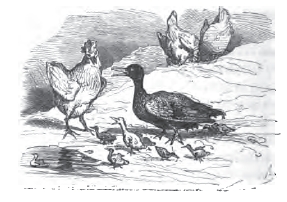
The tale of the open access ‘ugly duckling’

‘The ugly duckling’ illustrated by Bertall (1820 – 1882); 

Image source Wikimedia Commons 

It is often assumed that the Humanities and Social Sciences disciplines is the open access’ ugly duckling’ lagging far behind the Science, Technology and Medicine collective. Whilst this may be true in terms of the pure volume of open access articles and journals published (in part due to both support and pressure from research funders), this is certainty not true in innovation, for example the hugely successful  Open Humanities Press which publishes well-regarded open access books, and grassroots interest from academic staff.

A lot of recent attention and dialogue has focussed on some of the negative attitudes shown towards open access in the Humanities and Social Sciences, whilst a lot of the positives have been under reported and ignored. I would like to take the time to dwell on some of these and show the potential HSS has to become a beautiful open access swan.

Specifically, I have been intrigued by two encouraging phenomena in the social and behavioural sciences and the humanities; Firstly, the blossoming number of Library-Academic partnerships producing new journals, and secondly the rise of the cross-discipline ‘super’ journal.

 Library-Academic owned Open Access Journals

The HSS grassroots interest is wonderfully demonstrated by the number of new Open Access Journals being set up (using the Open Journal Systems platform) by academic staff in partnership with their University Libraries. Some excellent examples include the University of St Andrews Library Journal Hosting Service which publishes the following titles:

  • Ethnographic Encounters
  • Journal of Terrorism Research
  • Theology in Scotland

and the University of Edinburgh Journal Hosting Service which currently publishes:

  • Res Medica
  • The South Asianist
  • The Unfamiliar

You will notice that five out of the six titles listed here are from the HSS domain, and this trend is set to grow further with at least another two HSS journals in the pipeline to be published via these platforms this year.

So why are HSS academics more active in this space above and beyond other subject disciplines? Perhaps the Library has developed closer relationships with HSS academic staff, maybe HSS academics feel they are not being catered for adequately by publishers and feel the need to provide their own publishing options. I don’t know the answer, but I am extremely encouraged by these developments. It shows there is a fundamental interest in making HSS research open access, albeit perhaps in a different way that people expect.

Cross discipline ‘super’ journals for the Humanities

Another growing trend we are seeing in the Humanities & Social Science is for both  traditional and unconventional publishers attempting to provide a format of large, cross-discipline, open access journal which publishes original research and review articles similar to the PLoS One model. This was beginning to happen organically but seems to have been kickstarted by the Finch report and corresponding RCUK policy.

The first initiative I noticed was Sage Open which published its first issue in 2011. Unlike the sciences this open access journal has adopted an extremely low article processing charge to reflect the relative levels of funding available in HSS disciplines. The APC is discounted for institutions that have taken out subscriptions to their journals.  This is an interesting approach not seen elsewhere, and offers an incentive to keep the subscription renewed.

Other similar initiatives have taken alternative approaches for funding. The Social Sciences Directory and the Humanities Directory were launched in 2012 by a small independent publisher. The business model they are promoting is a yearly modest institutional membership fee which would enable all authors from that institution to publish for free at point of use. At the time of writing this article both directories were trying to gain traction: the Social Sciences Directory has published a couple of articles and the first issue of the Humanities Directory is yet to launch.

Palgrave Macmillan is another well-established commercial publisher that is actively experimenting with new publishing models. They have recently announced paid for open licences across all of their content, including monographs and Palgrave Pivot – a mid-length format (midigraph?) pitched somewhere between a journal article and a monograph. There are plans to expand this open access offering in 2013 with the launch of a fully open access journal, accepting articles from across the Humanities and Social Sciences.

Finally, I would like to mention the Open Library of Humanities. This is an independent initiative owned and led by the academy with the aim of building a low cost, sustainable, Open Access platform for the Humanities, similar in vision to the well established Public Library of Sciences. (Full disclosure – I am on the LibTech committee for OpenLibHums and wish to see it become a fully fledged successful enterprise). 
Summary remarks

‘The ugly duckling’ illustrated by Bertall (1820 – 1882); 

Image source Wikimedia Commons 

I think that the social sciences and humanities is far from being the open access ‘ugly duckling’ that many people unfairly consider it to be. It is clear that there is an appetite from publishers, academics and libraries to change the way scholarly publishing works in the Humanities and Social Sciences by embracing the open ethos. Most people recognise that the current status quo is unsustainable; however, for meaningful change to happen a critical mass of authors, editors and reviewers need to be ready to participate. Similarly the financial figures need to add up and be sustainable in the longer term for all involved, including scholarly societies, libraries and publishers. Far from being the threat that many people think open access is; I think the future looks very encouraging for the open access swan that is the Humanities and Social Sciences.


Event report: Open access publication and impact

On 29th November, Edinburgh University Library in conjunction with the College of Humanities and Social Science held an event on Open Access publication and impact.  The two invited speakers (Theo Andrew & Melissa Terras) gave an introduction to open access publishing and the benefits of sharing via social media like blogs and twitter. Full details about the talks including abstracts, slides and an audio introduction can be found on the Digital HSS website at:

http://www.digital.hss.ed.ac.uk/?page_id=721

Event report: RCUK Open Access – Scottish Collaboration & Planning Meeting

On December 7th 2012 a meeting was held at the University of Edinburgh to discuss the implications of the forthcoming RCUK Open Access policy and to share details of the differing institutional approaches to the BIS allocation plans. This event was convened and chaired by John MacColl of St Andrews, and sponsored by the JISC-funded Scottish Open Scholarship (SOS) project. The event was attended by representatives from the six main Scottish institutions in receipt of these funds.

It was agreed to run the meeting using the Chatham House Rule (information gathered during the meeting may be shared, but it should not be attributed to the individual or institution). The key messages from the meeting were as follows:

Key points from the BIS allocation plans are:

  1. Library to manage the funds (all six, one first year only – then distributed to faculties).
  2. Plan to use the BIS money as a true ‘pilot’ to prepare for the block grants (four of six).
  3. Setting up an institutional fund (all new, no existing – other than Wellcome Trust funds).
  4. Subsuming OA membership schemes – eg  BioMed Central (two out of six, but most likely will) (RP reminded us of the need to remember a possible SHEDL role here; JISC Collections may be working with OAK for OA payment).
  5. APC payment decision-making processes needed (four of six).
  6. Intention to use funds to pay for retrospective Gold (four of six).
  7. Intention to use funds to pay for retrospective Green (two of six, but many do this already).
  8. Intention to fund senior level posts (one of six).
  9. Intention to fund mid-range level posts (two of six).
  10. Archive all Gold items locally (only in one plan, but most likely to do).
  11. Advice to academic community on OA publishing options (four of six).
  12. Intention to build in Research Data Management requirements (three of six).
  13. Part of funding to go towards IR and CRIS technical development (two of six).
  14. Advocacy, as a costed activity (four of six).
  15. Analysis to guide future expenditure, including ‘the missing 20%’ (four of six).

Arguments in favour of Green OA:

  1. ‘The missing 20%’ strengthens the argument for Green and for cost-sharing collaboration.
  2. Signals from at least part of the US academy that they will not follow suit (eg the American Educational Research Association’s rejection of Finch/RCUK in the Times Higher Education, 6 December (‘Finch access plan unlikely to fly across the Atlantic’)).
  3. The anticipated market failure of APCs (excessively high APC charges already being considered by some very high-impact journals, such as Science and Nature).
  4. The particularly high financial impact on net creators – large research intensives – rather than net consumers.

What could Scotland achieve?

  1. Work with SHEDL over prospective APC payments at the time of negotiating collective e-journal deals.
  2. Establish an information service for libraries and academic authors to deliver the following as an initial set of possible services (this service might be set up fairly quickly within Scotland, but be capable of expansion across the rest of the UK in due course).
  3. Develop a model or template OA institutional policy by analysing all available policies provided by institutions.
  4. Develop a model Institutional Open Access Fund Mechanism, based on a distillation of existing institutional models and thinking. To permit most equitable distribution of monies; representation of potentially excluded authors (eg in certain humanities sub-fields; Early Career Researchers); principles for sharing APC costs between the OA fund and academic departments; bidding processes; workflows and management of the Mechanism.
  5. Develop a guidance document for academic authors on best practice, encouraging copyright retention and ‘Responsible Gold’ behaviour (see below).
  6. Shared metrics on compliance rates for RCUK-funded outputs.
  7. Shared metrics on Gold, Green and other OA publications per institution.
  8. Feed information into UK-wide services as appropriate.

What could the UK achieve?

  1. Consider setting up a collaborative ‘Green Mirror’ repository of publisher-provided articles available to universities on the basis of Gold APC payments. Consider the possibilities of this repository acting as an academy-owned archive which could represent the preferred corpus to support research data links, text- and data-mining applications, and preservation copies of UK-authored articles.
  2. Encourage the use of this repository by libraries and academic authors as ‘Responsible Gold’ behaviour.
  3. Expand SHERPA/RoMEO to include information on APCs; also to include trends data on publisher APC pricing and embargo policies.
  4. Work with JISC Collections to secure best pricing on retrospective APC payments.
  5. Develop and maintain best-practice OA-supportive CRIS systems models at a generic level (ie across Atira Pure, Symplectic Elements and Avedas Converis). Include support for ORCID.
  6. Discuss areas of copyright and licensing confusion with RLUK and RCUK, and in particular:
  • CC-BY: what are the commercial possibilities that should be allowed?
  • Would CC-BY-NC satisfy our major requirements for a Green mirror archive?

Immediate steps:

  1. Establish a Scottish Open Access Management email distribution group.
  2. Inform JISC Collections that the six Scottish institutions are interested in participation in a collaborative deal on Gold APC pricing.
  3. Build APC requirements as a standard requirement into new and renegotiated SHEDL deals.
  4. Share this report with RLUK and SCONUL colleagues to encourage collaborative action on the UK-wide points.

Gold Open Access: Counting the Costs

The Digital Library team at the University of Edinburgh have written a new paper analysing the cost of Gold OA over the past few years. The data arises from managing the Wellcome Trust’s Open Access grant awarded to the university.

Some of the article’s main take home messages are:

  1. Hybrid journals seem to be more popular venues for Open Access  publication, and
  2. Hybrid journals generally charge more than full OA journals independent of journal impact factor, and
  3. There is a positive correlation between APC cost and impact factor for both hybrid and full OA journals.

Some more reflective points arising from the work:

  1. It appears that Open Access policies require rigorous compliance monitoring to be successful, and seem to be more effective when punitive sanctions are imposed.
  2. Research-intensive institutions are likely to be hit by a cost ‘double whammy’; they not only publish more articles, but they also publish them more frequently in high-impact-factor journals.
  3. Institutions need to be more open about costs, and publish the data in a format that allows reuse.

The full article is available here:

http://www.ariadne.ac.uk/issue70/andrew

The data set upon which the article is based is available here:

http://datashare.is.ed.ac.uk/handle/10283/250


Gold OA: how much will it cost us?

As the administrator of our institutions Wellcome Trust open access grant it’s that time of year when we have to prepare a report on last years spend on open access publication charges.

Given that the recent RCUK OA policy has a strong steer towards Gold OA it gives us a chance to look at some real facts and figures at what this policy change could cost for a research intensive institution.

Looking at the basic figures for last year we spent approximately £170,000 on 100 articles published in 75 different journals, working out at an average cost of £1700 per paper.

Extrapolating upwards the University of Edinburgh publishes in the region of 4000 peer reviewed journal articles per year – this figure does not include other publication types like conference papers not affected by the RCUK policy. Assuming an average Article Processing Charge (APC) of £1500 (more in line with other institutions) the total publication costs will be in the region of £6M. It is clear that even with guaranteed funding from HEFCE large research intensive universities will not be able to pay for all of their research to be published under Gold OA. How to allocate funding to researchers will be a difficult choice that many institutions are currently asking themselves – will it be on a first come first served basis, funder specific, or will REF submitted material take priority?

A more detailed analysis of Gold OA costs from the past 5 years is being written up for publication in a forthcoming article of Ariadne. Here is a taste of some of the data we will be looking at:

Price range JIF Range JIF Mean JIF Median Number of articles* Type
£0-£999 2.263 – 10.472 4.849 4.537 41 44% hybrid 56% full OA
£1000-£1999 0.856 -15.389 6.328 5.117 108 63% hybrid 37% full OA
£2000-£2999 0.986 – 12.594 4.411 3.441 61 100% hybrid
< £3000 5.971 – 15.710 12.363 10.881 17 100% hybrid

Table.1: The range of journal impact factors and mean/median values for the 4 main prices ranges (*discounting 3 journals which were not allocated a JIF in the Journal Citation Report). Journals with high impact factors seem to charge significantly more than other types of journal for gold open access


Open Scholarship at UoE

Welcome to Open Scholarship at UoE.  Here we will be blogging about our initiative to  develop and promote open working practices within the University of Edinburgh. We will post about local and international activities related to open scholarship, updates of project progress and investigations into the impact of what working openly means for universities and the wider community.