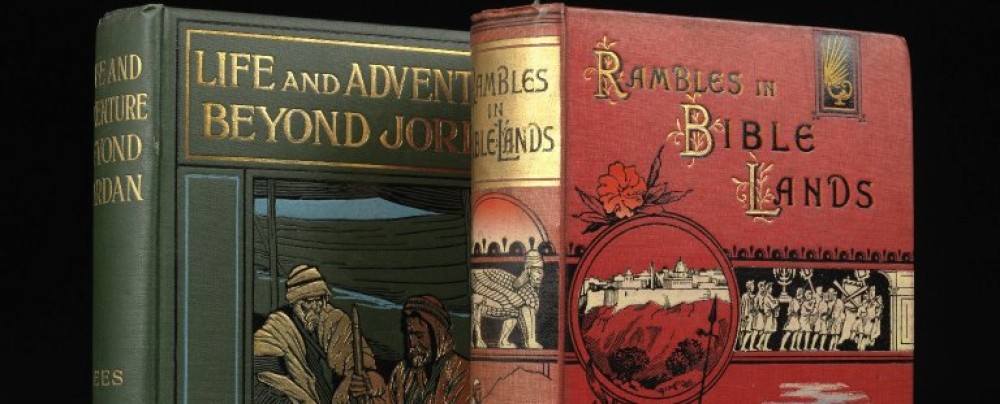
by Danielle Fox, Archive & Library Assistant, New College Library
Shorthand writing, also known as tachygraphy, stenography, or brachygraphy, is a system of writing that uses symbols and abbreviations to represent words. This method allows the writer to transcribe speech at the same rate it is spoken, making it ideal for recording sermons, lectures, and court sessions. While modern technology has reduced its widespread use, shorthand played a crucial role in communication for centuries and existed in various forms. We are lucky enough to have many wonderful examples of shorthand in our New College collections.
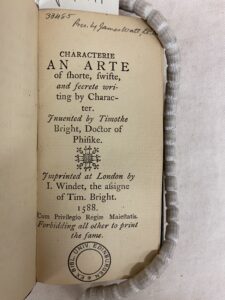
Bright, Timothy. Characterie (1588). University of Edinburgh, Heritage Collections. Df.9.141.
While shorthand can trace its origins back to ancient times, modern English shorthand systems largely emerged in the 16th and 17th centuries[1]. In 1588, Timothy Bright published Characterie; An Arte of Shorte, Swifte and Secrete Writing by Character, which introduced a refined system of shorthand that set the stage for future developments.
Other systems followed, such as Thomas Shelton’s Short Writing in 1626, and Isaac Pitman’s shorthand in 1837. Early English systems used arbitrary symbols for words or letters but eventually adopted phonetic systems. This meant that shorthand symbols focused on how words sounded, rather than how they were spelled, allowing writers to transcribe faster and capture the pace of speech.
-
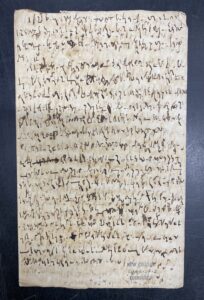
- Samples of Chalmers’ shorthand. [1830]. New College Special Collections. MS CHA 6.21.1-2.
-
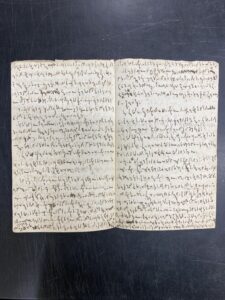
- MS CHA 6.21.1-2.
Shorthand was especially popular in the 19th and early 20th centuries for tasks like journalism and secretarial work. However, with the advent of modern technology (like computers and voice recognition software), the use of shorthand has declined. Even though shorthand is less common today, it remains a part of history as a crucial tool for efficient writing.
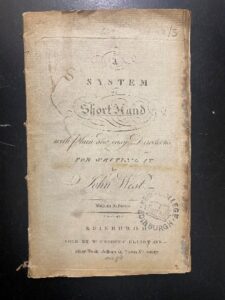
West, John. A new system of shorthand (1784). New College Special Collections. W.d.12/3.
Some of the most notable examples of shorthand in the New College Archives are found in the papers of Rev Dr Thomas Chalmers (1780-1847). Chalmers was instrumental in the establishment of the Free Church of Scotland and New College. He frequently used shorthand in his diary, sermon compositions, and to record important conversations. His shorthand was based on a system developed by John West (1756-1817), a mathematician and priest who taught at the University of St Andrews. A copy of West’s manual, A new system of shorthand (1784), can be found in our New College special collections.
Chalmers adapted West’s system to suit his own style, meaning that simply referencing the manual isn’t enough to decode his writings. Fortunately, a ‘key’ has been left for us, detailing some abbreviations and symbols commonly used by Chalmers. The Phonetic Journal published two articles about Chalmers’ shorthand – one in 1893 by Alexander Paterson and another in 1895 by James M. Warden[2]. Warden mentions that Chalmers’ daughter Margaret Parker Chalmers Wood (1822-1902) was left his papers and had been taught to read her father’s shorthand. This is quite an accomplishment as Chalmers’ handwriting is not known for being the best. It sometimes can be difficult to distinguish his longhand from his shorthand!
-
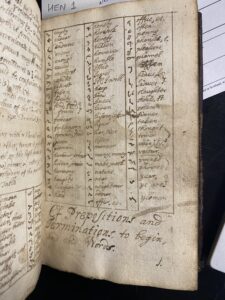
- Henderson, Robert. Tachy-graphy or Shortwriting (nd). New College Special Collections. MS HEN 1.
-
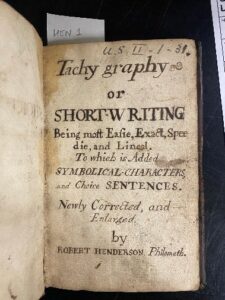
- MS HEN 1
In addition to Chalmers, the archive contains several other examples of shorthand. One of my favourites is a handwritten book from the 18th century attributed to Robert Henderson. The title is Tachy-graphy, or, Short writing, and although it appears to be styled off the works published by Thomas Shelton and Theophilius Metcalfe, the system itself seems to be unique.
We don’t know what Henderson’s intent was in creating this book, but an almost identical handwritten copy of the volume can be found in the Beinecke Library at Yale University (https://search.library.yale.edu/archives/9482810). It is possible he hoped his system would catch on.
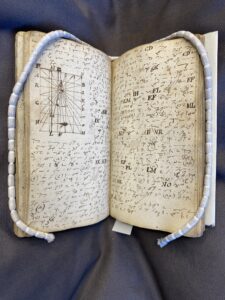
Sermon notebook of Henry Erskine (1624-1696). New College Special Collections. MS ERS H1.
Several other collections, such as Sermons by Donald Fraser (1733-1841) (MS FRA 1), the Papers of John Fraser (1744-1818) (MS FR 4), Sermons of Andrew Harper (1844-1936) (MS HAR 1), and Sermon notebook of Henry Erskine (1624-1696) (MS ERS H1) all contain shorthand notes in various styles and forms. If you’re interested in exploring shorthand further, or would like to see any of these materials, please feel free to get in touch. We have no shortage of examples to share!
[1] For a comprehensive overview of the history of shorthand, see: Levy, Matthew. Shorthand: Its History and Its Prospects. London, 1885
[1] Paterson, Alexander. “Dr Chalmers and shorthand.” The Phonetic Journal, vol 52, 1893.
[2] Warden, James M. “The Rev Dr Chalmers and shorthand.” The Phonetic Journal, vol 54, 1895.